eBook - ePub
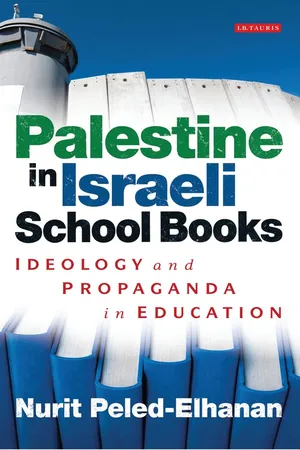
Palestine in Israeli School Books
Ideology and Propaganda in Education
- 280 pages
- English
- ePUB (mobile friendly)
- Available on iOS & Android
eBook - ePub
About this book
Each year, Israel's young men and women are drafted into compulsory military service and are required to engage directly in the Israeli-Palestinian conflict. This conflict is by its nature intensely complex and is played out under the full glare of international security. So, how does Israel's education system prepare its young people for this? How is Palestine, and the Palestinians against whom these young Israelis will potentially be required to use force, portrayed in the school system? Nurit Peled-Elhanan argues that the textbooks used in the school system are laced with a pro-Israel ideology, and that they play a part in priming Israeli children for military service. She analyzes the presentation of images, maps, layouts and use of language in History, Geography and Civic Studies textbooks, and reveals how the books might be seen to marginalize Palestinians, legitimize Israeli military action and reinforce Jewish-Israeli territorial identity. This book provides a fresh scholarly contribution to the Israeli-Palestinian debate, and will be relevant to the fields of Middle East Studies and Politics more widely.
Information
1
THE REPRESENTATION OF PALESTINIANS IN ISRAELI SCHOOL BOOKS
Israel never sought to achieve equal citizenship between Palestinian Arabs and Jews, nor did it seek the consent of its Arab citizens for the forceful ideological imposition of a Jewish state. (Yiftachel, 2006: 93)
Many Israeli textbooks not only discard and silence the Palestinian version of History but as Podeh (2002) found, they often manipulate the past in a way that entails the use of stereotypes and prejudice in describing the (Palestinian) ‘other.’ Stereotypes serve prejudice and ‘foster delegitimization – categorization of groups into extreme negative social categories which are excluded from human groups that are considered as acting within the limits of acceptable norms and/or values’ (Podeh, 2003). Oren and Bar-Tal (2007) found that common means used in school books for this delegitimization are dehumanization, outcasting, negative trait characterization, use of political labels and group comparison.
However, both Podeh and Bar-Tal refer only to explicit verbal de-legitimation, especially through evaluation, while neglecting almost entirely other rhetoric devices and visual means. The following chapters will concentrate on the visual discourse and the rhetoric devices as well.
Podeh and other researchers define the views that dominate school books in Israel as prejudiced and ethnocentric and therefore differentiated from racism, but the socio-cognitive approach adopted by many researchers of racism today does not distinguish between ethnicism, racism and adjacent forms of discrimination and consider them to be ‘fuzzy and overlapping concepts.’ Wodak and Reisigl contend that ‘Ideological articulations such as racism, nationalism, sexism, ethnicism, verge on one another, are connected and overlap.’ These articulations are meant first and foremost ‘to protect the interests of the dominant in-group’ (Reisigl and Wodak, 2001: 21). All the above ‘isms’ reinforce the de-legitimation of ‘others’ mainly through exclusion and classifications, by which control over conceptions of reality is achieved (Hodge and Kress, 1993: 63). Regarding exclusion I will only mention at this point that none of the textbooks studied here includes, whether verbally or visually, any positive cultural or social aspect of Palestinian life-world: neither literature nor poetry, neither history nor agriculture, neither art nor architecture, neither customs nor traditions are ever mentioned. None of the books contain photographs of Palestinian human beings and all represent them in racist icons or demeaning classificatory images such as terrorists, refugees and primitive farmers – the three ‘problems’ they constitute for Israel.
Classification of Palestinians in Israeli Textbooks
Categories engender meaning upon the world like paths in the forest that give order to our life-space. And like such paths they tend to resist change. (Allport, 1958: 171)
The classification of people or of ‘social actors’ is used ‘whenever actors are referred to in terms of the major categories by means of which a given society or institution differentiates between classes of people: age, gender, provenance, class, wealth, race, ethnicity, religion, sexual orientation etc.’ (Van Leeuwen, 2008: 42). These differentiations help constitute what Van Dijk (1997) terms the language of self-presentation and other-presentation. A major feature of the language of self-presentation and other-presentation is manifest in Israeli textbooks in the ethnic classification which differentiates between the Israelis or Jews1 and the ‘Non-Jews’ who are the ‘Arabs.’ This dichotomy, characteristic of racist discourse (Reisigl and Wodak, 2001), has always seemed to Israeli educators ‘essential for maintaining a distinct Jewish-Israeli identity and for sustaining the ability to compete successfully with the Arabs’ (Podeh, 2000: 2). As Allport (1958: 171) maintained, ‘It is characteristic of the prejudiced mentality that it forms in all areas of experience categories that are monopolistic, undifferentiated, two-valued and rigid.’
The distinction between Jews and non-Jews helps establish the Jewish in-group not only as dominant but as more real – for it has a distinct name – and to marginalize and subjugate the Palestinian citizens as an out-group which is defined only negatively as non-in-group. As we shall see in the following chapters, the differentiation between Jews as the dominant in-group and non-Jews as the marginal out-group of Israeli society pervades all areas of investigation. Even in matters that do not touch upon national or ethnic matters, such as industry, agriculture or the professions, textbooks – following the social and political discourse – divide the Israeli life-world ethnically, into Jewish and ‘non-Jewish’ or ‘Arab.’ This distinction is used in geography books to connote the difference between progress and backwardness, and illustrate on maps, graphs and diagrams the incompletion of the Zionist project of the ‘Judaization’ of the Land. For instance in the Geography textbook Settlements in Space (p. 59) a map of ‘rural areas in Israel’ depicts the Jewish settlements in blue and the Arab villages in red. The text below the map defines the Jewish settlement as: kibbutz, moshav, {Jewish} community settlement etc. while the Arab villages are only defined as ‘Arab,’ and that, in spite of the fact that there are several kinds of Arab villages in Israel (Katz and Grossman, 1993). In civics ‘the Non-Jewish/Arab sector’ connotes the centrality of the Jewish citizens and the marginality of the Palestinian ‘minority,’ and in History books it immediately connotes the distinction between right and wrong versions: the Jewish narrative is the right one while the Arab narrative is the wrong one. In terms of modality, the Israeli versions of events are stated as objective facts, while the Palestinian-Arab versions are stated as possibility, realized in openings such as ‘According to the Arab version.’ Here are two examples from school books that are considered by researchers more progressive:
1) ‘In the Arab sector the Kaffer Kassem massacre became the symbol of the evils of oppression’ (The 20th, 1998: 121).
2) ‘Dier Yassin became a myth in the Palestinian narrative { ... } and created a horrifying negative image of the Jewish conqueror in the eyes of Israel’s Arabs’ (Naveh et al. 2009: 112–113).
Immediately after this statement the book provides a definition of ‘myth,’ explaining that ‘myth is a story that becomes a meaningful symbol in the life of a nation, based on reality but at the same time distorts it. Narrative {is} the story of the people as the people perceives and tells it.’
As we shall see later, Israeli actions are usually presented in history books as right morally, according to universal and Jewish norms, while Palestinian actions are presented as whimsical or vicious. Israel ‘reacts to Arab hostility,’ performs ‘operations’ in their midst, and executes ‘punitive deterring actions’ against Palestinian terror, while the ‘Arabs’ murder Israelis, commit terror actions against Israel, take revenge and use what they call their suffering in anti-Israeli propaganda.
What’s in a Name?
Things don’t have meaning unless they are named. (Kress, 2003: 43)
As Firer (2004: 63) has already noted, the label ‘Palestinian’ is hardly ever used in school books for naming the Palestinian occupied territories or the Palestinians themselves. In Israeli social, political and educational discourse Palestinian citizens are called by the demeaning label ‘Israel’s Arabs.’ The Palestinians in the occupied territories are labeled, in addition to ‘Arabs,’ either Pales(h)tinaiim (in Hebrew) or Palestinim according to the speakers’ or writer’s political inclinations. Usually the left-wing oriented voices would call them Palestinim, which is equal to Palestinians, or in the Arabic pronunciation Falastinians as they call themselves. The right-wing oriented voices would call them Arabs or Pales(h)tinaiim, which is closer to Philistines and can be translated as ‘Philistinians.’ Therefore I will translate it as such from now on. Historically, the Palestinians are people who come from Palestina, or Syria Palestinae as the Romans named it, the land of the Philistines. Palestina was the name used by the Greek, the Romans and then by the Europeans and was the official name used by the British during their Mandate on the region. It refers to the whole land of southern Syria and not only to the portion of today’s Palestine, and was homeland to all the people, including the Hebrews, who lived there. Professor Shimon Shamir (2005) explains that the Jews living in Palestina were called Pals(h)tinaiim, and not necessarily the Arabs. For instance those who volunteered to the British Army during the Second World War were called Pales(h)tinaiim, and Golda Meir herself said once ‘I am also Pales(h)tinaiit,’ meaning that her origins were from the ancient land of Palestina and that on her identity card – issued during the British Mandate, Palestina was marked as her home. Hence, the two-state solution, says Shamir, would mean having a Jewish state – Israel and a Palestinian state on the land of Palestina.2
Palestinians (pronounced Falastinians) and Palestine (Falastin) are the names the Palestinian national movement chose for their land and their people at the beginning of the twentieth century, thus distinguishing themselves from the British label, from the Philistines and from the Hebrews, and ridding themselves of all the other connotations of Palestina.
Even though the books studied here were published subsequent to the Oslo agreement which included the mutual recognition of the Israeli and the Palestinian nations, they do not respect the name Palestinians call themselves by – Falastinians. The more left-wing books call them Arabs, Israel’s Arabs and Palestinians alternately, while the right-wing books call them Arabs, Israel’s Arabs and on rare occasions Pales(h)tinaiim which is usually reserved for terrorists. The label Arabs enhances the idea Israel has always tried to convey, that the Palestinians are not a nation by themselves but are part of another, much bigger nation outside Israel – the Arabs. In that they are similar to Israeli-Jews who are part of the bigger Jewish people, most of whom reside outside Israel. The only difference between Palestinians and Israeli Jews, according to Israeli conception, is that the Jewish people have only one state – Israel, while the ‘Arabs’ can settle in any of the 21 different states they have. Therefore any Jew who comes to Israel is granted instant citizenship, while Palestinians cannot be granted citizenship at all.
Served by this perception, Israeli policy has always been to implicitly (or indeed, sometimes explicitly) ‘encourage’ Palestinians to leave their homes and settle in other Arab countries. A significant example is a declaration made by Zipi Livni while she was the Minister of Foreign Affairs:
The national solution of Israel’s Arabs is elsewhere: In order to maintain a Jewish-Democratic state we must constitute two nation-states with clear red-lines. Once this happens, I will be able to come to the Palestinian citizens of Israel, whom we label Israel’s Arabs, and tell them that their national solution is elsewhere (Haaretz, 10 December 2008).
This is a rare occasion in which a prominent leader suggests to substitute ‘Israel’s Arabs’ with ‘Palestinian citizens of Israel.’ However, the reason for this shift is aligned with the old intentions and goals. Livni uses the label Palestinians for the same reason the school books use the label Arabs, namely to indicate that these people, though they are the citizens of the state of Israel, do not belong where they actually live and work, and where they have lived for generations. Livni is reiterating the ever-persistent idea of transferring them to the (still non-existent) neighbouring state of Palestine. This speech is worth mentioning here because Livni spoke to high school students in Tel Aviv, on the eve of their conscription.
In most of the books studied here the label ‘Palestinian’ is mainly reserved for terrorists. For instance, ‘The calm in Lebanon did not last { ... } Lebanon’s independence was at stake again when in the years 1968–69 Palestinian terrorist organizations, headed by the PLO, settled in Lebanon and started to act from its territory against Israel’ (AHH, p. 288). Or: ‘After the 1967 war the presence of Palestinian terrorist organizations increased in Jordan and they created a state within a state. From these territories they set out to commit terrorist acts in the Jordan valley, without the king’s permission’ (ibid.: 284). Both Face, and 50 Years emphasize the fact that the Palestinian refugees were a source of trouble and insecurity to all the countries they dwelt in, such as Lebanon and Jordan. On page 378 in Face there is a whole sub-chapter entitled ‘The Palestinian factor threatens the integrity and unity of Lebanon,’ and on page 382 there is a similar sub chapter about Jordan. In 50 Years The Palestinian non-terrorists, called ‘The Arabs of the Territories,’ are only mentioned as cheap labor and a threat to Israeli agriculture, or as ‘infiltrators’ who come from Jordan and Egypt to commit terror acts in Israel. The chapter ends with a photograph of fully armed, masked people wearing kaffiyah on a vehicle. This is the only photograph of Palestinians in the whole book, placed at the bottom centre, as if concluding the report. The caption explains these are ‘armed Philistinians patrolling the streets of Amman during the conflict between the Jordanian army and the Philistinians.’ In these books, as in books of the 1950s–90s ‘the Palestinians are perceived as a factor that constantly inflames and escalates the conflict’ (Firer, 2004: 64).
Palestinians who are not terrorists are usually called Arabs: ‘The Arab countries did not come to terms with the consequences of the {Israeli} War of Independence and, although they signed the cease-fire agreements, they demanded that Israel returns to the partition borders and reinstates the Arab refugees in their homes’ (JIP, p. 309). Or: ‘As a result of the fall of the Arab countries, vast areas where a million Arabs dwelt were annexed to Israel’ (AHH, p. 337). Only when the peace agreement between Israel and the PLO is mentioned, does JIP state explicitly, ‘Israel recognized the PLO as the sole representative of the Palestinian people’ (p. 332).
While 50 Years and Face, with their right-wing orientation, use the labels Pales(h)tinaiim which is equal to ‘Philistinians,’ and ‘Arabs,’ Naveh et al. (2009) and Domka et al. 2009, with their left-wing orientation use ‘Arabs’ and ‘Palestinians’ alternately. In Naveh et al. (2009) we find in one sub-chapter ‘the reasons for the departure of Israel’s Arabs,’ the name ‘Arab’ five times, and the name ‘Palestinians’ twice, when referring to the same people. By contrast, when this book reports about the Nakba the ratio is opposite: ‘Palestinians’ is used four times, and ‘Arab’ only once (pp. 142–143). In Domka et al. (2009) one sees the same tendency. Regarding the 1953 ‘infiltrations’ of Palestinian refugees who tried to come back to their fields and homes, the book ...
Table of contents
- Cover
- Author biography
- Title page
- Copyright page
- Epigraph page
- Contents
- List of Figures
- Preface
- Introduction: A Jewish Ethnocracy in the Middle East
- 1 The Representation of Palestinians in Israeli School Books
- 2 The Geography of Hostility and Exclusion: A Multimodal Analysis
- 3 Layout as Carrier of Meaning: Explicit and Implicit Messages Transmitted Through Layout
- 4 Processes of Legitimation in Reports about Massacres
- Conclusions
- Notes
- References
Trusted by 375,005 students
Access to over 1.5 million titles for a fair monthly price.
Study more efficiently using our study tools.
Frequently asked questions
Yes, you can cancel anytime from the Subscription tab in your account settings on the Perlego website. Your subscription will stay active until the end of your current billing period. Learn how to cancel your subscription
No, books cannot be downloaded as external files, such as PDFs, for use outside of Perlego. However, you can download books within the Perlego app for offline reading on mobile or tablet. Learn how to download books offline
Perlego offers two plans: Essential and Complete
- Essential is ideal for learners and professionals who enjoy exploring a wide range of subjects. Access the Essential Library with 800,000+ trusted titles and best-sellers across business, personal growth, and the humanities. Includes unlimited reading time and Standard Read Aloud voice.
- Complete: Perfect for advanced learners and researchers needing full, unrestricted access. Unlock 1.5M+ books across hundreds of subjects, including academic and specialized titles. The Complete Plan also includes advanced features like Premium Read Aloud and Research Assistant.
We are an online textbook subscription service, where you can get access to an entire online library for less than the price of a single book per month. With over 1.5 million books across 990+ topics, we’ve got you covered! Learn about our mission
Look out for the read-aloud symbol on your next book to see if you can listen to it. The read-aloud tool reads text aloud for you, highlighting the text as it is being read. You can pause it, speed it up and slow it down. Learn more about Read Aloud
Yes! You can use the Perlego app on both iOS and Android devices to read anytime, anywhere — even offline. Perfect for commutes or when you’re on the go.
Please note we cannot support devices running on iOS 13 and Android 7 or earlier. Learn more about using the app
Please note we cannot support devices running on iOS 13 and Android 7 or earlier. Learn more about using the app
Yes, you can access Palestine in Israeli School Books by Nurit Peled-Elhanan in PDF and/or ePUB format, as well as other popular books in Education & Education Theory & Practice. We have over 1.5 million books available in our catalogue for you to explore.