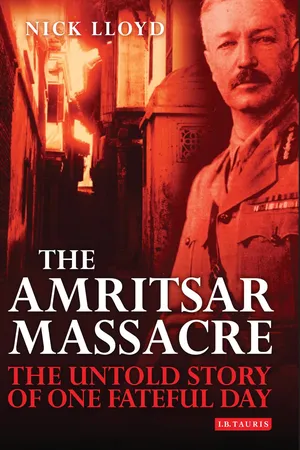
On 13 April 1919, a fateful event took place which was to define the last decades of the British Raj in India. At 5:10pm on that day, Brigadier-General 'Rex' Dyer led a small party of soldiers through the centre of Amritsar into a walled garden known as the Jallianwala Bagh. He had been informed that an illegal political meeting was taking place and had come to disperse it. On entering the garden, Dyer's men immediately lined up in formation. Dyer then gave the order to open fire on the huge crowd that had gathered there. 379 people were killed and at least 1,000 more were wounded in what has became known as the Amritsar Massacre. Nick Lloyd here provides a highly readable, but detailed account of the most infamous British atrocity in the entire history of the Raj. He considers the massacre in its historical context, but also describes its impact in uniting the people of the sub-continent against their colonial rulers. The book dispels common myths and misconceptions surrounding the massacre and offers a new explanation of the decisions taken in 1919.
Ultimately, it seeks to examine whether the massacre was an unfortunate and tragic mistake or a case of cold-blooded murder, and one which would fatally weaken the British position in India.
- 320 pages
- English
- ePUB (mobile friendly)
- Available on iOS & Android
eBook - ePub
About this book
Information
PART ONE
BEGINNINGS
CHAPTER 1
The Raj in an Age of Change
I told him that in my opinion the root cause of the whole trouble was the profound distrust, which may or may not be justified, shown by the civil servants of the Indian and the Indian of the civil servant.
Edwin Montagu1
Edwin Montagu landed in Bombay on 10 November 1917. The Secretary of State for India was, as he wrote in his diary, ‘glad to get off the ship, for . . . although I found it so thoroughly equipped, it was tedious in the extreme’.2 Montagu had spent the last three weeks travelling to India on the P&O liner, Kaiser-I-Hind, and apart from brief sojourns in Turin, Rome and Cairo, he had spent it on deck, studying the vexatious question of the reform of Britain’s Indian Empire and trying to prepare himself for the weeks of intensive negotiation and discussion that would inevitably follow once he set foot on the subcontinent. But, for the moment at least, Montagu was free to enjoy the beauty and splendour of the landscape that greeted him. He would later recall with pleasure,
The blue sea, the hills in the foreground, in the background, on the horizon, in the middle distance, of various degrees of blues and blacks and greys; the white buildings, the marvellous spacing, the silent, quiet crowds of foot passengers; the bright coloured garments of the women.
The city of Bombay was, he decided, ‘one of the wonders of the world’.
Of all those who occupied his position, Edwin Montagu perhaps polarised opinion more than any other. A former Private Secretary to the Prime Minister (Herbert Henry Asquith), Montagu had been Financial Secretary to the Treasury and Minister of Munitions before becoming Secretary of State for India in June 1917.3 Frequently described by his contemporaries as either nervous or fussy, Montagu was a deep-thinking man of decidedly liberal tendencies, whose time at the India Office was marked by controversy and fierce disagreement. A liberal by habit, Montagu was chronically afraid of conflict and deeply uncomfortable of anything that smacked of repression or punishment.4 Although an eloquent debater and hard worker, Montagu was not a charismatic man and had few friends. He was never able to convince Anglo-Indian opinion and the conservative wing of British political life that he would defend British interests in India with sufficient vigour. He was continually accused of being too close to a number of Indian politicians (particularly Mohandas Gandhi), and of not doing enough to support those who had to sustain the Raj in a period of acute difficulty. It also did not help that he was Jewish, and his career was dogged by anti-Semitism and distrust.
Montagu’s seven months in India may have been something of a ‘public relations gesture’,5 but his tour and the report that he would subsequently co-author with the Viceroy of India, Lord Chelmsford, marked a significant attempt to sketch out the future path along which the British Raj could operate. It was becoming clear that if the Raj was to have a future, then it would have to institute some kind of framework for increasing the participation of Indians in the decisions of government. In part this was a recognition of the unsettled international situation, for although the Great War had not touched India directly, the effects of over three years of bitter conflict between Britain, France and Russia, on the one hand, and the Central Powers of Germany, Austria-Hungary and Turkey on the other, had been felt throughout the subcontinent. The demands of recruitment, the economic dislocation and the mounting toll of dead and wounded began to erode the foundations upon which British power in India rested. The war had also given added fillip to the Home Rule and nationalist movements, which had by 1917 become increasingly difficult to ignore. The enormity of the task facing Montagu was not lost upon him. ‘My visit to India means that we are going to do something big,’ he wrote. ‘I cannot go home and produce a little thing or nothing; it must be epoch-making, or it is a failure; it must be the keystone of the future history of India.’6

The Raj may have been outwardly grand and monolithic, but as Montagu well knew, the reality was somewhat different. On contemporary maps India was an inverted pink triangle at the centre of the world where British rule stood firm, but internally it was a mess; a huge, unwieldy set of provinces that sat uneasily alongside hundreds of nominally independent princely states, covering lands and peoples of striking variety and complexity. The Indian subcontinent over which British rule was exercised lay between the jungles of Burma in the west to the mountains of the Hindu Kush in the east, bordered by the Himalayas and Tibet in the north and by the Arabian Sea and the Indian Ocean to the south. India had a land mass of roughly 1.8 million square miles (approximately 4.66 million square kilometres) with a population – recorded in the census of 1921 – at over 318 million people, which included Hindus, Muslims, Buddhists, Christians, Jews, Parsees, Jains and a whole host of other ethnic and religious minorities. And if this was not complicated enough, these religious groupings were far from united, formed masses and, as ‘old India hands’ would often relate to newcomers, the caste Hindus of Bombay were a world away from the bhadraloks of Bengal, and the cultured Muslim elite of Lucknow were nothing like the peasants of the Punjab.7
Visitors to India, amazed by its colour and exoticism, would often marvel at how British control could be exercised over so many people and over such vast distances, and the system would often require some explanation. The Secretary of State for India, based in London, was ultimately responsible for the administration of India, and had to submit an annual account of Indian finances to the House of Parliament. He was assisted by two under-secretaries and by the Council of India. This comprised between 10 and 14 members, each of whom had considerable experience of Indian affairs and had spent at least ten years living in British India. In the subcontinent, the Governor-General, otherwise known as the Viceroy, was the head of the Government of India and was assisted by the Executive Council. This was composed of seven members who were each given one of the following portfolios: Home, Revenue, Finance, Legislative, Commerce and Industry, Education, and Army. Under this was the Indian Legislative Council, composed of the Executive Council plus up to 35 members nominated by the Governor-General and 25 other elected members.8 The Legislative Council was empowered to discuss the financial statement of the Government of India and allowed to ask questions, but its resolutions were not binding and it always possessed an official majority. Its primary purpose was to allow for the discussion of government policy and bring to the attention of government any issues that were felt to be in the public interest.
The next level of power lay in the provinces. British India was divided into nine major and six minor provinces. The most important were the three presidencies of Madras, Bombay and Bengal. Each province was split into a number of administrative units, known as districts, which were overseen by a Collector or Deputy Commissioner, who was responsible for the administration of executive functions, including justice and taxation within that area. Further below them was a whole host of minor positions, occupied by both British and Indians, ranging from sub-divisional officers, magistrates and revenue officers, who ensured that the administration functioned effectively. And it was in these lower levels that the heart of the system lay; the world of the British official in India, where Briton and Indian met, which has been vividly chronicled in novels such as E.M. Forster’s A Passage to India (1924) and Paul Scott’s Raj Quartet (1966–75), and which remains essential to understanding the Raj.9 It was a world of great pressure and often great loneliness, with some officials spending years in remote districts, fending off the dangers of disease and exhaustion, and trying to deal with vast amounts of work and the huge decisions that had to be taken every day. Certainly it was not a particularly easy life and beneath the veneer of tiffin, memsahibs (wives of British officials) and ‘pig-sticking’, lay the harsh reality of life in the Raj: a ‘transient lifestyle’ of homesickness, disease and alienation from both British and Indian societies.10
To the untrained western eye, first impressions of India could be deceptive. Like Adela Quested in Forster’s A Passage to India, the new arrival would often search for what was thought to be the ‘real’ India, the essential unchanging core of poverty, corruption and spirituality that was often said to make up the ‘oriental’. But what may have initially seemed like a deeply conservative society, still in thrall to the terrifying visions of their ancient gods, the boundaries and regulations of the caste system or the time-honoured protocols due to the royal landowning elite, was in reality a society undergoing swift and significant change. The nineteenth century had seen remarkable developments in India as the ripples of the industrial revolution, that vast outpouring of power unleashed in the United Kingdom, washed upon India’s shores. The industrial revolution and the ever-growing levels of global communication and exchange led to a quickening of pace that would intrude into every aspect of Indian life. The Suez Canal had opened in 1869 and dramatically reduced sailing times to the east, but it was the growing communication within India that would have even more profound effects upon the subcontinent.
It was not just the physical infrastructure of India that was changing during the second half of the nineteenth century, but the mental world in which the educated classes lived. One of the major changes ushered in by the British was the gradual spread of English education in an ever-expanding network of schools and colleges that started in the old presidencies of Bengal, Bombay and Madras, but soon reached into every corner of the subcontinent. By 1901 there were 23,000 college students and over 630,000 pupils in secondary schools in India; admittedly a fraction of the total population but a growing pool of educated Indians from whom the British could draw. A Western or English education soon became the passport to a position in the administration as one of the scores of Indians that the British depended upon to maintain their rule. And it was from these Western-educated Indians that new stirrings of dissent began to emerge, presenting the British with the decision of whether to encourage or repress them. In 1835 the famous English philanthropist, Thomas Babington Macaulay, had declared that it should be the aim of British rule to create a class of Indians to act as interpreters between the rulers and the mass of the population. It would be this group, Indians ‘in blood and colour, but English in tastes, in opinion, in morals and in intellect’, that was intended to safeguard British interests, but who were now becoming increasingly impossible to ignore.11
The crushing of the Mutiny in the opening months of 1858 may have banished the likelihood of any serious internal military threat to the stability of the Raj, but by the early years of the twentieth century, the British position in India was coming under increasing pressure, as more and more Indians, through various regional associations and in a vociferous nationalist press, pressed for a greater role in the administration of the country. Of these the most important was the Indian National Congress. Founded in 1885 by a former member of the ICS, Allan Octavian Hume, Congress was created to represent the interests of the Indian people and ensure that British policy in India was beneficial to them. Every year at Christmas a congress would be held in a city chosen in India and delegates from all over the country would come and discuss the key issues of the day.12 Its first session was held in Bombay and was attended by 72 delegates. They agreed upon a set of resolutions, including a request for a Royal Commission to investigate the workings of the Indian administration, the reform of the Legislative Council and the admission of elected members, the need for simultaneous ICS examinations in both England and India, a decrease in military expenditure, and a protest at the recent annexation of Upper Burma.13
As might have been expected, Congress was an unpopular organisation within the corridors of power. Although there were some who welcomed it and believed that British policy should encourage the growth of educated Indian opinion, many others expressed a sincere dislike of it. Lord Curzon, Viceroy between 1899 and 1905, was one of those who regarded the Congress and its ilk as nothing more than an annoying nuisance that could be ignored. In a Parliamentary Debate on 28 March 1892, Curzon had stated that the politicians of the Congress Party were ‘a microscopic minority of the total population’ of India and expressed his hopes of presiding over its demise.14 Men like Curzon argued that British rule should rest, as it always had done, on rural landlords and other local notables, men who were regarded as being the ‘natural rulers’ of the rural tracts of India. Curzon’s criticisms of Congress as being unrepresentative of India’s people were painfully correct and many leading Indian politicians were aware of it. They knew that they could only demand greater concessions from the Raj if they were representative of a much larger swathe of the population. Until they did so, their demands were likely to remain limited, constitutional and of little interest to the vast majority of Indians. But if they were to appeal to more and more people, then they knew that this would only serve to bring up the vast differences of interests and opinions that were held across India, thus potentially undermining their appeal. It was a dilemma that would run through the entire history of the freedom movement.
By 1907 Congress stated that its objective was ‘the attainment by the people of India of a system of government similar to that enjoyed by the self-governing members of the British Empire’.15 This goal was to be achieved through constitutional and legal measures, and the advocates of this, the ‘moderates’ as they were known, were led by Gopal Krishna Gokhale, a high-caste Hindu politician and teacher from the Bombay Presidency. Gokhale believed that India would eventually become a self-governing dominion within the British Empire, and argued that the only way this was to be achieved was through gradual and constitutional means. But Gokhale’s moderate approach, one that kept politics within the hands of the elite, higher castes of the presidencies and within the realms of polite discussion, was coming under increasing pressure from those who were impatient and felt that Indian freedom could not be gained by goodwill or promises, but only by violent action. These ‘extremists’ were led by Bal Gangadhar Tilak – a forceful, passionate Indian nationalist – whose strategy was to advocate swadeshi (locally made goods) and the boycotting of all British cloth, and to uplift the people of India with passionate tales of their former heroes like the great Maratha king Shivaji who had defied the might of the Mughal Empire.16
Curzon’s departure in 1905 was the end of an era for the Raj; the closing of a period of self-confidence and assertion and the onset on a new series of problems for British rule. Curzon had seen his mission in India to improve the running and efficiency of the Indian Empire, to make it better able to serve India’s peoples. During one of his final speeches, at Simla in September 1905, he had said that if he were asked to sum up his administration in a single word, he would say ‘Efficiency’. ‘That has been our gospel,’ he enthused, ‘the keynote of our administration.’17 Nevert...
Table of contents
- Cover
- Author biography
- Title page
- Copyright page
- Dedication page
- Contents
- List of Illustrations
- List of Maps
- Abbreviations
- Acknowledgements
- Preface: Massacre at the Jallianwala Bagh
- Introduction
- Part One: Beginnings
- 1. The Raj in an Age of Change
- 2. The Great War and Reform in India
- 3. Gandhi and the Rowlatt Satyagraha
- 4. Hartals, Processions and Arrests
- 5. Violence in Ahmedabad
- 6. O’Dwyer in the Punjab
- Part Two: Disturbances
- 7. A ‘Great Calamity’ in Amritsar
- 8. A ‘Terrible Quietness’
- 9. Protest and Response in Lahore
- 10. A ‘Serious Rising’ at Kasur
- 11. The ‘High-Water Mark’
- 12. Causes and Conspiracies
- Part Three: Aftermath
- 13. The Introduction of Martial Law
- 14. ‘Fancy Punishments’ and ‘Erratic Acts’
- 15. Lord Hunter and the Disorders Inquiry Committee
- 16. Debates and Disagreements
- 17. Dyer and the Jallianwala Bagh
- 18. Shadows of Amritsar
- Conclusion: Amritsar and the British in India
- Epilogue: Operation Blue Star
- Notes
- Glossary of Selected Indian Words
- Bibliography
Trusted by 375,005 students
Access to over 1.5 million titles for a fair monthly price.
Study more efficiently using our study tools.
Frequently asked questions
Yes, you can cancel anytime from the Subscription tab in your account settings on the Perlego website. Your subscription will stay active until the end of your current billing period. Learn how to cancel your subscription
No, books cannot be downloaded as external files, such as PDFs, for use outside of Perlego. However, you can download books within the Perlego app for offline reading on mobile or tablet. Learn how to download books offline
Perlego offers two plans: Essential and Complete
- Essential is ideal for learners and professionals who enjoy exploring a wide range of subjects. Access the Essential Library with 800,000+ trusted titles and best-sellers across business, personal growth, and the humanities. Includes unlimited reading time and Standard Read Aloud voice.
- Complete: Perfect for advanced learners and researchers needing full, unrestricted access. Unlock 1.5M+ books across hundreds of subjects, including academic and specialized titles. The Complete Plan also includes advanced features like Premium Read Aloud and Research Assistant.
We are an online textbook subscription service, where you can get access to an entire online library for less than the price of a single book per month. With over 1.5 million books across 990+ topics, we’ve got you covered! Learn about our mission
Look out for the read-aloud symbol on your next book to see if you can listen to it. The read-aloud tool reads text aloud for you, highlighting the text as it is being read. You can pause it, speed it up and slow it down. Learn more about Read Aloud
Yes! You can use the Perlego app on both iOS and Android devices to read anytime, anywhere — even offline. Perfect for commutes or when you’re on the go.
Please note we cannot support devices running on iOS 13 and Android 7 or earlier. Learn more about using the app
Please note we cannot support devices running on iOS 13 and Android 7 or earlier. Learn more about using the app
Yes, you can access The Amritsar Massacre by Nick Lloyd in PDF and/or ePUB format, as well as other popular books in History & 20th Century History. We have over 1.5 million books available in our catalogue for you to explore.