eBook - ePub
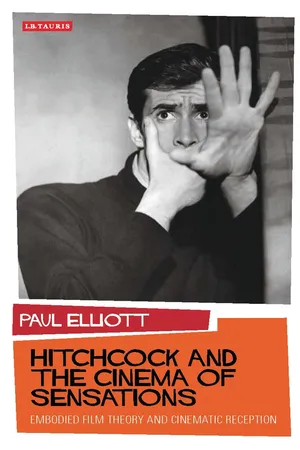
Hitchcock and the Cinema of Sensations
Embodied Film Theory and Cinematic Reception
- 248 pages
- English
- ePUB (mobile friendly)
- Available on iOS & Android
eBook - ePub
About this book
When we talk of 'seeing' a film, we do not refer to a purely visual experience. Rather, to understand what we see on screen, we rely as much on non-visual senses as we do on sight. This new book rethinks the body in the cinema seat, charting the emergence of embodied film theory and drawing on developments in philosophy, neuroscience, body politics and film theory. Through the prism of Alfred Hitchcock's films, we explore how our bodies and sensual memory enable us to quite literally 'flesh out' what we see on screen: the trope of nausea in "Frenzy", pollution and smell in "Shadow of a Doubt", physical sound reception in the "Psycho" shower scene and the importance of corporeality and closeness in "Rear Window". We see how the body's sensations have a vital place in cinematic reception and the study of film.
Information
PART ONE: THE THEORY
1
FILM THEORY AND EMBODIMENT: NEW SENSATIONS IN SPECTATORSHIP
Over the past ten years, we have discarded one type of theory, gradually switching to another, as yet to be defined, paradigm. Rather than continue to think about the cinema as an ocular-specular phenomenon, whose indexical realism we either celebrated or whose illusionism we excoriated (which was the case in ‘classical film theory’, and subsequently, during the decade when psycho-semiotic ‘apparatus theory’ held sway), scholars now tend to regard the cinema as an immersive perceptual event. Body and sound-space, somatic, kinetic and affective sensations have become its default values, and not the eye, the look and ocular verification.1
As Thomas Elsaesser suggests in the quotation that opens this chapter, since the late-1990s a number of different studies and theoretical works have been published that attempt to characterise cinema spectatorship as a process rather than a fixed point of meaning and furthermore one that uses and encompasses a whole range of senses and embodied experiences rather than merely the eye and the sense of self. Like many areas of theory, however, this process is less one of revolution and more one of evolution and the temporal flow of such changes (especially considering we are still within them) is not simple or clear cut. This book attempts the very exercise that Elsaesser suggests in his article – to classify the scopic paradigm that he terms ‘yet to be defined’ and to attempt to unravel the many threads of embodied film theory that have emerged over the past two decades. This book is a first tentative step at defining the move towards embodiment in film theory, in isolating its central ideas, highlighting its precedents and outlining its many methodological tools. Unfortunately, this exercise is complicated, firstly, by the fact that such theories are still in development and, secondly, because they arise out of widespread epistemic changes rather than present a distinct, shared theoretical position.2
With this in mind, this chapter aims to look at some of these emerging film theories in depth and moreover relate them to both each other and the wider cultural episteme. All of these works represent an expansion in thinking regarding vision and a move away from subjectivised optical thought into the area of the lived body, multi-modality, the emotions and sensation. However, in order to give this overview a sense of coherent structure, I have isolated what I see as the two major trends in this area: firstly, theories that deal with the body and its senses as an index of response regarding film; that is, theory that concentrates on the importance of the body as a receiver of affects, sensations and corporeal experiences (nausea, dizziness, excitation and so on); and, secondly, theories that view the body as a site of reception; that is, works that view the body and its senses as active tools for the understanding of moving images when knowledge arising from optical vision is found wanting (synaesthesia, haptic vision, physical sound reception and so on).
The distinction between these two areas is subtle but crucial to an understanding of the theoretical aims of this book and the ways in which film theory has begun to widen its field of reference. As we shall see, this move in film theory broadly reflects the epistemic shift in scopic thinking that was highlighted in the Introduction. Rather than merely representing a series of isolated critical acts, this book makes the claim that embodied film theory is part of some larger scene, one that is still in the process of becoming, one that is in constant evolution. Some of the theories outlined here are related to each other but many have been produced outside of mutual influence, the only thing that connects them is a sense that the field of vision is being expanded and that the body is being re-figured.
Theorists like Karin Littau and Linda Williams take the body of the spectator seriously, they value corporeal experience and what it adds to the process of observation; they examine the ways that films are registered on the bodies of those who are viewing and seek to find more corporeal or visceral levels of enjoyment, engagement and pleasure.3 However, they do this using what could be thought of as more traditional theoretical tools and with the assumption that sight and sound are the only ways we can interact with filmic images in a primary sense. Their cinematic bodies are feeling things that centre us in a world of sensation: shaking, sweating, beating, quaking, feeling nauseous, horny or scared. Their cinematic bodies are imprints of the film’s intentions, passive in some respects, but still vitally important. These are the theories that I see as viewing the body as an index of response.
Theories that I have characterised as viewing the body as a site of reception are far more akin to the kind of postmodern scopic thinking that was highlighted in the Introduction to this book (Pallesmaa, Nintendo Wii and so on). Their major theoretical tools are noticeably different from both theories of the body as an index of a film and from the vast majority of mainstream work on cinema, asserting as they do, the value of the other senses in spectatorship and the mimetic processes. These cinematic bodies use all their senses to understand the world, sensation becomes knowledge; corporeality becomes sentient. No longer is the flesh a passive receptor of sensation; it is its translator, bypassing the cognitive mind and the eye and reaching more visceral sites of affect. These cinematic bodies think and remember for themselves, they make instinctual choices and sub-cognitive selections; it is a synaesthetic thought, based in sensual memory and the flesh as chiasm, pointing inward and outward, existing in both a present and a past.
Both of these strains of thought serve to redefine what we think of as the cinema goer, redrawing the experience of film and those who view them, making the image of the detached voyeur that sits in the theatre as fragile and as evanescent as the very lights that flicker before them. As much of the film theory that will be examined in this chapter suggests, the embodied spectator constantly negotiates meaning between its many experiential levels and these include the sensual and the corporeal.
The Body as an Index of Response
The body has always figured, to some degree, in film theory; there has always been some consideration of the way in which an audience member’s flesh is made to creep, tingle, jump, or otherwise respond to the images that they witness on screen. In his book The Corporeal Image, David MacDougall rightly traces embodiment back to the very earliest film critics; Hugo Munsterberg, V.I. Pudovkin and Sergei Eisenstein all flirted with issues of corporeality in the embryonic days of cinema, they were interested in the ‘new ways of creating bodily sensations’ that cinema offered and sought to understand the underlying ‘kinaesthetic potential of [its] images’.4 However, as many recent critics have asserted, such interest in the body and its senses was soon outweighed by the dominant discourses of the self and its relationship to vision.5 The three major tropes of post-war film theory – Marxism, Semiotics and Psychoanalysis – all not only rely on the fixed visio-ontological self but elide the importance of corporeality within the processes inherent in spectatorship; all three are based in the removed contemplation of the modern scopic regime, and, as such, make use of its heuristic devices: identification, empathy, interpellation and on so, that rely on cognition and ontological fixity.6 As we saw in the Introduction, cinema has been seen as a form of apotheosis of the visual; Bazin’s teleological conception of its history in his essay ‘The Evolution of the Photographic Image’, for example, traces a direct line of ancestry from perspectivalism in painting, through the photograph, to the cinematic film; it is little wonder then that subjectivity and sight in film theory has always been so clearly linked and that the more corporeal, less distinct and more evanescent area of embodied theory has only recently been making itself felt in academic work.7
Often, when the body is directly seen as being targeted by a film it is considered as a detriment to its artistic worth and negated under the pejorative banners of pornography or cheap sensationalism. This point of view is highlighted in Jon Boorstin’s Making Movies Work, a book that that has the unintentionally telling subtitle of ‘Thinking Like a Filmmaker’:
Visceral thrills are filmmaking’s dirty little secrets. Though they can require considerable art to achieve, there’s nothing artistic about the results. The passions aroused are not lofty, they’re the gut reactions of the lizard brain – thrill of motion, joy of destruction, lust, blood, terror, disgust. Sensations, you might say rather than emotions. More complex feelings require the empathetic process, but these simple powerful urges reach out and grab us by the throat without an intermediary.8
Boorstin is not alone in this view, in Linda Williams’ study of filmed pornography Hard Core, she makes the prescient point that academia has been unusually slow in recognising the merits of ‘film genres aimed at moving the body, such as thrillers, weepies and low comedy, [and that they] have [also] been...slow to be recognised as cultural phenomena’.9 The subtext of this is clear: only low culture affects the body, true art is for the mind only. As we shall see, embodied film theory attempts to overturn this position and, not so much privilege the body, as reassert its value as both an index of a film and a method of knowledge formation; in doing so, such theory also both reflects and taps into the prevailing scopic zeitgeist that was identified by Elsaesser.
It is tempting to view embodied film theory as coming closer to the experience of most cinema goers than more established approaches such as Marxism or Semiotics. The adjectives used to describe the average Hollywood blockbuster or thriller alone asserts the value of the body as both a barometer and a receptor of the intentions of the film: spine chilling, spine tingling, blood boiling, hair raising, heart thumping, skin crawling and others, all attest to the fact that, for the filmmaker, the desire to touch the skin, flesh and bone of the audience is far from the guilty secret outlined by Boorstin, it is an integral aspect of the filmic experience and one that the audience knows instinctively but is perhaps unaware of. The seminal Russian filmmaker, Dziga Vertov, for instance, articulated what, we could assert, is at the heart of many film directors’ artistic intents:
The most careful inspection does not reveal a single picture, a single searching, which tries correctly to unserfage the camera, now in pitiful slavery, under orders of an imperfect shallow eye.
We do not object if cinematography tunnels under literature, under theatre; we fully approve the utilization of cinema for all branches of science, but we recognise these functions as accessory, as off shoots, as branches.
The fundamental and the most important: cinema – the feel of the world.10
Of course, it is telling here that Vertov does not speak of the sight of the world or even the sound of the world but its feel – the sensual experience of life that allows, as he says, film to ‘tunnel under’ the usual practices of aesthetics developed mainly by disciplines such as literary and dramatic criticism. Film here becomes something other than a visual experience, it becomes one that is less easy to classify, difficult to discern and, perhaps, even constantly renegotiated.
The insertion of the body and its feelings into the filmic equation breaks down the barriers between the audience and the screen; the spectator no longer identifies with what is happening but experiences it in a kind of shared space between the body of the film and the body of the audience. In the language of Deleuze and Guattari, the film no longer exists as a representation of an emotion with which the spectator identifies but as a rhizome that connects with the senses of the audience member (or the audience as a whole) and triggers new, unthought of connections based in sensation and sense appreciation.
Ironically, some of the most noticeable redefinitions of modern cinema spectatorship have come from works dealing with its very earliest films. This is both a testament to the continuing relevance of these early examples of cinema and to the sense that embodied theory represents an archaeological rather than a revolutionary process – the critical strategy is one of uncovering hidden tropes and existing ideas rather than inventing new ones. Paul Stoller, in his text Sensuous Scholarship makes the prescient point that for an artist such as Antonin Artaud, the body played a major part in the cinematic experience:
Although the cinema can seduce us into highly personalized but relatively inactive dreamlike states, its culturally coded images can at the same time trigger anger, shame, sexual excitement, revulsion and horror. Artaud wanted to transform his audiences by tapping their unconscious through the visceral presence of sound and image, flesh and blood.11
For Artaud, the cinema was an inherently embodied experience, in his essay ‘Cinema and Reality’, for example, he makes the surprising claim that ‘The human skin of things, the epidermis of reality: this is the primary raw material of cinema’,12 a statement that, as we shall see, mirrors some of the theories emanating from the postmodern scopic regime and the body as an index of the film’s intentions. As Lee Jamison asserts however, Artaud’s embodied theory was seldom taken up by critics as a realistic method of examining film, only recently have theorists like Paul Stoller and Jennifer Barker begun to take his ideas seriously, an indication perhaps that it is the surrounding episteme, not cinema criticism itself, that is changing.13
Tom Gunning’s essay ‘An Aesthetic of Astonishment: Early Film and the (In)credulous Spectator’ is an attempt to understand both the impact and the interest of the very early cinema shorts produced by the Lumière brothers and the Edison company.14 What, asks Gunning, was the attraction of these films for the early cinema goer, seated in the dim light of the café bar, considering they had no story, no plot and no characters to suture them into the action, and, moreover, what caused the reaction of near hysteria when faced with the oncoming train in the Lumière short Arrival of a Train at the Station?15 For Gunning, far from being the infantile figures of cinema’s early childhood that the popular imagination would suggest, these early audiences were well aware that what they were witnessing was a shadow of reality. The appeal of these early shorts was not that they mirrored actuality but that they existed at all, says Gunning, that they turned the stil...
Table of contents
- Cover
- Author biography
- Title page
- Copyright page
- Dedication page
- Contents
- Acknowledgments
- Introduction
- PART ONE: THE THEORY
- 1. Film Theory and Embodiment: New Sensations in Spectatorship
- 2. Critical Theory and Embodiment: Refiguring the Corporeal Self
- 3. Neuroscience and Embodiment: Exploring the Thinking Flesh
- PART TWO: THE FILMS
- 4. On Hitchcock
- 5. On Taste and Digestion
- 6. On Smell
- 7. On Hearing
- 8. On Touching
- Conclusion
- Notes
- Works Cited
- Filmography
Trusted by 375,005 students
Access to over 1.5 million titles for a fair monthly price.
Study more efficiently using our study tools.
Frequently asked questions
Yes, you can cancel anytime from the Subscription tab in your account settings on the Perlego website. Your subscription will stay active until the end of your current billing period. Learn how to cancel your subscription
No, books cannot be downloaded as external files, such as PDFs, for use outside of Perlego. However, you can download books within the Perlego app for offline reading on mobile or tablet. Learn how to download books offline
We are an online textbook subscription service, where you can get access to an entire online library for less than the price of a single book per month. With over 1.5 million books across 990+ topics, we’ve got you covered! Learn about our mission
Look out for the read-aloud symbol on your next book to see if you can listen to it. The read-aloud tool reads text aloud for you, highlighting the text as it is being read. You can pause it, speed it up and slow it down. Learn more about Read Aloud
Yes! You can use the Perlego app on both iOS and Android devices to read anytime, anywhere — even offline. Perfect for commutes or when you’re on the go.
Please note we cannot support devices running on iOS 13 and Android 7 or earlier. Learn more about using the app
Please note we cannot support devices running on iOS 13 and Android 7 or earlier. Learn more about using the app
Yes, you can access Hitchcock and the Cinema of Sensations by Paul Elliott in PDF and/or ePUB format, as well as other popular books in Media & Performing Arts & Film & Video. We have over 1.5 million books available in our catalogue for you to explore.