The fertile land of the five rivers (punj+ab in Persian) has persistently stirred the imagination of its peoples. Its story is the story of invasion. In 326 BCE Alexander the Great marched through the Hindu Kush, conquered the verdant plains now divided between India and Pakistan, and stamped Greek cultural and linguistic influence on the region. Over the centuries the lure of the Punjab attracted further waves of outsiders: Scythians, Sassanians, Huns, Afghans, Turks, Mughals and - closer to our own times - the British. Many savage battles were fought. But at the same time, as different ethnic and religious groups came together and melded, the collective psyche of the Punjab was coloured by vibrant new patterns, new worldviews and new languages. Punjabi poetry is the dynamic result of these cross-cultural encounters. In her rich and diverse anthology, Nikky-Guninder Kaur Singh makes a major contribution to interfaith dialogue and comparative literary studies. Covering the entire spectrum of writers, from the artistic patterns of the first Punjabi poet (Baba Farid, 1173-1265) to feminist author Amrita Pritam (d.
2005), the volume serves as an ideal introduction to the three faiths of Sikhism, Islam and Hinduism. Whether focusing on Sikh gurus or Sufi saints, it boldly illuminates the area's unique character, linguistic rhythms and celebrations, and will have strong appeal to undergraduate students of religion, literature and South Asian studies, as well as general readers.
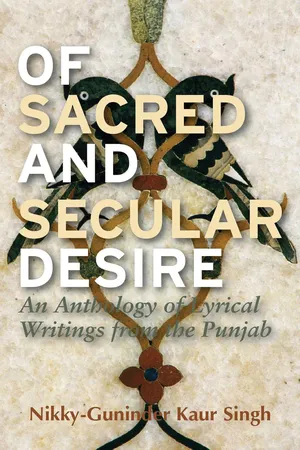
eBook - ePub
Of Sacred and Secular Desire
An Anthology of Lyrical Writings from the Punjab
- 288 pages
- English
- ePUB (mobile friendly)
- Available on iOS & Android
eBook - ePub
Of Sacred and Secular Desire
An Anthology of Lyrical Writings from the Punjab
About this book
Information
1
POETRY FROM SIKH SCRIPTURE
From the many different Gurus and saints gathered in the Guru Granth, I chose Guru Nanak, Guru Arjan, Sheikh Farid, Bhagat Namdev and Bhagat Ravidas. As I have acknowledged, they may be few in number, but they provide a strong feel for the diversity and rich literary textures of the archetypal Punjabi anthology.
Guru Nanak
We will begin with Guru Nanak because it is his vision and syntax that form the base for the entire volume. Nanak reveled in calling himself a poet: “sasu masu sabhu jio tumara tu mai khara piara / nanaku sairu eva kahatu hai sace parvadgara – to you belong my breath, to you my flesh; says the poet Nanak, you the True One are my Beloved” (GG: 660). He uses the term sairu/shair, which comes from the Arabic word for poetry (al-shi’r). S.H. Nasr traces its root meaning to consciousness and knowledge.1 Guru Nanak’s ideal of poetry is therefore very different from our word “poetry,” which means making. Rather than making or crafting, the poet Nanak is so consumed by his intense awareness and love for the Divine that he has no control over his words: “jaisi mai ave khasam ki bani taisara kari gianu ve lalo – as comes to me the Husband’s word, that is what I say O’ Lalo!” (GG: 722)
There is very little biographical documentation on him. From popular narratives we learn that he was born in Talwandi, a small village in northern India (now in Pakistan) into a Hindu home. But he rejected social structures and spent his time communing with nature. Later he went to live with his sister Nanaki and her husband Jairam in Sultanpur, and worked at the local grocery shop. It is believed that at Sultanpur Nanak had a revelatory experience into the unicity of the Divine. Thereafter he traveled extensively spreading his vision of the One and its social implications, the oneness of humanity. During most of his travels, his Muslim companion Mardana played on a rabab, while Guru Nanak sang songs of intense love addressing the ultimate One in everyday Punjabi. The Sikh Guru’s words and the Muslim Mardana’s music are intrinsically bonded. The simple style of Guru Nanak’s teaching drew people from different religious and social backgrounds. Those who accepted him as their “guru” and followed his teachings came to be known as Sikhs, a Punjabi word which means disciple or seeker (Sanskrit shishya; Pali sekha).2
Guru Nanak’s entire teaching is in the poetic mode. Plato may have found poetry too captivating and therefore banished the poets from his Republic, but the divinely inspired Guru tried to awaken his followers and revitalize their senses, psyche, imagination, and spirit through poetry. Martin Heidegger’s perspective illuminates the importance of the poetic mode inaugurated by Guru Nanak. For Heidegger, human existence rests and builds upon poetry, and almost quoting Shelley he says, “Language itself is poetry in the essential sense.”3 “Poetry…is not an aimless imagining of whimsicalities and not a flight of mere notions and fancies into the realm of the unreal. What poetry, as illuminating projection, unfolds of unconcealedness and projects ahead into the design of the figure, is the Open which poetry lets happen, and indeed in such a way that only now, in the midst of beings, the Open brings beings to shine and ring out.”4
Guru Nanak’s sonorous verse recorded in the Guru Granth comes in a gusty speed, and taking on beautiful artistic designs, it “lets happen.” As we heard him above, the Guru repeatedly points to the Divine as the source of his orality: “ta mai kahia kahanu ja tujhai kahaia – I said only what you made me say” (GG: 566). Again, “hau apahu boli na janda mai kahia sabhu hukmao jio – language I don’t know, I say what you order me to” (GG: 763). The Guru is not following any models nor working to compose his words, and yet his inspired words speedily flow out in perfect rhythm, alliteration, assonance, and consonance! In turn his geometric patterns, verbal arabesques, and linguistic somersaults, awaken the consciousness to the infinite reality permeating each and all. His words coming from a transcendent soil project every bit on earth with meaning – be it a tiny ant or a blade of grass or a fish, so what is overlooked and concealed “shines and rings out” with transcendent joy. The disclosure happens in the moment now – not before or hereafter, and in relationships with others – not in isolation or renunciation. Nanak’s language opens the door to a heightened mode of being. Definitely not an aimless or fanciful flight, his poetry is a real feel for the divine vibrancy present everywhere – motivating people to live socially, politically, and spiritually engaged with their families and communities. Guru Nanak’s verse has generated one of the five world religions, with more than 23 million people relying on its existential power. For the eminent Sikh historian Harbans Singh, “His genius was best expressed in the poetical attitude. No other way would have been adequate to the range and depth of his mood…”5
Guru Nanak’s boundless imagination and subtle aesthetic sensitivity served as the paradigm for the Fifth Guru who compiled the 1,430-paged volume for his growing Sikh community. Each of Guru Nanak’s compositions poetically expresses his theological vision of the Divine. The volume opens with his statement Ikk Oan Kar (One Being Is), and the rest can be read as an artistic hermeneutics of this primal expression of expansiveness and unity. Nanak grew up in a culturally and religiously rich North India with Sufis and Saints from many different orders and schools of thought. In his lifetime, he witnessed Babur’s conquest of the relatively peaceful regime of the Muslim Lodi Sultans and the establishment of the Mughal Empire. Nanak’s works disclose the common spirituality of his milieu, just as they disclose the prevailing stereotypical binaries: the upper class Brahmin vs. the low Shudra, the Hindu vs. the Muslim. In a socio-political context where God was named as either ram or rahim, the worship was either namaz or puja, the place of worship mandir or masjid, and the language of scripture either Sanskrit or Arabic, Guru Nanak proclaimed “1 Being Is.” Here the primary numeral “1” common to people of all languages and cultures is followed by the alpha of the Gurmukhi script (also a sign for Oan, the primordial Sanskrit syllable Aum or Being) and is completed by the sign for Kar (Is), a geometrical arc reaching away into space. While the former two constitute the beginning of the mathematical and verbal languages, the arc is at once without beginning or end. Nanak’s fundamental principle gestures motion and movement – an entry into countless possibilities. If the Muslim poet Firoz Din Sharaf admires the Sikh Guru for his ability to explain Vedic and Qur’anic terms (in his poem entitled “Defeated”), it is because he comprehended Guru Nanak’s language of Absoluteness and Infinity.
As I have been writing all along, we must not confine Guru Nanak’s innovative configuration of Ikk Oan Kar to any preexisting molds: the standard translation “There is One God” does not quite express the vastness, the plenitude, or the intimacy bursting forth in the original “One Being Is.”6 Instead of an opening into limitless possibilities as envisioned by the founder Sikh Guru, scholars and translators have selected and structured and shaped Ikk Oan Kar into an intimidating male God. As the feminist philosopher Mary Daly reminds us, the term “god” is a reified “noun”, which is static and laden with Jewish and Christian patriarchal assumptions. “God” with its “Father-Lord” connotations has negative effects on society as it produces an unhealthy experience with the Divine, and unhealthy relationships amongst people, she writes.7 Transcending languages, cultures, and religions, Guru Nanak’s primary numeral 1 with its soaring geometric arc is a universal modality. In any translation, the 1-ness of the numeral must be retained, and I would say “Be-ing” (recommended by Mary Daly in a Western context) works out quite well as its English equivalent for it preserves Nanak’s intention.8 When his language is accessed directly without patriarchal interpreters and translated without imperial hegemonies, its liberating enchantment becomes existentially available to those who hear him.
There is no need for adding the term “soul” in English translations either. Sikh scripture permeates with words like sakhi (female friend), suhagan (bride) nar, mahal, and kaman (all three denoting woman). But whenever these original words are translated, the term “soul” somehow gets latched on. Laden with Jewish-Christian connotations, “soul” is not appropriate in the Sikh context. It imposes a mind-body dualism that devalues bodies, female gender and sexuality, and shifts the attention from life on earth here and now to an afterlife and heaven out there. A simple suhagan (bride) for example, becomes “bride-soul.” The addition reduces the robust and authentic presence of female scriptural models into a mere figure of speech. It sends misogynistic and geophoebic messages to readers.
The essential celebration of the Divine One at the outset is followed by Guru Nanak’s composition called the Japuji (japu signifies quiet prayer, and ji is the Punjabi suffix for respect). Since this inaugural hymn of the Guru Granth forms the core of Sikh ethics and metaphysics, I have included it in its entirety. Devotees recite Japuji at the break of dawn, “the ambrosial hour,” considered most conducive to grasping its poetic force. While its prologue affirms the existence of the infinite One, its 38 stanzas celebrate the vibrancy of the cosmos reverberating with That singular Divine. Its vivid descriptions make readers feel a part of a magical plurality consisting of different complexions, faiths, heroes, rituals, languages, and species (Japuji: 27).
Towards the finale, readers are launched on a five-fold spiritual journey – across the realms of Dharam, Gyan, Saram, Karam and Sach (Duty, Knowledge, Beauty, Action, and Truth). As the journey progresses into wider planes and deeper depths, we come face to face with the infinity we partake in: “Here are continents, constellations, and universes, whose limits cannot be told” (Japuji: 37). The epilogue of the hymn presents a memorable scene in which the “entire universe” (sagal jagat) with its variegated and complex multiplicity “plays” (khele) in the lap of “day and night, the two female and male nurses” (divas rati dui dai daia). This first poem of the Granth constitutes a remarkably organic textual body: its prologue introduces the infinity of Be-ing; its epilogue vividly depicts humans and nature cozily nestled together on the Body of That metaphysical One.
Guru Nanak’s hymn entitled “Arati” is also very popular. It is recited by Sikhs every evening as they reverently close their holy book and put it to rest for the night. In some shrines it is an enormously festive event. At the Golden Temple for instance, the Arati sung by the congregation sonorously fills the air as the Guru Granth is taken in a gold and silver palanquin (palki) from the central shrine for its nightly rest, and the devotees (and visitors) in a procession take turns – offering their shoulders – to carry the revered Book. The hymn celebrates the cosmic choreography of the planets, and like the Japuji, it puts us in touch with something much larger. This joyous hymn is often interpreted as a repudiation of the traditional Hindu custom in which devotees encircle a platter with lamps, incense, and fruit around their favorite deities. In fact, Nanak’s Arati recounts the spacious and ethereal skies as the platter (thal) on which the sun, moon and twinkling starry lamps perform arati around the infinite One. In his poetic leap, entire vegetation comes together as a bouquet offered in homage, and the breeze blows from and in all directions as the fragrant incense. Rather than split Sikh from Hindu, Nanak’s discourse invites everybody – Hindus, Muslims, Jews, Christians, and Sikhs to hear and see and rejoice in the cosmic harmony. Instead of its interpreters, it is the text that needs to be heard directly.
By designating the Divine as numeral “1” Nanak shattered the dominance of conventional male motifs and divisive categories; he opened up a space for the Divine to be experienced in other new and important ways. So he and his successor Gurus reveal countless ways of imagining and experiencing that infinite One. In Guru Nanak’s compositions, we see the Divine as the bride in her wedding dress, as the groom on the nuptial bed… as the fisherman and the fish, as the waters and the trap, as the weight holding the net, as well as the lost ruby swallowed by the fish. In a speedy tempo, his similes and paradoxes free the mind from narrow walls. His literary tropes parallel natural phenomena: just as in nature new qualities can be engendered by the coming together of elements in new ways, so too, new semantic juxtapositions and combinations can produce a new isness.9 Is the Divine the dressed up bride or the groom on the nuptial bed? Breaking out of ordinary linear thought, Nanak’s language makes way for a new dimension of reality and being in this world. The artist offers readers myriad possibilities of recollecting the infinite One – without letting the mind halt on any one. It is also noteworthy that nothing in the cosmos is polluted or deemed too low for the Divine to sparkle through. Humans are not the only ones endowed with spiritual treasures – the fish has swallowed the ruby too!
Guru Arjan
Like his predecessor, the Fifth Guru heard language flowing out of a transcendent hub: “agam agocaru sacu sahibu mera nanaku bolai bolaia tera – unfathomable, ineffable, truth is my sovereign; Nanak speaks what you want him to” (GG: 743).10 A spontenous expression of the ontological force of the universe, speaking here is free from conceptual webs and linguistic codifications. Adhering to Guru Nanak’s discourse, Guru Arjan reiterates the singularity of that source: “Some call it Rama, some call it Khuda; some worship it as Vishnu, some as Allah” (GG: 885). In order to crystallize the founder Guru’s universal vision for perpetuity, he collected the verses of the Sikh Gurus, Hindu Bhagats, and Muslim saints from different social and geographical backgrounds. Through his profound personal sensibility, Guru Arjan heard the essential human language; he did not get stuck on external differences in accents, intonations, grammar, vocabulary or imagery.
He certainly did not aim at a blend of Hindu-Muslim ideas, for that would only deny the rich distinctions he respected. Till very recently books on world religions categorized Sikhism as a prime example of synthesis or “syncretism.”11 Such presumptions fail to see the originality of the Sikh poetic horizon. Guru Arjan did not try to add two disparate traditions to reproduce a hybrid Sikh text; he did not assemble their passages and market it as a new product. What he did seek was a vertical expansion of the spiritual consciousness shared by Hindus, Muslims, and Sikhs. And what he created was a literary text scripted in an enduring relationship with people of other faiths.
That the Sikh Guru voluntarily and consciously chose to incorporate the different religious paradigms of his day into the Sikh sacred volume shows his unusually liberal attitude. This inclusive process of textual compilation had begun early on. As ...
Table of contents
- Cover
- Author biography
- Title page
- Copyright page
- Dedication page
- Contents
- Glossary
- Preface
- Introduction
- 1 Poetry from Sikh Scripture
- Guru Nanak
- Guru Arjan
- Sheikh Farid
- Namdev
- Ravidas
- 2 Beloved Sufi Poets
- Bullhe Shah
- Waris Shah
- 3 Modern Poets
- Bhai Vir Singh
- Dhani Ram Chatrik
- Firoz Din Sharaf
- 4 Postmodern Female Poet
- Amrita Pritam
- Conclusion
- Notes
- Bibliography
Trusted by 375,005 students
Access to over 1.5 million titles for a fair monthly price.
Study more efficiently using our study tools.
Frequently asked questions
Yes, you can cancel anytime from the Subscription tab in your account settings on the Perlego website. Your subscription will stay active until the end of your current billing period. Learn how to cancel your subscription
No, books cannot be downloaded as external files, such as PDFs, for use outside of Perlego. However, you can download books within the Perlego app for offline reading on mobile or tablet. Learn how to download books offline
Perlego offers two plans: Essential and Complete
- Essential is ideal for learners and professionals who enjoy exploring a wide range of subjects. Access the Essential Library with 800,000+ trusted titles and best-sellers across business, personal growth, and the humanities. Includes unlimited reading time and Standard Read Aloud voice.
- Complete: Perfect for advanced learners and researchers needing full, unrestricted access. Unlock 1.5M+ books across hundreds of subjects, including academic and specialized titles. The Complete Plan also includes advanced features like Premium Read Aloud and Research Assistant.
We are an online textbook subscription service, where you can get access to an entire online library for less than the price of a single book per month. With over 1.5 million books across 990+ topics, we’ve got you covered! Learn about our mission
Look out for the read-aloud symbol on your next book to see if you can listen to it. The read-aloud tool reads text aloud for you, highlighting the text as it is being read. You can pause it, speed it up and slow it down. Learn more about Read Aloud
Yes! You can use the Perlego app on both iOS and Android devices to read anytime, anywhere — even offline. Perfect for commutes or when you’re on the go.
Please note we cannot support devices running on iOS 13 and Android 7 or earlier. Learn more about using the app
Please note we cannot support devices running on iOS 13 and Android 7 or earlier. Learn more about using the app
Yes, you can access Of Sacred and Secular Desire by Nikky-Guninder Kaur Singh in PDF and/or ePUB format, as well as other popular books in Theology & Religion & Indian & South Asian History. We have over 1.5 million books available in our catalogue for you to explore.