The Yugoslav communist leaders aspired to create a socialist Yugoslavia, and when they came into power in 1945, they claimed to have introduced a socialist solution to the Yugoslav national question. But what did it imply to 'solve a national question' and what did introducing a 'socialist solution' to a national question entail?
'Creating a Socialist Yugoslavia: Tito, Communist Leadership and the National Question' charts how the Yugoslav Communist leaders approached the national question, and what influence the complex national relations in the multinational state of Yugoslavia had on the development of the Yugoslav communists' policies, and on their post-war socialist project. From 1935 to 1990, tremendous changes took place in the Yugoslav approach to the national question, and in the institutions they devised as part of this solution. There were also significant changes to the role of the republics and the relations between the different national groups within the Yugoslav state. Discussions on the national question were not absent during this period, despite the communists claim to have solved it. Debates over what kind of Yugoslav unity was the most desirable continued to be a question of contention and different groups had different visions of this. A struggle over resources also developed between different republics.
This book identifies and examines four particular phases in the communists' strategies towards the national question; each marked by particular processes, issues and challenges. The claim to have solved the national question often meant that this issue could not be discussed openly and had to be expressed in a particular rhetoric approved by the Party. 'Creating a Socialist Yugoslavia' provides an authoritative account of the Yugoslav communist leaders' national policy and attempts to deal with the challenges encountered by the communists in reconciling their aspiration to create a socialist Yugoslavia with the need to regulate national conflict within the federation.
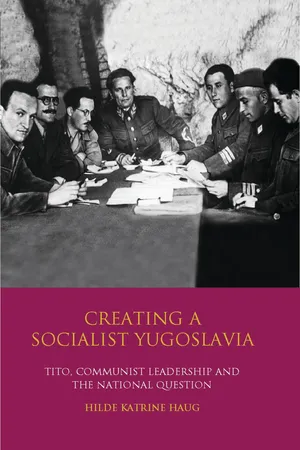
eBook - ePub
Creating a Socialist Yugoslavia
Tito, Communist Leadership and the National Question
- 304 pages
- English
- ePUB (mobile friendly)
- Available on iOS & Android
eBook - ePub
Creating a Socialist Yugoslavia
Tito, Communist Leadership and the National Question
About this book
Information
1
THE SEARCH FOR REVOLUTIONARY RESPONSES TO THE NATIONAL QUESTION IN YUGOSLAVIA, 1918–1935
The Communist Party of Yugoslavia came into existence during the Congress of Unification held in Belgrade in April (20–23) 1919, the year following the formation of the Yugoslav state. Originally under the name Socijalistička radnička partija Jugoslavije (komunista) (SRPJ[k]), the name of the Party was changed to Komunistička Partija Jugoslavije (KPJ) – the Communist Party of Yugoslavia – the following year at the Second Congress in Vukovar, June 1920. The new party was formed from various small groups within the socialist movement which formerly existed within Serbia and the Austro-Hungarian Empire. The KPJ became an underground organisation in 1920 when the government made the Communist Party illegal through the Obznana (Pronouncement). KPJ activities were outlawed in 1921, in the Law for the Protection of the State, and the KPJ was to remain an illegal party until World War II. Throughout this period, communists in Yugoslavia lived and worked in difficult conditions and were frequently subject to imprisonment.
Remaining at the fringe of political life for the large part of the inter-war period, communists were not directly engaged in the actual political struggle over what should be the relations between the state and the nations within the new Yugoslav entity. Nevertheless, the complex relations between the various groups inhabiting the new state, and the struggle to define their status, greatly affected the development of the revolutionary strategies of the KPJ. The gradually developing tension within the state also played its part. The multifaceted national composition in Yugoslav society was to have a profound impact on the organisation of the Party, on the framework within which they agitated for revolution, on their attempt to gain support for their cause, on the strategies developed by the KPJ to achieve the aim of a socialist revolution, and on the nature of the revolution itself. The communists’ ability to act as an effective political force became hugely inhibited by their inability to decide on a strategy on the national question. From 1919 until 1935 the Yugoslav communist movement moved through a number of stages in their search for a socialist approach to the national question in Yugoslavia. At the beginning of this period the KPJ attributed very little significance to the national question, but by 1935 it was a major issue for them. In the early 1920s they gave wholehearted support to the principle of Yugoslav unitarism, viewing the Slovenes, Serbs and Croats as three tribes of one nation. A decade later, they were advocating that the Yugoslav state should be dismantled and national self-determination granted to these three groups as well as to a number of groups not recognised by the Yugoslav regime.
The Party’s confusion and inability to agree a policy on the national issue can be observed in the factional struggles which characterised much of this period. These struggles originated in questions of party organisation and revolutionary strategies, becoming more apparent when the KPJ evolved from a loose federation of small groups within the socialist movement in Serbia and the Habsburg Empire into a centralised, Bolshevised party. This was not an easy process. The members of the Party had worked within different contexts; they had differing degrees of radicalism and divergent attitudes towards socialist agitation, therefore they focused their attention on different issues. The factional alliances changed and their positions did not remain constant. Gradually, however, two identifiable positions emerged, referred to as a ‘leftist’ and a ‘rightist’ wing of the KPJ, these labels identifying their attitude towards revolution. Although the factional struggles were, to a large extent, linked to questions of party organisation and revolutionary strategies, the national question was to emerge as a central issue in the ensuing disputes. Disagreement on issues of national relations and degrees of revolutionary radicalism became interlaced in a complex, almost intangible relationship. The Yugoslav case demonstrated that, for the communist movement, the national issue could be exploited for revolutionary purposes, yet it could also stifle revolutionary activity, and indeed, render socialist revolutionaries utterly ineffective.
An important factor in the development of KPJ strategies on the national question in Yugoslavia was the influence of the Communist International – the Comintern. The Comintern’s favoured strategies were not always particularly sensitive towards the reality of the Yugoslav socio-political context, nor towards the problems of socialist revolutionaries within it. Although the Comintern’s officially stated main purpose was to promote world revolution, in practice it functioned more like an extended defence system for the Soviet Union in which it was expected that the highest duty of all communist parties was the defence of the Soviet Union, ‘the only real existing socialist society’. The Comintern offered help to organise revolutionary activities and to promote socialist revolution in countries where the ‘objective’ conditions for revolution existed, but the Comintern’s interpretation of when and where such conditions existed were largely defined according to Soviet Union foreign policy interests. In return, communist parties from countries outside the Soviet Union were expected to give their full allegiance to the Comintern, and their full commitment to Comintern policies. Comintern interference has frequently been highlighted as a crucial contributing factor to the KPJ’s inability to get to grips with the national question in Yugoslavia. The Comintern showed a lack of understanding of the nature of the sometimes conflicting relationships between the Yugoslav nations, and its frequent interference in Yugoslav affairs clearly complicated the disputes surrounding the KPJ approach to the national question. The KPJ’s inability to agree on a nationalities policy in the 1920s and 1930s was however also influenced by domestic factors. KPJ leaders were the product of different backgrounds, different experiences, and came from different parts of Yugoslavia. Their opinions on how progressive the formation of a Yugoslav state might be when viewed within the Marxist concept of historical materialism also diverged considerably. While the socio-political context in Yugoslavia differed substantially from that in Russia, and posed a different set of problems for the KPJ, when the national question arose, the KPJ stance was similar to its Bolshevik mentors. The central issue for both was how to channel national discontent into communist support. Despite the differences in approach of KPJ members towards the national question, as well as the inability by the KPJ to decide on a common strategy, all approached it from the perspective of class. It is extremely difficult to present a coherent picture of the KPJ’s perception of the national question, or their policies and strategies on it, since neither remained constant during the inter-war period. The approaches suggested and taken up prior to 1935 attached differing degrees of relevance to the national question for Yugoslavia as a state, and for Communists within it. However, despite the extremely complex and often conflicting KPJ strategies towards the national question, it is important to remain aware that the motive behind each approach was always the attempt to find a socialist response to the Yugoslav national question.
Advocacy of Yugoslav unitarism, centralism and the ‘three-named people’
To understand the nature of the conflict which developed around the KPJ’s approach to the national question, and the radical change in the importance attached to it, one has to begin by understanding how the Communists conceptualised Yugoslav unity and the Yugoslav state formed in 1918. Although the merging of various parties in the region into a Yugoslav party came about under strong Comintern influence, the creation of the Yugoslav state was not looked upon in a particularly favourable light from the view of the international communist movement.1 The Comintern was generally hostile to the post-Versailles world order. In its view, the states which emerged from the former Austro-Hungarian Empire had been created to benefit the imperialist interests of the Entente powers. It was more in favour of exploiting the national question in the region for revolutionary purposes and toyed frequently with the idea of forming a Balkan federation, to be closely linked to the Soviet Union.2 Despite this hostility to the state of Yugoslavia, the Comintern did not interfere in the affairs of the KPJ, nor actively oppose the KPJ’s support for Yugoslav unitarism, until 1922. Unlike the Comintern, the Yugoslav communists viewed the creation of the Yugoslav state as a progressive event, at least initially, and tended to support some form of Yugoslav unitarism. The various factions which made up the KPJ came to strikingly similar positions on the national question. During the Unification Conference, and at party conferences over the next two years, the national question was granted little attention. At the Unification Conference, it was referred to in one single sentence, calling for ‘one national state with broad self-governing regions, districts and communes’.3 Members of the KPJ championed the concept of narodno jedinstvo (national oneness), the principle on which the state had been established, a principle declaring that the Serbs, Croats and Slovenes were three tribes (plemena) of one people.4 They considered the differences between Serbs, Croats and Slovenes to be negligible, and thought they would in time disappear through shared market, industry, administrative, legal and educational systems.5
A typical example of the communist attitude towards the national question was expressed by the Serbian Social Democratic Party (SSDP), in an editorial in the SSDP party newspaper, Radničke novine on 30 December 1918: ‘Serbs, Croats and Slovenes are one people because they have one language and indistinguishable ethnic characteristics… Serbs, Croats and Slovenes feel themselves to be one people … and that their unification in one national society is of great political, economic and cultural necessity.’6 The Croat Social Democrats expressed a similar view on 1 May 1918, asserting ‘Slovenes, Croats and Serbs are one and the same people, and as a consequence they have all the attributes of one people and especially in this respect … they constitute an independent free state.’7 Although the KPJ were united in their support for narodno jedinstvo and in advocating for South Slav unitarism, the reasons behind their support, and the manner in which they arrived at this position, were quite different.
The South Slav Social Democratic parties from the former Austro-Hungarian Empire had long been preoccupied with the national question, and with the attempt to find some accommodation to this question. Dušan Lukač argues that all the groups within the renewed social democratic movement, regardless of political differences, expected Serbs, Croats and Slovenes to unify in the name of the ‘three-named people’ and become one nation. Their differences related only to the manner in which they expected this unification to be realised.8 Three views among these groups had been dominant prior to the unification. One group, centred on Juraj Demitrović, was originally in favour of South Slav unity within the framework of Austria-Hungary, then radically evaluated its position in the aftermath of the disintegration of the Austro-Hungarian Empire, coming to support self-determination and the creation of a Yugoslav state.9 Another group, centred on Vitomir Korač, a former South Slav socialist leader under the Habsburg Empire, had from the start worked for South Slav unity, advocating that all parties in the country should concentrate their attention on creating a Yugoslav national state.10 Both these groups regarded the creation of a Yugoslav state as the natural result of a successful national revolution, and thus as a progressive step which socialists ought to support. The leftists, although they also supported the concept of the national oneness of Serbs, Croats and Slovenes, did not see unification as a ‘successful national revolution’. Rather, these radicals believed that the ‘ideal of a messianic South Slav state was betrayed by the bourgeoisie’.11 They had favoured ‘a solution to the national question of the Balkan people involving a proletariat revolution’ but they did not have a problem with the concept of Yugoslav unitarism, nor with the notion that Slovenes, Croats, and Serbs were three tribes of the same nation. August Cecarec, a leading Croat leftist, expressed the view that it was ‘singularly unfortunate … that the national unification was not brought about by the united revolt of the people themselves’.12
The Serbian Social Democratic Party (SSDP) had historically been less concerned with the national question, and did not have the same enthusiasm for the concept of South Slav unity. The SSDP was more theoretically orientated, and consisted mainly of intellectuals and students whose outlook was more doctrinaire.13 Despite the fact that SSDP members had gone over to Bolshevism en masse following the Russian Revolution, their attitude towards the national question seemed closer to the position of Rosa Luxemburg than to that of Lenin. They felt the national question belonged to the sphere of the bourgeoisie, and that socialists ought not to engage with it. Rather, their focus should be on class struggle. The unification of 1918, in the name of narodno jedinstvo, was seen as the bourgeois stage in the classical Marxist theory of revolution. Now the socialists had to concentrate on achieving the next stage – the proletarian revolution. The SSDP’s approach to the national issue, particularly the lack of enthusiasm for the concept of South Slav unity, reflected the organization’s socio-political background and the fact that the Serbs had already acquired their own state. Serbs did not have the same need for a supranational identity as did the South Slavs from the Austro-Hungarian regions. They had originally been in favour of the formation of a Balkan federation, but following the creation of the Yugoslav state they supported the concept of narodno jedinstvo, seeing no compelling reason to object to it. This support did not, however, have the same urgency and ideological overtones as that of the non-Serbian socialists; it was more a question of practicality, as was illustrated by the SSDP’s encounter with a delegation from another branch within the new Yugoslav socialist family: the Pelagićists from Vojvodina (mostly made up of returned war prisoners from Russia). The Pelagićists had been greatly influenced by Bolshevism, and attempted to put forward the idea, in a Marxist-Leninist spirit, that the Slovenes, Croats and Serbs constituted three different nations, and that the Yugoslav Communists ought to struggle for the creation of a socialist federal republic consisting of these peoples. At their meeting with the SSDP in Belgrade on 17 February 1919, the leader of the Party, and subsequently the first leader of the SRPJ(k), Filip Filipović, recognised that Serbs, Croats and Slovenes were formative nations, but nevertheless underlined that ‘since the workers’ movement with regard to all the layers of the nation accepted narodno jedinstvo,’14 it followed that the support for that idea be asserted within the Party.
Despite these differences within the newly merged Yugoslav Communist Party, the various factions arrived at the same conclusion, giving their support to a unitary, centralised Yugoslav state, based on the principle of narodno jedinstvo. The KPJ’s support for unitarism and centralism was partly rooted in specific local concerns, and partly in their adherence to Marxist ideology. Their unitarism was a response to the specific circumstances of the region in this period, and although ultimately, narodno jedinstvo, as Banac points out, represented a form of nationalism (more specifically ‘the prototype of South Slavic supra-nationalism’15), their approach was also influenced by Marxist universalism and the Marxist perception of historical development. Their continuing support of unitarism relied more than anything on their belief that Yugoslav unity was progressive in nature. This belief was largely rooted in the Marxist tendency to favour larger, centralised states. Narodno jedinstvo, lacking Marxism’s universalism, did not exactly correspond with international proletarianism, nor with the Comintern’s view that the national question should be exploited as a tactical tool for revolutionary purposes. Yet paradoxically, the Yugoslav communists’ support for South Slav unity, and their view that the concept of narodno jedinstvo was progressive, drew a lot of inspiration from the Marxist universalist perception of historical development. The KPJ’s approach to the national question in this period relied on the conviction that the accomplishment of narodno jedinstvo would settle national contentions, which in their view were relics from the past, and that the more important class struggle would become the main focus.
The KPJ’s continuing support of unitarism must also be viewed from the perspective of their tenden...
Table of contents
- Cover
- Author biography
- Title page
- Copyright page
- Contents
- Acknowledgements
- List of abbreviations
- INTRODUCTION
- 1 THE SEARCH FOR REVOLUTIONARY RESPONSES TO THE NATIONAL QUESTION IN YUGOSLAVIA,1918–1935
- 2 TOWARDS YUGOSLAV FEDERAL UNITY UNDER COMINTERN INFLUENCE
- 3 PEOPLE’S LIBERATION STRUGGLE AND BUILDING OF A NEW YUGOSLAVIA, 1941–1945
- 4 ‘WHITE LINES ON MARBLE PILLARS’: REPUBLICS, AUTONOMOUS PROVINCES AND BORDERS
- 5 INTRODUCING A SOCIALIST SOLUTION TO THE NATIONAL QUESTION IN YUGOSLAVIA, 1945–1948
- 6 TOWARDS SELF-MANAGEMENT SOCIALISM AND YUGOSLAV UNITY, 1948-1958
- 7 SOCIALIST YUGOSLAVISM BETWEEN UNITY AND DIVERSITY, 1958–1966
- 8 INSTITUTIONAL, CONSTITUTIONAL, AND IDEOLOGICAL CHANGES INTRODUCED IN YUGOSLAVIA, 1964–1971
- 9 THE NATIONAL QUESTION REVISITED: NATIONAL CONTROVERSIES, 1967–1971
- 10 THE CROATIAN NATIONAL REVIVAL AND YUGOSLAV CRISIS, 1967–1971
- 11 SERBIA AFTER RANKOVIĆ: ‘LIBERALS’, INTELLECTUALS AND THE ‘SERBIAN QUESTION’
- 12 A RECONSIDERATION OF THE PURPOSE OF THE YUGOSLAV STATE, 1971–1980
- 13 YUGOSLAVIA AFTER TITO
- CONCLUSION
- Notes
- Bibliography
Trusted by 375,005 students
Access to over 1.5 million titles for a fair monthly price.
Study more efficiently using our study tools.
Frequently asked questions
Yes, you can cancel anytime from the Subscription tab in your account settings on the Perlego website. Your subscription will stay active until the end of your current billing period. Learn how to cancel your subscription
No, books cannot be downloaded as external files, such as PDFs, for use outside of Perlego. However, you can download books within the Perlego app for offline reading on mobile or tablet. Learn how to download books offline
Perlego offers two plans: Essential and Complete
- Essential is ideal for learners and professionals who enjoy exploring a wide range of subjects. Access the Essential Library with 800,000+ trusted titles and best-sellers across business, personal growth, and the humanities. Includes unlimited reading time and Standard Read Aloud voice.
- Complete: Perfect for advanced learners and researchers needing full, unrestricted access. Unlock 1.5M+ books across hundreds of subjects, including academic and specialized titles. The Complete Plan also includes advanced features like Premium Read Aloud and Research Assistant.
We are an online textbook subscription service, where you can get access to an entire online library for less than the price of a single book per month. With over 1.5 million books across 990+ topics, we’ve got you covered! Learn about our mission
Look out for the read-aloud symbol on your next book to see if you can listen to it. The read-aloud tool reads text aloud for you, highlighting the text as it is being read. You can pause it, speed it up and slow it down. Learn more about Read Aloud
Yes! You can use the Perlego app on both iOS and Android devices to read anytime, anywhere — even offline. Perfect for commutes or when you’re on the go.
Please note we cannot support devices running on iOS 13 and Android 7 or earlier. Learn more about using the app
Please note we cannot support devices running on iOS 13 and Android 7 or earlier. Learn more about using the app
Yes, you can access Creating a Socialist Yugoslavia by Hilde Katrine Haug in PDF and/or ePUB format, as well as other popular books in History & 20th Century History. We have over 1.5 million books available in our catalogue for you to explore.