- 224 pages
- English
- ePUB (mobile friendly)
- Available on iOS & Android
eBook - ePub
About this book
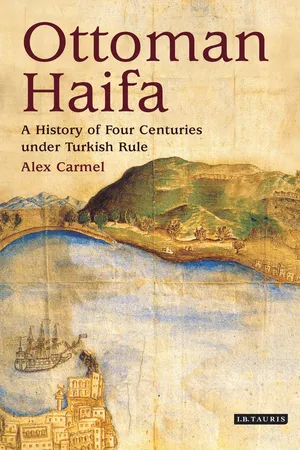
Under Ottoman rule, the city of Haifa, located at the southern point of the largest bay on the coast of what today is Israel, was transformed from a scarcely-inhabited fortress town to a major modern city. This book details the history of Haifa under the Ottomans during the period 1516-1918. Alex Carmel uses a variety of original sources to uncover the realities of life in Haifa under Ottoman rule and paints a vivid picture of the development of the city in this era. Carmel's work has become the benchmark of the historiography of Israel's third largest city and remains to this day, the best-known and most highly-regarded survey of Haifa under Ottoman rule. This, the first English edition of 'Ottoman Haifa', will be essential reading for all historians of the Ottoman Empire and the Middle East.
Information
Alex Carmel (1931–2002) was an historian of the Middle East, specialising in nineteenth-century Palestine. He joined the faculty of the University of Haifa in 1968 and was a visiting professor at the universities of Basle, Bern, Fribourg and the Free University of Berlin.
Ottoman Haifa
A History of Four Centuries under Turkish Rule
By Alex Carmel
Translated into English by Elias Friedman
Preface by Jakob Eisler

This book is dedicated,
as wished for by its late author Alex Carmel,
to the memory of the beloved Cornelius Beilharz (1976–2002),
descendant of the Haifa Templers.
Published in 2011 by I.B.Tauris & Co Ltd
6 Salem Road, London W2 4BU
175 Fifth Avenue, New York NY 10010
www.ibtauris.com
Distributed in the United States and Canada Exclusively by Palgrave Macmillan, 175 Fifth Avenue, New York NY 10010
Copyright © 2011 The Estate of Alex Carmel
Preface copyright ©2011 Jakob Eisler
The right of Alex Carmel to be identified as the author of this work has been asserted by him in accordance with the Copyright, Designs and Patents Act 1988.
All rights reserved. Except for brief quotations in a review, this book, or any part thereof, may not be reproduced, stored in or introduced into a retrieval system, or transmitted, in any form or by any means, eletronic, mechanical, photocopying, recording or otherwise, without the prior written permission of the publisher.
Library of Middle East History, Vol 2
ISBN 978 1 84885 560 1
eISBN 978 0 85773 119 7
A full CIP record for this book is available from the British Library
A full CIP record is available from the Library of Congress
Library of Congress Catalog Card Number: available
Typeset by JCS Publishing Services Ltd, www.jcs-publishing.co.uk
Contents
List of Illustrations
Preface by Jakob Eisler
Introduction
1 Ancient Haifa After the Ottoman Conquest
2 The Foundation of New Haifa
3 Days of Awakening
4 Haifa Thrives
5 Haifa at the End of Turkish Rule
Postscript: Haifa During the First World War
Notes
Select Bibliography and Abbreviations
Illustrations
1 The bay of Haifa about 1770
2 The bay of Haifa in the mid-seventeenth century
3 Old Haifa in April 1682 (painted by de Bruyn)
4 Mount Carmel
5 The Prosper Monastery
6 Drawing of the Prosper Monastery in the mid-seventeenth century
7 Haifa in 1801 (painted by Willyams Cooper)
8 Haifa in 1801 (painted by Willyams Cooper)
9 Haifa in 1880
10 Drawing of the city walls of Haifa, 1841
11 The house of the governor of Haifa, the Serail
12 The Grotto of Elijah on Mount Carmel
13 Agreement with the Carmelites from 1627
14 Proposed plans for the Carmelite monastery
15 The Carmelite monastery, 1840
16 Giambattista Cassini, architect of the present Carmelite monastery
17 The tower of Haifa – the Burj – in the nineteenth century
18 Haifa within its walls, 1841
19 The Carmelite monastery in the nineteenth century
20 The monument for the soldiers of Napoleon’s army
21 The city wall with the Acre Gate, 1870
22 The Austrian post office in Haifa, 1880
23 Christoph Hoffmann
24 Georg David Hardegg
25 The German Colony, 1877 (drawn by Jacob Schumacher)
26 Opening of a French school in Haifa
27 The walls around Mount Carmel, built by the Carmelites
28 Laurence Oliphant
29 The German vice-consul, Friedrich Keller
30 The monastery of the female Carmelites
31 The private house of Keller on Mount Carmel
32 The Luftkurhaus on Mount Carmel
33 The German quarter on Mount Carmel, Karmelheim
34 The Shemen oil factory in Haifa
35 The Technion college in Hadar
36 General view of Haifa, 1914
Credits
1: Vilnay, p. 55
2, 5, 6, 12, 13, 20, 27, 30: Marie-Bernard, pp. 36, 49, 45, 83, 37, 80, 9, 89 respectively
3: De Bruyn, opposite p. 225
4: Kopp, opposite p. 184
7, 8: Ludwig Meyer Collection, Jerusalem
9, 11, 22, 26, 34, 35: Jakob Eisler Collection, Stuttgart
10, 18: Alderson, Plate VIII, opposite p. 22
14, 16: Florencio, pp. 438, 445
15: Pelle, picture number 12
17: Wilson, Vol. 3, p. 83
19, 21, 25, 29, 31, 32, 33: Alex Carmel Collection, Haifa
23, 24: Brugger, frontispiece
28: Oliphant, frontispiece
36: Thevoz, picture number 36
Preface
This book – the first work of the historian and researcher Alex Carmel (1931–2002), who worked on the history of Palestine during the Ottoman Empire for over forty years – has come to be also his last published work, now in English.
In 1963, the Berlin-born Alex Carmel decided to write his Masters thesis on the history of Haifa, the city that had been his new home from 1939.1 Up to then, information about Haifa could only be found in reference works by Zeev Vilnay and Haim Aharonowitz.2 In the latter, Haifa was adjudged to be ‘a wretched, dirty fishing village, whose population amounted to no more than a few hundred’.3 Professor Uriel Heyd, Carmel’s teacher at the time, advised him not to go ahead with the thesis because there were hardly any historical sources and because he thought the topic was rather unimportant. Nevertheless, Carmel set out to work on the ‘History of Haifa in the Turkish Era, 1516–1918’. His sources for the history of the city – at least for the first two centuries of Ottoman rule – consisted mainly of travel literature, from which he carefully selected the more meaningful and historically accurate descriptions. Here, two fundamental qualities of Carmel the historian came to the fore, namely not only a desire to find all the relevant historical sources, but also an ability to evaluate them precisely. In his thesis he was able to reconstruct the city’s history and show that it experienced its first significant boom as early as 1761 under Dahar al-Umar (Zahir al-Umar).4 After the establishment of the Württemberg Templer colony in Haifa in 1868, the city began to flourish.5 Carmel’s ‘modest opus’ about Haifa – as he always called it – became the benchmark for the historiography of Israel’s third largest city, now with more than a quarter of a million inhabitants.6 Even though this book had its origin years ago, it is, to this day, the reference book on the history of Haifa during the Ottoman Empire.
For me, the book is a good deal more than just the history of the city of Haifa: this book connects me with Alex Carmel – the author and the man.
My first encounter with Professor Alex Carmel at Haifa University took place in 1988 when I was a young student. I was reading the present book on Haifa and was looking for the memoirs (cited in the book) of the German vice consul Friedrich Keller ‘Wie ich auf den Carmel kam’ (‘How I Came to Mount Carmel’), but could not find them anywhere. I mentioned this to Professor Carmel in his office on the twenty-seventh floor of Haifa University. Without further ado, Carmel opened one of the drawers of his desk and handed me Keller’s manuscript with the words: ‘Here are the memoirs of Friedrich Keller for your perusal. But if you are not back here in my office this time next week (with the originals), I will consider myself forced to have you hanged from Haifa’s tallest palm tree . . .’ Never before had I had such an encounter! I was especially intrigued by the phrase ‘the tallest palm tree’, because the groves of tall palms lining the Kison River had long since disappeared due to the industrialization of Haifa after the end of Ottoman rule and in the time of the British Mandate.
I did return the pages a week later and was subsequently privileged to study and work as Carmel’s assistant for a long period, starting from a year after this episode until his death in 2002.
I am happy that his wish to publish Die Geschichte Haifas in der Türkischen Zeit in English has now been fulfilled with the publication of this book.
I especially want to thank Professor Reinhold Würth of Künzelsau and Mr Jürgen Prockl of Stuttgart, whose support made it possible to publish this book. I am also indebted to Abigail Fielding-Smith and Joanna Godfrey for getting the book into print at I.B.Tauris.
Dr Jakob Eisler
Stuttgart
(Preface translated by Peter G. Hornung)
Introduction
Haifa is located at the southern point of the largest bay on the coast of Israel. The coastal plain, on the edge of which ancient Haifa spread out, is about 860 metres in length, facing Ras al-Kurum – today it is the area including Rambam Hospital, Quiet Beach and a portion of Bat-Galim. The width of the coastal strip on which the new town was established in the middle of the eighteenth century – nowadays part of Lower Haifa – was no more than 220 metres. The Haifa region served as an outlet to the sea for the Valley of Jezreel, the only one that cuts across the mountains of western Israel. The plain descends by easy stages to the valley of the Jordan and so offers a convenient connection through to the Lebanese Beq’a, the region of Damascus, Hauran and beyond. Haifa lies on the coastal road and serves as the junction for a network of roads running north, east and south. In addition to its advantage as a convenient outlet for an extensive hinterland, it is protected by Mount Carmel from the frequent southerly and south-westerly winds. The nearby seabed is smooth and devoid of natural obstacles that might be dangerous to shipping. In the light of these facts, it is surprising that for thousands of years it was Acre, at the northern edge of the bay, that predominated. It would appear that this was due, first and foremost, to reasons of security. The headland, which projected from that end of the bay and on which Acre was built, offered excellent opportunities for defence. Its port was excellent, though not as good as Haifa’s, and met the needs of maritime traffic in ancient times. In the absence of trains and motorized transport, the ease of access to the hinterland was not a decisive factor. The fundamental reason for the rise of Haifa was its transfer to a new site, where it could be defended. This occurred at the beginning of the second half of the eighteenth century. The far-reaching changes in maritime transport, such as the use of steamships, and inland transport, with the introduction of railroads, gave a decisive advantage to the southern part of the bay. Haifa, which had already begun to show signs of awakening, now rapidly overtook Acre.1
The origins of Haifa, even the meaning of the name, are still shrouded in obscurity.2 Some are of the opinion that a settlement by that name already existed in the Persian period.3 Others consider that it was founded four to five hundred years later. From the second century of the present era onwards, Haifa is mentioned in Talmudic sources and in the writings of the fathers of the Church. It was a small town by the seaside, stretching between Bat-Galim and the pres...
Table of contents
- Contents
- Illustrations
- Preface
- Introduction
- 1 Ancient Haifa After the Ottoman Conquest
- 2 The Foundations of New Haifa
- 3 Days of Awakening
- 4 Haifa Thrives
- 5 Haifa at the End of Turkish Rule
- Postscript
- Notes
- Select Bibliography and Abbreviations
Trusted by 375,005 students
Access to over 1.5 million titles for a fair monthly price.
Study more efficiently using our study tools.
Frequently asked questions
Yes, you can cancel anytime from the Subscription tab in your account settings on the Perlego website. Your subscription will stay active until the end of your current billing period. Learn how to cancel your subscription
No, books cannot be downloaded as external files, such as PDFs, for use outside of Perlego. However, you can download books within the Perlego app for offline reading on mobile or tablet. Learn how to download books offline
Perlego offers two plans: Essential and Complete
- Essential is ideal for learners and professionals who enjoy exploring a wide range of subjects. Access the Essential Library with 800,000+ trusted titles and best-sellers across business, personal growth, and the humanities. Includes unlimited reading time and Standard Read Aloud voice.
- Complete: Perfect for advanced learners and researchers needing full, unrestricted access. Unlock 1.5M+ books across hundreds of subjects, including academic and specialized titles. The Complete Plan also includes advanced features like Premium Read Aloud and Research Assistant.
We are an online textbook subscription service, where you can get access to an entire online library for less than the price of a single book per month. With over 1.5 million books across 990+ topics, we’ve got you covered! Learn about our mission
Look out for the read-aloud symbol on your next book to see if you can listen to it. The read-aloud tool reads text aloud for you, highlighting the text as it is being read. You can pause it, speed it up and slow it down. Learn more about Read Aloud
Yes! You can use the Perlego app on both iOS and Android devices to read anytime, anywhere — even offline. Perfect for commutes or when you’re on the go.
Please note we cannot support devices running on iOS 13 and Android 7 or earlier. Learn more about using the app
Please note we cannot support devices running on iOS 13 and Android 7 or earlier. Learn more about using the app
Yes, you can access Ottoman Haifa by Alex Carmel in PDF and/or ePUB format, as well as other popular books in History & Middle Eastern History. We have over 1.5 million books available in our catalogue for you to explore.