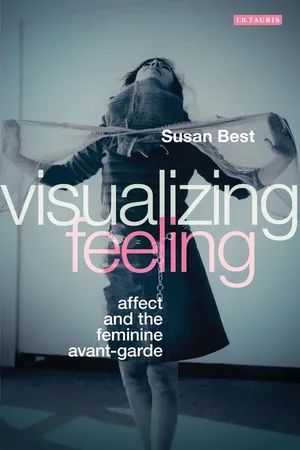
Is late modern art 'anti-aesthetic'? What does it mean to label a piece of art 'affectless'? These traditional characterisations of 1960s and 1970s art are radically challenged in this subversive art history. By introducing feeling to the analysis of this period, Susan Best acknowledges the radical and exploratory nature of art in late modernism. Her book focuses on four highly influential female artists - Eva Hesse, Lygia Clark, Ana Mendieta and Theresa Hak Kyung Cha - and it explores how their art transformed established avant-garde protocols by introducing an affective dimension. This aspect of their work, while often noted, has never before been analysed in detail. Visualizing Feeling also addresses a methodological blind spot in art history: the interpretation of feeling, emotion and affect. It demonstrates that the affective dimension, alongside other materials and methods of art, is part of the artistic means of production and innovation. This is the first thorough re-appraisal of aesthetic engagement with affect in post-1960s art.
The book also extends and enlarges the applications of psychoanalytic theory to art history. Susan Best draws on a rich array of psychologists and psychoanalytic thinkers such as: André Green, Sarah Kofman, Melanie Klein, Donald Winnicott, Ignacio Matte-Blanco, Silvan Tomkins and Daniel Stern. In addition, key aesthetic ideas and concepts are interrogated, including expressive theories of art, beauty and the sublime, and embodied responses to art.
By creatively re-evaluating late modern art, Susan Best offers a new way of thinking about subjectivity and feeling which acknowledges and celebrates the achievements of the feminine avant-garde.
- 208 pages
- English
- ePUB (mobile friendly)
- Available on iOS & Android
eBook - ePub
About this book
Information
| 1 | Minimalism and Subjectivity: Aesthetics and the Anti-Aesthetic Tradition |
In 1994, at a spirited roundtable discussion on conceptual art and the reception of Duchamp, Thierry de Duve asked the following provocative question: ‘Does anybody really believe that there is such a thing as the elimination of subjectivity [in art]?’1 Immediately prior to this question, Alexander Alberro had been explaining how the minimalist artist Donald Judd contributed to the dismantling of the time-honoured link between subjectivity and art. According to Alberro, Judd eliminated, among other things, the ‘transcendental investment from the work of art’ and this, Alberro argues, was ‘an important step in the process toward the dismantling of subjectivity from the work itself’.2 This idea that minimalism dismantled subjectivity, or eliminated it from the work of art, is a very familiar interpretation of minimalism and one which closely accords with many of the statements made by the artists themselves.
These artists aimed, we know, to break with the expressive theory of art and to thereby block the typical egress from the work of art back to the artist and his or her intentions or feelings. Various strategies were adopted to cut the usual filial tie from artist to work. The deliberation of composition was deposed by the industrial logic of artless sequence: ‘one thing after another’, as Donald Judd so famously put it.3 There is no specific artistic personality arranging materials according to this conveyor-belt logic. Industrial methods, materials and ready-made modules were deployed to disable the traditional aesthetic questions of expression, design and purposiveness. Or where design remained an aesthetic problem, it was opened out to include the contingent and incidental features of a site. As Robert Morris explains: ‘the better new work takes relationships out of the work and makes them a function of space, light, and the viewer’s field of vision. The object is but one of the terms in the newer aesthetic.’4 The aesthetic mingles here with the non-aesthetic so that design, and the intention that must be seen to drive it, is not so much negated as radically dispersed.
The work is not only dispersed, it is orphaned: no one and nothing is behind it – ‘what you see is what you see’, as the painter Frank Stella says of his own work.5 And all you see in Stella’s stripe paintings, according to Carl Andre, are stripes: ‘There is nothing else in his painting’, he insists.6 Stella, Andre continues, is not interested in expression, sensitivity or symbolism – just stripes. The meaning, then, is in the work, right there on the surface. As Stella further explains: ‘All I want anyone to get out of my paintings, and all I ever get out of them, is the fact that you can see the whole idea without any confusion.’7 Leaving aside the strange paradox of intending to have no legible intention, these various strategies, and their clear articulation by the artists themselves, indicate that the subjective qualities of art were fairly systematically attacked.
De Duve’s question radically breaks with this way of thinking about minimalism.8 By questioning the elimination of subjectivity he also seems to shear away the whole philosophical armature that has collected around this movement in support of this particular reading. This is not the first time de Duve opposed the standard reading of minimalism as anti-subjective. In 1983, in a little-known article called ‘Performance here and now: minimal art, a plea for a new genre of theatre’, de Duve set out to investigate the theory of the subject proposed by minimalism. In this venture he is partly retracing the steps of Rosalind Krauss in her groundbreaking 1973 essay, ‘Sense and sensibility: reflections on post-60s sculpture’, which supplies Alberro with the structure for his argument that minimalism is anti-transcendental. While Krauss does indeed claim that minimalism suspends the a priori or transcendental sense of space, she does not present minimalism as dismantling subjectivity; rather, as we will see shortly, her argument displaces a transcendental subject by way of a phenomenological one.
De Duve amplifies certain aspects of Krauss’ argument while disputing others; what the two critics share, however, is the belief that minimalism provides a sensuous theory of the contemporary subject. In other words, minimalism can be understood as setting forth or generating a particular model or theory of contemporary subjectivity. Krauss and de Duve do not agree on the theory of the subject that minimalism enacts, despite agreeing that a model of subjectivity is what is at stake.
I will return to these differences and commonalities at end of the chapter. What I want to emphasize here is that this crucial link between subjectivity and late modern art has been all but lost in the subsequent literature. A phenomenological approach to minimalism, such as Krauss’, is now simply shorthand for attending to the motile and perceptual experience of art and its context.9 This approach is then neatly historicized, and believed to be dispatched by subsequent art with a more politically attuned concern for context. To resuscitate Krauss’ theoretical concern with models of subjectivity, as de Duve does, upsets this foreclosure while also creating an opening for other ways to trace the progress of late modern art – my overall aim in this book.
To begin this task, in this chapter I want to question one of the key ways in which the progress of late modern art is traced – namely, the anti-aesthetic tradition which sees minimalism as the ‘first step’ in the dismantling of the subjective dimension of art. This may seem a rather controversial claim, particularly given the artists’ stated aims, however much depends on how we understand aesthetics, on the one hand, and the subjective dimension of art on the other.
Subjectivity in art is most often associated with feeling and, more particularly, the signs of the artist’s vital feeling. Hence minimalism – which, in the early literature, was associated with inhuman coldness, severity and austerity – seems an unlikely vehicle for the investigation of subjectivity. What Krauss and de Duve demonstrate in their analyses of minimalism is that there are other ways of thinking about subjectivity in art. By retracing the complexity of their arguments, their explicit (and implicit) refiguring of subjectivity in art can more clearly be seen.
Aesthetics has suffered an even worse fate than the idea of subjectivity in late-modern art history. It comes into play primarily as a set of ideas that are negated in this period: the autonomy of art, taste, beauty, visual pleasure, sensuousness, the expressive genius and so forth. While I certainly do not dispute that some of these ideas are questioned in this period, I do want to question the assumption that they represent the complexity of aesthetics. In what follows I will be arguing that to assume that minimalism is simply a rejection of traditional aesthetics is to miss crucial aspects of its transformation of aesthetic problems.
Although Krauss and De Duve do not overlook the aesthetic innovations of minimalism, they do not identify them as such. This curiously positions their work as intersecting with the traditional concerns and questions of aesthetics, despite the fact that this theoretical framework is not explicitly deployed. Before proceeding to their analyses, then, this methodological issue needs some clarification. I want to very briefly outline how their work contributes to aesthetic debate. In turn, I contend that the achievements and limitations of their arguments are uniquely illuminated by aesthetics.
1 aesthetics and the anti-aesthetic
The two accounts of minimalism by Krauss and de Duve represent highly innovative theoretical interventions into late modern art history: that is, they refigure the function of art and the terms of its engagement and, even more remarkably, they do this in accordance with challenging historical shifts in practice itself. One could say that these achievements are what one would expect from aesthetics rather than art history. The better contributions to aesthetics usually reflect, or can account for, the dominant art practices and theories of the time, while the best are able to operate beyond their immediate historical period by identifying key or recurrent aesthetic problems and issues.
To give an example of the latter, Gyorgy Markus argues that German Idealist aesthetics can be regarded as classical precisely because it inaugurates three key approaches to aesthetics. Most aesthetic theory can still be accommodated within this schema. The three moments into which Markus divides German Idealist aesthetics are characterized by the central aesthetic problem addressed: an aesthetics of reception (Kant), an aesthetics of production (Jena Romanticism) and an aesthetics of the work (Hegel).10 This schema will be used throughout this chapter to track and contextualize the way in which Krauss and de Duve work within the framework of aesthetics.
It will come as no surprise that de Duve’s analysis can be framed in terms of aesthetics. His work is distinguished on the contemporary scene by the dialogue he maintains between aesthetics and art history, although this early essay is certainly not as explicitly engaged with aesthetic theory as his more recent work. Krauss, however, is usually positioned within the anti-aesthetic tradition that characterizes much recent American criticism of late modern and contemporary art.
This tradition has, as it were, two arms: on the one hand, art practices deemed to be anti-aesthetic and, on the other, a mode of criticism that embraces and validates this approach. In post-war American art practice the anti-aesthetic tradition is commonly seen as beginning with minimalism – as Alexander Alberro’s comments make clear – although Neo-Dada, Fluxus and Pop art can equally be aligned with this general tendency. In the art criticism that parallels and thematizes these practices, aesthetics is generally presumed to only explain art outside this tradition; for example, art before minimalism (in particular, Abstract Expressionism) or, more recently, contemporary art that is argued to oppose the anti-aesthetic tradition. Recent American studies of what is referred to as ‘the return to beauty’ make this latter point quite explicitly. Bill Beckley, for example, posits the return of beauty in contemporary art as a rejection of the anti-aesthetic tradition, which he characterizes (or caricatures might be more accurate) as a mordant rejection of sensuousness and pleasure.11
Aesthetics in the anti-aesthetic tradition, then, is rejected twice over: first by certain post-war art practices and then by critics, such as Krauss, who seek to explain these practices. While an anti-aesthetic stance may be the self-conscious positioning of the critic herself, and in this instance the artists she studies, this does not mean that the concerns of aesthetics have thereby disappeared. I am reminded here of Jacques Derrida’s cautionary note that, one ‘always inhabits [the structures one wants to destroy], and all the more when one does not suspect it’.12 Aesthetics is precisely one of the structures of thought that art history inhabits, one that in recent times has been not only neglected and misunderstood but also positively maligned.13 Following Derrida’s logic, the vehement rejection of aesthetics, foregrounded by the very term ‘anti-aesthetic’, should alert us to the ongoing pertinence of this domain of knowledge.
Certainly the framework of classical aesthetics allows us to see more clearly what is at stake in the refiguring of art that these two groundbreaking accounts of minimalism trace and, in particular, one of its unnoticed but interesting by-products – the entanglement of beholder and work of art. This entanglement and the anthropomorphic work of art it produces, are the central concerns of this chapter. Anthropomorphism is handled differently by each critic: in Krauss it is inadvertently embraced to maintain the integrity of the work of art; in de Duve it is the nub of minimalism and why it represents a new genre of theatre.
2 relocating subjectivity: the rise of the spectator
Taking their cue from Robert Morris’ work in particular, both Krauss and de Duve locate art’s subjective dimension not at its point of production but in its reception. It is the spectator who is now ineluctably bound to the work, not the artist. The spectator, perhaps as never before, is crucial for completing the work of art, as indeed Michael Fried noted as early as 1967.14 One of Fried’s chief complaints about minimalism is precisely the need for the beholder. He argues that a minimalist work ‘is incomplete without him, it has been waiting for him’.15
The acknowledged importance of the spectator and the suppression of artistic expression led Hal Foster to say that minimalism embodies the principles of Roland Barthes’ infamous essay ‘The death of the author’.16 But here the reader or viewer has not displaced the author or artist; rather, the author has already ceded the ground. Moreover, the viewer is not the point of the work’s convergence – the reader’s function in Barthes’ text – the viewer is incorporated into the work itself.17 In other words, the spectator is built into the work: space, light and objects only become a work of art when the spectator’s field of vision is added.
This shift from an aesthetics of production, with its focus on the artist, to an aesthetics of reception poses a conceptual problem because, while the artist is a distinct individual, the spectator is not. We have no access to this peculiar abstraction, ‘the spectator’, no means to know, as Kant so fully foresaw, that this figure will share his or her taste or aesthetic experience with others.18 For Kant, the central problem or antinomy of taste is that we act as if everyone should agree with our taste (universal voice), despite the fact that we also know that there can be no agreement about taste as it is not based upon concepts. After all, Kant says, the ‘universal voice is only an idea’.19 Hans-Georg Gadamer describes this Kantian concentration on judgment and reception as a ‘radical subjectivization’ of the aesthetic.20 His chief criticism of this approach to aesthetics is that while it is designed to tell us about the most general and abstracted condition of the human subject, next to nothing is known about the aesthetic object. Perhaps downplaying the role of the artist and concentrating upon the importance and meaning of art reception risks this kind of oversight.
Neither de Duve nor Krauss identify this shift from the organizing trope of art production to that of reception, or certainly it is not put in these explicitly aesthetic terms. But then this move towards reception flows quite logically from the rejection of a particular account of expression both on the part of the artists and these critics, namely that expression is the transmission of the feelings or inner state of the artist. Once this kind of expression is barred the emphasis shifts to reception, as indeed it should if the shift in practice minimalism inaugurates is to be properly understood.
This emphasis on reception is combined with an analysis of the way in which the work of art relates to the contemporary state of subjectivity. In other words, Hegel’s contribution to Idealist aesthetics is also at work here. Hegel’s claim that art ‘presents man with himself’ is reinvigorated for a postmodern age.21 Indeed, de Duve delivers an almost word-for-word reprise of this Hegelian account of aesthetic function: ‘one of the ...
Table of contents
- Cover
- Author biography
- Title page
- Copyright page
- Contents
- List of Illustrations
- Acknowledgements
- Introduction
- 1 Minimalism and Subjectivity: Aesthetics and the Anti-Aesthetic Tradition
- 2 Feeling and Late Modern Art
- 3 Participation, Affect and the Body: Lygia Clark
- 4 Eva Hesse's Late Sculptures: Elusive Expression and Unconscious Affect
- 5 Ana Mendieta: Affect Miniaturization, Emotional Ties and the Silueta Series
- 6 The Dream of the Audience: The Moving Images of Theresa Hak Kyung Cha
- Conclusion: Which Anthropomorphism?
- Notes
- Bibliography
Trusted by 375,005 students
Access to over 1.5 million titles for a fair monthly price.
Study more efficiently using our study tools.
Frequently asked questions
Yes, you can cancel anytime from the Subscription tab in your account settings on the Perlego website. Your subscription will stay active until the end of your current billing period. Learn how to cancel your subscription
No, books cannot be downloaded as external files, such as PDFs, for use outside of Perlego. However, you can download books within the Perlego app for offline reading on mobile or tablet. Learn how to download books offline
Perlego offers two plans: Essential and Complete
- Essential is ideal for learners and professionals who enjoy exploring a wide range of subjects. Access the Essential Library with 800,000+ trusted titles and best-sellers across business, personal growth, and the humanities. Includes unlimited reading time and Standard Read Aloud voice.
- Complete: Perfect for advanced learners and researchers needing full, unrestricted access. Unlock 1.5M+ books across hundreds of subjects, including academic and specialized titles. The Complete Plan also includes advanced features like Premium Read Aloud and Research Assistant.
We are an online textbook subscription service, where you can get access to an entire online library for less than the price of a single book per month. With over 1.5 million books across 990+ topics, we’ve got you covered! Learn about our mission
Look out for the read-aloud symbol on your next book to see if you can listen to it. The read-aloud tool reads text aloud for you, highlighting the text as it is being read. You can pause it, speed it up and slow it down. Learn more about Read Aloud
Yes! You can use the Perlego app on both iOS and Android devices to read anytime, anywhere — even offline. Perfect for commutes or when you’re on the go.
Please note we cannot support devices running on iOS 13 and Android 7 or earlier. Learn more about using the app
Please note we cannot support devices running on iOS 13 and Android 7 or earlier. Learn more about using the app
Yes, you can access Visualizing Feeling by Susan Best in PDF and/or ePUB format, as well as other popular books in Social Sciences & History of Art. We have over 1.5 million books available in our catalogue for you to explore.