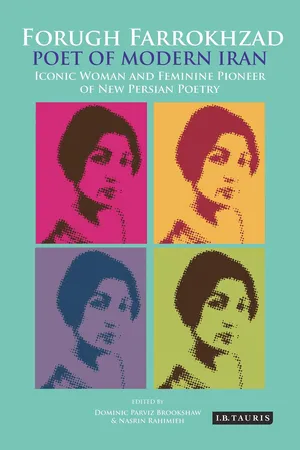
eBook - ePub
Forugh Farrokhzad, Poet of Modern Iran
Iconic Woman and Feminine Pioneer of New Persian Poetry
- 256 pages
- English
- ePUB (mobile friendly)
- Available on iOS & Android
eBook - ePub
Forugh Farrokhzad, Poet of Modern Iran
Iconic Woman and Feminine Pioneer of New Persian Poetry
About this book
The pioneering Iranian poet and filmmaker Forugh Farrokhzad was an iconic figure in her own day and has come to represent the spirit of revolt against patriarchal and cultural norms in 1960s Iran. Four decades after her tragic death at the age of 32, "Forugh Farrokhzad, Poet of Modern Iran" brings her ground-breaking work into new focus. During her lifetime Farrokhzad embodied the vexed predicament of the contemporary Iranian woman, at once subjected to long-held traditional practices and influenced by newly introduced modern social sensibilities. Highlighting her literary and cinematic innovation, this volume examines the unique place Farrokhzad occupies in Iran, both among modern Persian poets in general and as an Iranian woman writer in particular. The authors also explore Farrokhzad's appeal outside Iran in the Iranian diasporic imagination and through the numerous translations of her poetry into English. It is a fitting and authoritative tribute to the work of a remarkable woman which will introduce and explain her legacy for a 21st-century audience.
Information
Chapter 1
Of the Sins of Forugh Farrokhzād
Homa Katouzian
University of Oxford
‘Sin’ (‘Gonāh’) is probably the most well known poem of Forugh Farrokhzād, though it is not one of her best, even in comparison with most of the poems before the period of Rebirth (Tavallodi digar). Apparently a defiant declaration of feminist independence, a closer examination of that and some other early poems betrays a sense of guilt, bewilderment and remorse. It is in the later poems, and especially those of the period of her ‘rebirth’, that ‘pleasure’ gives way to acceptance, and ‘sin’, to real self-assertion and self-confidence. Nevertheless, analyzing her published letters, and especially the two long letters to her father, it will be argued that, in spite of the upward journey both in love and poetry, the poet’s longing for deep fulfilment remained frustrated until the very end.
‘Sin’ is one of the earlier poems that openly describe a carnal engagement, though not the first one. Its enormous impact on readers and critics in and out of Iran is due to its apparently vocal, almost proud, defiance against the social conventions and the condemnation that the poet knew to be mandatory for committing such sins, especially if the ‘sinner’ was a married woman. Otherwise the artistic value of the poem is considerably lower than not only all the poems she was to publish after her Rebirth but most of the earlier poems as well. This is best appreciated when the poem is read in the Persian original, it being possible to camouflage, misinterpret, explain away or mystify the weaknesses of form and substance in English translation. It is a simple poem, describing a sexual experience in the form of connected doublets in six short stanzas, involving some repetition and employing commonplace or unlikely figures of speech and literary devices. The poem opens with its first doublet or stanza:
I sinned a sin full of pleasure
in an embrace that was warm and fiery.
I sinned wrapped in arms
that were hot, vengeful and made of iron.1
Describing something fiery as warm and then calling it hot is not very elegant. In fact, the word ‘warm’ is completely redundant and has been necessitated by the need to make up the metre in the Persian original, the metre being that of fahlaviyāt: mafā‘ilon, mafā‘ilon, fa‘ulon, as in Bābā Tāher’s doublets (tarānehs).2 Other formal weaknesses may be shown in this short poem, especially if the Persian original is scrutinized: this is a short and defiant declaration of the commitment of a ‘sin’ which could well have been made in prose, its only poetical feature being versification by metre and rhyme which are made up by the use of any and all words and phrases such as, ‘My heart impatiently trembled in my chest’ (delam dar sineh bi-tābāneh larzid). This is a relatively early poem, written long before Another Birth, but the poet was writing far more sophisticated poetry before and at the time of writing it.
Take for example the poem ‘The Kiss’ (‘Buseh’), which had been published in the earlier volume (The) Captive (Asir), and ends with the stanza:
A shadow leaned over a shadow
In the secret hideout of the night
A breath brushed over a cheek
A kiss flamed up between two lips3
There can be many more examples – such as ‘Shab va havas’ (‘Night and Desire’), ‘Hasrat’ (‘Regret’) and ‘Mehmān’ (‘The Guest’), all of them from the collection Captive – to show that ‘Sin’ is a weaker poem than many that Farrokhzād had written before or about the same time.
In fact, it may be argued that the formal weaknesses of ‘Sin’ are not unrelated to the substance, where a sense of guilt and remorse is camouflaged by a brave gesture of defiance. The poetical voice, which is unmistakably that of the poet herself, confesses to what she herself describes as a sin; she ends the short poem by repeating the confession and remorsefully addressing God, saying:
I sinned a sin full of pleasure
beside a body, trembling and unconscious.
O God I know not what I did
in that dark, silent, secluded place4
The key words in the poem are sin and pleasure. The poem displays anger and defiance but it also reflects doubt and uncertainty. And it describes no more than a feverish physical experience resulting in pleasure. The confessor has committed a sin involving much pleasure, rather than giving herself up in a loving relationship resulting in a sense of liberation. This may be contrasted with an earlier poem which reads:
He wants the wine of kiss from me.
What shall I tell my hopeful heart?
He is thinking of pleasure, unsuspecting
that I want the pleasure which is eternal.
I want sincere love from him
so I could sacrifice myself.
He wants a fiery body from me
in which to burn up his anxiety.5
But the expression of guilt and remorse is familiar from other poems of this period. For example, in the poem ‘Tramp’ or ‘Whore’ (‘Harjā’i’), the title of which alone confirms the society’s judgement:
You came late when I had lost control.
You came late when I was drowned in sin,
when by the whirlwind of wretchedness and infamy
I had been extinguished and ruined like a candle.6
In the poem, ‘Demon of the Night’ (‘Div-e shab’), the mother is singing a lullaby for her infant son, warning him of the ill intentions of the demon of night, who later comes to snatch the baby away and is defied and abused by the mother:
Suddenly the silence broke;
the demon of night shouted.
Stop woman, I am not afraid of you;
your lap is tainted by sin, by sin.
I am a demon but you are worse than me
being a mother, but tainted with the shame of sin.
Take your baby’s head off your lap!
That is no place for the innocent babe to rest.
The mother accepts that judgment and says with a burning heart:
I moan O Kāmi, Kāmi
Take your head off my lap.7
Thus, it is clear that the statement issued in the poem ‘Sin’, although it is daring and rebellious, is the other side of the coin to such other poems as ‘Tramp’ and ‘Demon of the Night’. Except that in ‘Sin’ the poet has had enough of the prevailing social judgements, which she herself also accepts and so loses patience and shouts: ‘I sinned, a sin full of pleasure!’ And it is precisely this sloganeering style of the poem that makes it look like a versified statement confessing to a sin. Whereas, as I shall try to show below, in her later poems, especially those written in the period of Another Birth (or Rebirth), sin and pleasure are replaced with profound love and self-assured submission to the beloved, although love itself is never quite realized and the search for it continues until the end of the poet’s short life.
Before doing that, however, it is worth mentioning a poem whose significance has seldom been acknowledged in Persian or English studies of Farrokhzād’s works. Made up of eleven stanzas, this longish poem – ‘Dar barābar-e khodā’ (‘In the Presence of God’) – is addressed to God, pleading with him to forgive her sins, and speaking of hating her own body:
O God how can I tell you
that I am tired of and disgusted with my body.
Every night at the threshold of your splendour
it looks as if I wish for another body.
Give me a love that would make me
just like the angels of your paradise.
Give me a lover in whom to see
an example of the purity of your nature…
O God whose strong hand
has founded the world of being
Show your face and take from my heart
the zest for the sin of selfishness…8
This hatred of her body completely disappeared in the latter part of her life and work and gave way to self-confidence, acceptance, sublime experience, as well as search for a love that was never realized, and in fact would have been very unlikely to be realized, as it was chasing after an illusion. A long letter by Farrokhzād to her father, published relatively recently, throws considerable light on herself and her poetry. It was written from Munich to Tehran on 2 January 1957, shortly before Farrokhzād turned twenty-two. It is strangely reminiscent of Kafka’s famous piece, ‘Letter to His Father’, although Kafka’s letter was dressed up as fiction and was never actually sent to a father from whom he was so alienated and of whom he had been so much afraid in his childhood.9
Farrokhzād’s letter also shows the great distance as well as conflict between her and her father, the extent to which she was frightened of him and felt humiliated by him, and how she had felt like a stranger in her paternal home. She says that if she wrote all that she wanted to say, it would fill a whole book and make her father unhappy, ‘but I too cannot feel peace and contentment until I have told you all that is in my chest; and, being with you, try to be myself, rather than a being who neither laughs nor talks and can only sink into herself and stick to a corner.’ She goes on to add:
My greatest pain is that you never got to know me and never wanted to know me. I remember when I used to read philosophical books at home…You would judge me by saying that I was a stupid girl whose mind had been poisoned by reading journals. I would then fall into pieces inside myself, tears coming to my eyes for being so much a stranger at home, and sulk… And there are a thousand other cases like this…, every one of which will be enough to break the spirit of an individual.10
She goes on further to explain that many a time when she had committed an ‘error’ (khatā), she would have wanted to tell her father and seek guidance from him but that ‘as ever’ she had been afraid of him. Here she is referring to the time when she had been a girl living at home. Since then she had married, divorced with a little son and – after a short while when, due to a clash with her father, she had lived in a little rented room in a corner of town – she had been reconciled with him and returned home, only to face the same old regime. Thus, she wrote that even then, many a time when she had been trembling with remorse and regret for an ‘error’ which she had committed and wished to talk to her father and seek advice, ‘I was as ever afraid and felt that I am a stranger to you’. And she goes on to add:
Whenever I think of last year living at your house my heart sinks. I did everything, both good and bad things, secretly, just like thieves. Why did you lack respect for me, and why did you make me keep away from home, and just like a sleep-walker not to know where I am, what I do and whom I am talking to…And inevitably I used to commit errors, many errors.11
She points out bluntly that contrary to her father’s belief she is not a ‘street woman’ (zan-e khiyābāngard), and now that she lives independently ‘and no-one looks at me with hatred and contempt’, she will take responsibility for her actions and would never forgive herself for making a mistake, although she does not blame herself, but ‘others’ instead, for her past mistakes.12
She speaks of her intense suffering, feeling as if she is buried in a grave, and finally begs her father not to break his relationship with her again and love her as he does his other children. This shows that despite her sense of a new-found freedom, independence and personal responsibility, she is still deeply involved with her father and longs for his approval. She expresses regret that she cannot tell her father all that she wants to tell him, beginning with her childhood, because she is afraid that it might upset him.
Yet she repeatedly says that she loves her father and wishes that he love her too, and even thanks him for the monthly allowance he was sending her from Tehran. But at the same time she does not tire of repeating how fearful and alienated she is.13
Whatev...
Table of contents
- Cover
- Title Page
- Copyright Page
- Contents
- Acknowledgements
- Note on Transliteration
- Contributors
- Introduction
- Chapter 1: Of the Sins of Forugh Farrokhzād
- Chapter 2: Men and Women Together: Love, Marriage and Gender in Forugh Farrokhzād’s Asir
- Chapter 3: Places of Confinement, Liberation, and Decay: The Home and the Garden in the Poetry of Forugh Farrokhzād
- Chapter 4: Forugh Farrokhzād’s Romance with Her Muse
- Chapter 5: Bewildered Mirror: Mirror, Self and World in the Poems of Forugh Farrokhzād
- Chapter 6: Personal Rebellion and Social Revolt in the Works of Forugh Farrokhzād: Challenging the Assumptions
- Chapter 7: Garden in Motion: The Aesthetic of the Space Between
- Chapter 8: Forugh Farrokhzād’s Apocalyptic Visions
- Chapter 9: Capturing the Abject of the Nation in The House is Black
- Chapter 10: The House is Black: A Timeless Visual Essay
- Chapter 11: Forugh Farrokhzād as Translator of Modern German Poetry: Observations About the Anthology Marg-e man ruzi
- Chapter 12: Alien Rebirths of ‘Another Birth’
- Chapter 13: Re-Writing Forugh: Writers, Intellectuals, Artists and Farrokhzād’s Legacy in the Iranian Diaspora
- Notes
- Selected Bibliography
Trusted by 375,005 students
Access to over 1.5 million titles for a fair monthly price.
Study more efficiently using our study tools.
Frequently asked questions
Yes, you can cancel anytime from the Subscription tab in your account settings on the Perlego website. Your subscription will stay active until the end of your current billing period. Learn how to cancel your subscription
No, books cannot be downloaded as external files, such as PDFs, for use outside of Perlego. However, you can download books within the Perlego app for offline reading on mobile or tablet. Learn how to download books offline
We are an online textbook subscription service, where you can get access to an entire online library for less than the price of a single book per month. With over 1.5 million books across 990+ topics, we’ve got you covered! Learn about our mission
Look out for the read-aloud symbol on your next book to see if you can listen to it. The read-aloud tool reads text aloud for you, highlighting the text as it is being read. You can pause it, speed it up and slow it down. Learn more about Read Aloud
Yes! You can use the Perlego app on both iOS and Android devices to read anytime, anywhere — even offline. Perfect for commutes or when you’re on the go.
Please note we cannot support devices running on iOS 13 and Android 7 or earlier. Learn more about using the app
Please note we cannot support devices running on iOS 13 and Android 7 or earlier. Learn more about using the app
Yes, you can access Forugh Farrokhzad, Poet of Modern Iran by Dominic Parviz Brookshaw, Nasrin Rahimieh, Dominic Parviz Brookshaw,Nasrin Rahimieh in PDF and/or ePUB format, as well as other popular books in Literature & Literary Biographies. We have over 1.5 million books available in our catalogue for you to explore.