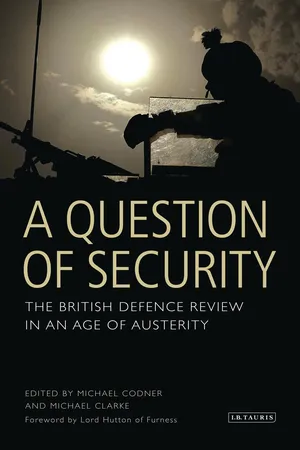
eBook - ePub
A Question of Security
The British Defence Review in an Age of Austerity
- 368 pages
- English
- ePUB (mobile friendly)
- Available on iOS & Android
eBook - ePub
A Question of Security
The British Defence Review in an Age of Austerity
About this book
Britain now faces fundamental choices in organising its armed forces and military strategy - more so than at any time since the 1930s. This vital new book prepares the ground for a major government review of UK defence and security policy, analysing every important facet the review will face: from the spending constraints created by the financial crisis, to the decisions the country has to take on matters of war, peace and terrorism. The analysis covers the military equipment Britain should procure; the industrial implications of defence procurement decisions; the relationship with allies and partners; the intelligence sources; and, not least, the moral and ethical dimensions of modern security policy in a globalised but disordered world. Written by the foremost independent security and defence experts in the field, this book is the result of RUSI's Future Defence Review research initiative. 'A Question of Security' sets the core agenda for all wishing to understand the defence and security problems Britain now faces, and also for those in government and parliament who have to answer these difficult questions at a generational moment for UK defence policy.
Information
NOTES AND REFERENCES
Introduction
1. Michael Codner, ‘The Hard Choices: Twenty Questions for British Defence Policy and National Military Strategy’, RUSI occasional paper, 2009, available at <http://www.rusi.org/downloads/assets/The_Hard_Choices_Discussion_Paper.pdf.>
2. Lee Willett, ‘The RUSI Maritime Workshop Series 2010: Interim Report’, RUSI occasional paper, 2010, available at <http://www.rusi.org/downloads/assets/2010_Maritime_workshops_report_final.pdf>; Richard Winstanley, ‘Whither Welfare? Structuring Welfare in the Military Community’, RUSI occasional paper, 2010, available at <http://www.rusi.org/downloads/assets/Whither_Welfare_April_2010.pdf>.
The United Kingdom’s Strategic Moment
1. National Audit Office, ‘Major Projects Report 2009’, December 2009; HM Government, Securing Britain in an Age of Austerity: The Strategic Defence and Security Review (SDSR), Cm 7948 (London: The Stationery Office, October 2010), para. 2.4.
2. SDSR, ibid., para. 2.D.3.
3. Ministry of Defence, Adaptability and Partnership: Issues for the Strategic Defence Review, Cm 7794 (London: The Stationery Office, February 2010).
4. The Office of National Statistics reported in summer 2010 that total indebtedness in the UK, including off-balance sheet and long-term items was almost £4 trillion. Not all of this looms immediately over the government, but coalition leaders were clear that they had to extract well over £80 billion out of public expenditure to fend off a crisis and maintain the country’s international credit rating. On the ONS Report, see ‘Britain’s Debt: The Untold Story’, Independent, 14 July 2010.
5. See Michael Howard, The Continental Commitment: The Dilemma of British Defence Policy in Europe (London: Penguin, 1974).
6. SDSR, op. cit., Para. 2.D.12.
7. Robert Cooper, The Breaking of Nations: Order and Chaos in the Twenty-first Century (London: Atlantic Books, 2004), pp. 75–80.
8. Giampiero Giacomello and R Craig Norton (eds.), Security in the West: Evolution of a Concept (Milan: Vita e Pensiero, 2009); pp. 19–22.
9. Gideon Rachman, ‘China Can no Longer Plead Poverty’, Financial Times, 26 October 2010, p. 13.
10. SDSR, op. cit., para. 2.2.
11. William Hague, ‘The Future of British Foreign Policy with a Conservative Government’, speech to the International Institute for Strategic Studies, London, 21 July 2010.
12. See Bruce Jones, ‘The Coming Clash? Europe and US Multilateralism under Obama’, in A Vasconcelos and M Zaborowski (eds.), The Obama Moment: European and American Perspectives (Paris: European Institute for Security Studies, 2009), pp. 63–77.
13. Philip Stephens, ‘Austerity Spells the End of Britain’s Post-imperial Reach’, Financial Times, 22 October 2010, p.13.
The Lean Years: Defence Consequences of the Fiscal Crisis
1. HM Treasury, Budget 2010, HC 61, June 2010, pp. 8–9.
2. For a useful analysis of the Strategic Defence Review, see Colin McInnes, ‘Labour’s Strategic Defence Review’, International Affairs (Vol. 74, No. 4, 1998), pp. 823–45.
3. This calculation takes into account £147 million of spending on Bosnia and £14 million spending on Kosovo during 1998/99. House of Commons, Hansard Written Answers, 2 May 2000. Operations spending during 2008/09 included £2,559 million for Afghanistan, £1,958 million for Iraq and £19 million for the Balkans. ‘Further memorandum from the Ministry of Defence’ in House of Commons Defence Committee, Spring Supplementary Estimate 2008-09, HC 301, March 2009, p. 7. On the real increase in defence spending, see UK Defence Statistics 2009, Tables 1.1 and 1.5.
4. Calculated for the period from 1983/84 to 1990/91. HM Treasury, Public Expenditure Statistical Analyses 1999–2000, Cm 4201 (London: The Stationery Office, March 1999).
5. National Audit Office, op cit., press release, 15 December 2009. The Gray Report contains a detailed analysis of this issue. See Trevor Taylor, ‘The Gray Report’, RUSI Newsbrief (Vol. 29, No. 9, November 2009).
6. Ministry of Defence, Delivering Security in a Changing World: Future Capabilities (London: The Stationery Office, July 2004). The reference to the QDR is from Paul Cornish and Andrew Dorman, ‘Blair’s wars and Brown’s budgets: from Strategic Defence Review to strategic decay in less than a decade’, International Affairs (Vol. 85, No. 2, 2009), p. 253.
7. Ministry of Defence, Adaptability and Partnership: Issues for the Strategic Defence Review, Cm 7794 (London: The Stationery Office, February 2010).
8. These figures compare final unit procurement costs, and therefore include any cost increases that take place between project inception and completion. These three projects account for 50% of the total value of the fifteen largest ongoing equipment projects for which the MoD has taken the decision to invest. National Audit Office, Ministry of Defence: Major Projects Report 2009 (London: The Stationery Office, December 2009), Figure 3.
9. See Malcolm Chalmers, ‘The Myth of Defence Inflation’, RUSI Defence Systems (June 2009, Vol. 21, No. 1), pp. 14–15. The impact of growth in the unit capital costs of new equipment on the procurement budget as a whole is worsened if one allows for development costs, since these have to be spread over a smaller number of production units. On the other hand, since support costs appear to be rising less rapidly than new equipment costs, overall equipment cost growth may be moderated.
10. For military salaries, see UK Defence Statistics 2009, Table 2.24; for average earnings (including bonuses), see Office for National Statistics, National Statistics Online, available at <http://www.statistics.gov.uk/statbase/TSDdowload2.asp last accessed 16 November 2009>.
11. The unadjusted total number of civilian personnel fell from 175,200 in April 1988 to 89,500 in April 2008: a reduction of 51%.
12. Stephen Daggett, ‘Resourcing the National Defense Strategy: Implications of Long-Term Defense Budget Trends’, testimony before the House Committee on Armed Services, Congressional Research Service, November 2009, p. 2. If only UK service personnel are included, the rate of growth is 2.2% per annum.
13. The figures used here are on the ‘net cash requirement’ basis used in Ministry of Defence, Defence Statistics 2009, Table 1.1, and are expressed in 2008/09 prices. They exclude additional Treasury-funded operational spending of £4,026 million in 2008/09, on the assumption that most of such spending reflects one-off extra costs that do not build total capability. The Treasury provides time series on spending on a functional basis, including around £1.6 billion annual ‘defence’ spending by the security and intelligence services. Public Expenditure Statistical Analysis, various years, available at <http://www.hm-treasury.gov.uk/pespub_index.htm>. The Treasury definition of defence spending is not consistent between 1998/99 and 2008/09, making it more difficult to show trends over this period.
14. Number of major vessels as of 1 April, including Royal Navy and Royal Fleet Auxiliary. Based on figures in Ministry of Defence, Defence Statistics 2009, Chapter 4, available at <http://www.dasa.mod.uk/modintranet/UKDS/UKDS2009/ukds.html>. Excludes patrol craft, survey ships and mine counter-measure vessels.
15. Number of aircraft as of 1 April, including combat, C4/ISTAR, air support, logistics, helicopters and training aircraft from all three services. Based on Forward Available Fleet in ibid, Chapter 4.
16. Number of ground formations as of 1 April, including British Army, Royal Marines and RAF Regiment.
17. In order to make this series consistent over time, it has been necessary to make two adjustments to time series published in Defence Statistics, various editions. First, the 1988 figure excludes positions that were later privatised, and are therefore not included in 2008. Second, the 2008 figure excludes unpaid staff, including those on loan to US bases (around 2,000), as well those on long-term sick leave, maternity pay and career breaks. These are excluded from the published 1988 figure. The author thanks the Defence Analytical Services Age...
Table of contents
- Cover
- Author biography
- Title page
- Copyright page
- Contents
- List of Tables and Figures
- Acronyms and Abbreviations
- Foreword
- Introduction
- Grand Strategy
- The United Kingdom’s Strategic Moment
- Multilateral Approaches to British Security
- The Lean Years: Defence Consequences of the Fiscal Crisis
- Partners and Problems
- Strategic Considerations for the Anglo-American Alliance
- Entente or Oblivion: Franco-British Defence Co-operation
- The SDSR and China
- Ways and Means
- British Strategy after Afghanistan
- A Force for Honour? UK Military Strategic Options
- Jointery and the Defence Review
- The Special Relationship and the British Army
- Redefining the Military’s Role in Domestic Security
- Delivery
- The Case for the RAF
- Armed Inducement in Conflict Prevention
- Defence Information Superiority: Still Underplayed
- Failing Intelligence: Reform of the Machinery
- The Armed Forces and the British People
- Procurement Reform
- Defence Industrial Strategy under the Coalition
- Conclusion
- References
- About the Authors
Trusted by 375,005 students
Access to over 1.5 million titles for a fair monthly price.
Study more efficiently using our study tools.
Frequently asked questions
Yes, you can cancel anytime from the Subscription tab in your account settings on the Perlego website. Your subscription will stay active until the end of your current billing period. Learn how to cancel your subscription
No, books cannot be downloaded as external files, such as PDFs, for use outside of Perlego. However, you can download books within the Perlego app for offline reading on mobile or tablet. Learn how to download books offline
Perlego offers two plans: Essential and Complete
- Essential is ideal for learners and professionals who enjoy exploring a wide range of subjects. Access the Essential Library with 800,000+ trusted titles and best-sellers across business, personal growth, and the humanities. Includes unlimited reading time and Standard Read Aloud voice.
- Complete: Perfect for advanced learners and researchers needing full, unrestricted access. Unlock 1.5M+ books across hundreds of subjects, including academic and specialized titles. The Complete Plan also includes advanced features like Premium Read Aloud and Research Assistant.
We are an online textbook subscription service, where you can get access to an entire online library for less than the price of a single book per month. With over 1.5 million books across 990+ topics, we’ve got you covered! Learn about our mission
Look out for the read-aloud symbol on your next book to see if you can listen to it. The read-aloud tool reads text aloud for you, highlighting the text as it is being read. You can pause it, speed it up and slow it down. Learn more about Read Aloud
Yes! You can use the Perlego app on both iOS and Android devices to read anytime, anywhere — even offline. Perfect for commutes or when you’re on the go.
Please note we cannot support devices running on iOS 13 and Android 7 or earlier. Learn more about using the app
Please note we cannot support devices running on iOS 13 and Android 7 or earlier. Learn more about using the app
Yes, you can access A Question of Security by Michael Codner, Michael Clarke, Michael Codner,Michael Clarke in PDF and/or ePUB format, as well as other popular books in Politique et relations internationales & Gouvernement américain. We have over 1.5 million books available in our catalogue for you to explore.