- 288 pages
- English
- ePUB (mobile friendly)
- Available on iOS & Android
eBook - ePub
About this book
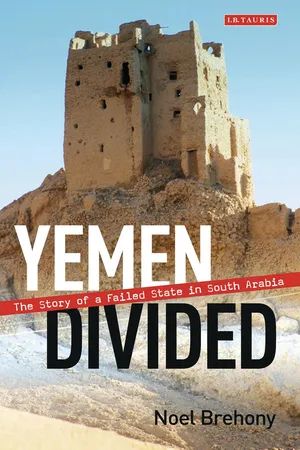
South Yemen today is seen as a potential Al-Qaeda stronghold and the heart of a separatist movement threatening to rip apart southern Arabia. How has this country of forbidding mountains and arid deserts changed from British colony to communist state and then to 'terrorist base' in half a century? What went wrong with the People's Democratic Republic of Yemen and why are Southern Yemenis once more calling for a separate state?
Information
NOTES
Chapter One
1There is a very large body of works covering the period. The best summary is Gavin, Aden under British Rule.
2Yemenis at the time of the PDRY referred to the northern and southern states as ‘halves’ (shatrain in Arabic) of one nation. The term came into formal use in the revised PDRY constitution of 1978.
3Willis, ‘Making Yemen Indian’: pp. 23–38.
4These were the Abdali, Amiri (Dhala) Fadhli, Awlaqi, Yafi‘i, Hawshabi, Alawi, Aqrabri and Subayhi.
5The Master of Belhaven, The Kingdom of Melchior: p. 2.
6The figures quoted are drawn from two publications by the British authorities in Aden: the ‘General Handbook on Aden Colony and the Protectorate’ (dated about 1960) and ‘A Survey of Aden and the Protectorates of South Arabia’ (August 1965). The latter said that the figures ‘are rarely more than an intelligent guess and, depending on the context in which they are used, will almost certainly be disputed’.
7Stephen Day quoted two anecdotes to the author, attributed to tribal leaders, on their attitude to the British:
1)Sharif of Bayhan: ‘In any dealing with the British it is better to be their enemy than their friend. If you are their friend, they will sell you. If you are their enemy there is a good chance they will buy you.’
2)Sultan Nasir of Fadhli: ‘I have studied the history of Britain in the Middle East and do not believe your government will keep a single word of its promises. But I will trust you.’
8International Fund of Agricultural Development, Report of the Special Programming Mission: p. 67.
9The NLF and its Ba‘athist and communist associates will be considered in later chapters.
10The British believe that the NLF exploited it; the NLF insists it inspired it.
11There are several accounts of this. See for example Jones, Britain and the Yemeni Civil War.
12Nashir, Yahya al-Mutawakil: pp. 94–6.
Chapter Two
1Muhammad, Dhakriyat wa Ahadith: p. 20.
2Naumkin, Red Wolves of Yemen: p. 67.
3PDRY Ministry of Culture and Information, Aden’s Bloody Monday: p. 35.
4Stephen Day, then a political officer in the Sultanate of Fadhli, recalls arresting Salmin and al-Sallami around the time for organizing a strike, and was surprised to find codes and other incriminating material in their possession. It suggests that MAN was planning action even before the formation of the NLF.
5Dresch, History of Modern Yemen: p. 91.
6Muqbil, Uktubar.
7The others were Nasir Saqqaf, Abdullah Majali, Muhammad Ali Dumani, Thabit Ali Mansuri, Muhammad Ahmad al-Duqm, Ahmad Abdullah al-Awlaqi, Aidrus Husain al-Qadi, Ali Muhammad al-Kazimi and Abdullah Muhammad al-Salahi.
8Naumkin, Red Wolves of Yemen: p. 82.
9Halliday, Arabia without Sultans: p. 191.
10Muhammad, Dhakriyat: p. 21, and in conversation with the author, June 2009.
11Carapico, Civil Society in Yemen: pp. 94–5. Paul Dresch notes that this organization based its constitution on the Holy Qur‘an – see History of Modern Yemen: p. 98. Naumkin also refers to the Organization of South Yemen which was a secret group within a legal organization called the Yafi‘i Youth League – see Red Wolves of Yemen: p. 83.
12Muqbil, Uktubar (quoting Muhsin Ibrahim): p. 82.
13Kostiner, Struggle for South Yemen: p. 67.
14See Harding, Roads to Nowhere for a vivid account of his contacts with tribes in Radfan during and after the campaign, esp. pp. 215–43.
15There is a detailed description of the NLF organization, leaders and activities in Arabic in Muhammad Sa‘id Abdullah (Muhsin), Adan Kifah Sha‘b wa Hazima Imbaraturiya (Beirut, 1989).
16FCO documents: PDRY Leadership: Political Philosophy and the Power Structure (1977), National Archives, FCO 8/2967.
17Interview with Abdullah al-Asnaj, London, December 2008.
18Interview with Muhammad Ali Ahmad, March 2010.
19It was drafted by Salim Zayn, who was from the right wing of the NLF.
20Muqbil, Uktubar: p. 206.
21Ibid.: pp. 181–2.
22Halliday, Arabia without Sultans: p. 208.
23Naumkin, Red Wolves of Yemen: p. 162.
24Many of the NLF fighters in the rural areas were illiterate tribesmen. See Muqbil, Uktubar: pp. 182–200. He also talks of a reorganization of internal forces and gives details of the membership and operations.
25These were: Abd al-Karim Muhsin from Radfan; Muhammad al-Bishi from Dhala; Ahmad al-Sha‘ir from Aden; Haydarah Mutlaq from Halmayn; Ali Midayr from Yafi‘i; Salih Muslih from Shu‘ayb; and Ali Nasir Muhammad from the Central District.
26Halliday, Arabia without Sultans: p. 202.
27These were said to be Abd al-Nabi Madum, Mayyub Ali Ghalib, Salih Ba-Qish, Muhammad Sa‘id Abdullah (‘Muhsin’) and Abdullah al-Khamiri) – see Muqbil, Uktubar: p. 206.
28FCO documents: letter from D.J. McCarthy to Ivor Lucas of the Middle East Department of the FCO, dated 30 January 1977, National Archives, FCO/2967.
29Interview with Muhammad Ali Ahmad, March 2010.
30The Upper Yafi‘i Sultanate, which had not joined the federation, did not become part of PRSY until March 1968.
31The NLF ‘government’ in Abyan despatched a small group to assist the NLF in Hadhramaut – consisting of six people in two vehicles, according to Muhammad Ali Ahmad in an interview, March 2010.
32Interview with Haydar al-Attas, November 2009.
33Trevelyan, Middle East in Revolution: p. 266. Many Yemenis educated under the British might disagree.
Chapter Three
1Quoted in Dresch, History of Modern Yemen: pp. 118–19.
2Halliday, ‘People’s Democratic Republic of Yemen’: p....
Table of contents
- Cover
- Title page
- Dedication
- Copyright
- Contents
- Illustrations
- Preface and Acknowledgements
- Abbreviations
- Outline Chronology
- Maps
- Introduction
- Part A: From South Arabia to South Yemen
- Part B: The Salmin Years
- Part C: The Struggle For Power
- Part D: From The Pdry to The Republic of Yemen
- Part E: Did The Pdry Fail?
- Appendices
- Notes
- Select Bibliography
Trusted by 375,005 students
Access to over 1.5 million titles for a fair monthly price.
Study more efficiently using our study tools.
Frequently asked questions
Yes, you can cancel anytime from the Subscription tab in your account settings on the Perlego website. Your subscription will stay active until the end of your current billing period. Learn how to cancel your subscription
No, books cannot be downloaded as external files, such as PDFs, for use outside of Perlego. However, you can download books within the Perlego app for offline reading on mobile or tablet. Learn how to download books offline
Perlego offers two plans: Essential and Complete
- Essential is ideal for learners and professionals who enjoy exploring a wide range of subjects. Access the Essential Library with 800,000+ trusted titles and best-sellers across business, personal growth, and the humanities. Includes unlimited reading time and Standard Read Aloud voice.
- Complete: Perfect for advanced learners and researchers needing full, unrestricted access. Unlock 1.5M+ books across hundreds of subjects, including academic and specialized titles. The Complete Plan also includes advanced features like Premium Read Aloud and Research Assistant.
We are an online textbook subscription service, where you can get access to an entire online library for less than the price of a single book per month. With over 1.5 million books across 990+ topics, we’ve got you covered! Learn about our mission
Look out for the read-aloud symbol on your next book to see if you can listen to it. The read-aloud tool reads text aloud for you, highlighting the text as it is being read. You can pause it, speed it up and slow it down. Learn more about Read Aloud
Yes! You can use the Perlego app on both iOS and Android devices to read anytime, anywhere — even offline. Perfect for commutes or when you’re on the go.
Please note we cannot support devices running on iOS 13 and Android 7 or earlier. Learn more about using the app
Please note we cannot support devices running on iOS 13 and Android 7 or earlier. Learn more about using the app
Yes, you can access Yemen Divided by Noel Brehony in PDF and/or ePUB format, as well as other popular books in History & Middle Eastern History. We have over 1.5 million books available in our catalogue for you to explore.