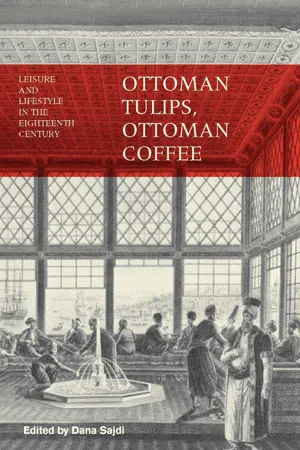
Tulips and coffee are defining cultural products of the Ottoman eighteenth century, along with their related institutions of palace and coffeehouse. These cultural products hold multiple meanings in the history and historiography of the period. For example, scholars argue that the janissary coffee house was used variously for such diverse means as headquarters for rebellion, a Sufi lodge, police station and racketeering office. 'Ottoman Tulips, Ottoman Coffee' offers a critical exploration of a range of definitive cultural phenomena of the Ottoman 18th century, including the coffee house, print culture, imperial architecture, royal pageantry and festivals. Chapters explore previously untouched subjects such as the changing forms of imperial ritual in Ottoman public circumcision celebrations as well as unravelling the historiography of the so-called 'Tulip Period'. This has traditionally been characterised by the construction and eventual destruction of the famed palace of Saadabad and the reputedly failed project of the first Ottoman printing press. The book reassesses these failures as reflective of the general ill-preparedness of the Ottoman public for enlightened reform.
Most importantly this book rejects the prevailing view that the 18th century was in political and cultural decline, and argues in fact it was a period of cultural dynamism and change. 'Ottoman Tulips' breaks free of the twin teleologies of Ottoman decline and Western-induced change, reassessing the impact of Westernization and modernization in the 18th century and revealing comparisons and interactions between the Ottoman court and its Safavid counterpart.
eBook - ePub
Ottoman Tulips, Ottoman Coffee
Leisure and Lifestyle in the Eighteenth Century
- 272 pages
- English
- ePUB (mobile friendly)
- Available on iOS & Android
eBook - ePub
About this book
Trusted by 375,005 students
Access to over 1.5 million titles for a fair monthly price.
Study more efficiently using our study tools.
Information
Chapter 1
Decline, its Discontents and Ottoman Cultural History: By Way of Introduction
Decline, its Discontents and Ottoman Cultural History: By Way of Introduction
Dana Sajdi
Those who have not been keeping careful track of recent monographs in Ottoman history, the time has come to stop and take notice. … Dina Rizk Khouri’s study … joins the monographs of Çızakça, Darling, Fahmy, Hathaway, Hickok, Hoexter, Salzmann, Todorova and Zeʾevi … adds to the earlier studies (but all since 1980) of scholars such as Abou-El-Haj, Aksan, Barkey, Cohen, Cuno, Doumani, Faroqhi, Kunt, Marcus, and Toledano … these works in aggregate have made obsolete all discussion of Ottoman stasis in the period from the death of Suleiman I in 1566 to the reform era initiated by Selim III in the late eighteenth century. Those who persist in portraying those interim centuries as a time of decline, Ottoman ineptitude, and weakness … do so out of sheer laziness. Read together, the works mentioned portray an empire whose leadership continually adjusted methods of taxation, assessment, landholding, revenue-holding, and military formations in an attempt to respond to the changing circumstances and demands of the empire for money or military might.1
This excerpt from a book review by Amy Singer published in 1999 warrants several observations. Mirroring the general state of the field of Ottoman studies on the period between the late sixteenth and early nineteenth centuries, the monographs cited above are characterized by an overwhelming collective concern to topple a single problematic, namely the ‘decline thesis’. The listed works also reflect the manner in which the decline thesis was tackled, that is by focusing on the Ottoman state in order to demonstrate the ability of the state to adapt to changing circumstances, and by writing Ottoman provincial histories within the sub-disciplines of social history, economic history and political economy to show transformations in the polity, economy and society symptomatic of indigenous moves towards modernity. Culture, however, is decidedly absent both as an object of study, and as a method of analysis.
The present volume contains studies in Ottoman culture of which the temporal scope converges on the eighteenth century with necessary glances backwards and forwards into the period between the sixteenth and nineteenth centuries. While the focus on culture in each chapter is a response to a deliberate call by the editor, the topics and methods are not. The relative uniformity of the topics covered in this volume, which deal with either a deconstruction of the history and historiography of the so-called ‘Tulip Period’ (roughly, the first three decades of the Ottoman eighteenth century), or the rethinking and characterization of the institution of the coffee house, is itself indicative of the direction that the field is taking. Conceptually and methodologically, there is an implicit leitmotif that informs the chapters as a collective – namely, the social and political uses of cultural products and institutions ranging from architecture to ritual, to coffee houses, to the printing press and to historiography itself. Later on in this essay, we will have the opportunity to locate these studies within the new field of Ottoman cultural history; for now, it suffices to mention that this volume is one of the first collective treatments to focus on culture and thus seeks to add culture to the study of Ottoman early modernity.
The historiography of Ottoman early modernity has been almost intractably entangled in the overarching dialectic of ‘decline/anti-decline’. Within the folds of the dialectic of decline and its anti is a long history of epistemological (and political) complications. By now one can comfortably state that, at least in the academy and specifically within Ottoman studies, the decline thesis has been overwhelmingly and successfully discredited. Thus, if one were to provide a quick characterization of the location of the present volume in the field, it would be between the tail end of anti-decline scholarship and the emerging field of cultural history. The obvious question is, therefore, is there a relationship between the rise of cultural history and the near closure of anti-decline scholarship?
This question is one of the issues that will be raised here. However, to address it I take this opportunity to devote much of this introduction to anti-decline scholarship, with the aim of exposing and thematizing its contributions. This will not only shed light on the circumstances surrounding the subsequent rise of Ottoman cultural history, but will serve to provide the widest possible context in which to locate, and appreciate, the contributions of the current volume. While the reader will find here the accustomed brief introduction to the various chapters (in the section entitled ‘Tulips and coffee houses’ below), the general thrust of this chapter is to acknowledge the contributions of the scholarship in the past 25 years, while simultaneously sketching rough contours of the state of the field.2 Since the geographical coverage of the contributions to this volume overlap on the imperial centre, Istanbul, and the provinces of Damascus and Egypt, the majority of the scholarship reviewed here will be about these areas.
In the first section I delineate the decline thesis along with its theoretical and paradigmatic bases. The section following is devoted to the effort to dismantle the category of decline starting from the earliest calls in the late 1950s, but focusing on scholarship in the 1980s and 1990s. In this part I shall review the different frameworks and theories that were advanced in place of the decline thesis by exposing one or more salient studies in each of the fields of political economy, economic history, state formation studies, gender studies, urban social history and intellectual history. I then approach the emergence of Ottoman cultural history by exploring the attitudes of modern scholars towards the text and using the example of recent studies on textural production and book history. I will do so by asking two questions. The first, asked above, has to do with whether there is a relationship between the rise of cultural history and the end of anti-decline scholarship, and the second attempts to explore the enabling effect anti-decline scholarship has had on cultural history. In the fourth section I introduce the studies in this volume, while in the epilogue I temper the general optimistic tone by asking whether in the current political atmosphere it is really possible to dismantle the decline thesis and to transcend Eurocentricism.
The category of decline
Since the eighteenth century, first European observers and then academics have employed the notion of ‘decline’ to describe the post-sixteenth-century Ottoman condition. This notion, popping up in different guises, the most familiar of which is the ‘sick man of Europe’, while initially used to explain the military setbacks, territorial contraction and/or economic deterioration of the Ottoman empire, came to represent an overarching category that subsumed every aspect of society, polity and culture.3 This rather comprehensively damning view of the Ottoman sixteenth to nineteenth centuries, resembling the attitude to the pre-modern histories of many regions that came under colonial rule, served the purposes of, or perhaps was propelled by, a Western hegemonic agenda. This view fitted neatly into Enlightenment progress discourse, coalesced in Orientalist scholarship, and acquired further academic rigour in formulations such as the Marxian ‘Asiatic mode of production’ and ‘Oriental despotism’, and Weberian-inspired modernizationist and developmentist theories. The process of the epistemological consolidation and academic legitimation of such Eurocentric and imperialist views has been sufficiently delineated, and need not delay us here.4 However, a brief outline of the meanings and manifestations of ‘Ottoman decline’ is necessary.
The category of decline assumes an isolated and unique Islamic society/civilization, which, because of its essential difference, is not susceptible to meaningful comparison. This society/civilization functioned according to its own particular institutions and ideals. Though successful during the ‘Golden Age’ of Süleyman the Magnificent, Ottoman society/civilization soon witnessed a decay of its institutions and a woeful departure from its ideals. Incapable of adapting to changing circumstances or technological innovations, both the Ottoman state and society remained unchanged, insisting on rigid traditionalism and retaining decayed institutions, thus receding on the civilizational scale into a backward stage. Deliverance – read modernity – came in the form of the ‘impact of the West’, injecting or inspiring reform and paving the way for modern nationalisms. Consequently, the dates fixed to demarcate Middle Eastern modernity are the Napoleonic invasion with regard to Egypt (1798), the first wave of Zionist migrations in Palestine (1882) or the Egyptian invasion of the Levant (1831), and the Western-inspired Tanzimat (1839–76) for the rest of the empire.
A host of indications are cited in support of the foregoing conceptual framework, the starting point of which is the weakening authority of the Sultan over both polity and economy in the seventeenth and eighteenth centuries. The sultanic loss of control is seen in phenomena ranging from the passage of power from the person of the Sultan to the harem and the eunuchs of the imperial household, to frequent urban rebellions in the centre and some provinces, to rampant banditry in the countryside, to treasury deficits, to price inflation and currency deflation, to the overexploitation and flight of the peasantry, to the loss of the military identity of the once exemplary Janissary corps, to the empire’s shrinking borders. Mirroring these phenomena was moral decay in the bureaucracy and other state institutions, where rules of fair play were suspended in favour of bribery, venality, corruption and favouritism. And, despite the reforming efforts by the Köprülü viziers in the seventeenth century, and by Sultan Ahmed III in the early eighteenth century, the Sultan’s increasing loss of control is evinced in the eighteenth century by the rise of provincial notables aʿyān/ayan who asserted their regional power, challenging the grip of the imperial centre, Istanbul. The system needed an overhaul, which came with the reforming, institutionalizing and centralizing effort of the Tanzimat, which, in turn, gave the Ottoman empire its last breath before its collapse in the First World War.
For our purposes, it is important to stress that the concept of the rise and decline of empires is frequently associated with the civilizational paradigm. The latter assumes that societal complexity is gauged by the aesthetic and originality value of cultural products. Often, when decline or stasis is assumed, cultural production is also neglected on the basis of absence of value. This treatment of cultural production thus reserves historicity only to cultural products that are deemed beautiful or original. I shall return to this point later in this chapter.
Dismantling decline
In their collective effort to tackle the assumptions of the decline thesis, modern scholars had to demonstrate the following (whether individually or severally):
1. the changing nature and adaptability of Ottoman state and society;
2. indigenous or internal social, economic, and/or intellectual processes displaying signs of modernity prior to the advent of the West;
3. the comparability of Ottoman state and society with their counterparts in the world in the same period; and
4. a logic, or a framework, alternative to decline and the Eurocentricism implied therein, that takes into account the phenomena of the seventeenth to eighteenth centuries.
Early calls
While the anti-decline scholarship of the 1980s and 1990s was explicitly or implicitly given theoretical fuel by the publication of Edward Said’s Orientalism.5 scepticism of the decline thesis had begun a quarter of a century earlier. These early ventures deserve more than a brief treatment, not only as antecedents to anti-decline scholarship, but also because they were departure points for much of the research to come.
The first hints of displeasure with the decline thesis were raised on empirical grounds. In a masterful and elegantly written essay published in 1957, ‘The changing face of the Fertile Crescent in the XVIII century’, Albert Hourani proposed to look at the eighteenth century anew ‘to ask whether in fact it was decaying and lifeless; whether indeed we can speak of a self-contained Ottoman Moslem society ‘before the full impact of the West was felt’.’.6 This was probably one of the earliest (if not the earliest) exposition of the dynamics of change in the eighteenth century, and contained in its pages the seeds not only of Hourani’s later works, but of a whole generation of Ottomanists. The critical apertures opened in that seminal essay eventually became, without exaggeration, entire trajectories that allowed for the establishment of the great masters in the field. Hourani’s observations about the change in imperial centre–provincial relations in the eighteenth century would later be officially dubbed ‘decentralization’ by the master of Ottoman studies, Halil İnalcık.7 The phenomenon of the assertion of provincial local authority and the emergence of semi-dynastic rule in the eighteenth century was similarly highlighted by Hourani, and would soon after be studied by Abdul-Karim Rafeq, the eventual doyen of Ottoman–Syrian studies.8 Hourani took up the idea of the assertion of provincial authority to develop the model of the ‘notables’ (aʿyān), which still serves as a productive analytical category.9 As late as 1999 Rafeq developed Hourani’s observations on the proto-nationalist tendencies of eighteenth-century Damascene ʿulamāʾ.10 Hourani’s essay also drew attention to renewed Mediterranean trade in the eighteenth century and the consequent rise of certain trading minority communities, a subject that Thomas Philipp would develop into a fully fledged study.11 However, the significance of what was perhaps one of Hourani’s subtlest observations in the article has only relatively recently been manifested in the scholarship of the field.
We tend to think of the Empire of Suleiman the Magnificent as the ‘true’ Empire, and judge all that came before and after in terms of it. Seen in this light, what came after was sheer decline; and in saying this, we are indeed only reflecting what the Ottomans themselves believed, or at least what they were in the habit of saying. From Khoja Bey [Koçu Bey] onwards, it was the custom of Ottoman writers to put their proposals for reform in the shape of exhortation to return to the great days of Sultan Suleiman.12
Here, Hourani precociously and intuitively unveils the constructed nature of historical discourse, in this case, the myth of the golden age of Süleyman the Magnificent. Although stated in a reflective mode rather than as a methodological assertion, Hourani’s statement about the modern historian ‘reflecting what Ottoman [writers] themselves believed’ would encourage the next generation of scholars to exercise a healthy and productive scepticism towards their sources, and a vigilance not to take at face value what Ottomans tell us about their society for fear of falling into the trap of their myths. The search for the politics of, in and behind the text is something that Ottomanists would take seriously, especially when treating the genre of nasihatname (advice literature or ‘mirrors...
Table of contents
- Cover
- Dedication
- Title page
- Copyright page
- Contents
- List of Tables and Figures
- Notes on Contributors
- Preface, Note on Transliteration and Acknowledgements
- 1. Decline, its Discontents and Ottoman Cultural History: By Way of Introduction
- 2. The Perception of Saadabad: The ‘Tulip Age’ and Ottoman–Safavid Rivalry
- 3. The First Ottoman Turkish Printing Enterprise: Success or Failure?
- 4. Nahils, Circumcision Rituals and the Theatre State
- 5. Janissary Coffee Houses in Late Eighteenth-Century Istanbul
- 6. The Heart’s Desire: Gender, Urban Space and the Ottoman Coffee House
- Notes
- References
Frequently asked questions
Yes, you can cancel anytime from the Subscription tab in your account settings on the Perlego website. Your subscription will stay active until the end of your current billing period. Learn how to cancel your subscription
No, books cannot be downloaded as external files, such as PDFs, for use outside of Perlego. However, you can download books within the Perlego app for offline reading on mobile or tablet. Learn how to download books offline
Perlego offers two plans: Essential and Complete
- Essential is ideal for learners and professionals who enjoy exploring a wide range of subjects. Access the Essential Library with 800,000+ trusted titles and best-sellers across business, personal growth, and the humanities. Includes unlimited reading time and Standard Read Aloud voice.
- Complete: Perfect for advanced learners and researchers needing full, unrestricted access. Unlock 1.5M+ books across hundreds of subjects, including academic and specialized titles. The Complete Plan also includes advanced features like Premium Read Aloud and Research Assistant.
We are an online textbook subscription service, where you can get access to an entire online library for less than the price of a single book per month. With over 1.5 million books across 990+ topics, we’ve got you covered! Learn about our mission
Look out for the read-aloud symbol on your next book to see if you can listen to it. The read-aloud tool reads text aloud for you, highlighting the text as it is being read. You can pause it, speed it up and slow it down. Learn more about Read Aloud
Yes! You can use the Perlego app on both iOS and Android devices to read anytime, anywhere — even offline. Perfect for commutes or when you’re on the go.
Please note we cannot support devices running on iOS 13 and Android 7 or earlier. Learn more about using the app
Please note we cannot support devices running on iOS 13 and Android 7 or earlier. Learn more about using the app
Yes, you can access Ottoman Tulips, Ottoman Coffee by Dana Sajdi in PDF and/or ePUB format, as well as other popular books in History & Eastern European History. We have over 1.5 million books available in our catalogue for you to explore.