eBook - ePub
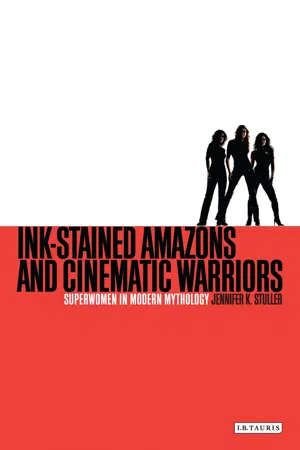
Ink-stained Amazons and Cinematic Warriors
Superwomen in Modern Mythology
- 256 pages
- English
- ePUB (mobile friendly)
- Available on iOS & Android
eBook - ePub
About this book
From "Wonder Woman" to Buffy Summers, Emma Peel to Sydney Bristow, "Charlie's Angels" to "The Powerpuff Girls", Superwomen are more than just love interests or sidekicks who stand by their Supermen. In her new book, Stuller shows how the female hero in modern mythology has broken through the boy's club barrier of tradition and reveals the pivotal role of high-heeled crime fighters in popular culture.Featuring spies and sexuality, daddy's girls and super-mothers, this is a comprehensive, engaging and thought-provoking guide to female detectives, meta-humans and action heroines, as well as their creators, directors, performers, and consumers. The book also includes a glossary of modern mythic women, from Aeon to Zoe, as well as a foreword by acclaimed cultural commentator Roz Kaveney, author of "Superheroes! Capes and Crusaders in Comics and Films" (published by I.B. Tauris, April 2008).
Information
Standing on the Shoulders
of Amazons
1
The Birth of Modern
Mythology and the Mother
of Female Superheroes
Mythology and the Mother
of Female Superheroes
“Aw, that's girl's stuff !” snorts our young comics reader. “Who wants to be a girl?” And that's the point; not even girls want to be girls so long as our feminine archetype lacks force, strength, power… The obvious remedy is to create a feminine character with all the strength of a Superman plus all the allure of a good and beautiful woman. This is what I recommended to the comics publishers.
—William M. Marston
Thus wrote Dr. William Moulton Marston in a 1943 essay for The American Scholar. Motivated by his disappointment in how he had seen women portrayed in the nascent, yet booming, medium of comic books, Marston created a superhero character the world would know as Wonder Woman—a lasting symbol of female power, independence, and sisterhood.1
There were already many remarkable women in both comic books and news strips by the time Wonder Woman debuted in late 1941, but the liberatory power of most of them was contained, even diminished, by the secondary status of their roles. There were female superheroes, yes, but more often there were girl sidekicks, girl heroes, girl sleuths, and girl reporters; “Girl,” meaning not yet woman, not quite mature, not entirely whole. Girls could have careers, as long as they were culturally appropriate for their gender, but grown women were married and homemakers.
Beyond girls of books and radio shows, there were some flying aces and a spy or two, as well as a nominal number of costumed female action heroes in comics of the 1930s, 1940s, and 1950s.2 But Wonder Woman would become the only female superhero of that era to rival the iconic status of Superman, a character widely recognized as the first modern superhero.
Superman was born in the 1930s, when Cleveland teenagers Jerry Siegel and Joe Shuster combined their love of science fiction stories, pulp magazines, adventure movies, radio serials, and Sunday newspaper funnies to forever change the world of mythic storytelling. A writer and an artist, respectively, the young men suffered numerous rejections until finally, in 1938, their amalgam of genre and form debuted in Action Comics #1.
Extraordinary beings possessing phenomenal strength have been around since stories were first told, but Siegel and Shuster's legacy to popular culture was a modern myth for modern times. By 1941, comics that featured superheroes—larger-than-life characters with a secret identity, a costume, and a greater purpose—were flying off newsstands and rolled up in the back pockets of a generation of children. As America prepared for its involvement in the Second World War, Superman, Batman, Captain America, and Captain Marvel were just a few of the names illustrating patriotism and bolstering hope: that families would be reunited from across the Atlantic Ocean; that the innocent would be saved and protected from our enemies; that justice would prevail; and that maybe beneath our seemingly frail exteriors, which were damaged by the Depression or stricken with polio, there existed warriors to entertain, lead, and inspire us toward greatness.3
But these growing ranks of superheroes were missing a superwoman who could capture the national imagination as they did. She was soon to come from the unusual mind of Dr. William Moulton Marston.
Dr. Marston was a modern renaissance man, a Harvard-educated doctor and lawyer who was also a writer, an editorial consultant, and the inventor of the systolic blood pressure test—a precursor to what is known today as the polygraph lie detector test. He was also a notoriously shameless, yet successful, self-promoter. In the 1930s and 1940s, the comics industry was growing so fast that parents began to worry about this overwhelmingly new medium that was monopolizing their children's attention.4 Savvy publishers quickly hired psychologists as editorial advisors, who also publicly gave their “expert” opinion on the value of comic books—namely, that they were good for children.
Marston was savvy as well, and saw an opportunity to promote himself. He had his girlfriend and assistant, Olive Byrne, “interview” him on the topic of children and comic books for the women's magazine Family Circle. The article caught the attention of All American Comics5 executive M.C. Gaines, who subsequently hired Marston as an editorial advisor and writer for the company. The position ultimately led to the creation of Wonder Woman.
Marston had observed that the majority of superheroes were men, and that women were relegated to secondary roles. He later reflected:
It seemed to me, from a psychological angle, that the comics' worst offense was their blood-curdling masculinity. A male hero, at best, lacks the qualities of maternal love and tenderness which are as essential to a normal child as a breath of life. Suppose your child's ideal becomes a superman who uses his extraordinary power to help the weak. The most important ingredient in the human happiness recipe is still missing—love. It's smart to be strong. It's big to be generous. But it's sissified, according to exclusively masculine rules, to be tender, loving, affectionate, and alluring.6
What Marston rejected was not the presence of violence in comics (as other psychologists had and would) but the lack of multidimensional female characters. To him, masculinity was overshadowing femininity, and that was a disservice to both men and women alike. This was compounded by the fact that Marston had fairly radical ideas about sex and gender—ideas that would be subversively expressed in the comic he would come to write, but which were already overtly expressed in his other works, most notably his 1928 publication The Emotions of Normal People. In brief, Marston believed that women were the superior sex and that men should submit to what he called, “their loving dominance.” These convictions were based on his pseudo-psycho-physiological theories regarding the human organism, including that a woman's body contained “twice as many love generating organs and endocrine mechanisms as the male.”7
To further promote his ideology, Marston's formula for his superhero series consisted of a beautiful woman who fought for the greater good of humanity through her altruistic love. The doctor also went so far as to proclaim that Wonder Woman was “psychological propaganda” for the type of woman he believed would soon rule the world, and predicted our society would evolve into a matriarchy within a century—if only characters like his led the way. By using the Amazon Princess and her allies as role models, he hoped to show that any young girl could become a Wonder Woman if only she took the time and energy to properly train herself; if only she had an example to guide her.
Written by Marston under the pseudonym “Charles Moulton” (a combination of the names Maxwell Charles Gaines and William Moulton Marston) and drawn by Harry G. Peter, Wonder Woman first appeared in the December 1941 issue of All Star Comics #8. One month later she began a regular appearance in Sensation Comics #1, and an eponymous title, Wonder Woman, saw print six months later.
Wonder Woman's origin story tells us that she is Princess Diana of the matriarchal Paradise Island. The Amazons of this hidden island are peaceful, highly trained athletes who live an immortal existence free from the brutality of men. When their Queen, Hippolyte, desires a child she is instructed by Aphrodite to mold one from clay. So was born Diana, a child “as lovely as Aphrodite, as wise as Athena, with the speed of Mercury and the strength of Hercules.”8
This first tale also tells us how Steve Trevor, a US army officer, comes to crash his plane on the women-only island. As he is nursed back to health, it is discovered through a sort of magic television that Trevor is fighting for America against the “forces of hate and oppression.” Hippolyte consults the gods, who order that he immediately be returned to duty and that the strongest of the Amazons must return with him to help win the war. Athena proclaims America as “the last citadel of democracy, and of equal rights for women.”
An athletic contest is held to find the strongest emissary. Diana has been forbidden to participate by her mother, but since she has fallen in love with Trevor—the only man she has ever seen—the princess disobeys her Queen by participating in disguise. She bests her competitors and wins the tournament. As Diana leaves for “man's world,” she takes sacred totems with her: a magic Lasso of Truth formed from the girdle of Gaea (inspired by Marston's proto-polygraph) and bullet-proof bracelets—a reminder to never submit to the authority of any man. Her mission to protect America is alive in her star-spangled costume of red, white, and blue. She returns Steve Trevor to his base, and adopts a secret identity as “Diana Prince.”
Marston freely borrowed from classic Greek and Roman culture, blending names, places, and customs with contemporary American values to create his mythic Amazons. The Amazons familiar to the ancient Greeks, however, were a legendary matriarchal society that took part in activities normally associated with Greek men such as hunting, farming and fighting. Stories of Amazons frequently placed them geographically near the southeastern shore of the Black Sea, around the city of Themiscyra. (Years later, in a Wonder Woman reboot, Themyscira would replace Paradise Island as the home of Marston's Amazons.) Historian Sue Blundell notes that for most writers of classical Greek texts the Amazons were “a phenomena of the distant past” and that no one had ever claimed to have seen or met one.9
The “outrageous” customs of the Amazons included members of the all-female society anonymously copulating with men twice a year.10 Of the resulting births, only female children remained with their mothers. Some stories tell that the males were given up for adoption, while others claim they were victims of infanticide. It was told that the Amazons removed their right breast, either with a knife or cauterization, in order to more proficiently wield weapons. Legends say that these women were horse riders and horse stealers, who fed their girl children on horse's milk to prevent breast development altogether.11 Tall tales to be sure; vase paintings and other images almost always depict Amazons with two breasts. However, the Greek word a-mazon can be translated as “without a breast.”12
Just as centuries later Marston wanted his stories about Wonder Woman to be psychological propaganda for the empowerment of women, it is argued that Amazonian myths served as “Athenian propaganda” for the proper behavior of women—yet another testament to the power of stories to influence societal ideas. As Ruby Blondell writes in her essay “How to Kill an Amazon,” “in the Greek imaginary, Amazons function in many respects as an antithesis to ‘civilized' society, and their myths enact a prohibition on disrupting the roles and relationships between the sexes enshrined in the institutions of marriage and the household.”13 For Athenians, these daughters of Ares represented female independence and bravery, which was as exciting as it was a threat to established social structures. Amazonian rejection of appropriate gender roles necessitated their defeat, and as a cautionary tale about the dangers of social transgression, Amazon defiance actually facilitated their mythic downfall.
In ancient Greece, myths were continually reimagined to serve a changing culture and politics—a tradition Marston continued by manipulating the raw power inherent in a story about a race of warrior women to make it relevant for his time and place. In his efforts to invert the classic myths about warrior women who were tamed by love and domination, he made a symbolic nod to them in the origins of his Amazon race. In All Star Comics #8, Marston retells the myth of Hercules' Ninth Labor (of which there are many classic versions)—to steal the magic girdle of the Amazon Queen, which was a gift to her from the goddess Aphrodite. Hippolyte tells her daughter Diana, “Hercules, by deceit and trickery, managed to secure my MAGIC GIRDLE—and soon we Amazons were taken into slavery. And Aphrodite, angry at me for having succumbed to the wiles of men, would do naught to help us!”14 The Amazons continued to appeal to the goddess for help, and she eventually relents. But she decreed that the women must always wear the wrist bracelets fashioned by their captors as a reminder to be cautious of men. These became famous for being Wonder Woman's bullet-proof bracelets.15
Marston believed in the power of stories to influence children; if they were going to read comics, they should be given comics that mattered— words and pictures that could change ideas about gender roles, power structures, and war. Clearly, Marston's warrior women were much more playful than their mythic namesakes, and perhaps it is because he rewrote their myth for a modern consciousness that the word Amazon is no longer associated with the “bogeywomen” whose gender subversiveness was a threat to Athenian society. Instead, “Amazon” now generally connotes strength, independence, power, and sisterhood—ideas which Wonder Woman would symbolize during the Women's Liberation Movement of the 1960s and 1970s (indicating that American feminism during this time also influenced new associations with the word, as covered in Chapter 2).
Marston's fictional superwoman was also infused with aspects of the real females in his life—he lived with not one, but two wonder women, each phenomenal in their unique way. His legal wife, Elizabeth Holloway Marston, had three degrees herself, including one in psychology and one in law. She also assisted ...
Table of contents
- Title page
- Copyright page
- Contents
- Foreword
- Acknowledgments
- Introduction
- SECTION I | Standing on the Shoulders of Amazons
- SECTION II | Journey of the Female Hero
- SECTION III | The Mythmakers
- Conclusion: “Where Do We Go from Here?”
- From (A)eon to (Z)oë: A Select Glossary of Superwomen in Modern Mythology
- Endnotes
- Bibliography, Filmography, and Internet Sources
- Author Recommendations
Trusted by 375,005 students
Access to over 1.5 million titles for a fair monthly price.
Study more efficiently using our study tools.
Frequently asked questions
Yes, you can cancel anytime from the Subscription tab in your account settings on the Perlego website. Your subscription will stay active until the end of your current billing period. Learn how to cancel your subscription
No, books cannot be downloaded as external files, such as PDFs, for use outside of Perlego. However, you can download books within the Perlego app for offline reading on mobile or tablet. Learn how to download books offline
Perlego offers two plans: Essential and Complete
- Essential is ideal for learners and professionals who enjoy exploring a wide range of subjects. Access the Essential Library with 800,000+ trusted titles and best-sellers across business, personal growth, and the humanities. Includes unlimited reading time and Standard Read Aloud voice.
- Complete: Perfect for advanced learners and researchers needing full, unrestricted access. Unlock 1.5M+ books across hundreds of subjects, including academic and specialized titles. The Complete Plan also includes advanced features like Premium Read Aloud and Research Assistant.
We are an online textbook subscription service, where you can get access to an entire online library for less than the price of a single book per month. With over 1.5 million books across 990+ topics, we’ve got you covered! Learn about our mission
Look out for the read-aloud symbol on your next book to see if you can listen to it. The read-aloud tool reads text aloud for you, highlighting the text as it is being read. You can pause it, speed it up and slow it down. Learn more about Read Aloud
Yes! You can use the Perlego app on both iOS and Android devices to read anytime, anywhere — even offline. Perfect for commutes or when you’re on the go.
Please note we cannot support devices running on iOS 13 and Android 7 or earlier. Learn more about using the app
Please note we cannot support devices running on iOS 13 and Android 7 or earlier. Learn more about using the app
Yes, you can access Ink-stained Amazons and Cinematic Warriors by Jennifer K. Stuller in PDF and/or ePUB format, as well as other popular books in Social Sciences & Film History & Criticism. We have over 1.5 million books available in our catalogue for you to explore.