eBook - ePub
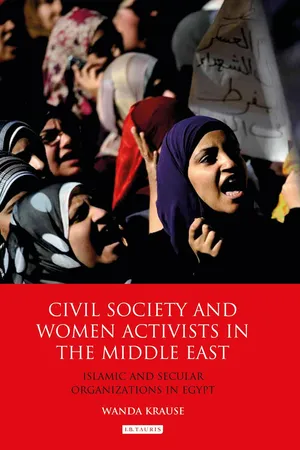
Civil Society and Women Activists in the Middle East
Islamic and Secular Organizations in Egypt
- 272 pages
- English
- ePUB (mobile friendly)
- Available on iOS & Android
eBook - ePub
Civil Society and Women Activists in the Middle East
Islamic and Secular Organizations in Egypt
About this book
In the Middle East, and in Egypt in particular, there has always been a tendency to accord complete supremacy to the authority and might of the state, and to see 'society' as a separate, powerless entity. However, after the uprising of 2011, this assumption was turned on its head. And it is the wide range of political activity beyond the remit of the official state where Wanda Krause locates a dynamic potential for political change from the bottom up. She looks in particular at the influential role of women's private voluntary organisations in Egypt in shaping concepts of civil society and democracy. Exploring both secular and 'Islamist' organisations, she offers a steadfast critique of the view that Islamic women activists are insignificant, 'backward' or 'uncivil'. Krause's examination of women activists in Egypt today is vital for those interested in Middle East and Gender Studies, as well as those researching the wider issues of civil society and democratisation.
Information
CHAPTER 1
WOMEN ACTIVISTS IN THE MIDDLE EAST
Introduction
If one is looking for change in any Middle Eastern country, the participation of women matters. I remember beginning my quest to understand the roles of women in the Middle East and stumbling across book after book that told of the unfortunate plight of women in the Middle East, their oppression and subjugation to patriarchy. The picture presented is that men play a role in public and women, too repressed, cannot. I persisted in wanting to know what was beyond what most of the literature was claiming. Exceptions to related established ‘knowledge’ surfaced as I began to delve deeper into my study of the region. Perhaps it was also partly subconscious in that my great-great-grandmother fled her home in the Middle East to be with the one she loved, my great-great-grandfather. Especially for her time, she most strenuously defied authority and norms to marry someone she loved outside of her nation and not born of her religion – his effort to convert did not cut it. Certainly, there would have to have been many women contributing to change in the Middle East as they saw fit, too.
The first country I visited in the Middle East was Egypt. Since then I have lived in more countries in the region. However, what became quickly evident was that women played a role in society; they are not passive, and this is not an exception to any rule. As a female protester in the Mubarak uprisings asserted, ‘Egyptian women have an important role in society by their nature. It is very usual in Egypt to see a woman making peace between two quarreling men in the streets.’ I met women from the educated class, such as my mother-in-law, who has worked ardently in the way of women’s rights for decades, and that includes within government, secular feminist organizations – the public sphere. True, comparatively few women have government posts so there might still be the understanding that participation in politics is the exception.
Much of the literature succeeds in establishing within the minds of many enquirers into state-society relations the view that if women are not seen in government it is a reflection on their level of participation in what matters. The 2011 revolution in Egypt has illustrated that focus on the state for change and institution of democracy has been entirely misplaced. What matters is how politics is not only driven but sustained. Change at the state level and within what is termed the public sphere cannot stick if it is not developed and supported from the grassroots and what is termed the private sphere. If a woman disrupts the patriarchal, patrimonial or even economic frameworks that govern her everyday life, that creates a ripple effect on the world outside the home. It follows then that participation within the most everyday ways or within the organizational types that support her to pursue her context-specific needs, and secure sometimes the most basic rights, must be included in any serious study of change. These avenues are most significant because through them women change the political culture on which ideology and action sprout.
Most useful for identifying how women’s struggles result in securing the ‘good’ life and attempting to correct a number of biases that obscure an understanding of women’s activism is the application of a civil society framework. It is within associations, groups and networks that resistance and initiatives take place to respond to or circumvent other or overriding power structures. Many scholars have recognized the usefulness of employing a bottom-up approach to the study of state-society politics and political reconfigurations of the state. Nonetheless, impediments to the study of existing and substantive political processes persist even within frameworks that focus on change from the societal level. Large sectors of the population, such as women, the poor, or those who use Islamic frameworks within their strategies remain hardly represented and little understood.
In looking at what are often referred to as ‘illiberal’ movements, this work seeks to provide more depth to the types of activism that are marginalized. This is particularly important not only in the way of striving as an academic to study and include all actors. It is important because as part of actual developments, in Coleman’s words (2010: xxiii): ‘It is fair to say that secularism as a political force is on life support across the Middle East.’ Coleman points to the secular leaders in the region who have fallen and the ascendency of political Islam as rooted within society and, thus, puts forward the argument that Islamic feminism should matter in the study of political change in the Middle East (ibid.). Despite the significance of both secular feminist organizations and women’s Islamic organizations, when I began my study there was almost nothing published on women’s Islamic organizations in Egypt that I could start with. This was indicative of the enormous gap in analyses on civil society in the Middle East as women whose activism is motivated by and framed through Islam are certainly not marginal.
Through research I have conducted on Egypt, initially through a case study and then with follow-up over 10 years, I argue that women’s organizations, as demonstrated in both Islamic women’s and secular feminist organizations in Egypt, exhibit a wide range of activities that serve to expand civil society in the Middle East. While my research looks specifically at these two organizational types, I asked questions about networks as a significantly growing avenue in Egypt for women to pursue their interests. Oftentimes, networks comprised the more protest-oriented expressions of activism and it was through the mushrooming social networks before the 2011 revolution in which women pushed for freedoms and democratic rights. I followed up with further research that I include for a more nuanced picture. I argue, importantly, that secular women’s organizations cannot be placed hierarchically above Islamic women’s organization in terms of their effect. In fact, it is more often through the Islamic discourse that activists can expand civil society more effectively and participants within organizations deemed secular, therefore, very often use the same lingo and frame of references. It is also interesting that activism of a decidedly feminine and practical nature sometimes has an advantage over strategic activism in creating openings for participation, despite the importance political and feminist scholarship has allotted to the latter. Beyond my study on Egypt, my research on the Middle East has shown that the epistemological bias towards the state and secularism has so grossly misconstrued the nature of politics as it continually transforms from the grassroots that I argue a major refocusing is required for which blinkers need to be dropped.
Throughout the period of research, change appeared to be slow and, at times, it proved to be a contradictory process. By keenly watching developments, I have learned a precious lesson from the women. Real change must be slow and the women I studied seemed to know this already as, despite several setbacks experienced, they persevered. If one is looking to the sudden developments at the state level starting in early 2011 and the momentous successes achieved, this is really a result of a long period of struggle in which an ethos of democratic desire and values has been impregnated into society from the grassroots up. More importantly, when change is fast, one should not be quick to be too jubilant. It is the ethos which has pervaded a polity’s political culture that will determine what politics will really look like in the time to come. The impact of the women studied is enduring because they structure civic principles and reform into their activism. Women activists in Egypt are politically significant to developing basic principles of democracy from the grassroots, and this includes secular and, importantly, Islamic or Islamist women activists. This is significant because if the state remains the focus, incomplete and grossly wrong conclusions about where politics is headed will be drawn. If the activism of women’s Islamic organizations is discounted as ill-suited to such a project, perhaps one of the greatest resources for ‘civilizing’ will be lost. It is also my hope that this book will serve to illustrate that while state politics might be so authoritarian that greater stagnation or a ‘blow over’ may be the possibilities for other countries in the surrounding region, in whatever happens the developments underneath all this will be enduring. These include the instilling of democratic principles at the foundations. To this, women matter.
The Female Struggler as Political Actor
In what Egyptians consider a village, though it is really a densely-populated urban slum, I stayed with some women in their homes. Some, certainly not all, of these women lived in homes with their spouses and children whose entire circumference is that of my humble living and dining room put together. Others had surprisingly reasonable living quarters although the shack-like outsides concealed their better living standard. Many of these women had at least four children. Yet their generosity could not be matched anywhere as I have never experienced anything like it. Generosity was their signature and they were proud of this quality when they compared themselves to ‘real’ city dwellers. I was comfortable enough and fed far better than I had hoped, despite having to walk over mounds of garbage in the street outside the entrances every day or sleep with lice every night. I spent a total of three months on and off. My mother thought placing me on a farm for ‘research’ would be good for me – once in the field, I discovered that such an option would be a little far-fetched. Yet, without having had these generous invitations and, hence, having the experiences I did, I could never have remotely understood so many intricacies of this research and what some people sometimes thought they could never possibly convey to a foreigner, and these certainly did etch in my heart and mind a fuller understanding of life.
These women are originally fallaheen (farmers) and called sha‘b (common folk or popular people) by the more well-to-do Egyptians. They did not stay at home, although nearby the women who did were engaged in extremely difficult tasks to keep up the fallaheen means of subsisting. Some of these women were related to those who subsisted as fallaheen and I would visit them as well. Where I stayed, the women were educated, although no household had a single book except on occasion a Qur’an, and few people in these areas are literate. Otherwise, these women could not afford to stay home. Their income was maximum LE 240 ($40) a month, which was crucial to use towards the family budget, which was always more than the cumulative family income (in a few cases not reaching more than LE 350 or $50). These households would even help a relative who was in yet greater need. These women’s concerns were not women’s rights as the common westerner often understands women’s rights or even as some Egyptian women might describe. Their concerns were dominated by finding ways to put food on the table or related issues such as, in one case, how to fix a roof that had cracks so large I could put my hands through and, as the mother of the house feared, could result in the roof caving in on her children.
Feminists examine politics as the study of power. Power is the ‘capacity to have an impact or produce an effect’ (Rowlands 1998: 14) and as such can be both a source of oppression and emancipation. How many such women are able to make changes in their own lives and those they care for has not mattered, however, within mainstream feminism or political science. As Diane Singerman argues (1995: 5), these people are still largely portrayed as objects of political rule rather than architects of political change. At the same time, however, how Islamist programmes (along with secular organizations) set up in some such neighbourhoods to address these large-scale concerns might affect political outcomes is largely ignored. Politics has been defined so narrowly that the struggles of not just a group of women in a village out there but, in fact, the majority of women and their families in poor circumstances in the Middle East have been entirely ignored. These living conditions were not an exception to any norm in Egypt, yet the struggles of the poor and programmes at the grassroots level to fill such a large vacuum and to which particular discourses are attached remains little understood.
How patriarchy is subverted does not begin within an organization that aims its activities at the state; it begins within the home, within the village and among women whose concerns, dreams, and ingenious ways to achieve these practical things in life do matter. When these women together formed a daycare centre out of one of their homes to host their several children and take turns caring for the children in that home so that they could all together improve their economic circumstances, they contributed to their empowerment. They are perhaps not subverting government policies that marginalize women more generally and nor are they necessarily strategizing that such is their goal. They are, however, subverting economic constraints that oppress not only them but also all members of their immediate society.
Such women may not be purposefully subverting patriarchal laws that govern women’s lives, nor are some of these women even aware of many of these laws. They have much less to do with the legal system or government in their daily lives than would their sisters in some areas in the bigger cities, at least in direct terms. However, as I witnessed, when a divorcee is told that she must only leave the family home accompanied by a younger brother and she protests and eventually makes headway in securing spatial movement without a male guardian, she has indeed contributed to greater freedoms from these norms that can permeate public life and are sustained within the private. I learned of secular organizations that helped such women change the minds of the patriarch in the family to allow for greater freedoms. That is achieved by entering the home, the private sphere, and working on the individual level as a strategy to eventually create shifts in thinking within the public. Securing the wellbeing of women in ‘private’ concerns is securing the wellbeing of society – they are half of any citizenry.
It is essential to recognize the multifaceted nature of women’s struggles. Women sometimes do address the state in an attempt to gain more voice and secure rights, and throughout my study this avenue was becoming much more pronounced. Women do struggle against a great many patriarchal ideas, norms and policies that they perceive to oppress them. However, it is crucial to understand that women’s participation in the Middle East is so much broader if a more accurate understanding of politics that will have impact at the state level is to be gained. Sometimes they have patriarchy to work with. Not all that might be considered patriarchal from a western point of view is deemed an issue or something that must be fought against. Some of the women I got to know through my research were the ones who embraced and sustained patriarchy as a variable in a way of protecting and securing their view of a ‘common good’.
What is also important to emphasize is that women do not necessarily struggle against the state or state policies. Some of the women I worked with could not name a single minister, nor could they relay anything about their president’s recent decisions, speeches or what he stood for. Others who might be able to really could not care less. Their struggles are shaped by their immediate circumstances and a variety of sources they perceive as a more direct threat to their wellbeing. The strategies to combat these threats may be secular in nature, grounded in Islamist discourse, and importantly variations of these. The overriding concerns will be related to their economic wellbeing because such interests comprise immediate dilemmas. Other concerns include ensuring piety or a moral society. State-directed action or fighting patriarchy form only a few aspects of women’s participation.
The literature on popular participation in the Middle East contains numerous misconceptions and biases which serve to delineate inquiries on these political processes and function to exclude these women from the political process. A significant bias in this respect is the problem of politics viewed as the sole domain of formal institutions. As Parvin Paider (1995: 2) underscores:
One widespread assumption is the only political and economic domains worth studying in Muslim societies are the formal ones, and Muslim women are unimportant or at best marginal to these domains because they have few formal political and economic rights and make a limited contribution to formal domains.1
The drive to see change by looking for signs within the state results from and continues a form of prejudice and misunderstanding about politics. This bias and approach has grave consequences more generally in misunderstanding political processes. There is little sign of change happening by way of democratization or liberalization if one insists on looking towards the state. Although protest movements had gathered pace towards the ousting of Hosni Mubarak and ministers, these cannot help explain change adequately either. If anything, their analysis supports conclusions drawn from studying the regimes, in large, that there had been no progress in terms of greater rights, freedoms, and participation.
A prejudice and misunderstanding about the sphere of political action that matters results, more particularly, in misconstruing women’s actual roles in political life. Women’s activities are misrepresented as politically inconsequential to state politics as a result of how politics has traditionally been burdened by methodological and epistemological bias. Today’s scholarship has grown from works based in the eighteenth and nineteenth centuries in which a methodological bias is often evident. Travellers to the Middle East were predominantly male and did not have access to women’s quarters to be able to describe what they saw, or in most cases, did not see. Thus, the harems were of great interest and became the subject of several writings. Female writers who were able to travel to the region were generally elite women who also had sporadic access to women’s lives and described what little they observed from a Eurocentric point of view. Because little case study research is available to address these resilient biases adequately, misrepresentation is a continuing feature among scholarship on women in the region. As one remnant of orientalist discourse on Middle Eastern women and a direct result of a considerable bias towards the study of institutional politics, a theoretical division has enabled the continued marginalization of women’s activities. The public/private divide has served to secure this bias in the literature and is still followed in scholarly work.
The private sphere is typically defined as that realm which comprises the family (though it is sometimes viewed as encompassing the neighbourhood or even the community) and interpersonal relations between friends and acquaintances (Bystydzienski 1992: 2). Thus, as Jill Bystydzienski points out, in contrast to the public sphere, perceived as an area of male activity, women’s roles have been defined by and to a large extent limited to the private sphere and their activities deemed apolitical (ibid.). As such, what is termed as apolitical will be eliminated as insignificant for the study of civil society politics.
Gender analysis, though further blurring the public/private dichotomy, has further marginalized sectors of women’s activism that fall outside mainstream feminist discourse. As Saba Mahmood has argued in her analysis of women in religious lessons (dars; plural: durūs) located in Cairo mosques, feminist scholarship overemphasizes the politically subversive form of agency, while it has ignored other modalities of agency whose significance is missed within what she refers to as the ‘logic of subversion and resignification of hegemonic terms of discourse’ (Mahmood 2004: 155). She argues that this overemphasis results from feminism’s teleology of progressive politics on the analytics of power (ibid.: 9). Not only forms of resistance, but also other expressions of power are excluded through this narrow lens of both politics and feminism. Michele Foucault explains that power cannot be understood merely within the framework of domination, as something possessed and used by persons or states over others. Instead, it permeates life and produces new forms of desires, objects, relations, and discourses (Foucault 1978, 1989, cited in Mahmood 2004: 17).
There is, furthermore, the bias that when women’s activism in the Middle East is studied, whether as civil society actors or as protest movements, strategically formulated goals that shape women’s activism are given signi...
Table of contents
- Cover
- Title Page
- Copyright Page
- Contents
- List of Illustrations
- List of Tables
- Acknowledgements
- 1 Women Activists in the Middle East
- 2 Civil Society and Political Participation
- 3 Key Issues for Struggle: Poverty and Marginalization
- 4 Practical Considerations for Methodology and Fieldwork
- 5 The Islamic and Secular as Means of Participation
- 6 Empowerment through the Feminine and Strategic
- 7 Women’s Activism through Networking
- 8 Conclusions
- Notes
- Bibliography
Trusted by 375,005 students
Access to over 1.5 million titles for a fair monthly price.
Study more efficiently using our study tools.
Frequently asked questions
Yes, you can cancel anytime from the Subscription tab in your account settings on the Perlego website. Your subscription will stay active until the end of your current billing period. Learn how to cancel your subscription
No, books cannot be downloaded as external files, such as PDFs, for use outside of Perlego. However, you can download books within the Perlego app for offline reading on mobile or tablet. Learn how to download books offline
Perlego offers two plans: Essential and Complete
- Essential is ideal for learners and professionals who enjoy exploring a wide range of subjects. Access the Essential Library with 800,000+ trusted titles and best-sellers across business, personal growth, and the humanities. Includes unlimited reading time and Standard Read Aloud voice.
- Complete: Perfect for advanced learners and researchers needing full, unrestricted access. Unlock 1.5M+ books across hundreds of subjects, including academic and specialized titles. The Complete Plan also includes advanced features like Premium Read Aloud and Research Assistant.
We are an online textbook subscription service, where you can get access to an entire online library for less than the price of a single book per month. With over 1.5 million books across 990+ topics, we’ve got you covered! Learn about our mission
Look out for the read-aloud symbol on your next book to see if you can listen to it. The read-aloud tool reads text aloud for you, highlighting the text as it is being read. You can pause it, speed it up and slow it down. Learn more about Read Aloud
Yes! You can use the Perlego app on both iOS and Android devices to read anytime, anywhere — even offline. Perfect for commutes or when you’re on the go.
Please note we cannot support devices running on iOS 13 and Android 7 or earlier. Learn more about using the app
Please note we cannot support devices running on iOS 13 and Android 7 or earlier. Learn more about using the app
Yes, you can access Civil Society and Women Activists in the Middle East by Wanda Krause in PDF and/or ePUB format, as well as other popular books in Social Sciences & Middle Eastern History. We have over 1.5 million books available in our catalogue for you to explore.