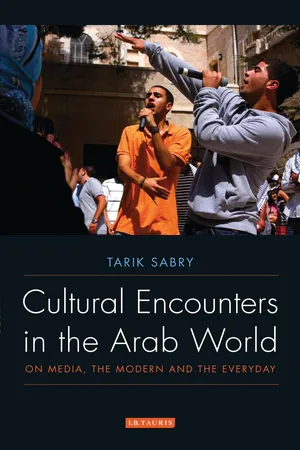
- 240 pages
- English
- ePUB (mobile friendly)
- Available on iOS & Android
eBook - ePub
About this book
In this groundbreaking book, Tarik Sabry is seeking out the terrain for best understanding the experience of being modern in transitional societies. He adopts a dynamic, ethnographically based approach to the meanings of 'modernness' in the Arab context and, within a relational framework, focuses on structures of thought, everydayness and self-referentiality to explore the process of building a bridge that rejoins the 'modern' in Arab thought with the 'modern' in Arab lived experience. In bringing together modernity as a philosophical category with the bridging spaces of Arab everyday life, Sabry is offering fresh methods of comprehending the question of what it means to be modern in the Arab world today.
Information
1
On Encountering and Modernness
In ontological interpretation an entity is to be laid bare with regard to its own state of being; such an interpretation obliges first to give a phenomenal characterization of the entity we have taken as our theme, and thus to bring it into the scope of our fore-having, with all its subsequent steps of our analysis are to conform.
(Heidegger, [1962] 2007: 232)
When people say: modern painting, modern music, modern technology, modern love, they think they know what they are saying and that there is nothing more to be said. . . anyone who utters a doubt or poses a question is immediately branded as not being ‘modern’. He is not to be trusted, he is not ‘with it’, not with the movement which justifies its own existence merely by moving.
(Lefebvre, 1995: 1)
The history of the ‘Arab’ is a history of cultural encounters with others: in no particular order or chronology, the Greeks, Aristotle, Byzantines, Persians, Indians, Romans, Jews, Amazighs, Kurds, Africans, Turks, Chinese, Paganism, Zoroastrianism, Judaism, Christianity, Islam, Sufism, Aramaic, Hebrew, Napoleon, Europe, European colonialism, Empire, Marxism, socialism, capitalism, liberalism, Rock’ n’ Roll and much more; yet, it seems, all this common cultural universe, this cosmos of encountering has never stopped people from searching for that one thing they call a pure and ‘authentic’ Arab identity. It’s like a continuous search for a lost mythical city, the Atlantis of identities, a chimera that will prove forever illusive. What they’ll find, if they ever find it, is a mélange or métis of all those things, or/and the different discourses of becoming disguised in ‘ideological intoxications of the past’, nothing more and nothing less. This book is not a search for the certain, pure, absolute or any kind of origin/essence; it is rather a search into encountering in its liminal and translucent state, the transient, the intersectional as well as the ironies and, let’s add, the contradictions and the possibilities that they bring.
At the age of 7, I suddenly started to have frequent nightmares. Initially, at such moments my mother would kindly give me water and gently caress me back to sleep. Soon, however, the incessant nightmares became more of an ordinary (somewhat annoying) nightly occurrence to which the rest of the family had got accustomed. Some joked I was maskun or mkahalat (possessed by jinn), relatives to whom my nightmares were no secret decided it was boughatat: a helpless feeling of paralysis that happens in one’s sleep and which others, being more sensible, simply put down to eating late at night. However, my parents, hitherto staunch Marxist-Leninists and materialists par excellence, thought the whole superstitious explanations to be mere traditional poppycock. Once on our way back from Rabat, a trip much of which I cannot remember, at the advice of a friend, my mother decided to stop by the Khyayta (holy men who dealt with jinn possession and problems of shur – ‘black magic’). No one had talked with me or had cared to enlighten me as to what happened when one encountered the holy Khyayta; was I supposed to keep quiet, scream, close my eyes, bow in awe, I simply had no idea. What’s more, having been brought up in a quasi-atheist entourage for much of my childhood, I was almost alien to traditional protocol and could therefore not help the feeling of mortification and fallnness that had engulfed me. However, there was no time for hesitation or fear, as my agnostic mother ordered: ‘go down, a fkih will come to see you, he’ll help you with your nightmares’. I remember how my small feet trembled as I went down the high and awkward stairs leading to a stable-like space with hay scattered sporadically on the floor. Two big stones had been intentionally positioned to act as sitting objects. Then there were chains, lengthy ones with rusty handcuff s. The smell was eerie. It reminded one of the London Dungeon’s simulations of the inner city’s seventeenth-century torture houses. There was nothing holy about the place; not in the least, it was practically a shit-hole, a cave, but what is with the chains I thought? Am I to be jailed, exorcised? Am I really possessed? Have my family brought me here to rid me of my demons? What demons? I did not think Marxists could be superstitious. A psychiatrist with smart spectacles and a cosy sofa would have been more suitable to such ‘modern’ thinking parents, I thought in hindsight. After a five-minute wait or so, a small thin man, with a long white beard, dressed in a greyish traditional Jellaba seemed to appear from nowhere. He waddled slowly, but with certainty, towards me and looked me straight in the eyes. He gestured pointing to the stone facing him for me to sit and started putting the rusty chain handcuffs around my hands without uttering a word. I, of course, being taken by the whole spectacle, and the care with which it was performed, conformed willingly to this absurd madness. The man then, all of a sudden, came closer and closer until there was only a few inches gap between our faces. As I made a move to withdraw my face, for the distance between us was so intimately and embarrassingly close, I felt sudden shooting pangs in my cheeks, and slowly in other parts of my face as well. It took me a while to realise that he (I dare not curse him even now) was bloody well spitting at me. I remained frozen throughout the spitting ritual, unable to run for my life, call for help or even wipe my now red and wet embarrassed face. If you remember, I was not prepared for this ‘holy’ moment. Should I have spat back at him? That’s what the ‘modern’ Karl Marx would have done, I guess! After a while, the spitting holy-man untied my hands, again with notable care, and asked me not to be afraid. I rushed to my pockets to hand him a modest Baraka1, the only thing I knew I had to do. Maybe it’s all in the spit; I tried to reason much later. This old man’s spit must be holy. He nodded, as if to thank me for the Baraka I gave him and asked me to go up the stairs, where my mother was waiting. ‘What’s the problem with him sidi [sir]?’ asked my mother from the top of the cave. ‘It’s television’, he replied. ‘Make sure he stops watching it for 17 days. That will cure him completely.’
My encounter with the Khyayta was my first introduction to ‘cultural schizophrenia’. It was a double-encounter: one of a popular traditional ritual in all its colourfulness; the other, my mother’s treason towards the ‘modern’, embodied in Karl Marx, whose Das Kapital, and not the Koran, took centre-stage in our home library. Does my mother’s treason in any way alter or cancel out her state of modernness; her being modern in the world? Can one be modern all the time? Could my mother have been ‘traditional’ and modern at the same time? Was she, as Lerner would have put it, a ‘transitional’? What does it mean to be both modern and traditional? What are we really talking about here? As for the holy-man’s take on television, it is strangely McLuhanian, or shall I say phenomenological, par excellence, for it was not – according to his diagnosis that is – any specific programming, Arab or Western, that had caused my nightmares or possession, but television itself, as a medium. What’s even more impressive about his diagnosis, as I remember quite vividly, is that the nightmares had coincided with the year my father had bought our first black and white television set in 1977. My demons had possessed me at the point of my encounter with television, the ‘magic box’, as the older generation of Arabs would call it. Television is the medium through which a new world with its different jinns had come to take possession of my ‘natural’ state of being in the world. This double-encounter calls for a ‘double-critique’ or to use another of Khatibi’s terms: a ‘double-semiotics’. The disjuncture between the ‘modern’ encounter through the revolutionary work of Karl Marx, the spirit of ‘modernisation’ it had instilled in my parents, and the encounter with the Khyayta’s ‘metaphysical soil’ (Khatibi, 1980) coexist or, shall I say, overlap in the same cultural temporality without continuity or linearity – what does this mean and how does it affect our understanding of what it means to be ‘modern’ in a traditional setting? What does it mean to encounter something in the world? What happens at the point of the encounter? Can we study the encountering of the ‘modern’ as a cultural phenomenon – that is in a phenomenological way? What structures and mechanisms underline the encounter with the ‘modern’? In Being and Time Heidegger states that ‘the temporal interpretation of everyday Dasein2 must start with those structures in which disclosedness constitutes itself: understanding, state of mind, falling and discourse’. (Heidegger, [1962] 2007: 335) How can we make use of such structures to study encountering the ‘modern’ in the Arab world as a kind of spatio-temporal disclosedness? To appropriate Heidegger’s structures in the form of questions, we could ask: how does the ‘Arab’ understand/interpret encountering ‘modern’? How is this disclosed as a state of being? Through what kinds of discourse is encounter with the ‘modern’ communicated? Does encountering the ‘modern’ in any way lead to some sort of fallnness3; that is a crisis in identity or culture? What are we really talking about when we bring up the subject of cultural encounter/encountering the modern as an object of study? Through what means do cultural encounters occur, or what are the facilitators or mediators through which encounters happen? The corpus that falls under the rubric of cultural encountering and the mediators that facilitate such an act are limitless. These include many forms of human interaction, such as fashion, aesthetics, education, communication, epistemology, music, art, ideas, literature, commerce, popular cultures/visual cultures, sport and travel. Each of the above-mentioned areas is important enough to constitute solid components of the historiography of cross-cultural encountering as a phenomenon and can also be considered as separate intellectual projects in their own right. My contribution, since it cannot cover any of the above thoroughly (for the task is evidently impossible in one book), and though it concentrates mainly on the Arab case, can only be a metonym for encountering the ‘modern’ and its meaning. When mentioning art, aesthetics and other categories from the corpus of ‘cross-cultural encountering’ what we are really dealing with is general categories under which we can place a whole stratum of sub-areas that can also easily constitute independent and coherent areas of study. To give an example, the historical study of coins and their spread beyond geographical localities is in itself a global act of cultural encounter. As Georganteli and Cook (2006) put it in their introduction to Encounters: Travel and Money in the Byzantine World ‘the study of Byzantine coins in their archaeological, geographical and historical context offers crucial evidence for the study of medieval economic and cultural encounters’ (Georganteli and Cook, 2006: 7). ‘Byzantine-derived designs, used on the coins of other lands similarly’, they added, ‘echo the transmission of Byzantine culture and ideas of kingship’ (ibid).
During one of my recent fieldwork visits to Morocco (2007), I spent a week in Asfi (a small coastal Moroccan city known for its pottery and very good clay quality), talking to its famous potters (young and old) about their art and how the ‘modern’, or encounters with Western art and technique, influenced their work. The story that emerged from the interviews was one of ‘hybridisation’ and cross-cultural exchange rather than ‘authenticity’. Even the old school of Moroccan potters I interviewed emphasised the influence of borrowed styles and technique encountered through travel on the development of their art4. Whilst jotting down observations on pottery making in Asfi, I was more than tempted to tell the story of Arab modernity through the art of pottery making in Morocco, but such a deviation would have shocked my publisher, to whom I had promised a different kind of story and, to be candid, it would be far more suitable to an art/ceramics historian to pursue such a project. The point of highlighting this episode from the fieldwork is to emphasise, yet again, the vastness of the topic and the rubric that is found under the umbrella of cross-cultural encounter. My concern in this book is with ‘modernness’ as a phenomenological category and how it is communicated to and expressed by the young Arab through different forms of communication5. I do not, in any way, intend that this book be a complete exposé, or even a coherent summary, of the ‘modern’ condition in the Arab world and how the latter is mediated through mass communication. Nor is it intended as a cultural history or indeed a historiography of the Arab world’s encounters with the West or modernity, which would have made for a useful and logical sequel to, especially, Ibrahim Abu-Lughod’s Arab rediscovery of Europe (1963) and Bernard Lewis’s The Muslim Discovery of the West (1957) as both pieces were written before the spread of technologies of seeing (mainly television) in the Arab region, nor do I intend that the book should act as a social history of media uses in the Arab world or the Middle East. Daniel Lerner’s attempt (1958) at this intellectual task (still an object of critique and debate today) was indeed too premature, as some have rightly argued (see Sparks, 2007; Sreberny, 2008), but it remains, regardless of its known disadvantages, a seminal and indeed a pioneering piece of scholarship. I’d like to take a less fashionable position here and state that Lerner’s work on the characteristics of the modern personality or ‘self-system’, ‘psychic-mobility’, ‘mass mediated experience’ or ‘vicarious experience/psychic displacement’, as he also calls it (Lerner, 1958: 53), has lost neither relevance nor topicality. In fact, these analytic frames, if we can call them that, especially ‘psychic-mobility’, which I articulated elsewhere as ‘mental emigration’ (Sabry, 2003, 2005), are central to this book’s thesis. My interest in Arab ‘modernness’ is both ontological and epistemological, and the chapters that follow are nothing other than an attempt to understand the concept vis-à-vis these two distinct yet somehow interrelated interpretive frames. The epistemological interest in the concepts of ‘modern’ and ‘modernness’ comes from a conscious intellectual desire to bridge the contemporary Arab philosophical discourse on6 modernity with a new field of enquiry, namely Arab cultural studies, so that the former is able to inform the latter and vice versa. The bridging task is not much more than an attempt to rehearse the possible ways in which the Arab cultural repertoire can come to terms with its ‘present’ cultural temporality creatively. I believe this to be a major concern of this book, as the study and theorisation of modernity in the Arab cultural repertoire has yet (with very few recent exceptions) to surpass its metaphysical stage and open up to the study of man, contemporary cultural life and its transformative character. The ontological interest in this book comes from asking a purely ontological question: What does it mean to be modern in the Arab world? Dealing with being modern or modernness, as I prefer to call it, and what it means, raises a number of questions that problematise the meaning of Arab modernity. What determines modernness – the spatial, the temporal or both? Can one be modern and traditional at the same time? What does this mean? Where is modernness most conspicuous? Does one need to be conscious of one’s modernness for him or her to be so, modern that is?
Genealogical research into cultural encountering and its impact on the Arab cultural repertoire is still scarce. A serious and welcome intellectual effort came from Mohammed Abed al-Jabri’s philosophical treatise a Critique of Arab Reason, especially the fourth volume, A Critique of Arab Ethical Reason (Al-Jabri, 2001) that unearths the archaeology of the Arab ethical/moral ‘reason’ and its many imported aspects, including Greek, Persian, European and Islamic influences. Another work, this time a historical study by Ibrahim Abu-Lughod (1963) entitled Arab Rediscovery of Europe: A study in Cultural Encounters7 provides an interesting analysis of the French expedition to Egypt in 1789 and its effect (as a cultural moment) on the Arab world and its metamorphosis from tradition to modernity (Abu-Lughod, 1963: 7). The Napoleonic communiqué, a cultural text, written by French Orientalists and distributed upon arrival by the French Army was (if we discarded earlier encounters with the work of Greek philosophers) the Arab’s first encounter with modern concepts, such as republic and the just state (Abu-Lughod, 1963: 20). The book also explores the influence of the translation movement in Egypt (1800–1936) and its effect as an intellectual encounter on the Arab cultural repertoire. The School of Translation founded by Muhammad Ali in 1936 was responsible for the translation of around 2000 books into Arabic, more than all that had been translated for the whole century in the Arab world (Abu-Lughod, 1963: 41). However, unlike the translations of the ninth century, which covered a wide area of knowledge, the nineteenth century translation movement, argues Abu-Lughod, discarded a number of subjects including philosophy, logic and science. This deficit had had a major influence on the Arab cultural repertoire, especially in the area of philosophy and critical thinking. What was transmitted through the translations was only ‘the superstructure of the cultural manifestations’ and not the intellectual creativity or ‘bent of mind’ that led to the establishment of the sciences in the West. Abu-Lughod speculates that ‘early nineteenth-century transmission of European knowledge had only a limited immediate effect on the intellectual outlook of the Arab world’ (ibid, 59).8 Travel constitutes the act of cultural encounter par excellence and there is a well-documented compendium on Arab travellers’ accounts and experiences of far away lands (the West included) that can be traced to the travels of the famous Ibn Batouta and Ibn Khaldun. The most quoted is a book entitled Takhlis by Tahtawi (1834–5) in which he recounts his voyage to Paris. We can also add the observations of the Arab traveller Marun al-Naqqash (1817–55), credited as the father of Arabic drama. Al-Naqqash spent time in Italy watching plays and opera and was the first to direct a modern play in the Arab world (Abu-Lughod, 1963). Also, in recounting his voyage to Paris, Muhammad al-Saffar, a Moroccan ambassador in the mid-nineteenth century, provides gripping observations about French bourgeois politesse, bosoms, wine, food, time, technology and administrational issues; and how his encounters changed his view of the temporal and the spatial (See Miller, 1992). Delving into historical aspects of Arab encounters with Europe, the ‘modern’ and modernity unveil a limitless pool and possibilities for research. My concern in this book, however, is with the present tense of Arab cultures and the meanings of Arab modernness. Let’s begin with unpacking cultural encountering as a spatio-temporal p...
Table of contents
- Cover
- Title Page
- Copyright Page
- Dedication
- About the Author
- Contents
- List of Illustrations
- Acknowledgements
- Chapter 1: On Encountering and Modernness
- Chapter 2: Contemporary Arab Thought and the Struggle for Authenticity: Towards an Ontological Articulation of the ‘Modern’
- Chapter 3: Arab Popular Cultures and Everyday Life
- Chapter 4: The Bridge and the Queue as Spaces of Encountering
- Chapter 5: Modernness as a Multiple Narrative-Category: Encountering the West
- Chapter 6: Still Searching for the Arab Present Cultural Tense: Arab Cultural Studies
- Notes
- Bibliography
Trusted by 375,005 students
Access to over 1.5 million titles for a fair monthly price.
Study more efficiently using our study tools.
Frequently asked questions
Yes, you can cancel anytime from the Subscription tab in your account settings on the Perlego website. Your subscription will stay active until the end of your current billing period. Learn how to cancel your subscription
No, books cannot be downloaded as external files, such as PDFs, for use outside of Perlego. However, you can download books within the Perlego app for offline reading on mobile or tablet. Learn how to download books offline
Perlego offers two plans: Essential and Complete
- Essential is ideal for learners and professionals who enjoy exploring a wide range of subjects. Access the Essential Library with 800,000+ trusted titles and best-sellers across business, personal growth, and the humanities. Includes unlimited reading time and Standard Read Aloud voice.
- Complete: Perfect for advanced learners and researchers needing full, unrestricted access. Unlock 1.5M+ books across hundreds of subjects, including academic and specialized titles. The Complete Plan also includes advanced features like Premium Read Aloud and Research Assistant.
We are an online textbook subscription service, where you can get access to an entire online library for less than the price of a single book per month. With over 1.5 million books across 990+ topics, we’ve got you covered! Learn about our mission
Look out for the read-aloud symbol on your next book to see if you can listen to it. The read-aloud tool reads text aloud for you, highlighting the text as it is being read. You can pause it, speed it up and slow it down. Learn more about Read Aloud
Yes! You can use the Perlego app on both iOS and Android devices to read anytime, anywhere — even offline. Perfect for commutes or when you’re on the go.
Please note we cannot support devices running on iOS 13 and Android 7 or earlier. Learn more about using the app
Please note we cannot support devices running on iOS 13 and Android 7 or earlier. Learn more about using the app
Yes, you can access Cultural Encounters in the Arab World by Tarik Sabry in PDF and/or ePUB format, as well as other popular books in Social Sciences & Social Philosophy. We have over 1.5 million books available in our catalogue for you to explore.