- 256 pages
- English
- ePUB (mobile friendly)
- Available on iOS & Android
eBook - ePub
About this book
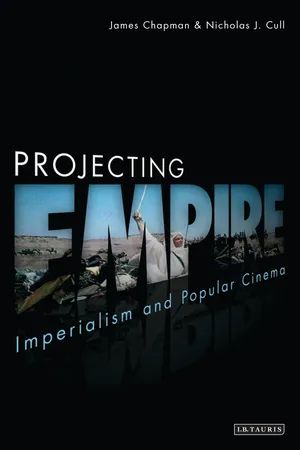
Popular cinema is saturated with images and narratives of empire. With "Projecting Empire", Chapman and Cull have written the first major study of imperialism and cinema for over thirty years. This welcome text maps the history of empire cinema in both Hollywood and Britain through a serious of case studies of popular films including biopics, adventures, literary adaptations, melodramas, comedies and documentaries, from the 1930s and "The Four Feathers" to the present, with "Indiana Jones" and "Three Kings". The authors consider industry-wide trends and place the films in their wider cultural and historical contexts. Using primary sources that include private papers, they look at the presence of particular auteurs in the cinema of Imperialism, including Korda, Lean, Huston and Attenborough, as well as the actors who brought the stories to life, such as Elizabeth Taylor and George Clooney. At a time when imperialism has a new significance in the world, this book will fulfil the needs of students and interested filmgoers alike.
Information
1
IMPERIALISM AND POPULAR CINEMA: A SURVEY
From its outset cinema has been a vehicle for disseminating images and ideologies of empire. Some of the earliest ‘topicals’ – short film records of newsworthy events – were of imperial spectacles such as the Diamond Jubilee of Queen Victoria in 1897 and the Delhi Durbar of 1903. Imperial subjects were a natural for the travelogues, or ‘scenics’, that provided a staple of early film exhibition. They impressed audiences with their images of imperial splendour and brought pictures of exotic lands and customs to the patrons of the cinematograph. At the same time early cinematographers were involved in the propagation of imperial propaganda. The Spanish–American War (1898) and the South African War (1899–1902) were the first to be covered by film cameramen. G. W. Bitzer of the Biograph Company and Alfred E. Smith of American Vitagraph were amongst the pioneer cinematographers who travelled to Cuba as America first flexed its imperialist muscles against the Spanish. And William K.-L. Dickson of the British Mutoscope and Biograph Company sailed to South Africa in October 1899. He shot footage of troops in camp and staged re-enactments with British soldiers dressed in Boer uniforms. Dickson’s published memoir, The Biograph in Battle, recorded that the British commander-in-chief, Lord Roberts, ‘consented to be biographed with all his Staff, actually having his table taken out into the sun for the convenience of Mr Dickson’.1
It is significant that the advent of cinema in the 1890s coincided both with the zenith of British imperialism and with the first stirrings of America as an imperial power. It was only natural that early film-makers would reflect the popular mood of jingoism. The Edison Manufacturing Company’s The Monroe Doctrine, released in April 1896, was probably the first propaganda film. It referred to a boundary dispute between Venezuela and the colony of British Guiana: it was nothing less than a warning to Britain to keep out of America’s back yard. The Boston Globe reported that the film ‘shows John Bull bombarding a South American shore, supposedly to represent Venezuela. John is seemingly getting the better of the argument when the tall lanky figure of Uncle Sam emerges from the back of the picture. He grasps John Bull by the neck, forces him to his knees and makes him take his hat off to Venezuela’.2 Similarly, early British films of the South African War included staged allegorical dramas such as the Warwick Trading Company’s The Set-to between John Bull and Paul Kruger (1900) and R. W. Paul’s Kruger’s Dreams of Empire (1900).
The Spanish–American War occurred at an opportune moment for the fledgling US motion picture industry. The novelty value of moving pictures was waning by 1898 but the war created a demand for topical films ranging from actualities of American troops to staged dramatic re-enactments. This gave a boost to exhibitors and stimulated competition between producers. The role of press magnates such as William Randolph Hearst in precipitating the US intervention in Cuba is well known, but less attention has been paid to the part played by the cinematograph. As the early cinema historian Charles Musser has written: ‘It would be a gross exaggeration to say that the cinema launched a new era of American imperialism. But cinema had found a role beyond narrow amusement, and this sudden prominence coincided with a new era of overseas expansion and military intervention.’3
In Britain, too, the cinematograph played an important role in supporting the British Empire in its war against the Boers. The evidence would suggest that actuality films from the front were well received by cinema audiences. A review of a programme of topical films at the Empire Theatre, Leeds, in January 1900, for example, records that the ‘audience cheered wildly when the presentment of Lord Roberts was shown on the screen ... One and all of these patriotic pictures stirred deeply the emotions of the crowded audience’.4 When actuality material was not available, however, enterprising film-makers were not averse to dramatic reconstruction. The Gaumont Company produced a ‘ludicrously imaginative’ film Signing of the Peace at Vereeniging (1902) with actors playing Lord Kitchener and Jan Smuts. Gaumont’s Colonel A. C. Bromhead later recalled: ‘We included Lord Roberts and only found out afterwards that he had not been there.’5
Early film representations of empire took a variety of different forms. Some, such as James Williamson’s Attack on a China Mission (1900), adopted the conventions of Victorian stage melodrama. This short film (actually shot in Williamson’s back yard) was a distillation of events during the Boxer Rebellion in China with the rebels killing a European missionary and laying siege to the mission station until the arrival of the Bluejackets. It is an embryonic version of the rescue narrative later perfected by D. W. Griffith in his Biograph shorts such as The Lonely Villa (1909), The Lonedale Operator (1911) and The Battle of Elderbush Gulch (1913). Other films, consistent with the theatrical tradition of early cinema, drew upon the imperial pageant. W. G. Barker’s The Pageant of Empire (1911), produced for the coronation of George V, for example, ‘shows Britannia on her throne, supported by John Bull, his bull-dog and sisters, and before whom the Colonies pay obedience’.6 The most spectacular of these pageants was Charles Urban’s film of the Delhi Durbar of 1911 – a great Orientalist extravaganza welcoming George V as Emperor of India – which was shot in Kinemacolor and premièred at the Scala Cinema in London accompanied by a 24-piece orchestra.7
These early films of empire need to be understood in the context of a wider popular culture of imperialism during the late Victorian and Edwardian periods. As social historians of imperialism such as John MacKenzie have shown, imperialism was a core element of the British historical experience. MacKenzie identifies an ‘ideological cluster which formed out of the intellectual, national, and world-wide conditions of the late Victorian era, and which came to infuse and be propagated by every organ of British life in the period’.8 The British Empire was celebrated in popular fiction, theatre, music hall, cigarette cards and postcards. It represented a force for political stability and moral improvement. Nowhere was this more evident than in the field of juvenile literature where the works of W. H. G. Kingston, R. M. Ballantyne, Manville Fenn and, pre-eminently, G. A. Henty imagined the empire as a site of heroic adventure for their schoolboy protagonists. While novels may have been aimed at a predominantly middle-class readership, the working classes were catered for by the story papers such as Marvel, Union Jack, Chums, Captain and Young England – cheaper rivals to the decidedly middle-class Boy’s Own Paper.9 The working classes were amongst the most avid consumers of such fiction and also provided the core audience for the cinematograph.
The relationship between early cinema and the popular culture of imperialism can be seen on several levels. Early film shows, for one thing, were part of a multimedia experience which also included lectures, slide shows and novelty acts. The influence of juvenile fiction, furthermore, can be seen in the production of series films featuring similarly square-jawed imperial heroes. The British and Colonial Kinematograph Company, for example, produced a series of 13 Lieutenant Daring films between 1911 and 1914 relating the adventures of a naval officer who saved Great Britain from the plots of assorted spies and anarchists. In the United States the 1910s were the heyday of the ‘serial queen’ melodrama as plucky heroines such as Pearl White (The Perils of Pauline, The Exploits of Elaine, Pearl of the Army) and Ruth Roland (The Red Circle, The Adventures of Ruth, Ruth of the Rockies) took on all manner of foreign villains in narratives of American intervention and overseas expansion.
It was during the First World War, however, that the cinematograph came of age as a medium of propaganda. The British War Office was initially sceptical of the value of film and refused to allow cameramen access to the front. Consequently the early films of the war were staged melodramas, with a particular vogue for atrocity stories about the ‘beastly Hun’. It was not until 1915 that the Topical Committee for War Films was set up under Sir William Jury to liaise between the government and the trade. The first official cinematographers were allowed in British sectors of the Western Front in November 1915 and the first newsreels of the front line were shown publicly in London in January 1916. The first feature-length film produced by the Topical Committee was The Battle of the Somme (1916), compiled from material shot by two British official cameramen, Geoffrey Malins and J. B. McDowell. It was a critical and commercial success and was followed by two more long documentaries: The Battle of the Ancre and the Advance of the Tanks (1917) and The German Retreat and the Battle of Arras (1917). In 1917 the War Office took over the production of the newsreel Topical Budget which included items from other fronts. Amongst the events covered by War Office Official Topical Budget were General Allenby’s entry into Jerusalem on 11 December 1917 and the signing of the peace treaty in the Hall of Mirrors at Versailles on 28 June 1919.10
The growing acceptance of the cinematograph by military authorities was indirectly responsible for the creation of one of the most enduring myths of the war. T. E. Lawrence has been described as ‘the only old-style hero of the first World war’.11 Lawrence came to prominence largely through the efforts of Lowell Thomas, an American journalist, who, with cameraman Harry Chase, covered the British campaign in the Middle East in 1917–18. There was already an official British cinematographer in Palestine, Harold Jeapes, who, along with his Australian colleague Frank Harvey, shot General Allenby’s Entry into Jerusalem. Lawrence, then a major, can be seen taking part in the parade and is visible amongst a group of officers standing around Allenby.12 The fact that other cinematographers were allowed in the theatre – Ariel Varges, another American, was shooting in Mesopotamia at the same time – suggests that the War Office attached considerable importance to the propaganda value of the Middle East campaign at a time when the Western Front was still deadlocked.
Thomas’s arrangement with the War Office prevented him from showing any of his material publicly until after the war. In August 1919 he brought his travelogue With Allenby in Palestine from New York to London where he presented it to packed houses at the Royal Opera House, the Albert Hall and the Queen’s Hall. Thomas was a showman rather than a historian: his account of the war i...
Table of contents
- Cover
- Title Page
- Copyright Page
- Contents
- List of Illustrations
- List of Abbreviations
- General Editor’s Introduction
- Preface
- 1. Imperialism and Popular Cinema: A Survey
- 2. Technicolor Empire: The Four Feathers (1939)
- 3. America’s Kipling: Gunga Din (1939)
- 4. The British Empire at War: Burma Victory (1945)
- 5. Facing the Stampede of Decolonization: Elephant Walk (1954)
- 6. The Watershed: Lawrence of Arabia (1962)
- 7. Pursuing Respect: The Naked Prey (1965)
- 8. Camping Up the Empire: Follow That Camel (1967), Carry On Up the Khyber (1968) and Carry On Up the Jungle (1970)
- 9. The Imperial Trap: The Man Who Would Be King (1975)
- 10. Calling Dr Jones: Raiders of the Lost Ark (1981)
- 11. The Raj Revival: Gandhi (1982)
- 12. Imperial Adventure Redux: Three Kings (1999)
- Afterword
- Filmography
Trusted by 375,005 students
Access to over 1.5 million titles for a fair monthly price.
Study more efficiently using our study tools.
Frequently asked questions
Yes, you can cancel anytime from the Subscription tab in your account settings on the Perlego website. Your subscription will stay active until the end of your current billing period. Learn how to cancel your subscription
No, books cannot be downloaded as external files, such as PDFs, for use outside of Perlego. However, you can download books within the Perlego app for offline reading on mobile or tablet. Learn how to download books offline
Perlego offers two plans: Essential and Complete
- Essential is ideal for learners and professionals who enjoy exploring a wide range of subjects. Access the Essential Library with 800,000+ trusted titles and best-sellers across business, personal growth, and the humanities. Includes unlimited reading time and Standard Read Aloud voice.
- Complete: Perfect for advanced learners and researchers needing full, unrestricted access. Unlock 1.5M+ books across hundreds of subjects, including academic and specialized titles. The Complete Plan also includes advanced features like Premium Read Aloud and Research Assistant.
We are an online textbook subscription service, where you can get access to an entire online library for less than the price of a single book per month. With over 1.5 million books across 990+ topics, we’ve got you covered! Learn about our mission
Look out for the read-aloud symbol on your next book to see if you can listen to it. The read-aloud tool reads text aloud for you, highlighting the text as it is being read. You can pause it, speed it up and slow it down. Learn more about Read Aloud
Yes! You can use the Perlego app on both iOS and Android devices to read anytime, anywhere — even offline. Perfect for commutes or when you’re on the go.
Please note we cannot support devices running on iOS 13 and Android 7 or earlier. Learn more about using the app
Please note we cannot support devices running on iOS 13 and Android 7 or earlier. Learn more about using the app
Yes, you can access Projecting Empire by James Chapman,Nicholas J. Cull in PDF and/or ePUB format, as well as other popular books in Media & Performing Arts & Film & Video. We have over 1.5 million books available in our catalogue for you to explore.