- 336 pages
- English
- ePUB (mobile friendly)
- Available on iOS & Android
eBook - ePub
About this book
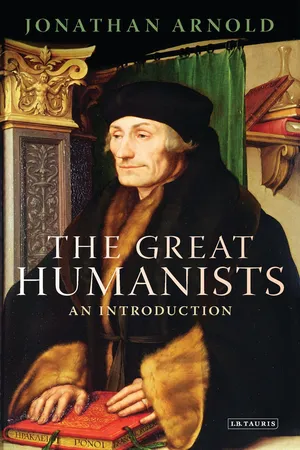
Born out of a love of language, text, classical learning, art, philosophy and philology, the Christian Humanist project lasted beyond the turmoil of sixteenth-century Europe to survive in a new form in post-Reformation thought. Jonathan Arnold here explores the finest intellects of late-Renaissance Europe, providing an essential guide to the most important scholars, priests, theologians and philosophers of the period, now collectively known as the Christian Humanists. "The Great Humanists" provides an invaluable context to the philosophical, political and spiritual state of Europe on the eve of the Reformation through inter-related biographical sketches of Erasmus, Thomas More, Marsilio Ficino, Petrarch, Johann Reuchlin, Jacques Lefevre d'Etaples and many others. The legacy of these thinkers is still relevant and widely-studied today, and this book will make invaluable reading for scholars and students of philosophy and early-modern European history.
Information
NOTES
Introduction
1.J. Hankins, ‘Humanism, Scholasticism, and Renaissance Philosophy’ in J. Hankins (ed.), The Cambridge Companion to Renaissance Philosophy (Cambridge, 2007) [hereafter CCRP], pp. 30–48 [hereafter Hankins, ‘Humanism’]. Here at pp. 30–31, citing G. Voigt, Die Wiederbelebung des Classischen Altertums Oder das Erste Jahrhundert des Humanismus (Berlin, 1859) and V.R. Giustiani, ‘Homo, Humanus, and the Meanings of “Humanism” ’, The Journal of the History of Ideas [hereafter JHI], 46 (1985), pp. 167–95.
2.R. Weiss, The Dawn of Humanism in Italy (London, 1947), revised and reprinted in The Bulletin of the Institute of Historical Research, 42 (1969), pp. 1–16. [hereafter Weiss, ‘Dawn of Humanism’]. Here at p. 3. Other early humanists included Geri d’Arezzo and Francesco da Barberino in Florence, as well as Paolo da Perugia and Barbato da Sulmona in Naples.
3.R. Witt, ‘Coluccio Salutati in the Footsteps of the Ancients’, [hereafter Witt, ‘Salutati’] in A.A. MacDonald, Z.R.W.M. von Martels and J.R. Veenstra (eds.), Christian Humanism: Essays in Honour of Arjo Vanderjagt (Leiden, 2009) [hereafter Christian Humanism], pp. 3–12.
4.Attributed to the humanists Crotus Rubeanus (Johannes Jäger) and Ulrich von Hutten, who wrote a sequel (1519). L.W. Spitz, ‘The Renaissance: Humanism and Humanism Research’, English version of ‘Humanismus/Humanismusforschung’ in Theologische Realenzyklopädie, 15 (Berlin and New York, 1986), pp. 639–61; reprinted in L.W. Spitz, Luther and German Humanism, (Hampshire, 1996), pp. 1–40 [hereafter Spitz, ‘Humanism’]. Here at pp. 2–3.
5.For this survey, see M. Dowling, Fisher of Men: A Life of John Fisher, 1469–1535 (Basingstoke, 1999) [hereafter Dowling, Fisher], p. 31; N. Mann, ‘The Origins of Humanism’ in J. Kraye (ed.), The Cambridge Companion to Renaissance Humanism (Cambridge, 1996) [hereafter CCRH], p. 1; A. Hamilton, ‘Humanists and the Bible’ in CCRH, p. 100; N. Mann, ‘The Origins of Humanism’ in CCRH, pp. 1–2.
6.Hankins, ‘Humanism’, p. 31.
7.Ibid., p. 32.
8.Ibid.
9.D. MacCulloch, Reformation: Europe’s House Divided, 1470–1700 (London, 2003) [hereafter MacCulloch, Reformation], p. 76; R. Rex, ‘The New Learning’, The Journal of Ecclesiastical History [hereafter JEH], 44 (1993), pp. 26–44.
10.Hankins, ‘Humanism’, p. 46; P.O. Kristeller. ‘The Scholar and his Public in the Late Middle-Ages’ [hereafter Kristeller, ‘Scholar’] in E.P. Mahoney (ed.), Medieval Aspects of Renaissance Learning: Three Essays by Paul Oskar Kristeller (Durham, N. Carolina, 1974) [hereafter Kristeller, Renaissance Learning], pp. 3–28. Here at p. 10: For the humanists, ‘grammatical and historical interpretation for the most part takes the place of dialectical analysis and argumentation, more value is placed on style, and the terminology of scholastic learning is rather avoided.’; on the Septennium and liberal arts see S. IJsseling, Rhetoric and Philosophy in Conflict: A Historical Survey (The Hague, 1976) [hereafter IJsseling], p. 46.
11.P. Mack, ‘Montaigne and Christian Humanism’ in Christian Humanism, pp. 199–209. Here at p. 199.
12.IJsseling, p. 1. See also Spitz, ‘Humanism’, pp. 5–7; Weiss, ‘Dawn of Humanism’, p. 1.
13.Hankins, ‘Humanism’, p. 39; this point is also noted by R. Witt, ‘In the Footsteps of the Ancients’: The Origins of Humanism from Lovato to Bruni (Leiden, 2000), p. 240.
14.Witt, ‘Salutati’, p. 9.
15.Weiss, ‘Dawn of Humanism’, p. 14.
16.A. Levi, Renaissance and Reformation: The Intellectual Genesis (New Haven, Connecticut and London, 2002) [hereafter Levi], pp. 80–85.
17.F. Petrarch, ‘On his Own Ignorance and that of Many Others’, trans. H. Nachod in E. Cassirer, P.O. Kristeller and J.H. Randall, Jr. (eds.), The Renaissance Philosophy of Man (Chicago, 1948) [hereafter Renaissance Philosophy of Man], p. 115.
18.‘Nihil enim est aliud eloquentia nisi copiose loquens sapientia’: Cicero, De Partitione Oratoria, p. 79. Also quoted in H.H. Gray, ‘Renaissance Humanism: The Pursuit of Eloquence’, The Journal of the History of Ideas [hereafter JHI], 24 (1963), pp. 497–514, quoted on p. 508.
19.Kristeller, ‘Scholar’, p. 12.
20.Ibid., pp. 16–17.
21.Ibid., pp. 13–14.
22.J.B. Gleason, John Colet (Berkeley, 1989) [hereafter...
Table of contents
- Cover
- Dedication
- Title Page
- Copyright Page
- Contents
- Acknowledgements
- Introduction
- Italy
- The Low Countries
- Germany
- England
- France
- Spain
- Appendices
- Abbreviations
- Notes
- Bibliography
Trusted by 375,005 students
Access to over 1.5 million titles for a fair monthly price.
Study more efficiently using our study tools.
Frequently asked questions
Yes, you can cancel anytime from the Subscription tab in your account settings on the Perlego website. Your subscription will stay active until the end of your current billing period. Learn how to cancel your subscription
No, books cannot be downloaded as external files, such as PDFs, for use outside of Perlego. However, you can download books within the Perlego app for offline reading on mobile or tablet. Learn how to download books offline
Perlego offers two plans: Essential and Complete
- Essential is ideal for learners and professionals who enjoy exploring a wide range of subjects. Access the Essential Library with 800,000+ trusted titles and best-sellers across business, personal growth, and the humanities. Includes unlimited reading time and Standard Read Aloud voice.
- Complete: Perfect for advanced learners and researchers needing full, unrestricted access. Unlock 1.5M+ books across hundreds of subjects, including academic and specialized titles. The Complete Plan also includes advanced features like Premium Read Aloud and Research Assistant.
We are an online textbook subscription service, where you can get access to an entire online library for less than the price of a single book per month. With over 1.5 million books across 990+ topics, we’ve got you covered! Learn about our mission
Look out for the read-aloud symbol on your next book to see if you can listen to it. The read-aloud tool reads text aloud for you, highlighting the text as it is being read. You can pause it, speed it up and slow it down. Learn more about Read Aloud
Yes! You can use the Perlego app on both iOS and Android devices to read anytime, anywhere — even offline. Perfect for commutes or when you’re on the go.
Please note we cannot support devices running on iOS 13 and Android 7 or earlier. Learn more about using the app
Please note we cannot support devices running on iOS 13 and Android 7 or earlier. Learn more about using the app
Yes, you can access The Great Humanists by Jonathan Arnold in PDF and/or ePUB format, as well as other popular books in Philosophy & European History. We have over 1.5 million books available in our catalogue for you to explore.