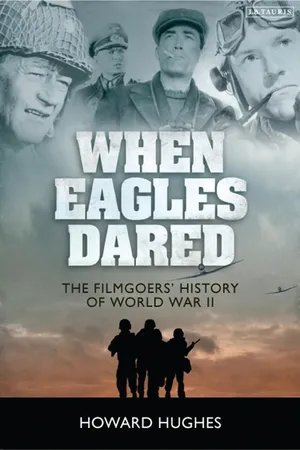
When Eagles Dared is a salute to the men and women who participated in World War II and the filmmakers who have immortalised their stories on screen. It tells both the story of the historical events of this first truly 'world war' and of the films that have depicted these events - comparing the cinematic myth with the historical reality - as a guide to history through cinema.
When Eagles Dared portrays the people who participated in the war, from the evacuation of the Allied forces from France at Dunkirk through to the battle for Berlin and beyond. Each chapter discusses a theatre of war, an event, a campaign or battle by explaining the historical events as they unfold and then examines how filmmakers have represented them. Chapters discuss the war in the skies (Battle of Britain and The Dam Busters), the sea (Sink the Bismarck! and The Cruel Sea) and the North African desert (The Battle of El Alamein and Tobruk). There are 'special mission' movies including Where Eagles Dare and The Dirty Dozen, classic tales of ingenuity (The Great Escape), valour (Saving Private Ryan), and human endurance (The Bridge on the River Kwai). Offering a unique view of war through the lenses of over 150 diverse films that have shaped our perceptions of the conflict, When Eagles Dared is illustrated with rare stills and posters from this ever popular genre.
- 320 pages
- English
- ePUB (mobile friendly)
- Available on iOS & Android
eBook - ePub
About this book
Information
Chapter 1
THE FALL OF FRANCE (1940)
On 1 September 1939 Germany invaded Poland. Britain declared war on Germany on 3 September and there followed eight months of ‘Phoney War’. The Germans called it the Sitzkrieg (‘Sitting War’) and in France it was Drôle de Guerre (‘Funny War’). This was a strange stalemate, as Europe held its breath and waited for something to happen. The false security of this period appeared in many films, such as In Which We Serve (1942) and in Spike Milligan’s autobiographical Adolf Hitler: My Part in His Downfall (1972), while Stephen Poliakoff’s period espionage thriller Glorious 39 (2009) – which featured Ramola Garai, Julie Christie, David Tennant, Bill Nighy, Jenny Agutter, Eddie Redmayne and Christopher Lee – was set in the uncertain summer preceding the declaration of war.
The British propaganda film The Lion Has Wings was released during the Phoney War in November 1939. It was produced by Alexander Korda and co-directed by Adrian Brunel, Brian Desmond Hurst and Michael Powell. Made in two weeks on a tiny budget, it combines newsreels, stock footage and dramatic re-enactments. The film begins by contrasting Britain’s tranquillity with the political turmoil in Germany. ‘This is Britain, where we believe in freedom’, intones the patriotic voiceover by E.V.H. Emmett (from Gaumont British News). Pastoral scenes of the countryside, children at school and at play, holidays, sports and pastimes are intercut with goose-stepping parade footage from Triumph of the Will. ‘What is your idea of a holiday?’ asks the narrator. ‘This?’ (a shot of a fairground carousel) ‘or this?’ (Hitler delivering a speech). Britain’s military power on land, sea and air is celebrated and factories churn out bombers, weapons and munitions. Newspaper headlines recount Hitler’s territorial demands and gains in Europe (including ‘Frightfulness In Occupied Poland’). We see a recreation of Wellington bombers attacking German ships in the Kiel Canal and a Luftwaffe bombing raid on south-eastern England (created from various footage, as Britain had not yet been bombed). The first wave of bombers is repulsed by British fighters, the second wave is broken up by anti-aircraft fire (‘Stand by boys to welcome the Nasties’, notes an ack-ack gunner) and the third wave curtail their attack on London when they spot the area is protected by barrage balloons (blimps tethered by steel wires), which force the bombers to fly at an altitude too high for accurate bombing. This raid is compared to the Spanish Armada, via stock footage of Flora Robson as Elizabeth I in Fire over England (1937). Lion Has Wings also features a scene between a husband and wife, an RAF officer (Ralph Richardson) and a nurse (Merle Oberon), both of whom are doing their bit for the not-yet-at-war effort. Oberon delivers a speech extolling the virtues of land and freedom, and a Britain that believes in truth, beauty, fair play and kindness. The film is a naive view of what lay in store – the British Army was hopelessly outclassed in terms of tactics and armour, and it was going to take more than a few balloons to discourage the Luftwaffe. But the film served its purpose as encouraging, reassuring propaganda.
As the Phoney War simmered, the German navy sneaked into the Atlantic in preparation for hostilities. In the Allies’ shipping lanes the Germans deployed magnetic mines, U-boat submarines and surface raiders, which sank commerce tonnage wherever they found it. The most famous was the ‘pocket battleship’ the Admiral Graf Spee. Pocket battleships were so-called because of their small size in comparison with true battleships, though they were heavily armed and armoured – the Graf Spee had 11-inch guns and 4-inch thick armour. Their size was necessitated by the Treaty of Versailles, which banned Germany constructing warships larger than 10,000 tonnes. The Graf Spee and her sister ship the Deutschland were loose in the Atlantic in August 1939, before the outbreak of hostilities. Under the command of Captain Hans Langsdorff, the Graf Spee struck in the South Atlantic and the Indian Ocean. From late-October to early-December she sank the following merchant ships: the Clement (30 September), the Newton Beach (captured 5 October, sunk 7 October), the Ashlea (7 October), the Huntsman (captured on 10 October, sunk on 17 October), the Trevanion (sunk 22 October), the Africa Shell (15 November), the Blue Star Line’s Doric Star (2 December), the Tairoa (3 December) and the Streonshalh (7 December). The Graf Spee met her match on 17 December near Montevideo harbour in neutral Uruguay, following an encounter with British naval Force G (based on the Falkland Islands) in the mouth of the River Plate.
The Battle of the River Plate (1956) accurately retold the Graf Spee’s last month at sea. The film begins on Wednesday 15 November 1939, with the sinking of the M.S. Africa Shell in the Mozambique Strait of the Indian Ocean. Her captain, Patrick Dove (Bernard Lee) is taken prisoner and he’s soon joined by other merchant captains and crew members captured by the German ship. Graf Spee refuels from the supply ship the Altmark and sets off around the Cape of Good Hope into the South Atlantic, sinking more merchant ships and eventually heading for South America. There she is attacked by Force G under Commodore Harwood: the cruisers HMS Ajax, HMS Exeter and the New Zealand HMNZS Achilles. Though outclassed, the trio of cruisers inflict heavy damage on the Graf Spee, which heads into port in Montevideo, while the Exeter heads for the Falklands for repairs. As running repairs are carried out on the Graf Spee and the British prisoners are released in neutral Uruguay, a diplomatic storm brews as to the German ship’s rights in a neutral harbour. The newly repaired HMS Cumberland arrives from the Falklands. British intelligence, misinformation and whispered rumours on the streets of Montevideo inflate the British force lying in wait for the Graf Spee to be as many as 13 vessels. On the evening of Sunday 17 December, Langsdorff sails the Graf Spee out of the harbour, abandons ship and scuttles her in the Rio de la Plata.
The Battle of the River Plate was known as The Pursuit of the Graf Spee for US release. It was the penultimate collaboration between writer-director-producers Emeric Pressburger and Michael Powell, and was based on Patrick Dove’s 1940 book I Was Graf Spee’s Prisoner (Dove also acted as a technical advisor on the imprisonment scenes) and on Powell’s 1956 book Graf Spee. The film was a factually accurate re-enactment of the events, using several actual naval ships, which are an improvement on the models and miniatures usually deployed in movie sea battles. Here the Achilles was played by the Indian Navy’s INS Delhi, the Exeter was HMS Jamaica, Ajax was portrayed by HMS Sheffield, HMS Cumberland played herself and the US heavy cruiser Salem made a memorable Admiral Graf Spee. Peter Finch played Langsdorff, Anthony Quayle was Commodore Harwood aboard his flagship the Ajax and John Gregson was Captain Bell on the Exeter. Lionel Murton played American Mike Fowler, a fast-talking NBC news reporter, who provides a running commentary on developments in Montevideo harbour (filmed in Montevideo and Malta). In a cast of future stars, Patrick Macnee (later Steed in TV’s The Avengers) had an early role as Lieutenant Commander Medley, Jack Watson played Swanson, the Cornish lookout who first spots the Graf Spee, John Le Mesurier (later of TV’s Dad’s Army) was the Exeter’s padre and Barry Foster played a rating (a non-commissioned sailor). Christopher Lee had a brief role as Manolo, a moustachioed bar owner in Montevideo. Michael Goodliffe played Naval Attaché McCall and Anthony Newley appeared as a captured merchant seaman.
The film loses momentum when the story arrives in Montevideo, becoming bogged down in diplomacy, but the naval scenes of Force G and the Graf Spee on the move are splendidly shot in colourful VistaVision and more than compensate for the film’s talky lulls. The biggest failing is the stagy use of studio-bound interiors recreated at Pinewood for the warships’ bridges: these are completely unconvincing, being both windless and motionless. The film also allows Langsdorff dignity in defeat and the climax concentrates on the victorious British ships sailing into the sunset. In reality Langsdorff committed suicide on 18 December in Buenos Aires.
The catastrophic fall of France amazed the world in May and June 1940 and still confounds historians today. The Phoney War ended when Hitler’s Wehrmacht (‘armed forces’) turned its attention to Western Europe. First they invaded Norway on 9 April 1940, in operations that combined seaborne transporters and airborne landings. To the south, Denmark too was overrun on 9 April. Since the invasion of Poland, Hitler had amassed his army along the eastern borders of the Netherlands, Belgium, Luxembourg and France. By May, the Germans were prepared for an invasion, but the eight-month gap since Poland’s demise had allowed the Allies to mobilise their forces. Eight Dutch divisions protected Holland; 18 divisions deployed in Belgium (with four in reserve); and 22 divisions protected France’s northern border (with a further 22 in reserve). The British dispatched the British Expeditionary Force (BEF) under General Lord John Gort to the Western Front. Nine divisions joined the French line, with two in reserve in the Netherlands. Prime Minister Chamberlain was convinced that ‘Hitler has missed the bus’, but although the Allies outnumbered the German troops – the Allies numbered over 2.8 million troops and 3,600 tanks; the Germans 2.3 million troops and 2,700 tanks – Hitler’s generals deployed their resources more effectively.
Crucially the Germans had the advantage in the air – 3,200 planes to the Allies 1,700 – and knew that their Luftwaffe air force could be best used in conjunction with their ground forces. This Blitzkrieg, or ‘Lighting War’, was a sustained spearhead push that would punch a hole through enemy defences. The fast-moving ground columns, a combination of armour and mechanised infantry (the Panzergrenadiers), were supported by air cover from the bombers – the two-engined fighter bomber the Messerschmitt Bf 110C and most significantly the Junkers Ju-87, the deadly Stukas. The Stukas were airborne artillery, swooping on their targets and obliterating them, their Junkers Jumo engines emitting a piercing scream as the planes dived. They bombed their opponents into submission while the well-drilled Panzer Corps – motorised infantry and tanks – provided a hammer blow on the ground. Behind enemy lines, paratroop and glider shock-troops secured vital objectives. The Allies, still labouring under the preconceptions and tactics of the last war, weren’t prepared for Hitler’s lightning bolts.
Hitler struck on 10 May, the day Chamberlain stepped down as prime minister of Britain and was replaced by Winston Churchill (the Conservative head of the Admiralty). The Allies had expected the Germans to avoid the Maginot Line – the French defences which ran from Luxembourg to Switzerland – and were prepared for an attack through Belgium. This would have been a replay of the Schlieffen Plan, the German tactics used in World War I. True to form, the German forces did attack in the north into Holland and Belgium on 10 May. Operation Amsterdam (1959) was set during the weekend the Germans invaded Holland. British intelligence’s Major Dillon (Tony Britton) and two diamond experts, Walter Keyser (Alexander Knox) and Jan Smit (Peter Finch), infiltrate the city to extract the country’s valuable supply of industrial diamonds before the Germans can loot them. Eva Bartok played their Dutch compatriot Anna and the film is more espionage-thriller than war movie, though the deserted Amsterdam streets, with their carnivalesque Pierement organ players, are rather eerie.
The German invasion of Holland and Belgium was a diversion – Hitler’s strategist General Erich Von Manstein had formulated a new plan: Operation Sichelschnitt (Operation Sickle Cut). German airborne troops took the fortress at Eben Emael, which defended the Albert Canal and allowed German troops to attack Belgium. On 14 May, Rotterdam was levelled by German bombers in the so-called Horror Raid, which resulted in Holland’s surrender on 15 May. Meanwhile Hitler’s Panzers of Army Group A worked their way through the Ardennes forest, catching the Allies completely by surprise. The dense Ardennes in the Allies centre had been deemed impassable to armoured vehicles, but General Heinz Guderian found a way through, meeting only light resistance, and drove on to the River Meuse. The river was crossed at Sedan and Monthermé in the south and at Dinant in the north. The Germans achieved a breakthrough at Sedan and once the line was breached there was no stopping Guderian. French and British counterattacks failed and a German column reached the Channel coast at Noyelles on 20 May. The BEF and French forces fighting in Belgium now found themselves outflanked and surrounded. Boulogne was taken on 25 May and Calais the next day. On 28 May Belgium surrendered, leaving the remaining Allied forces hemmed in on the coast and low on supplies, with a further pocket of French forces surrounded inland around Lille.
In an attempt to salvage something from this shambles, the Allies evacuated the BEF, French and Belgian forces stranded on the Dunkirk coast back to England in Operation Dynamo. Vice-Admiral Bertram Ramsay oversaw the operation from the Dynamo Room, which was cut into Dover’s white cliff s. The operation was a logistical nightmare, as the Royal Navy couldn’t cope with such a large-scale expedition. The Admiralty provided 42 destroyers and other large transporters and assembled an armada of boats of all types – the Mosquito Navy – from boatyards and private owners along the Thames and the south coast. Anything deemed suitable was commandeered: fishing boats, cabin cruisers, motor boats, tugs, fire ships, pleasure boats, paddle steamers, barges, launches and yachts. They sailed from Sheerness, Ramsgate, Dover, Folkestone, Newhaven and Margate, and Southend and Deal were also used as return points. On the French coast, the evacuation began on 26 May from the beaches of Malo-les-Bains, Bray-Dunes, La Panne and St. Pol-sur-Mer, and the port of Dunkirk. The Luftwaffe strafed and dive-bombed the beaches, as the helpless soldiers waded out into the sea (to be picked up by the smaller boats and ferried to larger destroyers) or queued on makeshift jetties and piers. The Allies’ saving grace was that the sand muffled the bomb explosions, minimising the radius of shell burst. The rescue ships had to avoid enemy E-boats (surface water motor launches), submarines, mines and artillery barrages. The beaches became littered with abandoned and burned-out vehicles and bodies, as grim Dynamo went on. All the BEF’s equipment was left behind, including some 75,000 vehicles and 11,000 machine guns. On 2 June, the Germans bombed a hospital ship and by 4 June, when Dynamo was called off, 338,000 Allied soldiers had been rescued. On 5 June, the French rearguard finally capitulated, collapsing the beachhead defences.
Ealing Studios, a British company best-known for comedies, produced the finest version of these events. Dunkirk (1958) told the evacuation’s story through three protagonists – cynical journalist Charles Foreman (Bernard Lee) and cowardly civilian John Holden (Richard Attenborough), both of whom are in England, and British ‘Tommy’ Corporal Tubby Binns (John Mills) with the stranded BEF. British soldiers were called ‘Tommies’ after ‘Tommy Atkins’, the name used as the example on specimens of official enlistment forms. These three protagonists’ separate stories intertwine on the beach at Dunkirk during Operation Dynamo.
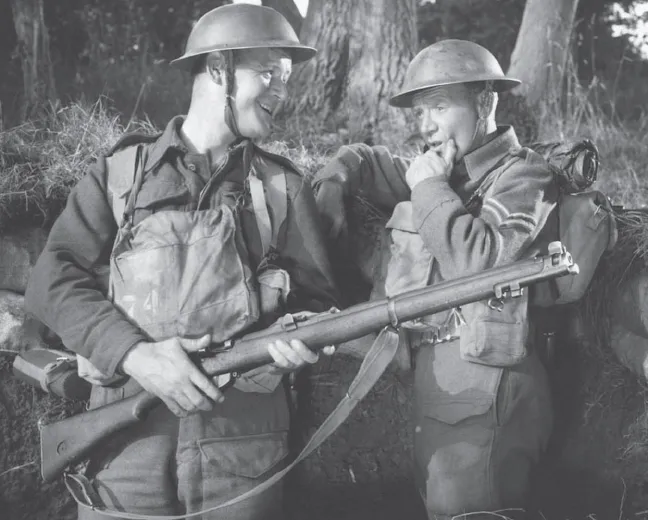
Stranded in France with the British Expeditionary Force, British ‘Tommy’, Corporal Tubby Binns (John Mills, right), contemplates his next move in Leslie Norman’s Dunkirk (1958). Courtesy Kevin Wilkinson Collection.
In 1940, during the ‘Phoney War’, journalist Foreman tries to force straight answers from British Army spokesmen who are economical with the truth, while Hitler’s divisions mass on the border. When the fury of the Blitzkrieg is unleashed, the Belgian, French and British forces are overwhelmed. Binns and his Wiltshire regiment are ordered to pull back from their defence of the River Dyle, destroying bridges as they go. An aerial attack kills Lieutenant Lumpkin (Kenneth Cope) and Binns takes command of the remaining four men, who are separated from their unit in the confusion of the war zone. They witness a Royal Artillery battery obliterated by a dive-bombing Stuka attack: ‘That’s murder, that’s sheer bloody murder’, notes a British Tommy. It is decided that the situation is hopeless and the BEF is ordered to pull back to Dunkirk for evacuation. In an effort to assemble a flotilla, the Royal Navy requisition ‘anything that can float’. Foreman and Holden have their riverboats purloined and sail to Ramsgate, via Sheerness, where they volunteer to take their boats across the Channel. Meanwhile Binns and his men scrounge for food as the Germans close in. They manage to break through German lines and hitch a lift in a British lorry heading for Dunkirk. On the outskirts of the town they scuttle the lorry to prevent it falling into enemy hands (emptying the sump and running the engine until it seizes up) and join the thousands of soldiers waiting for rescue on the beaches. The troops are at the mercy of the Luftwaffe, who strafe the beaches and bomb the relief ships off shore. Foreman’s boat is sunk and Holden’s engine packs up, so they try to repair it on the beach. During an air attack, Foreman is killed. Holden, his boat fixed, ferries Binns and his comrades back to Blighty.
Produced by Michael Balcon and directed by Leslie Norman (UK film critic Barry Norman’s father), Dunkirk was based on The Big Pick Up, a 1955 novel by Adam Hall (as ‘Elleston Trevor’) and the play Dunkirk by Lt-Col Ewan Butler and Major J.S. Bradford. The screenplay was written by David Devine and W.P. Lipscomb. Malcolm Arnold provided the rousing, patriotic score. Norman shot interiors at Ealing Studios and used authentic locations for the English scenes, including Fingringhole, Colchester and Sheerness Dockyards in Kent. The flotilla sails down the Thames past Westminster and Big Ben, and the cliffs of Dover also appear as a backdrop. The long flat beach backed by dunes on Camber Sands in East Sussex was ‘Dunkirk’.
Dunkirk’s parallel stories keep the plot moving. Mills is his usual stalwart self in a genre he excelled at. He made many war movies, including three in 1958: Dunkirk, Ice Cold in Alex and I Was Monty’s Double. Bernard Lee (later M in the James Bond films) is good as the cynical journalist who stands on Dunkirk beach and witnesses the fiasco firsthand. He notes that the BEF are using ‘last-war weapons, last-war methods’. But it’s Attenborough who most impresses, with his portrayal of Holden, the garage owner and proprietor of a small engineering firm which makes belt buckles for the army. Holden thinks he’s ‘doing his bit’, but others take him for a cowardly shirker with a ‘soft job’. He initially claims that he’s far too busy to pilot his boat to Sheerness, let alone to Dunkirk, and frets for his wife Grace (Patricia Plunkett) and their newborn baby. In a moving scene, he attempts to fit a cumbersome gasmask on the baby. Holden realises that he’s not doing enough for the...
Table of contents
- Cover
- Title Page
- Copyright Page
- Dedication
- Contents
- List of Illustrations
- Preface: War and Remembrance
- Acknowledgements
- Introduction: Before the Blitzkrieg
- Chapter 1 The Fall of France (1940)
- Chapter 2 The War in the Skies (1940–45)
- Chapter 3 The War at Sea (1940–45)
- Chapter 4 The Pacific War (1941–42)
- Chapter 5 The Submarine War (1940–45)
- Chapter 6 The War in the Med (1940–45)
- Chapter 7 The Desert War (1940–43)
- Chapter 8 War Behind the Wire (1940–45)
- Chapter 9 The War in the Far East (1941–45)
- Chapter 10 The Eastern Front (1941–45)
- Chapter 11 The Battle for Italy (1943–45)
- Chapter 12 Special Ops in Europe (1940–44)
- Chapter 13 Special Ops in Europe II (1944–45)
- Chapter 14 Operation Overlord: The D-Day Landings (1944)
- Chapter 15 The Battle for France (1944)
- Chapter 16 Operation Market Garden (1944)
- Chapter 17 The Pacific War II (1942–45)
- Chapter 18 The Ardennes Offensive (1944–45)
- Epilogue: The End of Days
- Bibliography and Sources
Trusted by 375,005 students
Access to over 1.5 million titles for a fair monthly price.
Study more efficiently using our study tools.
Frequently asked questions
Yes, you can cancel anytime from the Subscription tab in your account settings on the Perlego website. Your subscription will stay active until the end of your current billing period. Learn how to cancel your subscription
No, books cannot be downloaded as external files, such as PDFs, for use outside of Perlego. However, you can download books within the Perlego app for offline reading on mobile or tablet. Learn how to download books offline
Perlego offers two plans: Essential and Complete
- Essential is ideal for learners and professionals who enjoy exploring a wide range of subjects. Access the Essential Library with 800,000+ trusted titles and best-sellers across business, personal growth, and the humanities. Includes unlimited reading time and Standard Read Aloud voice.
- Complete: Perfect for advanced learners and researchers needing full, unrestricted access. Unlock 1.5M+ books across hundreds of subjects, including academic and specialized titles. The Complete Plan also includes advanced features like Premium Read Aloud and Research Assistant.
We are an online textbook subscription service, where you can get access to an entire online library for less than the price of a single book per month. With over 1.5 million books across 990+ topics, we’ve got you covered! Learn about our mission
Look out for the read-aloud symbol on your next book to see if you can listen to it. The read-aloud tool reads text aloud for you, highlighting the text as it is being read. You can pause it, speed it up and slow it down. Learn more about Read Aloud
Yes! You can use the Perlego app on both iOS and Android devices to read anytime, anywhere — even offline. Perfect for commutes or when you’re on the go.
Please note we cannot support devices running on iOS 13 and Android 7 or earlier. Learn more about using the app
Please note we cannot support devices running on iOS 13 and Android 7 or earlier. Learn more about using the app
Yes, you can access When Eagles Dared by Howard Hughes in PDF and/or ePUB format, as well as other popular books in History & World War II. We have over 1.5 million books available in our catalogue for you to explore.