- 192 pages
- English
- ePUB (mobile friendly)
- Available on iOS & Android
eBook - ePub
Art and Animals
About this book
'Art is continually haunted by the animal', wrote Deleuze and Guattari. Over the past two decades, animals have quite literally invaded the gallery space, from Joseph Beuys' co-habiting with a coyote, Janis Kounelli's instillation of live horses, Damien Hirst's shark in formaldehyde to Mark Dion's natural history displays and Marco Evaristti's 'goldfish in a blender'. In this latest addition to the highly acclaimed 'Art and...' series, Giovanni Aloi surveys the insistent presence of animals in the world of contemporary art, exploring the leading concepts which inform this emerging practice. From exhibitions featuring live animals, to taxidermy, and interspecies communication, Giovanni Aloi explores how animals feature in modern art with a range of thought-provoking and innovative visual representations. Art and Animals challenges ideas of identity, 'otherness' and civilisation by explaining the role animals have occupied in our cultural development and illustrating their presence in the visual arts today.
Information
Chapter 1
Caught up in Representation
Only occasionally, without a sound, do the covers of the eyes slide open – an image rushes in, goes through the tensed silence of the frame – only to vanish, forever, in the heart.
(R.M. Rilke, Der Panther, 1907)1
In 1992, Damien Hirst’s The Physical Impossibility of Death in the Mind of Someone Living, a tiger shark submerged in formaldehyde and housed in a large glass case, hit the headlines. The work generated great controversy, and among other things it was responsible for bringing the topic of animals in contemporary art to wider audiences. Most notably, the British tabloid The Sun, reported the famous story titled ‘£50,000 for fish without chips’2 humouring at once the work, its alleged artistic qualities, and the seemingly absurd value assigned to it by the art market. Whether we like it or not, the artwork has already secured its place in the History of Art book, while simultaneously finding a space in the minds of the many who know it, without even having seen it in the flesh. From the perspective of this book’s subject, the work brings to the fore a number of issues related to the presence of the animal in contemporary art.
There are a number of fundamental differences between the representation of animals in art from the classical to the romantic, the modern and the postmodern periods. The main difference between the traditional representation of animals in art and the use Damien Hirst makes of the shark lies in the fact that the animal we see in The Physical Impossibility of Death in the Mind of Someone Living is an animal body, not the man-made depiction of one. We are all familiar with the multitude of works featuring animals that have helped define the canon of one of the lower genres in the history of painting, but the presentations of real animal bodies in art is a much newer occurrence. As such, it does not entirely function within the paradigmatic set in which the painted representations of animals operate. The tiger shark in Hirst’s work was a natural body now preserved in formaldehyde, and it therefore belongs to the tradition of natural-history museum preservation, not that of classical art. However, upon being relocated from the museum’s vaults to the gallery space, this body becomes interlinked with the heritage and aura of the art object. It is stripped of its scientific value and finds itself caught up in a web of representational references. The shark is made of flesh and bones, but is not alive, and therefore it can easily be classified as object. An interesting comparison could be here drawn between Hirst’s shark and a famous painting by John Singleton Copley, Watson and the Shark, from 1778. Let’s, for instance, argue that Hirst’s shark is the real thing and not a representation, and that therefore this substantial difference adds something to his work that Copley’s painting can never quite capture. What is this something? And does this something tell us anything more about the shark that Copley’s painting could not convey? The many formulations of postmodernism all overlap in the outlining of the crisis of representation that so greatly pervades most contemporary artistic production. In postmodern art, unmediatedness is a relevant value, the assumption being that art and life are both fiction that can intertwine in the creation of visions which by nature are open-ended and undetermined. In this merging, is it therefore ever possible to escape the work of representation? Perhaps it would be more appropriate to argue that postmodernism is in perpetual conflict with representation itself in the same way that a pianist’s improvisation can relentlessly attempt to shy away from harmonic balance, just to find that the mere act of juxtaposing notes has inadvertently outlined a different kind of harmonic structure. This is to say that for as much as Hirst’s shark may seem unmediated because it is presented as real, the artist has taken a number of decisions which all do, in one way or another, bring the animal body closer to the paradigmatic set of more traditional art.
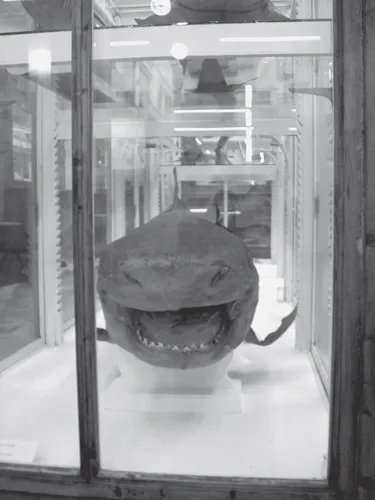
1. Shark (Display cabinet at Museum La Specola, Florence, Italy) (Photograph Giovanni Aloi 2010).
The history of animals in painting began in the Palaeolithic period (32,000 years ago),3 and it is not known why men started to look at animals and then paint them on the walls of caves. Drawing animals would then constitute a tool towards the understanding of them. But what other reason brought man to paint animals? Assumptions are all we can draw, and it is difficult to admit that there is something rather dramatic about the amnesia that erased from our minds the original relational mode we entertained with animals. A sense of having lost an original connectedness with nature seems forever gone, as we can’t remember or clearly reconstruct the grounds on which this relationship may once have existed. It has been claimed that cave paintings may have served a divinatory role, whereby the drawing of animals would have resulted in fruitful hunting. Others have claimed that the images were instead part of shamanic rituals, in which the animals painted do not refer to animals in flesh and bone but to ‘spirit-animals’, mediating and reconciling human experiences in nature.4
From this point onward, until the romantic period, whatever the real purpose of the cave painting was, we find that the animal in art substantially came to inhabit two extremely opposed categories: that of food and that of god. In Egyptian art, for instance, gods were frequently pictured with animal heads: Ra had the head of a falcon, Thot that of an ibis and Bastet that of a cat, while it is of course worth remembering that the supremely important job of moving the sun in the sky was carried out by a scarab (dung beetle).
In Greek mythology, the chimerical combination of human and animal was also a persistent presence: the Minotaur, the Gorgon and the Sphinx are only a few among many examples. The transformation of humans into animals, most notably by Zeus in order to fulfil his lustful desires, have become a staple of classical mischievousness. It is, however, between 186 BCE and 281 CE that we find a consistent shift in our relationship with animals through the celebrated Roman entertainment of public animal slaughtering. From this point onwards, the history of human–animal relationships can indeed be read as a quest for control over the strange, the exotic and the unknown, a phenomenon that historically resurfaces in different forms and media through the spectacle of game hunting, the performative ritual of the corrida, the assembling of dioramas in natural-history museums, and the opening of zoos through the appropriations of imperialist Europe.
The Sublime Animal
Let’s now return to Hirst’s shark, as we bear in mind that the relational platform on which modern human–animal relationships are formed is largely informed by the historical development briefly outlined above. As mentioned earlier, despite its cutting-edge appearance, Damien Hirst’s shark restages a relatively traditional encounter with the ‘animal in art’ based on the notion of the sublime. It does so by invoking in the viewer primordial and overwhelming responses triggered by the presence of one of the most dreaded natural predators. It has been argued by Paul Crowther that contemporary art has mainly endorsed two aspects of the sublime.5 One revolves around the responses induced by the romantic legacy established by the stormy landscapes of W.J.M. Turner, the spiritually imbued scenes of Caspar David Friedrich and the crisp paintings of wild animals by Sir Edwin Henry Landseer. The other is more directly linked to the ‘shock factor’ caused by the imminence of utter destruction. The latter is of course something Damien Hirst’s shark quite clearly relies on.
In Hirst’s vision, it was essential that the shark be ‘big enough to eat you‘6 in order to achieve the desired effect. When looked at head on, the shark is meant to trigger pure ‘animal fear’ in the viewer, suggesting an instinctive connection with our prehistoric ancestors, for whom nature was not a subjugated external entity in which to indulge, but an all-encompassing system of life and death, where death could come at any time, in the shape of a larger predator. This overwhelming sense of fear that metaphorically removes us from the top of the food chain entirely functions on the dynamics of the sublime, especially on the evoked sense of impotence experienced in front of a potentially deadly force of nature. However, in this conception, the sublime only functions when the viewer is at some distance or protected from the source of overwhelming fear; therefore, safe from destruction. A certain pleasure can be found in panic. This is the overriding paradox that in Hirst is embodied by the glass tank, the element that visually prevents the shark from ‘killing’ the viewer.
From this perspective, the glass functions similarly to a painterly surface: a closed surface that confines the subject in traditionally illusory representational dimensions. Despite all this, Hirst’s shark gives us the opportunity to experience an intensity that a painting cannot quite conjure: that is the encounter with the animal matter. Facing the shark, the viewer is directly confronted by it. In this specific case, it is not the eyes but the mouth that becomes the most eloquent signifier in the relational. Here, the animal body has almost entirely ceased to be that of an animal, only being such from a morphological perspective. Immersed in its perpetual bath of formaldehyde, a liquid substance that symbolises the subjugation of the animal, the shark’s body is stripped of its animality and allowed only to summon fears in humans. By animality, we here mean all the biological and behavioural traits along with the complex interconnectedness with other animals and environments that make the animal much more than a preserved dead body. As such, the abrasive presence of this animal is undeniable, but simultaneously fundamentally hollow. Do we learn anything new about sharks by standing in front of this work? In The Physical Impossibility of Death in the Mind of Someone Living, the little we already know about these animals is reassessed through the violent ‘reality check’ staged by the artist. What the work moreover reveals is the extent to which our knowledge of the animal is constructed by pop-cultural and literary sources.
In front of Hirst’s shark, it is impossible to escape the haunting memory of Steven Spielberg’s Jaws (1975), one of the most successful films of all time, and which forever cast a shadow on happy seaside summer holidays. Culturally, the film has, through the defining of iconic imagery and the use of a highly engaging soundtrack (one which at times resembles the sound of a terrorised speeding heartbeat), set a stereotypical identity for the shark by which, broadly speaking, the animal is perceived as nothing more than a death-machine to fight and kill. Paradoxically, all this happened through the making of a film in which the shark itself is almost completely absent, as the purpose-designed mechanical shark designed for filming constantly malfunctioned, forcing Spielberg to redraw large parts of his storyboard and use camerawork capable of conjuring the presence of the animal.7
Specimens and Trophies
The achieving of the impossible, also echoed in the title of Hirst’s work, is key to the seemingly indissoluble development of knowledge through technological advancements that saw a progressive distancing from nature in the Victorian period. Then, colonial expeditions brought back to Europe exotic animals that nobody, or very few, had ever had the luck to see in the flesh. These opportunities were offered by the technological developments that made ships larger and faster, and allowed for live animals to be transported from extremely remote locations.
The element of the spectacle is paramount to the understanding of animal interrelationships in the 1800s. This is something that will be fully explored in the next chapter, but for the time being it is important to take into account the ambivalent and contradictory manifestations of animal relations in this period, as these most define our approach. To this purpose, Hirst’s shark at once encapsulates the two main embodiments of these manifestations: the specimen and the trophy. Many animals were brought to Europe in the name of scientific research. Some were displayed in natural-history museums as a source of education and entertainment. Hirst presents the shark in compliance with this tradition, submerged in formaldehyde; the animal is a museum specimen that viewers look at for entertainment and, to some degree, for education. Looking at animal bodies on display, it is easy to forget that behind the acquisition of these there lies a thriving hunting business which at times has depleted many areas of species. The emergence of the animal trophy is emblematic of the 1800s, and the human-animal relationship that shaped it. Hirst’s shark can indeed also be seen as a trophy, especially if it is taken into account that Hirst commissioned the killing of the fish especially for the piece, with the explicit request that the shark be a large one, in order to trigger the desired effect.8 Within the artistic system of sourcing and delegating in which Hirst exists as an artist, the animal can be understood as his personal trophy. It can be read as a masculine statement of power addressing the art world at large, ‘An artist capable of bottling a shark is more dangerous than the shark itself’ being the message delivered to the contemporary viewer. Most interestingly, the work also relies on the trope which in popular culture links the shark to capitalism, something which clearly can be read as a tongue-in-cheek self-referential comment about the artist’s own approach to making art, which relies heavily on commodification and market power. Using the animal body in art, whether alive or dead, is an implicit attention-grabber. This is effectively what substantially differentiates Hirst’s piece from Copley’s painting and any other painting of sharks. The publicity artists garner from the focus on animals as main subject of their works can define the success of a career. The art involving animals that this book is concerned with typically displays a critical approach to the subject, and tries to untangle the multi-layered problematics involved in our relationship with animals. Many contemporary artists have, for instance, recently revisited the ambivalent practice of taxidermy and its function as creating specimens in natural-history museums and trophies in the hunter’s home, in order to deconstruct the origins of our modern relationship with animals for the purpose of developing a more self-aware approach in the future.
One such example is that of artist France Cadet, who in 2008 created a robotic installation titled Hunting Trophies, in which a number of robotic animal heads were mounted on the wall in the tradition of taxidermy-trophy. The interactive installation featured animatronic animal heads equipped with sensors triggered by gallery visitors. As in Damien Hirst’s shark, the artist took care to display the heads at eye level, so as to stage a reciprocal and direct encounter – the heads would suddenly move upon being approached, surprising the viewer. Cadet’s animals are generally represented in robotic guises in order to comment on the Descartian influential view that animals are no more than machines with a complex assemblage of parts. However, their ‘trophy-heads’ status also addresses the current posthumanist enthusiasm for the triangulation between animals, machines and humans that in philosophical realms proposes an abandoning of anthropocentric certitude.9
The use of live or dead animals in contemporary art also raises a number of ethical issues that we will consider further throughout the book. But for the time being, it is worth noting that France Cadet’s robotic creations, in their effective directness, do without the involvement of any live or dead animal, and therefore without any animal killing. Of course the same may not be said for Hirst, where the killing of a wild animal was commissioned expressly for the creation of a work of art that was sold by Saatchi in 2004 for $8 million.10 The killing of animals will be discussed at length in Chapter 6, but it is worth pointing out here that the live presence of animals in the gallery space, something that has become increasingly common, also entails a set of specific complications.
Alive and Kicking
It is interesting to note that the first live animals to appear in the gallery space belonged to the categories of ‘the pest’ or ‘the e...
Table of contents
- Cover
- Title page
- Copyright page
- Dedication page
- Contents
- List of Illustrations
- Acknowledgements
- Preface: Why Look at Animals Now?
- Chapter 1 Caught up in Representation
- Chapter 2 Taxidermy: Subjugated Wilderness
- Chapter 3 Levels of Proximity
- Chapter 4 An Uncomfortable Closeness
- Chapter 5 The Animal that Therefore I am Not
- Chapter 6 The Death of the Animal
- Chapter 7 Conclusion In Conversation with Mark Dion – The Culture of Nature
- Notes
- Bibliography
- Filmography
Trusted by 375,005 students
Access to over 1.5 million titles for a fair monthly price.
Study more efficiently using our study tools.
Frequently asked questions
Yes, you can cancel anytime from the Subscription tab in your account settings on the Perlego website. Your subscription will stay active until the end of your current billing period. Learn how to cancel your subscription
No, books cannot be downloaded as external files, such as PDFs, for use outside of Perlego. However, you can download books within the Perlego app for offline reading on mobile or tablet. Learn how to download books offline
We are an online textbook subscription service, where you can get access to an entire online library for less than the price of a single book per month. With over 1.5 million books across 990+ topics, we’ve got you covered! Learn about our mission
Look out for the read-aloud symbol on your next book to see if you can listen to it. The read-aloud tool reads text aloud for you, highlighting the text as it is being read. You can pause it, speed it up and slow it down. Learn more about Read Aloud
Yes! You can use the Perlego app on both iOS and Android devices to read anytime, anywhere — even offline. Perfect for commutes or when you’re on the go.
Please note we cannot support devices running on iOS 13 and Android 7 or earlier. Learn more about using the app
Please note we cannot support devices running on iOS 13 and Android 7 or earlier. Learn more about using the app
Yes, you can access Art and Animals by Giovanni Aloi in PDF and/or ePUB format, as well as other popular books in Art & Art General. We have over 1.5 million books available in our catalogue for you to explore.