Mustafa Kemal – latterly and better known as Atatürk - is without doubt the most famous figure in modern Turkish history. But what was his path to power? And how did his early career as a soldier in the Ottoman army affect his later decisions as President?
The Young Atatürk tracks the lesser covered period of Kemal's life – from the War of Independence to the founding of the Republic. George W. Gawrych shows that it is only by understanding Kemal's military career that one can fully comprehend how he evolved as one of the twentieth century's most extraordinary statesmen. Gawrych also contributes to the understanding of Kemal by presenting a systematic and critical analysis of his military writings, orders, actions, and letters as well as his political decisions, speeches, proclamations, and private correspondences.
Soldiering helped shape Kemal's critical reasoning, personal values and emotional intelligence. His experiences as an officer and commander forced him to adjust theories to practices in order to solve problems and make decisions. But Kemal was a natural political leader and his broad intellectual interests and personal studies helped prepare him for political leadership. Gawrych demonstrates that in the last year of the War of Independence Kemal excelled as both Commander-in-Chief of the Armed Forces and President of the Grand National Assembly of Turkey.
Gawrych incorporates previously-unstudied Ottoman archival documents and is the first Western scholar to conduct extensive research on Kemal in the military archives of the Turkish General Staff. This book is essential reading for those seeking to understand the establishment of the Republic of Turkey and the part that Kemal played in that process.
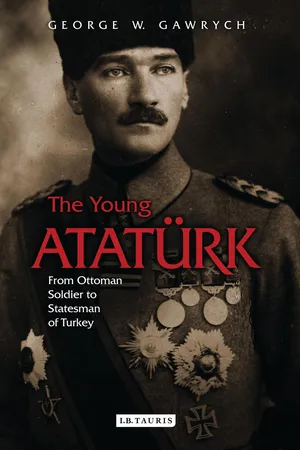
- 288 pages
- English
- ePUB (mobile friendly)
- Available on iOS & Android
eBook - ePub
About this book
Information
1
The Making of an Ottoman Soldier
War is a matter of vital importance to the State; the province of life and death; the road to survival or ruin. It is mandatory that it be thoroughly studied.
Sun Tzu1
Not being reinforced by my experience and continuous studies, my ideas on people and life are, more or less, changing from my former ones.
Mustafa Kemal, Syria, late 1906 or early 1907
MUSTAFA KEMAL ATATÜRK was a serious student of people and life who believed in the power of the mind and intuition. An avid and serious reader, he devoted himself to the study of war outside the classroom, while at the same time broadening his intellectual interests beyond the military profession into other fields. For Mustafa Kemal, theory and practical knowledge were important vehicles for developing leadership skills. As a result of his stellar performance in military schools, he graduated from the Staff College as a member of the prestigious General Staff. Quite naturally, he eagerly sought command responsibilities. It took the Revolution of July 1908, however, to release the energies of the officer corps, and Mustafa Kemal thrived in the new environment of professional opportunities.
The Road to Istanbul
Born in the winter of 1880/1881 (exact date unknown), Mustafa Kemal spent the greater part of his first fourteen years in the town of his birth, Selanik (Salonica), in Macedonia. Located 510 kilometers southwest of Istanbul, Selanik was a cultural, commercial, and economic center in the Balkans and the second most important city in the Ottoman Empire. Estimates for the early 1890s put the city’s population at around 150,000 inhabitants. The fifty-six mosques, five medreses (religious seminaries), a library, twenty-three tekkes (Sufi convents), sixteen churches, and twenty-one synagogues attested to the diversity of its people’s backgrounds. The city claimed education and culture: three hospitals, a theater, two secondary schools, a military preparatory school, a state high school, and an agricultural school, in addition to a number of religious minority and foreign schools. All the major European countries had consulates in the city. Selanik also possessed good port facilities and railroad connections, a major marketplace, fifteen guest houses, and twenty-three factories or business establishments. Jews counted for approximately half the inhabitants. Muslims formed the second largest group, approximately 20 per cent of the population. Rums (Ottoman Greeks), Bulgarians, and Europeans constituted the remainder.2

Map 1.1 Ottoman Empire Boundaries, 1881
Throughout his life, Mustafa Kemal carried a strong attachment to his hometown and its region. Years later while a student at the Staff College (1902–5), he would write in his personal notebook: “I am pleased, with a feeling of good fortune, to be from Selanik. If you want to know the truth better, I feel that my chest is overflowing with a feeling of pride … The most perfect qualities come to life in my mind.”3 Attachments to his roots and early years remained strong throughout Kemal’s life. In November 1912, for example, Ali Fuad (Cebesoy) reported seeing Mustafa Kemal cry when he learned of the fall of Selanik to Greece in the Balkan Wars. At the time, he uttered a poignant question: “Will I ever see you again as a Turk?”4 As President of the Republic, though he loved Western music, Mustafa Kemal remained wedded to Rumelian music, so much so that Falih Rıfkı (Atay), a close associate, found it a bit puzzling to witness such a strong bond to the past from one so determined to transform everything. He described Mustafa Kemal as a man whose mind had eyes looking forward but whose heart had eyes looking back at his past and all his memories.5 Selanik’s rich and diverse culture laid the seeds for Kemal’s cosmopolitan mind.
Overall, the Ottoman Empire was ethnically and religiously quite heterogeneous. Excluding areas under special administrations, such as Egypt and Lebanon, its population numbered some 17 million, with Muslims accounting for 12.5 million. On the European side, Christians outnumbered Muslims: 1.7 to 1.4 million. These figures represented a significant shrinkage in both population and territory that resulted from the Russo-Turkish War of 1877–78, when Bosnia-Herzegovina was occupied by Austria-Hungary, the Kars region by Russia, and Cyprus by Britain. Part of Bulgaria, nevertheless, became an autonomous principality, while Eastern Rumeli fell under a special administration. Adding more humiliation, the British occupied Egypt in 1882, establishing a de facto protectorate over this important province.
Mustafa Kemal had experienced a difficult childhood. His home has been aptly called “a house of mourning.”6 His father, Ali Rıza, worked as a minor civil servant, seeing service for a period as a border customs official. Zübeyde, some twenty years younger than her husband, married young and began having children at the age of fifteen. Of five to six children, depending on the account, only Mustafa Kemal and his younger sister Makbule survived to adulthood. Meanwhile, Ali Rıza ventured into business, selling timber and then salt. These enterprises failed, and Ali Rıza took to drinking, developed tuberculosis, and suffered from illness the last three years of his life.7
The family’s life reflected the tensions between traditional and progressive forces at work in the larger Ottoman society. Based on his own account, Zübeyde, a pious Muslim, wanted her son to attend a local Muslim school and become a religious figure in his community. His given name was Mustafa or “The Chosen,” an epithet of the Prophet Muhammad. In 1886–87, Mustafa began his formal education at the neighborhood religious school. This schooling lasted for only a few days. In sharp contrast to his wife, Ali Rıza desired a modern education for his son and quickly transferred him to a private school founded by Şemsi Efendi, a champion of “new principles” that emphasized critical thinking over rote learning in education.8
Ali Rıza died when Mustafa was seven years old, leaving the family in a difficult financial situation. Suddenly a widow, Zübeyde sought shelter by moving the family to the farm of an uncle, one named Hüseyin Ağa, some thirty kilometers away. There a Greek Orthodox priest at a local church and an imam at a local mosque both gave Mustafa additional schooling. Then Zübeyde sent Mustafa back to Selanik to live with his paternal aunt so that he could attend a government school. Meanwhile, she married Rağıb Bey, a minor government official with four children from his previous marriage, and the couple lived in Selanik. Mustafa felt estranged in this new household and left home to stay with a relative.
In 1893, now twelve years old, Mustafa made a life-changing decision. He passed an entrance exam for the Selanik Military Preparatory School, where he enrolled against the expressed wishes of his mother.9 Mustafa apparently had fallen under the magical spell of soldiering.
We had a neighbor named Major Kadri Bey. His son, Ahmed, was studying at the secondary military school [in Selanik] and wore his military uniform. When I saw him, I decided also to wear such a uniform. Then I observed officers on the street. I realized that the road to reaching this rank required entering the military secondary school.10
Mustafa’s was an era when impressionable young boys still heard stories of past Ottoman military glories and played soldier games as part of their socialization.11 Thus the military environment provided Mustafa with steady meaning, purpose, direction, order, and discipline. Three members of his extended family—Nuri (Conker), Fuad (Bulca), and Salih (Bozok)—followed his example and enrolled in the same school, also carving out military careers for themselves. All three became Mustafa’s trusted and loyal lieutenants and friends.
Mustafa’s attendance at the military preparatory school in Selanik covered the period 1893–95. Throughout his life, he credited teachers as playing an important role in what he once described in a 1924 speech as “enlightening influences on the development of our souls and minds.” From his Selanik days, he singled out Nakiyüddin (Yücekök), his French teacher, who during the Republic served as deputy in the Grand National Assembly of Turkey and assisted in the alphabet and religious reforms.12 Mustafa commenced study of the French language, but mathematics became his favorite subject. His math teacher, a Captain Mustafa Efendi, reportedly gave Mustafa the second name of Kemal because of his exceptional work in the subject.13 Kemal means maturity or perfection. Or, another explanation, Mustafa adopted the name on his own in honor of the famous Ottoman poet Namık Kemal, whose influence was felt by many young people.14 Whatever the explanation, the name change fit Mustafa well, if one understands maturity or perfection as a process in a purpose-driven life.
In 1895, Mustafa Kemal demonstrated his academic commitment to learning by graduating fourth in his class. That same year, he entered Manastır (today Bitola) Military High School. Situated 180 kilometers northwest of Selanik, Manastır had over 30,000 inhabitants and served as the capital of the province with the same name. The city also possessed a rather diverse population, with Muslims constituting approximately two-thirds of the inhabitants, with Rums, Vlachs, Bulgarians, and Jews forming much of the rest.15 Unlike Selanik, Manastır was very much a military town, housing the headquarters of Third Army, a military hospital, two large military barracks, and a military high school. Mustafa Kemal spent almost four years, from 1895 to 1898, studying there. The curriculum emphasized mathematics, the sciences, and French.16 Manastır exer...
Table of contents
- About the Author
- Title Page
- List of Images
- List of Maps
- List of Abbreviations
- Introduction
- 1 • The Making of an Ottoman Soldier
- 2 • The Great War and an Imperialist Peace
- 3 • Developing a Resistance
- 4 • The Grand National Assembly
- 5 • A Crisis in Battle
- 6 • Commander in Chief
- 7 • From Lightning Campaign to Peace
- Conclusion
- Notes
- Biographical Notes of Key Figures
- Bibliography
Trusted by 375,005 students
Access to over 1.5 million titles for a fair monthly price.
Study more efficiently using our study tools.
Frequently asked questions
Yes, you can cancel anytime from the Subscription tab in your account settings on the Perlego website. Your subscription will stay active until the end of your current billing period. Learn how to cancel your subscription
No, books cannot be downloaded as external files, such as PDFs, for use outside of Perlego. However, you can download books within the Perlego app for offline reading on mobile or tablet. Learn how to download books offline
Perlego offers two plans: Essential and Complete
- Essential is ideal for learners and professionals who enjoy exploring a wide range of subjects. Access the Essential Library with 800,000+ trusted titles and best-sellers across business, personal growth, and the humanities. Includes unlimited reading time and Standard Read Aloud voice.
- Complete: Perfect for advanced learners and researchers needing full, unrestricted access. Unlock 1.5M+ books across hundreds of subjects, including academic and specialized titles. The Complete Plan also includes advanced features like Premium Read Aloud and Research Assistant.
We are an online textbook subscription service, where you can get access to an entire online library for less than the price of a single book per month. With over 1.5 million books across 990+ topics, we’ve got you covered! Learn about our mission
Look out for the read-aloud symbol on your next book to see if you can listen to it. The read-aloud tool reads text aloud for you, highlighting the text as it is being read. You can pause it, speed it up and slow it down. Learn more about Read Aloud
Yes! You can use the Perlego app on both iOS and Android devices to read anytime, anywhere — even offline. Perfect for commutes or when you’re on the go.
Please note we cannot support devices running on iOS 13 and Android 7 or earlier. Learn more about using the app
Please note we cannot support devices running on iOS 13 and Android 7 or earlier. Learn more about using the app
Yes, you can access The Young Atatürk by George W. Gawrych in PDF and/or ePUB format, as well as other popular books in History & Middle Eastern History. We have over 1.5 million books available in our catalogue for you to explore.