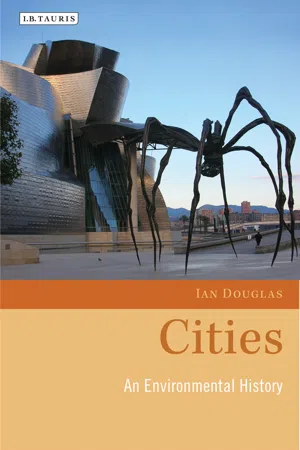
Cities are amongst our greatest creations. Yet, with cities now home to over half the world's population, there is increasing concern over their unchecked expansion and the detrimental effect this is having on the planet. This unfettered growth is affecting every ecosystem on Earth, from the deepest oceans to the highest mountains, as induced climate change and ever increasing demands upon the world's resources take effect. As the pace of urbanisation quickens, how can we make the world's cities more sustainable? Ian Douglas tells the story of cities. He shows why they exist, how they have evolved and the problems they have encountered, revealing how from the very beginning environmental management played a key role in urban life. He addresses specific problems, such as noise and air pollution, water supply and waste management, as well as the vulnerability of cities to hazards such as earthquakes and flooding. And he considers strategies to make cities more sustainable and help them adapt to climate change, such as waste recycling, energy conservation, dual water systems, sustainable housing, as well as initiatives to retrofit existing cities.
Written by an acknowledged international authority, this unique volume will be welcomed by students and specialists in environment, planning, geography, ecology and the built environment.
- 384 pages
- English
- ePUB (mobile friendly)
- Available on iOS & Android
eBook - ePub
About this book
Information
1
Trading Village
to Global Megalopolis
to Global Megalopolis
The Origins and Expansion of Cities
Now that more than half the world’s people live in cities we are becoming increasingly aware that we need to understand the origins, present dynamics and future trends of urban development in much more detail than ever before. Not only has international and intra-national migration made the social character of cities more diverse and complex than previously, but also patterns of international trade and globalization have led to large urban centres taking on something of a familiar pattern everywhere, with the same multiple stores and similar middle-class housing, motor vehicle congestion and urban rapid transit conditions in cities across all continents. The environmental history of cities examines how these changes in cities have impacted upon the environment, how they have aggravated or produced environmental problems and how city governments and communities have endeavoured to deal with these problems.
The earliest human settlements were clusters of families engaged in subsistence hunting and gathering. Later they became involved in sedentary agriculture, and sometimes found they had occasional surplus production which could be traded for obsidian to make tools, copper ornaments, better seeds or other types of food. Some settlements began to develop specialized tool-making and ornament-making, others became trading posts where goods were exchanged. These were the beginning of urban functions. In some cases there were needs for military protection behind walls, and, quite often, the need for special structures for religious activities. In such ways the settlement began to meet some of the pre-conditions for an urban entity including: permanent settlement in dense aggregations; non-agricultural specialists; taxation and wealth accumulation; monumental public buildings; and a ruling class. Such phenomena are usually associated with the existence of: writing techniques; predictive science; artistic expression; trade for essential materials; and a decline in the importance of kinship.
It was not always thus. Compared to the existence of Homo Sapiens in Africa 164,000 years ago and the migration from Africa to other continents about 50,000 years ago,1 the development of cities has been short-lived, but dramatic. Cities, or more probably towns and urban settlements, where a specialization of labour and some form of social hierarchy emerged, began to develop 9000 to 6000 BC. Nearly all this rural to urban transition began with agriculture and trade. The first towns were essentially overgrown villages associated with trade routes and water management. During the Neolithic, trade in obsidian became important in villages to the north of the Tigris and Euphrates rivers. Copper was worked into ornaments that were also traded. Centres began to produce pottery, but there is no evidence of the development of strong government or political authority. Çatalhöyük and Jericho (Table 1.1) are usually regarded as ‘precocious’ urban-like developments. However, they like their successors all involved enormous human effort to modify the environment to create building sites and reliable water supplies. Çatalhöyük was built on a large artificial mound, while Jericho had huge rock-cut ditches to carry its water (Table 1.1). The hydrological and geomorphological changes will have affected surrounding areas and changed the local biota. The cities also had to deal with their rubbish, usually by piling it up nearby. Not surprisingly, archaeologists often find many layers of garbage accumulated over centuries, interspersed with periods of new building after fire or temporary abandonment of the settlement. Records of destruction by fire or by war also emerge as do changes in the types of food used and the remnants of changing technologies. Soon metals begin to appear in the waste, indicating new forms of urban consumption and technology. It is therefore good to look at how the technologies of the earliest cities have ramifications for today’s cities. The basic water supply system of the palace at Knossos, Crete in 1700 BC is highly similar to that of today. Aqueducts bring water in and it is stored in local distribution reservoirs. The wastewater is removed by one drainage system, stormwater in another. Many of the more deprived city dwellers of the twenty-first century AD do not benefit from such water supply and sanitation.
ÇATALHÖYÜK
Çatalhöyük in Anatolia (Turkey) flourished due to its rich obsidian deposits from around 6500 to 5550 BC. Neolithic Çatalhöyük is important both in terms of its record of symbolic expression and cultural complexity and as one of the best-studied of the first wave of agricultural settlements to appear in South-west Asia and the Balkans.2 Çatalhöyük thus demonstrates that cities may have developed outside the so-called Fertile Crescent, for long thought to have provided a unique environment for the creation of the first Near Eastern cities.3
The detailed multi-disciplinary investigations at Çatalhöyük reveal the close relationship between the environment and human activity at the beginnings of urbanization. Neolithic Çatalhöyük was located in an extensive alluvial wetland with a strongly seasonal climatic regime that produced a spring flood that surrounded the settlement mound by water for up to two months of the year (Figure 1.1). The seasonal wetlands provided a range of environmental resources from the protein-rich tubers of club-rush and wildfowl to marl clay for wall plaster, while the Çarşamba River, then flowing past the site, provided a key means of transport and communication.4 However, unless planted in late spring as flood-recession farming, the local alluvial soils cannot have provided the locus for cereal crop cultivation. Archaeobotanical data indicate that most of these crops were dry-farmed in non-alluvial soils located too far from Çatalhöyük to have been visited on a daily basis. The dry-farming would have been supported by the wetter and more reliable rainfall regime of Neolithic times.
Many of the themes found in symbolism and daily practice at Çatalhöyük occurred early in the processes of village and town growth. These themes include a social focus on memory construction; a symbolic focus on wild animals, violence, and death; and a central dominant role for humans in relation to the animal world.5 These themes are integral to the development of settled life and the domestication of plants and animals. Human settlements and early urbanism were thus part of efforts to overcome environmental difficulties, to have protection against the annual floods, to achieve adequate food supplies by seasonal engagement in dry-farming some distance from the settlement, and so extend the ecological footprint of the settlement. Eventually the site was transformed from a village into a town. This transformation must have been associated with an element of expansion and spreading of influence, perhaps under the leadership of a dynamic leader, family or group.
THE NORTE CHICO REGION OF PERU
In South America, urban settlements developed independently of those elsewhere. Caral and Aspero (Table 1.1) in Peru, date back to 5000 BC and provide a distinct counter-example to the concept of human conglomerations coming about due to war alone. The settlements are devoid of all signs of warfare; they have no walls, no defensive battlements, no weapons or mutilated bodies have been found and there are no artistic depictions of battle. Both enjoyed the benefits of trade between farmers and fishermen. They constructed large mounds to support ceremonial buildings. Baskets made of reeds were found beneath some of these earthworks, indicating how labourers had carried stones and earth on their backs. These settlements grew into major cities. Altogether, 20 sites in the region, sharing certain basic characteristics, including large-scale monumental architecture, extensive residential architecture and a lack of ceramics, demonstrate the development of a major cultural complex in the Norte Chico region of Peru by 3000 to 1800 BC.6
Table 1.1: Key early cities and their characteristics and environmental features


Figure 1.1: River flood regime annotated to show possible fission and fusion of Çatalhöyük’s population, along with seasonal activities located close to and more distant from the site. Lines show maximum, mean, and minimum monthly water flows of the Çarşamba River at Bozkir for the period 1964–80 (after Roberts and Rosen, 2009)
THE TIGRIS–EUPHRATES RIVER BASIN (ESPECIALLY MESOPOTAMIA)
From 6500 BC onwards urban settlements that combined defensive, commercial and religious functions began to develop both in Mesopotamia proper and along the trade routes of the upper Euphrates. Places like Tell Zaidan (Table 1.1) and Halaf, in the extreme northern river basin of the Euphrates in present-day Syria, became important. Specialist skills became concentrated in urban settlements. Religious leaders and rulers developed their power in the larger settlements and protected their interests by building defensive walls. These cities were primarily concerned with security and commerce. Many also had religious functions. Most of them changed the local environment by building mounds for the main structures.
By 3500 BC many prosperous cities, such as Uruk (Table 1.1), each surrounded by irrigated fields and villages, existed in the Tigris–Euphrates basin. They shared several key characteristics. They were governed by male priests, initially serving a female deity. Cultivated land came right into the city: many townspeople being part-time farmers who lived just outside the walls, within walking distance of the fields. The poor lived at the periphery but inside the walls. Merchants and craftsmen had homes closer to the centre, while the nobility, priests and warriors lived at the centre which had imposing ceremonial structures, the ziggurats and temples. The great surge in urban development led to the near abandonment of the surrounding countryside. Probably, most of the part-time farmers were people who had left their homes in isolated villages and moved into the city.7 Warfare is also a possible cause of the abandonment of rural settlements. Another might be that the kings of Uruk wanted tighter control of their subjects,8 perhaps in order to be able to coerce them to work on major construction projects.
However, these cities were vulnerable and plagued by major problems, including fires from out of control cooking fires; disease, linked to poor sanitation; famine in years when the annual floods were reduced in extent; and the threat of invasion by enemies. The famines were also associated with the impact cities had on their environment. The farmers had no drainage channels to carry excess water away from their fields. Thus salt built up as the excess water was evaporated, forcing farmers to switch from wheat to the more salt-tolerant barley (as at Eridu, Table 1.1). Eventually the salt levels were too great even for barley and the fields had to be abandoned. This legacy of saline soils still constrains agriculture in Iraq today.9
THE EARLIEST EGYPTIAN CITIES
Around 3500 BC, the village of Maadi was established about 15 km south of present-day Cairo, probably as a trade centre, with warehouses, silos and cellars. Maadi was at the end of an overland trade route to Palestine, and was probably inhabited by middlemen from the Levant at that time, trade items including copper and bitumen from South-west Asia being found at the site. Other artifacts linking the site with Upper Egypt suggest that Maadi was a junction of trade routes for the upper Nile and the Levant.
By 3000 BC, the first Egyptian kings consolidated their power at Memphis, developing a royal ideology that bonded all the districts to the person of the ruler. Although an important population centre throughout three millennia of pharaonic history, Memphis responded to environmental changes by moving eastwards as the Nile channel changed and sand dunes moved towards the city. At the peak of its development, the population of Memphis was probably below 40,000. Further south Thebes (the site of modern Luxor) reached a similar size, but most ancient Egyptian towns, such as Illahun, Edfu, Hierakonpolis and Abydos had from 1,400 to 3,000 inhabitants. Their residents included rural people, such as farmers and herdsmen who worked the fields every day. The kings, nobles and...
Table of contents
- Cover
- About the Author
- Title Page
- Copyright
- Contents
- List of Illustrations
- Acknowledgements
- Introduction
- 1. Trading Village to Global Megalopolis: The Origins and Expansion of Cities
- 2. Communities Responding to Disasters and Threats: Vulnerable and Resilient Cities
- 3. Foods, Goods, Materials and Ornaments: The Metabolism of Cities
- 4. Smoke, Fumes, Dust and Smog: Changing the Atmosphere of Cities
- 5. Water from the Hills, the Ground, the Sea, and the Roof: Towards Integrated Water Resource Management in Cities
- 6. Sanitation, Sewage and Mountains of Trash: Wastewater and Garbage in Cities
- 7. Urban Sounds and Smells: The Noisy, Aromatic City
- 8. Cities and a Dynamic Earth: Urban Changes to the Land Surface and Responses to Geophysical Hazards
- 9. Urban Greenspaces: the Tamed and Wild Nature in Cities
- 10. Urban Sustainability: Cities for Future Generations
- Final thoughts
- Notes
- Bibliography
- Back Cover
Trusted by 375,005 students
Access to over 1.5 million titles for a fair monthly price.
Study more efficiently using our study tools.
Frequently asked questions
Yes, you can cancel anytime from the Subscription tab in your account settings on the Perlego website. Your subscription will stay active until the end of your current billing period. Learn how to cancel your subscription
No, books cannot be downloaded as external files, such as PDFs, for use outside of Perlego. However, you can download books within the Perlego app for offline reading on mobile or tablet. Learn how to download books offline
Perlego offers two plans: Essential and Complete
- Essential is ideal for learners and professionals who enjoy exploring a wide range of subjects. Access the Essential Library with 800,000+ trusted titles and best-sellers across business, personal growth, and the humanities. Includes unlimited reading time and Standard Read Aloud voice.
- Complete: Perfect for advanced learners and researchers needing full, unrestricted access. Unlock 1.5M+ books across hundreds of subjects, including academic and specialized titles. The Complete Plan also includes advanced features like Premium Read Aloud and Research Assistant.
We are an online textbook subscription service, where you can get access to an entire online library for less than the price of a single book per month. With over 1.5 million books across 990+ topics, we’ve got you covered! Learn about our mission
Look out for the read-aloud symbol on your next book to see if you can listen to it. The read-aloud tool reads text aloud for you, highlighting the text as it is being read. You can pause it, speed it up and slow it down. Learn more about Read Aloud
Yes! You can use the Perlego app on both iOS and Android devices to read anytime, anywhere — even offline. Perfect for commutes or when you’re on the go.
Please note we cannot support devices running on iOS 13 and Android 7 or earlier. Learn more about using the app
Please note we cannot support devices running on iOS 13 and Android 7 or earlier. Learn more about using the app
Yes, you can access Cities by Ian Douglas in PDF and/or ePUB format, as well as other popular books in Historia & Arquitectura general. We have over 1.5 million books available in our catalogue for you to explore.