eBook - ePub
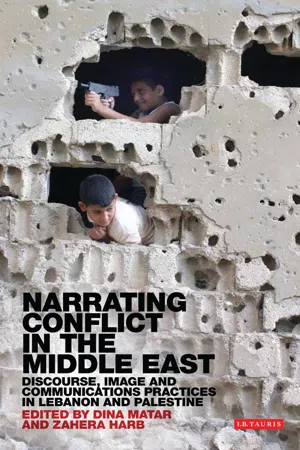
Narrating Conflict in the Middle East
Discourse, Image and Communications Practices in Lebanon and Palestine
- 288 pages
- English
- ePUB (mobile friendly)
- Available on iOS & Android
eBook - ePub
Narrating Conflict in the Middle East
Discourse, Image and Communications Practices in Lebanon and Palestine
About this book
The term 'conflict' has often been used broadly and uncritically to talk about diverse situations ranging from street protests to war, though the many factors that give rise to any conflict and its continuation over a period of time vary greatly. The starting point of this innovative book is that to consider conflict within a singular concept disables a coherent analysis of the constituent factors behind any particular conflict. At the same time, to consider each conflict as entirely distinct and unique undermines an attempt to examine common factors in all conflicts. The contributors set out to explore alternative ways in which the long-term conflicts in Palestine and Lebanon have been and are narrated, imagined and remembered in diverse spaces, including that of the media. They examine discourses and representations of the conflicts as well as practices of memory and performance in narratives of suffering and conflict, all of which suggest an embodied investment in narrating or communicating conflict. In so doing, they engage with local, global and regional realities in Lebanon and Palestine and they respond dynamically to these realities.
Information
1
APPROACHES TO NARRATING CONFLICT IN PALESTINE AND LEBANON: PRACTICES, DISCOURSES AND MEMORIES
DINA MATAR AND ZAHERA HARB
At the beginning of the twenty-first century, fewer countries are at war with each other than before, but the world remains beset by endemic and diverse conflicts. Many states are locked in bloody internal conflicts and internecine struggles, while the USA leads a highly public conflict in its self-defined “war against terror” post-September 11, 2001, plunging Iraq into bloody chaos and requiring a long-term presence of foreign troops in Afghanistan. At the same time, diverse conflicts against economic deprivation, dispossession and marginalization of particular groups whether on ethnic, gendered, sexual or religious grounds, as well as struggles over presence and power continue in several regions in the world, including the Middle East. Here, these struggles translated into popular uprisings in Egypt and Tunisia that ended with the overthrow of authoritarian regimes at the beginning of 2011 and spurred other similar protests in much of the Arab world over political representation and basic human needs, including the right to free thought and speech.
As clearly witnessed worldwide, these contests over power and presence were played out, and continue to be played out, on the street, and mediated via diverse systems of communication, including an increasingly overcrowded satellite broadcasting market in the Arab world and popular social networking sites. Within these highly mediated contexts, the potential for new and diverse struggles over identities, visibility and public presence becomes even more likely in various spaces and at different levels, rendering attempts to adequately theorize contemporary conflicts more problematic and demanding new research agendas and approaches on how conflicts are narrated, where and by whom, and how they are lived in everyday life.
Conflict and Media: Problems of Definition and Approach
The literature on conflict is extensive and impossible to detail here. However, to date there is no single theoretical approach that can adequately map, much less explain, all the conflicts in the world today (Cottle, 2006). In fact, to consider conflict as a singular or uniform concept that can be applied to all contexts and different geographical areas irrespective of history disables an analysis of the constituent factors and subjectivities defining and surrounding any particular conflict in a particular region, nation or space. At the same time, to consider each conflict as entirely distinct and/or unique undermines attempts to examine common and largely structural factors causing conflicts, such as economic disparities, marginalization and exclusion of certain groups by others (Maltby and Keeble, 2007). Generally speaking, the term conflict has been loosely used to refer to struggles between opposing interests, groups and outlooks, ranging from cultural and geo-political contests over discourse and power, to street protests, to civil or armed conflict within nation-states, and to the outbreak of armed hostilities between nations.
Briefly, the literature classifies conflicts in the post-Cold War era under three broad categories: those conflicts in which genuine geo-strategic and economic interests are involved; those caused by ethnic or nationalistic politics as witnessed in the war in the former Yugoslavia and those “invisible” conflicts such as the wars in Sudan and other parts of the world which rarely register on international media radar (see Thussu and Freedman, 2003). However, these categories are too general and vague, and cannot adequately or analytically describe complex, multiple or long-term conflicts, such as those in Palestine and Lebanon, which are a mixture of some or all of these categories put together, as well as some other categories not mentioned in these classifications. Furthermore, in the burgeoning literature on communication and conflict, or the scholarship on media and war (which includes studies related to Palestine and Lebanon), much emphasis has been placed on the representation and the reporting of contemporary conflict. In this area, analysis has mostly followed the methods and concepts of Western-centric mass communication theories and approaches which tend to focus on the mainstream media and other conventional forms of communication while ignoring other areas and spaces of expression.
In their edited book War and the Media (2003), Daya Thussu and Des Freedman suggest that the mainstream media’s role in communicating conflict can be identified as that of critical observer and publicist, and as battleground on which war and conflict are imagined and executed or framed. Other scholars working on the relationship between media and conflict, or media and war, particularly post-September 11, have focused on issues around the reporting of conflict in the news media; the communication of conflict between various parties and to outsiders; journalistic ethics and norms; objectivity, bias and propaganda; as well as representations of contemporary conflict. Most of these studies tend to address the traditional media—such as broadcasting, the press, the internet and other new technologies—often at the expense of alternative diverse spaces in which conflicts are imagined and narrated. In addition, little attention has been paid to what conflicts mean for those involved in them, whether as agents or as subjects, particularly in today’s globalizing and “post-traditional” times (Giddens, 1994) when solidarities once taken for granted—based on class, ethnic, gendered, religious or other forms of identifications—are constantly challenged and re-imagined in various cultural and media spaces.
Given the multiplicity of available and expanding discursive and mediated spaces in which contemporary conflicts are played out in different ways, this book uses the phrase “narrating conflict” rather than the more ubiquitous “mediating conflict” which tends to suggest a view of media and other forms of communication as neutral conveyors of information or even as arbitrators between contestants, or that media themselves can become implicated in conflict. Narration allows us to examine the diverse discursive spaces and forms within which conflict is mediated, communicated, experienced, imagined and lived, while not losing sight of the fact that the term narration itself implies subjectivity and agency, if not a provisional and partial reconstruction of lives and histories. In this edited collection, we use the term narration to also include actors and spaces that have been sidelined or neglected in the public and academic discussions of conflict. We hope our contribution can open the field of inquiry and help us better comprehend the meaning of long-term conflict for ordinary people and for political and cultural lives. Ultimately, the concern is to shift attention in the study of communication and conflict from top-down analyses concerned with formal politics and the elites to discussions of the everyday and the non-elites.
Narrating Conflict: Palestine and Lebanon
Nowhere is the competition over the imagination, construction and narration of conflict, as well as its meanings and its centrality to people’s everyday lives, more compelling for academic attention, if not more divisive, than in discussing Palestine and Lebanon, which have experienced, and continue to experience, long-term and different conflicts over space, identity, discourse, image and narrative. Their populations have been subjected to persistent processes of terror, counter-terror, violence, counter-violence, similar to what Frantz Fanon (1963) has talked about in his work on post-colonial societies, but particularly Algeria.
History and politics reveal much about why these conflicts— namely the Israel-Palestinian conflict and the Lebanese long-term internal and external conflicts—started, why they continue, how they could be resolved, and how they have influenced or might influence local, regional and international relations. However, many of these studies, as Ted Swedenburg and Rebecca Stein (2005) have argued, are rooted in the national and the political economy analytical paradigms: The first puts the nation or nation-state as the inherent logic guiding critical analysis of these conflicts, and the second Marxist paradigm complicates the narrative of national conflict by paying attention to the struggle over control of the state and the means of production. Both these paradigms tend to underplay the complex multi-vocalities and the diverse experiences and memories that reside within each individual and within the collective, and which have shaped and continue to shape contemporary and lived experiences of state and nationhood.
In recent years, a tentative paradigmatic shift has occurred in analytical articulations of the ongoing conflict between Palestine and Israel, in particular, as scholars began to rethink questions of power and knowledge at different levels of societal interaction, placing an increased emphasis on popular culture as providing significant alternative “political” and “cultural” narratives. A new generation of scholars from diverse disciplines has also started to take up questions that move beyond narrow definitions of the political to explore the social, economic and cultural histories of these conflicts, as well as the diverse cultural trends that can yield “a fuller chronicle of politics and power than political economy or diplomatic models can alone provide” (Swedenburg and Stein, 2005: 11). Central to these approaches is a rethinking of culture as a crucial terrain for the struggle between hegemonic powers and subaltern counter-hegemonic forces and one that takes place across a vast array of spaces and modern institutions, including media institutions and other cultural forms and practices. Revisionist histories, including some studies by Israeli historians such as Tom Segev and Ilan Pappé, and the expanding field of oral history (see Sayigh, 1978, Matar, 2011), too, are providing personal counter-narratives that stand against established authoritative master narratives while also serving to argue against and seriously disturb hegemonic discourses that have informed and shaped public accounts of this conflict.
A full history of the Palestinians’ conflict with Israel is not possible to provide here, but as the chapters in this edited collection suggest, for most Palestinians, “narrating in the present” the ongoing and as-of-yet unresolved conflict with Israel, in its diverse forms, remains inextricably linked to the past, and specifically to the year 1948. This is the date of the Nakba (the term Palestinians use to describe the events that led to the loss of their land) which marked the end of a lengthy chapter in the fight over the possession of Palestine, the roots of which lay in the emergence in the late nineteenth century of the European-based Zionist movement dedicated to establishing a Jewish national homeland on the land of historic Palestine (Sayigh, 1997). Before 1948, the Arabs of Palestine constituted an absolute majority of its inhabitants and owned nearly 90 percent of the privately owned land. Within a few months of the 1948 Arab-Israeli war, between 850,000 and 1 million Palestinian Arabs, according to most estimates, were expelled or forced to flee from the area, most of which became the state of Israel. About 150,000 Palestinians remained within Israel, which by then controlled 78 percent of the territory of former mandatory Palestine (Matar, 2011). More than 531 Palestinian villages were destroyed and 11 urban areas were emptied of their inhabitants in the resulting war of 1948, “a clear-cut case of an ethnic cleansing operation, regarded under international law today as a crime against humanity” (Pappé, 2006: xiii).
The Nakba, the formative event par excellence of the thousands of Palestinians who lived it or even the thousands who imagined living it by proxy (through storytelling and other forms of popular memory) has over the years spurred a folk culture conveyed by songs, ballads, poetry and narratives formed around three motif—the praise and memory of the lost paradise from which Palestinians were expelled, lamentation about the present and the depiction of the imagined return. This folk culture formed the foundational stones for some of the most durable collective memories that have shaped Palestinian popular discourse and collective memory for more than six decades. Indeed, stories and imagery associated with the events of 1948 have galvanized and sustained political energy, even among the Palestinian refugee population and the overall diaspora, despite the overarching presence and dominance of the “other” counter-narrative, that of Israel. Other critical events in the conflict, including the 1967 war with Israel, the 1982 Israeli invasion of Lebanon, the two Palestinian intifadas (uprisings) of 1987 and 2000, internal Palestinian divisions and internecine struggles, as well as the lack of progress on the fate of more than 5 million Palestinians in exile have, too, without doubt helped structure the memories and everyday lives of Palestinians, as much as have Israeli occupation practices which continuously squeeze Palestinians into or out of changing and diminishing spaces, while crippling economic and other advancements.
Lebanon, too, has experienced long-term internal and external conflicts, some of them involving Israel. Often described as a country of paradoxes, Lebanon is characterized by a complex political structure and tenuous relations between its diverse confessional groups which have moved between peaceful coexistence and open warfare. Despite Lebanon being one of the smallest nation-states in the Arab world, the legacy of colonial rule, Lebanon’s delicate demographic balance, fragile political system, military invasions and successive incursions by Israel, Syrian political claims over the country, as well as its protracted 1975–1990 civil war have all combined to contribute to a deep identity crisis over what it means to be Lebanese. The civil war between 1975 and 1990, the Israeli invasions of 1978 and 1982, ongoing conflicts between various political and sectarian groups that pervade everyday life, the emergence of the Shi’i party, Hezbollah, as a resistance militia to Israeli occupation in 1982 then as the main political party in Lebanon in the first decade of the twenty-first century, the assassination of Prime Minister Rafic Hariri in 2005 and the 2006 war between Hezbollah and Israel have all brought about a dramatic rupture in the national narrative of progression and development forged under the National Pact born with independence from colonial rule in 1943.
The causes and interpretations of the long-term internal and external conflicts are myriad and too complex to detail in this brief introduction, but as the burgeoning work on cultural memory reveals, the proliferation of cultural practices and events to do with the 15-year civil war suggests a rather complex and continuous mediation of personal, often-emotive recollections of events. As Sune Haugbolle (2010) writes, memory studies, especially those produced during the 1990s and before the assassination of Hariri in 2005, show that the debate about the war oscillated between probing discourses and nationalist nostalgia in which contested memories of fraternity and/or sectarian separation competed with and were manipulated by social and political actors. As Haugbolle notes, the civil war was complex with different players and agendas that changed over time depending on the historical context, but it was a period of Lebanese history when the very existence of the nation-state was jeopardized by various degrees of internal and external conflict. At times, the civil war was a “war of others,” mainly Israeli, Palestinian and Syrian troops fighting each other and Lebanese groups in turn. At other times, it was a “war for others”, in which Lebanese factions fought agendas put forward by others, including outsiders. Between 1972 and 1982, the Palestine Liberation Organization was involved in the Lebanese war to defend the Palestinian refugees in Lebanon. In 1978, Israel invaded southern Lebanon, and then launched a full-scale invasion of Lebanon in 1982, ostensibly to drive the PLO out (see Harb, 2011, for a detailed analysis of the origins and key moments of the conflict between Lebanon and Israel). However, inasmuch as Lebanon became a battleground for external interests, the war was also undoubtedly spurred by contests over what it means to be Lebanese as well as a complex and unfair political system that marginalized some of the country’s constituent communities. The civil war ended with the signing of the Ta’if Accord in 1990 and several other treaties that legitimized Syria’s involvement in Lebanon’s internal affairs until its forces were compelled to leave following the killing of Hariri.
Not surprisingly, the multiple forms and layers of violence created, sustained and perpetuated during the Lebanese civil war as well as continuous tension between the country’s various political groups and sects have constituted a recurring theme in numerous novels and other forms of cultural production presented by Lebanese writers and artists living in Lebanon and abroad, not only during the war itself but also in the post-war era. The experience of living through a civil war predominantly controlled and manipulated by militia fighting, the military intervention of foreign forces, the killing and kidnapping of thousands of people, and the destruction of cities and villages has resulted in a collective trauma for both younger and older generations of Lebanese descent. But also crucially, Israeli actions in Lebanon, including the occupation of south Lebanon for over 22 years between 1978 and 2000, and the 2006 war, provide fertile ground for subversive popular politics that finds outlets in diverse forms of cultural expression and media.
Plan of the Book
This book sets out to explore some of the various forms and practices in which the conflicts in Palestine and Lebanon are constructed and narrated. It is divided into three themes: the first explores the cultural practices in which conflict is imagined and narrated, beginning with an analysis by Matt Sienkiewicz of the political and economic environment in which independent Palestinian media makers operate. In this chapter, Sienkiewicz argues that this environment, overshadowed by the conflict with Israel, results in a unique coalescing of internal and external forces, creating what he calls a transnational “censorscape” in which all production must take place and under which transnational production and funding can have the opposite effect. By weaving together the idiosyncratic and occasionally contradictory political concerns of international funders, regional buyers and local authorities, the global collaboration that much contemporary Palestinian production requires creates a set of obstacles that exacerbate an already difficult media environment operating under continuous conflict conditions.
Zahera Harb’s chapter discusses the contemporary Lebanese media scene as polarized and as characterized by an interwoven relationship between the media and various Lebanese politicians, engendering a model of “media confrontation” between two main opposing camps in Lebanon’s contemporary domestic political scene: the March 14 camp and March 8 camp which were led by the two main parties, the Future Movement and Hezbollah. The political confrontation between the two groups also takes place on television broadcasting stations affiliated with the two parties: Future TV and Al Manar, while other Lebanese television stations are divided in support of one over the other. In this atmosphere, journalists become open about their religious and political affiliations, and news programs that set to serve directly this camp or the other are produced. In examining the continuous media battles between the various groups, Harb questions the ethical boundaries that Lebanese journalists retain when reporting internal conflict.
Hanan Toukan turns to post-civil war contemporary art from and in Beirut to unveil local and international perceptions of representations circulating in such art works. She argues that these visual narrations can be seen as counter-hegemonic artistic productions aimed at troubling dominant representations of the Lebanese civil war...
Table of contents
- Cover
- Author biography
- Title page
- Copyright page
- Contents
- List of Illustrations
- List of Contributors
- 1 Approaches to Narrating Conflict in Palestine and Lebanon: Practices, Discourses and Memories
- I. Practices
- 2 Just a Few Small Changes: The Limits of Televisual Palestinian Representation of Conflicts within the Transnational “Censorscape”
- 3 Mediating Internal Conflict in Lebanon and its Ethical Boundaries
- 4 Negotiating Representation, Re-making War: Transnationalism, Counter-hegemony and Contemporary Art from Post-Taif Beirut
- 5 Narratives in Conflict: Emile Habibi’s al-Waqa’i al-Ghariba and Elia Suleiman’s Divine Intervention
- II. Discourses
- 6 Islam in the Narrative of Fatah and Hamas
- 7 Al Manar: Cultural Discourse and Representation of Resistance
- 8 The Battle over Victimhood: Roles and Implications of Narratives of Suffering in the Israeli-Palestinian Conflict
- 9 The “I Love...” Phenomenon in Lebanon: The Transmutations of Discourse, its Impact on Civil Society, the Media and Democratization
- III. Memories and Narration
- 10 Making Sense of War News among Adolescents in Lebanon: The Politics of Solidarity and Partisanship
- 11 Narrating the Nakba: Palestinian Filmmakers Revisit 1948
- 12 Bearing Witness to Al Nakba in a Time of Denial
Trusted by 375,005 students
Access to over 1.5 million titles for a fair monthly price.
Study more efficiently using our study tools.
Frequently asked questions
Yes, you can cancel anytime from the Subscription tab in your account settings on the Perlego website. Your subscription will stay active until the end of your current billing period. Learn how to cancel your subscription
No, books cannot be downloaded as external files, such as PDFs, for use outside of Perlego. However, you can download books within the Perlego app for offline reading on mobile or tablet. Learn how to download books offline
Perlego offers two plans: Essential and Complete
- Essential is ideal for learners and professionals who enjoy exploring a wide range of subjects. Access the Essential Library with 800,000+ trusted titles and best-sellers across business, personal growth, and the humanities. Includes unlimited reading time and Standard Read Aloud voice.
- Complete: Perfect for advanced learners and researchers needing full, unrestricted access. Unlock 1.5M+ books across hundreds of subjects, including academic and specialized titles. The Complete Plan also includes advanced features like Premium Read Aloud and Research Assistant.
We are an online textbook subscription service, where you can get access to an entire online library for less than the price of a single book per month. With over 1.5 million books across 990+ topics, we’ve got you covered! Learn about our mission
Look out for the read-aloud symbol on your next book to see if you can listen to it. The read-aloud tool reads text aloud for you, highlighting the text as it is being read. You can pause it, speed it up and slow it down. Learn more about Read Aloud
Yes! You can use the Perlego app on both iOS and Android devices to read anytime, anywhere — even offline. Perfect for commutes or when you’re on the go.
Please note we cannot support devices running on iOS 13 and Android 7 or earlier. Learn more about using the app
Please note we cannot support devices running on iOS 13 and Android 7 or earlier. Learn more about using the app
Yes, you can access Narrating Conflict in the Middle East by Dina Matar,Zahera Harb in PDF and/or ePUB format, as well as other popular books in Social Sciences & Media Studies. We have over 1.5 million books available in our catalogue for you to explore.