The roots of the recent financial crisis can be found in the substantial changes which have affected British economy and society over the last three decades. In economic terms, the UK has transformed from a predominantly industrial to one led by services and creative industries, whilst society has also became less industrial with new class 'networks' emerging. Post-war Social Democracy in its original form - as advocated by Tony Crosland - relied heavily on an industrial economy and society. A central statist, ideal-oriented version of Social Democracy can only go so far in the post-crash economy and society, hence the ease with which many of New Labour's reforms and resource allocation have since been reversed by the Conservative-Liberal Democrat coalition. The centre-left has always been at its strongest when building new long-term institutions such as the NHS, expanding higher education, establishing the national minimum wage and increasing access to national parks. Anthony Painter here argues that this institution-building tradition is the one to which the left should return.
He advocates new economic, social and cultural policies which provide a manifesto for the future development of Social Democracy - and centre-left institutions - in Britain.
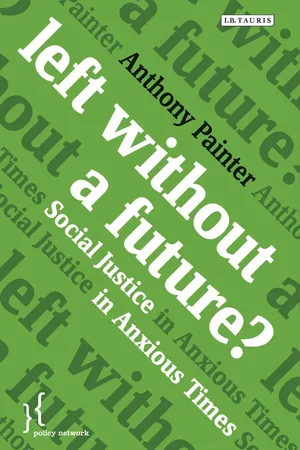
- 256 pages
- English
- ePUB (mobile friendly)
- Available on iOS & Android
eBook - ePub
About this book
Information
C H A P T E R 1
Witnessing the Left’s Decline
It was not meant to be this way. The global financial crash, the election of a new type of movement-driven inspirational leader in Barack Obama and the collapse of an age of deregulation ushered in from the 1970s onwards by a broadly neo-liberal worldview were supposed to ignite a revival of the left. As it happened, however, Obama’s success was an exception that has proved the rule of the left’s decline. Rather than providing European or global leadership, the left is instead locked in to the rhythms of opposition-first and populism. There is a political uncertainty to these times reminiscent of the 1930s and 1970s. What has been noticeable, in observation, is the way in which the left has aimed to project a remarkable, if not entirely convincing, self-confidence in an uncertain political environment. It has proposed risk, whereas people, unsure about which way to go, have preferred security.
A witness always sees things from a particular angle. He or she will inevitably have his or her own perceptions and preconceptions to wrestle with. What such an observer might find striking about this moment of political history is the doubt of the majority and a desire for a different course – a different leadership – yet an uncertainty about what exactly is wanted. Our political leaders, on the other hand, exude certainty and confidence. And yet – and this is not a partisan point – their failure to track a way out of the thicket has been near universal.
The front cover of the David Marquand book Britain Since 1918, mentioned in the Introduction, is decorated with portraits of all the post-1918 British prime ministers. With a handful of notable exceptions, these were great men, and one woman. Whatever their politics, they had ambition for Britain, believed the country to be a player on the world stage and saw politics as being capable of purposeful change. Now, at this very moment of necessity – when we are crying out for statecraft and leadership – such leadership is sorely needed. As one YouGov poll in February 2012 showed, 42 per cent of respondents said ‘neither of them’ when asked which of the two main parties was led by ‘people of real ability’. There is a leadership opportunity; one for which people are thirsting.
For all his difficulties, and for all his tendency to seek compromise when confrontation may actually be what is needed, Barack Obama stands alone in finding a language and meaning to articulate a different future for his nation. It is a constructive future: one that invests in science, new energy sources, industry, jobs and skills. He has been blocked pretty much every step of the way since the Republicans took control of the House of Representatives in 2010, such is the current state of American democracy. Where his first term showed the promise, his second term will be focusing on the institutional changes that will provide the spark for America’s next upward curve.
There were moments when others on the left demonstrated a practical and poetic vision – Gordon Brown at Methodist Central Hall a few days before the 2010 General Election springs to mind. But this has largely been a time in which the left failed to anticipate and respond to the social, economic and political change around it. What follows are dispatches from the front line of that decline. The purpose is not to wallow but to reflect. The hope is that, after a pause, the need for a more reasoned and reflective path might be agreed. In the UK and beyond, the left has met every setback with a forward march. These reflections and dispatches provide the foundation for a more fundamental rethink in later chapters.
After Change
On the morning of Barack Obama’s inaugural presidential address, 20 January 2009, I was picked up by a cab at 6.15 a.m. The driver, who was Afro-Caribbean, told me that his two daughters, aged four and five, were excited about the inauguration. His five-year-old had got up at 5.30 a.m. that morning. She told him that she just wanted to share a moment with her father on what was, for her, an important day in her very young life. This was a global moment, touching the lives of small children in London as much as in Los Angeles.
Racial inequality does not evaporate with the election of a single man. Nor can four or eight years reverse the legacy of 250 years of injustice. But the election of Barack Obama was not only a story of racial division and injustice. It was not about looking back in a regressive sense, but rather reaching into America’s history to define a new future. If America could change, then we all could.
When five-year-old children feel a sense of history, when they feel a connection to the prevailing political wind, then there is promise anew. What more jolting a message could there be for us in Britain, who far too often slouch in cynicism and scepticism? It was a moment that not only resonated with the very young, but also with those rather longer in the tooth. While I was discussing the election of Barack Obama during a meeting in Nottinghamshire back in 2009, the conversation drifted towards UK politics, as the MP expenses scandal had started to take hold. It is probably fair to assume that a good many of those attending were naturally conservative – with both a small and a big ‘c’. In the local County Council elections of that year the Conservatives beat Labour overwhelmingly, with 3,333 votes to Labour’s 879.
Even addressing this conservative sensibility, there was a strong sentiment that political change was not something that should be reserved for the other side of the Atlantic; change was demanded here too. It was not just a change of government these people were interested in – it was a change in the whole of politics. The general consensus was that an intolerable chasm had opened up between the people and their representatives. They felt more connected to a man across the Atlantic than to their own political representatives – even those with whom they agreed politically.
The impact of the Obama ‘effect’ is worth considering more closely. With the inevitable downgrading of his fortunes since the Democrats lost the House of Representatives in 2010, it is easy to forget the enormous legislative victories won in the first year or so of his presidency – especially in the first 100 days. The change was more than symbolic.
Barack Obama’s election campaign was a lesson in how to accumulate political capital, and the first 100 days of his presidency were a lesson in how to use it. Political capital is a perishable good to be consumed rapidly after purchase. A spirit of urgency – the fierce urgency of now – defined the new President’s early period in office.
The economy was the priority. He outlined his approach with lawyerly clarity in a speech at Georgetown University in April 2009, where he invoked the parable at the end of the Sermon on the Mount: ‘the rain descended, and the floods came, and the winds blew, and beat upon that house … it fell not: for it was founded upon a rock’. George W. Bush’s America was built on sand instead of rock. Obama went on to argue that it was not sustainable to have an economy where 40 per cent of all corporate profits come from a financial sector, based on, ‘inflated home prices, maxed out credit cards, overleveraged banks and overvalued assets’.
As Representative Henry Steagall once said during the Great Depression,
We cannot stand by when a house is on fire to engage in lengthy debates over the methods to be employed in extinguishing the fire. In such a situation we instinctively seize upon and utilize whatever method is most available and offers assurance of speediest success.
This has been the approach of the Obama administration, when Congress has allowed. It included: a $787 billion stimulus plan which kept the US out of depression and mass unemployment; the Dodd–Frank Act to regulate Wall Street; a G20 agreement; a toxic bank asset plan; the $80 billion auto-industry bailout – opposed by many Republicans, including Mitt Romney – which saved around 1.5 million jobs; a budget for long-term investment in education; health care reform – greeted as ‘socialism’ by hysterical Republicans despite its resemblance to a plan proposed by Richard Nixon and one introduced by Mitt Romney when he was Governor of Massachusetts; and investment in the green economy of the future. The stimulus legislation was called the American Recovery and Reinvestment Act. And that is precisely what it was.
Congress has played ball on a less and less frequent basis since 2010 as Obama has struggled to pass his American Jobs Act, aiming to stimulate the US economy. This places Congress in the same ‘do nothing’ position that enabled Harry Truman to pull off an unlikely presidential victory in 1948.
There are still those who struggle to reconcile the transformative candidate and inspirational global voice with the instinctive pragmatist who resides in the Oval Office. Many even question whether he is of the left at all. His domestic policy approach suggests that he is centrist and pragmatic, but certainly pursues the policy goals of the centre-left – namely, greater social justice. Pressing questions remain: what does Barack Obama want to achieve in office? Why remain reasonable when faced with Tea Party lunacy every which way he turns? Is his presidency about more than helping America adapt to relative decline? Does he have the right approach but in the wrong times?
Some of the criticism of Obama’s presidency has failed to acknowledge the reality of the political system in which he found himself. The American constitution is a wonderful construct for a nation of reasonable men and women. The problem is that the political representatives who currently populate the nation’s capital are not, in the main, reasonable people. How can a reasonable man lead in a political system stacked with checks and balances that allow unreasonable people to obstruct reasonable endeavour?
Reasonable men reach for consensus first. Time and again, Obama has sought to demonstrate the virtues of restraint and compromise: choosing his primary opponent Hillary Clinton as his Secretary of State; seeking a bi-partisan deal on health care; or pursuing consensus and balance on reducing the federal deficit. It has often worked to his advantage – but frequently it has not. A system designed for the likes of Obama has been hijacked by such Republican representatives as Paul Ryan, Eric Cantor and Tom Coburn. In a battle between a dove and a hawk, it is the hawk that wins.
Obama’s domestic style extends also to the international arena as he works to define a more restrained and collegiate model of American leadership. He reached out to Iran; found a co-operative way of dealing with Dmitry Medvedev of Russia; and allowed France and Britain to make the running in confronting Colonel Gaddafi in Libya. The record is ultimately mixed, but there have been successes. Obama oversaw the capture and elimination of Osama bin Laden and much of the senior Al Qaeda leadership. He has ended US engagement in Iraq and at the time of writing is drawing down troops from Afghanistan. In terms of objectives, foreign policy has been defined by a degree of continuity with the Bush administration – and this creates strategic, political and moral dilemmas, such as the increased usage of predator drone strikes. Yet the means by which these objectives are pursued and secured are very different. He has sought to lead in partnership rather than alone; isolated leadership has been abandoned. He exercises Niebuhrian restraint by temperament; he knows that the more America uses its hard power, the more it demonstrates its limits.
The critical moment – when it was clear that we had a break with the past – came in the post-G20 Summit press conference in London in 2009, when Obama declared:
What I’ve tried to do … is communicate the notion that America is a critical actor and leader on the world stage, and that we shouldn’t be embarrassed about that, but that we exercise our leadership best when we are listening.
In a single off-the-cuff statement, the world encountered a new American leadership: one that listens, engages, negotiates and will find itself better able to achieve its goals. Most clearly and critically, Obama’s approach placed a new notion of leadership at its core. From that point onwards, leadership was to be primarily a collective endeavour. Power would be sought from distributed authority and alliance-building, not through demonstrations of military might and assertive international relations.
His style, both at home and abroad, was to seek strength through consensus – the success of a second term will depend on finding reasonable allies at home and abroad, combined with a harder edge when they do not emerge. As Andrew Sullivan described in Newsweek: ‘What liberals have never understood about Obama is that he practices a show-don’t-tell, long-game form of domestic politics. What matters to him is what he can get done, not what he can immediately take credit for.’
The election of Barack Obama was, from the perspective of the global left, a false dawn. However, in its careful alliance- and institution-building focus it provides some important lessons: ruthless pragmatism over utopianism. His achievements in office – especially in the domestic sphere – have been significant, given the context. His re-election gives him a fresh opportunity to take this approach further. Elsewhere, though, the mainstream left has found it more difficult to obtain, retain and use power – not least in the UK.
The Sun Setting on the Progressive Consensus
In 1933, the midst of a global recession, world leaders came together in London, but they failed to respond to their collective challenge – the repayment of war debt, competitive devaluation and the rising tide of protectionism – and so the world continued on a catastrophic course. The new administration of Franklin D. Roosevelt was largely uninterested in the international dimension of its domestic economic difficulties. From a yacht in New England, Roosevelt effectively torpedoed any deal.
At Bretton Woods in 1944, a system of pegged exchange rates was created, alongside the IMF and the International Bank for Reconstruction and Development (IBRD) (now incorporated into the World Bank), ushering in a new international system that had more flexibility and security. The new system catalysed – along with post-war reconstruction – 30 years of prosperity for liberal democratic nations. It enabled a massive expansion of trade, investment and the creation of the European welfare states with which we are familiar. From London 1933 to Bretton Woods in 1944 there was a wide gulf in what was achieved.
The G20 Summit of April 2009, held at the Excel Centre in London’s Docklands, lay somewhere between the two in terms of success. The deal was meaningful: beefing up the IMF, greater emergency support for emerging economies, and the beginnings of a new system of international regulation that would better manage risk in global capital markets (though still not fully). The centrepiece was a deal to co-ordinate global fiscal expansion. It was also a personal triumph for Gordon Brown, as he demonstrated an ability to shift global decision-making in the context of crisis.
At every stage of the crisis from 2007, the Conservatives had underestimated its nature and its severity. In its immediate aftermath, they had fallen short on providing meaningful solutions and looked dangerously out of their depth. Had they been in power when the crash occurred, it could have been a case of blind panic. Economic storm could well have turned into economic catastrophe. Ideological preconceptions would have meant that a Conservative government would have been extremely slow off the mark in bailing out the banks and stimulus would only have been pursued reluctantly and inadequately.
David Cameron would have been a million miles away from the Obama presidency line of regulate and stimulate. Nor would he have had influence with the European leaders – as has been shown since with his ‘veto’ of the Fiscal Union treaty. Ever since he took his party out of the European People’s Party, David Cameron’s posturing politics has not gone down well in the EU. He is now isolated in Europe – and, consequently, so is the UK.
Yet none of the achievements of the Labour government and Gordon Brown percolated into the national political conversation back in 2009. They remained in the transnational ether and were mocked in the domestic media-political chatter: a fact that was clear in the European elections that followed the Summit in June 2009. Labour gained ju...
Table of contents
- Author Biography
- Title Page
- Copyright Page
- About Policy Network
- Contents
- List of Illustrations
- Acknowledgements
- Introduction
- 1. Witnessing the Left’s Decline
- 2. Society’s ‘Bubbles’, ‘Networks’ and ‘Tribes’
- 3. Economy
- 4. The Force of Cultural Identity
- 5. England and Scotland
- 6. Imagining the Future
- 7. Institutions of Change
- 8. The Left: Caught Between Populism and Leadership?
- 9. Conclusion: We’ve Been Travelling on Rocky Ground
- Bibliography
Trusted by 375,005 students
Access to over 1.5 million titles for a fair monthly price.
Study more efficiently using our study tools.
Frequently asked questions
Yes, you can cancel anytime from the Subscription tab in your account settings on the Perlego website. Your subscription will stay active until the end of your current billing period. Learn how to cancel your subscription
No, books cannot be downloaded as external files, such as PDFs, for use outside of Perlego. However, you can download books within the Perlego app for offline reading on mobile or tablet. Learn how to download books offline
Perlego offers two plans: Essential and Complete
- Essential is ideal for learners and professionals who enjoy exploring a wide range of subjects. Access the Essential Library with 800,000+ trusted titles and best-sellers across business, personal growth, and the humanities. Includes unlimited reading time and Standard Read Aloud voice.
- Complete: Perfect for advanced learners and researchers needing full, unrestricted access. Unlock 1.5M+ books across hundreds of subjects, including academic and specialized titles. The Complete Plan also includes advanced features like Premium Read Aloud and Research Assistant.
We are an online textbook subscription service, where you can get access to an entire online library for less than the price of a single book per month. With over 1.5 million books across 990+ topics, we’ve got you covered! Learn about our mission
Look out for the read-aloud symbol on your next book to see if you can listen to it. The read-aloud tool reads text aloud for you, highlighting the text as it is being read. You can pause it, speed it up and slow it down. Learn more about Read Aloud
Yes! You can use the Perlego app on both iOS and Android devices to read anytime, anywhere — even offline. Perfect for commutes or when you’re on the go.
Please note we cannot support devices running on iOS 13 and Android 7 or earlier. Learn more about using the app
Please note we cannot support devices running on iOS 13 and Android 7 or earlier. Learn more about using the app
Yes, you can access Left Without a Future? by Anthony Painter in PDF and/or ePUB format, as well as other popular books in History & British History. We have over 1.5 million books available in our catalogue for you to explore.