- 208 pages
- English
- ePUB (mobile friendly)
- Available on iOS & Android
eBook - ePub
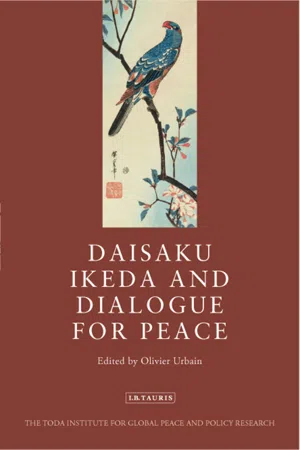
Daisaku Ikeda and Dialogue for Peace
About this book
The prominent Buddhist religious leader and advocate for peace, Daisaku Ikeda, has placed dialogue at the centre of his efforts towards securing global justice and conflict resolution. However, far from constituting abstract plans for the future of the world, Ikeda's dialogues represent very concrete and focused activity. He concentrates on one significant individual (such as Joseph Rotblat, Linus Pauling and Mikhail Gorbachev) at a time, or sometimes small groups, in order to attempt the transformation of thinking and society through intense discussion. This book offers detailed exploration of this crucial aspect of Ikeda's philosophy of peace. Contributors examine topics such as: the background to Ikeda's dialogic thinking as found in the Lotus Sutra; Buddhism as a practical philosophy of dialogue; Ikeda's use of dialogue, specifically in the field of education; and dialogue in relation to the abolition of nuclear weapons. Ikeda's concept of dialogue emerges as a paradoxical movement towards common ground based on respectful difference. This study will appeal to students of peace, politics and modern Buddhism.
Information
PART I
THE LOTUS SUTRA AND
CITIZEN DIPLOMACY
CITIZEN DIPLOMACY
CHAPTER 1
Philosophy of Peace in the Lotus Sutra
Yoichi Kawada
This world is like a burning house
The Simile and Parable chapter of the Lotus Sutra likens the phenomenal world to a “burning house,” recounting how the Buddha appears in this world of suffering to save living beings. Even at the dawn of the twenty-first century humankind continues to repeat the destructive cycle of animosity and violence, and to suffer from the three poisons of hatred (rage), excessive desire (greed), and fundamental egoism (ignorance). The September 11, 2001 terrorist attacks in the first year of the new millennium were a historical occurrence painfully reminiscent of a well-known story in which “a fire suddenly broke out on all sides, spreading through the rooms of the house,” as told in the Simile and Parable chapter of the sutra (Lotus Sutra 1993, 56). The terrorist acts led to a series of wars and conflicts, and the three poisons now threaten to engulf the entire world.
Soon after the September 11 tragedy, a collection of articles contributed by spiritual leaders around the world, representing Christianity, Islam, Judaism, Hinduism, and Buddhism, was published in the United States under the title From the Ashes: A Spiritual Response to the Attack on America. Daisaku Ikeda, president of the Soka Gakkai International, contributed an article entitled “The Evil over which We Must Triumph,” in which he states that “international cooperation against terrorism cannot be limited to the short term. At a deeper level, it requires a profound reexamination of the nature of human civilization” (Ikeda 2001, 105–106). He calls for growth and development of the goodness inherent in human nature, saying:
It is the function of evil to divide, to alienate people from each other and divide one country from another. The universe, this world, and our own lives are the stage for a ceaseless struggle between hatred and compassion, the destructive and constructive aspects of life (…)
Unless we can achieve a fundamental transformation within our own lives, so that we are able to perceive an intimate connection with all our fellow human beings and feel their sufferings as our own, we will never be free of conflict and war. In this sense, I feel that a “hard power” approach, one that relies on military might, will not lead to a long-term, fundamental resolution (Ikeda 2001, 106).
Ikeda urges that inherent goodness be developed through inter-civilizational dialogue on all levels. Trying to solve problems through reliance on hard power such as military might is futile. The bloodshed and tragedy it causes only aggravates the reaction of hatred and rage. More integrated and multilayered efforts should be made on various levels to generate a trend toward changing the violence of our times.
One such effort is aimed at strengthening international legal frameworks in order to prevent the spread of terrorism and conflict. Legal solutions should be sought through international legal institutions such as the International Criminal Court.
In order to grapple with the structural violence that broadly underlies direct violence, it is essential to promote human security, collaborating with various NGOs coordinated by the United Nations. Human security today requires not only protection of people by meeting their basic needs but also by increasing their skills and capacities, for people are the main engines of change.
In a complementary relationship with human security is “human development,” which requires a philosophical and religious foundation upon which to cultivate goodness within human beings. Earthly passions should be conquered through innate goodness. One approach to the development of goodness is education; another is dialogue between civilizations and between religions. Education for peace, education for the environment, education for human rights, and so forth will help awaken the goodness inherent in the lives of children.
If education of this kind is sustained across the vertical axis of time, inter-civilizational and inter-religious dialogue spans the horizontal axis of space. Dialogue builds mutual trust and helps people to overcome their stereotypical and prejudiced views of civilization and religion; it helps them mutually recognize what is good that their civilizations and religions have in common. If we promote the common, universal features of humanity such as love, compassion, nonviolence, and morality, we can open up the way for destroying the “erroneous views” that encourage inter-religious and inter-civilizational divisiveness and conflict and for removing the hatred and enmity that such views generate.
I believe the most fundamental means of ensuring human security and development is promotion of dialogue and exchange on all levels – among heads of state, among specialists in various fields, and among ordinary people around the globe. Only when the current of dialogue for development of human goodness expands globally will legal, economic, and political measures be truly effective.
Philosophy of peace: Three key concepts in the Lotus Sutra
Here I introduce the three main concepts of the Lotus Sutra – “buddhahood in all people,” “the eternal Buddha,” and “bodhisattva practice” – and then discuss the idea of peace to which these concepts lead us. First, let us look at the concept of “buddhahood in all people.” The Expedient Means chapter of the Lotus Sutra talks about the ichidaiji innen, or the sole purpose of the appearance of the Buddhas in this phenomenal world. They appear, it says, because they wish to “open” the door of Buddha wisdom to all living beings, “show” Buddha wisdom, “awaken” them to it, and induce them to “enter” the Buddha way (kai-ji-go-nyu) (Lotus Sutra 1993, 31). According to Chinese priest and scholar Tiantai (538–597) “Buddha wisdom” here means the same thing as Buddha nature.
From this passage, we can observe the following: (i) Buddhism affords the basis for human dignity; the reason human beings have dignity is because the “cosmic-scale life” (the Buddha wisdom, or Buddha nature), is inherent in the innermost depths of human life; (ii) the Lotus Sutra teaches that Buddha nature is inherent in every person, in all people, without distinction as to race, gender, ethnicity, cultural background, class, physical or psychological condition, occupation, and so forth; it thus makes the case for equality of all people; (iii) the idea of opening, showing, awakening, and inducing people to enter the Buddha way is a manifestation of the potential of human life, or full development of inherent goodness, abilities, sensitivity, and life energy; and (iv) the Parable of the Medicinal Herbs chapter of the Lotus Sutra relates how all plants and trees, which grow in the same earth and the same rain, each have their “differences and particulars” (Lotus Sutra 1993, 98), suggesting a principle for a peaceful society where all things coexist in harmony.
In a lecture given at Harvard University, SGI President Ikeda presented an image of the peaceful coexistence of all beings, saying:
[This parable in the Lotus Sutra] symbolizes the enlightenment of all people touched by the Buddha’s Law of great and impartial wisdom. At the same time, it is a magnificent paean to the rich diversity of humanity as well as all forms of sentient and insentient life, each equally manifesting the inherent enlightenment of its nature, each thriving and harmonizing in a grand concert of symbiosis (Ikeda 1993).
All beings developing their potential to the maximum equally sustained by the impartial workings of the universe; all people and nature breathing the Buddha life and demonstrating their individuality – this image of the sutra’s parable evokes a peaceful society in which people live in harmony and prosperity with nature, a world where people have ceased destroying the environment and overcome direct and structural violence. Buddhism is a religion that aims to create such a society.
As for the “eternal Buddha,” the second key concept, the Life Span of the Thus Come One chapter of the Lotus Sutra perceives Shakyamuni Buddha as a manifestation of the “Buddha from time without beginning,” or the eternal Buddha (Lotus Sutra 1993, 225). In Buddhism, the universe was never created, and it will never end. The life of the universe is eternal and can be experienced by people here and now through chanting and other forms of meditation. Shakyamuni as the eternal Buddha is one with the eternal Law and secures eternal salvation for all people. Shakyamuni guides people by various means, gives them benefits and salvation, and he has “never for a moment neglected” such acts of great compassion (Lotus Sutra 1993, 226). Josei Toda (1900–58), second president of the Soka Gakkai, talks about the salvation of the eternal Buddha who is one with the eternal Law from the viewpoint of cosmology, stating that salvation is the cosmic Buddha’s practice of great compassion. He regards this universe entirely as the Buddha’s substance, saying all things in the universe are the workings of compassion and that, therefore, compassion is the inherent nature of the universe. He describes the mission of humans, born in this universe, as follows:
Inasmuch as the universe itself is compassion, our daily acts should naturally be acts of compassion. We lead special lives as humans, moreover; our position cannot be that of plants and animals. Lofty deeds are the work of those who truly serve the Buddha (Toda 1981, 45).
Toda adds, “We should live fully aware of the quality of true compassion” (Toda 1981, 48).
Toda explains the raison d’être and calling of humankind from Buddhism’s cosmic perspective. In short, the “universal mission” of humans born on this planet is to take part in the cosmic workings of compassion and amplify them. Amplification of compassion means taking part in the creative evolution of the cosmos. In Mahayana Buddhism, those who practice this universal mission are bodhisattvas.
This brings us to the third key concept, or “bodhisattva practice.” Let us look at bodhisattvas who appear in the Lotus Sutra – “bodhisattvas of the earth” (jiyu no bosatsu) and other bodhisattvas.
Bodhisattvas of the earth appear first in the Emerging from the Earth chapter of the Lotus Sutra as those who propagate the teachings of the sutra after Shakyamuni Buddha’s passing. The Teacher of the Law chapter states that a person who expounds the sutra “is the envoy of the Thus Come One (…) dispatched by the Thus Come One and carries out the Thus Come One’s work” (Lotus Sutra 1993, 162). This passage clearly shows the characteristics of bodhisattvas of the earth. These bodhisattvas are envoys of the Buddha following Shakyamuni Buddha’s passing and perform the Buddha’s work – salvation of humanity.
These bodhisattvas’ work of compassion is seen in actual practice in the “burning house” of this phenomenal world. Such specific acts performed by other bodhisattvas are depicted from various angles in the Former Affairs of the Bodhisattva Medicine King and subsequent chapters. These are called “bodhisattvas of theoretical teaching” (shakke no bosatsu), the foremost of whom are the Medicine King (Yakuo), the Wonderful Sound (Myoon), the Universal Worthy (Fugen), and the Perceiver of the World’s Sounds (Kannon), working in medicine, art, science, and information, respectively. Amid the “burning house,” the Medicine King takes charge of freedom from illness, securing food, water, medicine, and health, and displaying the rights of people who pray for health and longevity. The bodhisattva Wonderful Sound asserts the freedom of artistic expression as represented by music, and the bodhisattva Universal Worthy proclaims freedom of thought and learning.
The bodhisattva who listens to people’s earnest wishes, fulfills those wishes, and brings people into a “fear not” state is the Perceiver of the World’s Sounds, who is also called Semui-sha (Bestower of Fearlessness). The actual content of salvation secured by this bodhisattva takes the form of benefits obtained in this world. In this mundane world, which is in the state of a burning house, perceiving and meeting the needs of people is what constitutes human security.
Qualities of global citizens:
Bodhisattva Never Disparaging as a model
Bodhisattva Never Disparaging as a model
In the Lotus Sutra, a specific behavior of the bodhisattvas of the earth can be best found in the bodhisattva Never Disparaging, whom Shakyamuni identifies as himself in a previous existence. In the Bodhisattva Never Disparaging chapter, at a time when arrogant monks were a dominant force, a bodhisattva named Never Disparaging appeared and revered everyone he met, saying, “I would never dare treat you with disparagement or arrogance. Why? Because you are all practicing the bodhisattva way and are certain to attain Buddhahood” (Lotus Sutra 1993, 266–67).
The behavior of the bodhisattva depicted in the sutra suggests to us ways we should behave as global citizens. First, the reason the bodhisattva reveres everyone is because, even if he finds them to be arrogant on the surface, he reveres the Buddha nature that shines inside them. He preaches that, by practicing the bodhisattva way, people can manifest their Buddha nature and fully enjoy a great state of Buddhahood brimming with goodness of heart. Second, the bodhisattva Never Disparaging is committed to nonviolence as a means of manifesting his Buddha nature. The only way for us to manifest from our innermost depth the great life of the eternal Buddha is to devote ourselves to nonviolence. It is impossible to manifest the Buddha world by means of violence and enmity. And third, when he is about to die, the bodhisattva Never Disparaging hears the voice of a Buddha, which purifies his life force and extends his life span. This is the best example of the Buddha world becoming manifest in one’s last moments and one’s Buddha nature coming into full bloom. The life energy of the Buddha world extends the Never Disparaging bodhisattva’s life, and he devotes that extended life to salvation of others through nonviolent means.
It is global citizens who are the driving force behind the movement for nonviolence. In conclusion, therefore, let me sum up several qualities of global citizens as suggested by the Lotus Sutra.
First, global citizens are those who embrace a view of life that supports the dignity of humankind and the sanctity of life. The Life Span chapter emphasizes this dimension by way of the Buddha as eternal savior, namely the eternal Buddha who is at one with the eternal Law.
Second, global citizens should manifest the Buddhahood inherent within themselves based on the idea of the Buddha as eternal savior, as shown in the Expedient Means chapter. The respect of global citizens for human dignity is an embodiment of the idea that all people are equally equipped with the Buddha nature regardless of race, gender, ethnicity, cultural background, occupation, or social standing, and the implementation of that idea.
Third, global citizens are committed to nonviolence, as the behavior of the bodhisattva Never Disparaging suggests. They should not use violence as a means for improving the world, but develop, with wisdom and compassion, nonviolent means, such as dialogue, face-to-face or communication exchange, proactive participation, education, culture, and awareness-raising.
Fourth, for global citizens, self-actualization is found in work for the benefit of others and in doing their best to save all humanity and bring an everlasting peace to planet Earth. As described in the Lotus Sutra, the bodhisattva way consists of performing the universal mission, or salvation of all humanity. World citizens, having been born in this world, should be aware of their mission and cultivate their lives in order to fulfill it.
Fifth, as the Parable of the Medicinal Herbs chapter conveys the image that all plants and trees, which grow in the same earth and are nourished by the same rain, each have their differences, global citizens should aspire to the peaceful coexistence of diverse cultures – an ideal state of “all for one, one for all.” That is the society where all its members display their characteristics and develop their latent talents and abilities while maintaining a symbiotic integrity within that dynamic harmony.
Sixth, global citizens, who take the lead in creating a multicultural society of coexistence as described above, should have a pluralistic identity of self. Like bodhisattvas in the Lotus Sutra, they should be able to adapt themselves to whatever situation they might be in so that they can flexibly serve others. The Bodhisattva Wonderful Sound and Bodhisattva Perceiver of the World’s Sounds, for example, manifest themselves, respectively, in 34 and 35 different forms in accordance with the particular suffering people are facing.
Seventh, the bodhisattva-like self of a global citizen is a multi-layered, dynamic, and integrated self consisting of an “ethnic self,” “national self,” and “global self.” In his book A Geography of Human Life, Tsunesaburo Makiguchi (1871–1944), the first president of the Soka Gakkai, discusses the plurality of the self of all people, who are at the same time citizens of the homeland, of the nation, and of the world, in what he calls a “multilayered worldview” (Makiguchi 2002). The homeland is where you are living now, and by solidly observing that local place you can broaden your perspective, first to “nation” and “country,” and then become aware of your being one of the countless global citizens living in coexistence with Nature, says Makiguchi. He emphasizes experience with the homeland because a person whose perspective begins from the homeland will look at the world from a perspective firmly rooted in the local.
The bodhisattva-like self will broaden one’s homeland experience and, as a member of one’s nation and then as a fully global citizen, one will act in the different places where one finds oneself, and in fields where one’s latent abilities can be best displayed. All the qualities of a global citizen described above are encompassed by the universal mission of saving all humanity and of utilizing nonviolence and compassion as means to fulfill that objective. It is global citizens committed to this mission and nonviolent means who will create the everlasting peace demonstrated in the Lotus Sutra.
2323_...Table of contents
- Cover
- About the Author
- Title Page
- Copyright
- Contents
- Notes on Contributors
- Preface
- Message to the Conference
- Introduction
- Part I. The Lotus Sutra and Citizen Diplomacy
- Part II. Buddhism as a Practical Philosophy of Dialogue
- Part III. Dialogic Practice in Education
- Part IV. Dialogue on Global Issues
- Notes
- Bibliography
Trusted by 375,005 students
Access to over 1.5 million titles for a fair monthly price.
Study more efficiently using our study tools.
Frequently asked questions
Yes, you can cancel anytime from the Subscription tab in your account settings on the Perlego website. Your subscription will stay active until the end of your current billing period. Learn how to cancel your subscription
No, books cannot be downloaded as external files, such as PDFs, for use outside of Perlego. However, you can download books within the Perlego app for offline reading on mobile or tablet. Learn how to download books offline
Perlego offers two plans: Essential and Complete
- Essential is ideal for learners and professionals who enjoy exploring a wide range of subjects. Access the Essential Library with 800,000+ trusted titles and best-sellers across business, personal growth, and the humanities. Includes unlimited reading time and Standard Read Aloud voice.
- Complete: Perfect for advanced learners and researchers needing full, unrestricted access. Unlock 1.5M+ books across hundreds of subjects, including academic and specialized titles. The Complete Plan also includes advanced features like Premium Read Aloud and Research Assistant.
We are an online textbook subscription service, where you can get access to an entire online library for less than the price of a single book per month. With over 1.5 million books across 990+ topics, we’ve got you covered! Learn about our mission
Look out for the read-aloud symbol on your next book to see if you can listen to it. The read-aloud tool reads text aloud for you, highlighting the text as it is being read. You can pause it, speed it up and slow it down. Learn more about Read Aloud
Yes! You can use the Perlego app on both iOS and Android devices to read anytime, anywhere — even offline. Perfect for commutes or when you’re on the go.
Please note we cannot support devices running on iOS 13 and Android 7 or earlier. Learn more about using the app
Please note we cannot support devices running on iOS 13 and Android 7 or earlier. Learn more about using the app
Yes, you can access Daisaku Ikeda and Dialogue for Peace by Olivier Urbain in PDF and/or ePUB format, as well as other popular books in Theology & Religion & Eastern Philosophy. We have over 1.5 million books available in our catalogue for you to explore.