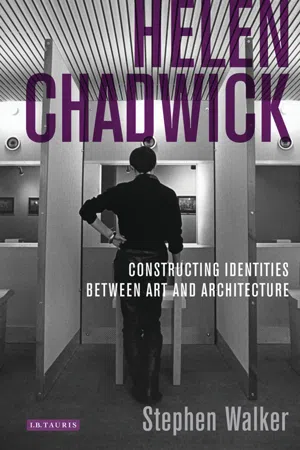
Highly respected by her peers and hugely influential on the subsequent generation of artists, the British artist Helen Chadwick produced a wideranging body of work in a variety of media, which shifted from early institutional and architectural critique to operatic installations, and to photographic projects and sculptures. Stephen Walker looks behind this apparent variety, identifying a consistent range of interests - ranging from classical Greek through to sub-particle physics - that accompanied and supported Chadwick's realised work. Although she enjoyed significant critical attention in her lifetime, this is the first study to explore the rich archive which informed her oeuvre. Critical of the impact that limiting political, philosophical and scientific constructions have on identity, Chadwick's work can offer insights into the relationship between body and space; self and world; art and science; artifice and nature; theory and practice; the creative self and the creative process.
Dismantling and reassembling her ideas, this book combines a close reading of Chadwick's notebooks and research with broader speculation regarding their ongoing relevance for artistic and architectural work today.
- 240 pages
- English
- ePUB (mobile friendly)
- Available on iOS & Android
eBook - ePub
About this book
Information
Table of contents
- Cover
- About the Author
- Title Page
- Copyright
- Dedication
- Contents
- List of Illustrations
- Acknowledgements
- Preface
- Integration of sources
- Introduction: New negotiations
- Part One: The creative process and the creative persona
- Part Two: Experience, architecture and identity
- Part Three: Artifice and nature
- Part Four: Theory and practice
- Conclusion
- Notes
- Bibliography
Trusted by 375,005 students
Access to over 1.5 million titles for a fair monthly price.
Study more efficiently using our study tools.
Frequently asked questions
Yes, you can cancel anytime from the Subscription tab in your account settings on the Perlego website. Your subscription will stay active until the end of your current billing period. Learn how to cancel your subscription
No, books cannot be downloaded as external files, such as PDFs, for use outside of Perlego. However, you can download books within the Perlego app for offline reading on mobile or tablet. Learn how to download books offline
Perlego offers two plans: Essential and Complete
- Essential is ideal for learners and professionals who enjoy exploring a wide range of subjects. Access the Essential Library with 800,000+ trusted titles and best-sellers across business, personal growth, and the humanities. Includes unlimited reading time and Standard Read Aloud voice.
- Complete: Perfect for advanced learners and researchers needing full, unrestricted access. Unlock 1.5M+ books across hundreds of subjects, including academic and specialized titles. The Complete Plan also includes advanced features like Premium Read Aloud and Research Assistant.
We are an online textbook subscription service, where you can get access to an entire online library for less than the price of a single book per month. With over 1.5 million books across 990+ topics, we’ve got you covered! Learn about our mission
Look out for the read-aloud symbol on your next book to see if you can listen to it. The read-aloud tool reads text aloud for you, highlighting the text as it is being read. You can pause it, speed it up and slow it down. Learn more about Read Aloud
Yes! You can use the Perlego app on both iOS and Android devices to read anytime, anywhere — even offline. Perfect for commutes or when you’re on the go.
Please note we cannot support devices running on iOS 13 and Android 7 or earlier. Learn more about using the app
Please note we cannot support devices running on iOS 13 and Android 7 or earlier. Learn more about using the app
Yes, you can access Helen Chadwick by Stephen Walker in PDF and/or ePUB format, as well as other popular books in Architettura & Critica sull'architettura. We have over 1.5 million books available in our catalogue for you to explore.