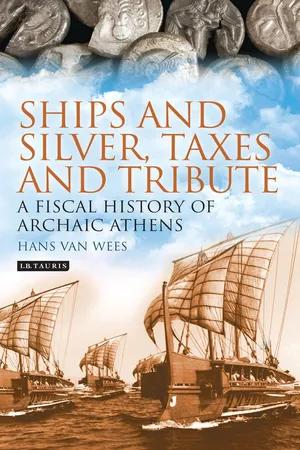
Historians since Herodotus and Thucydides have claimed that the year 483 BCE marked a turning point in the history of Athens. For it was then that Themistocles mobilized the revenues from the city's highly productive silver mines to build an enormous war fleet. This income stream is thought to have become the basis of Athenian imperial power, the driving force behind its democracy and the centre of its system of public finance. But in his groundbreaking new book, Hans van Wees argues otherwise. He shows that Themistocles did not transform Athens, but merely expanded a navy-centred system of public finance that had already existed at least a generation before the general's own time, and had important precursors at least a century earlier. The author reconstructs the scattered evidence for all aspects of public finance, in archaic Greece at large and early Athens in particular, to reveal that a complex machinery of public funding and spending was in place as early as the reforms of Solon in 594 BCE. Public finance was in fact a key factor in the rise of the early Athenian state – long before Themistocles, the empire and democracy.
'With this important book Hans van Wees is the first historian systematically to approach ancient Greek economy and society along the lines of the "new fiscal history". The results are highly rewarding, and go far beyond the area of public finance. In addition to a fresh perspective on key aspects of the archaic Greek world, the author provides numerous insights into the elusive process of state formation in Athens and elsewhere.'
- Paul Millett, Senior Lecturer in Classics, University of Cambridge, author of Lending and Borrowing in Ancient Athens
- 224 pages
- English
- ePUB (mobile friendly)
- Available on iOS & Android
eBook - ePub
About this book
Information
1 | A Fiscal History of Archaic Athens: Why and How? |
Ancient Athens’ most under-appreciated achievement is the sheer scale and sophistication of its system of public finance. In one peak period, the city’s chief treasurer Lycurgus is said to have spent 18,650 talents over twelve years (336–324BC), an average of about 40 tonnes of silver a year, for a total population of about 250,000, or 160 grammes per head. In relative terms, this exceeds the annual expenditures of France during the Napoleonic Wars, which at its peak amounted to 3,600 tonnes of silver for a population of 30 million, or 120 grammes per head. No modern European state exceeded Athens’ financial performance before Britain in the Industrial Revolution made a quantum leap to another level.1 The figures are all the more impressive if we take into consideration that Athens’ large budget was supplemented by devolving a sizeable part of the city’s military and religious expenditure onto wealthy private individuals who were required to perform so-called ‘liturgies’.
Moreover, at least two features of classical Athenian public finance are otherwise associated only with the most modern fiscal regimes. First, taxation was ‘progressive’, since property taxes were levied only upon the richest of citizens. Secondly, expenditure involved a remarkably generous redistribution of wealth, since the treasury paid all citizens wages for fulfilling their military, political and ritual duties, which became a major source of income for the poorest families. In the 350sBC, Xenophon’s pamphlet Ways and Means went so far as to advocate that the city should aim to generate enough revenue from taxes, duties and public assets to provide a subsistence income of 3 obols of silver per day for every single citizen family.2
How and when did this extraordinary system of finance, which paid for Athens’ democratic government, famous military victories and stunning public architecture, come into being? Many scholars believe that it was created in the classical period (c.480–320BC), and that as late as the 480sBC Athens had had almost no public funds. Indeed, it is thought that before 500BC Athens’ governmental organization had been barely worth the name ‘State’, and that in the preceding centuries the city’s economy had produced hardly any surplus which could have contributed to public funds controlled by the State – if there had been any such thing. The consensus is that later developments were made possible by a lucky strike in Athens’ silver mines in 483BC, the proceeds of which were unprecedentedly put to public use by funding the construction of a war fleet, which in turn made Athens an international power with previously inconceivable streams of imperial revenue. On this common view, the Athenian state and its system of public finance were created almost at a stroke, along with the navy, the empire and radical democracy.3
The story is dramatic and appealing, but history it is not. This book will show that the roots of Athens’ public finance lay much further back, in the archaic age (c.700–480). Athens did not transform itself in and after 483BC but merely expanded a navy-centred system of public finance that had already existed for at least a generation and had forerunners another century earlier. A detailed reconstruction of the scattered and often obscure evidence for all aspects of public finance – administrative institutions, expenditures, revenues and financial media – will reveal that a complex machinery of public funding and spending was in place from at least the time of Solon’s reforms in 594BC and steadily became still more sophisticated throughout the turbulent sixth and early fifth centuries. Public finance will emerge as the most highly developed part of the Athenian apparatus of government, and indeed as a driving force in the rise of the State itself. Without it, the new revenues from silver mines and imperial tribute might never have come into being, or would at any rate not have been put to public use with such momentous historical consequences.
Whereas classical Athenian public finance has been relatively well studied, the financial dimension of archaic Athenian history has never yet been investigated systematically or in any detail. One simple reason may be that the activities of figures such as Solon and Cleisthenes as tax-reformers and architects of financial institutions seem mundane compared to their role as founding fathers of democracy. But even if taxation is as widely disliked as democracy is cherished, we can hardly ignore the immense importance of public finance – never more obvious than when it falls short or fails, as it has done so spectacularly in recent years. A ‘new fiscal history’ which treats public finance as a matter of primary historical importance and a potential driver of major change has emerged since the 1980s, but historians of ancient Greece have not yet taken up the baton.4 The major work of reference on public finance remains August Boeckh’s monumental Die Staathaushaltung der Athener (1817), which has been superseded only by its own second and third editions (1850, 1886), and like almost all subsequent scholarship, discussed barely any archaic evidence.5
Before we can embark on our new reconstruction of archaic Athenian public finance, however, we must address the standard objections that no such thing could have existed because (a) our sources imply that it did not; (b) the archaic city was not a ‘State’ and could not have had a system of public finance; and (c) the archaic economy was too simple to have produced significant surplus resources for public use.
PUBLIC FINANCE AND THE LEGEND OF THEMISTOCLES
The greatest single influence on modern ideas about the development of Athenian public finance and the Athenian state is the story of Themistocles’ proposal in 483BC to build a new fleet of triremes. According to Herodotus,
when the Athenians, who had in their common treasury (ἐν τῷ κοινῷ) large funds which accrued to them from the mines at Laurion, were about to distribute ten drachmas each to all men, Themistocles persuaded them to halt this distribution and to build with these funds 200 ships for the war, meaning the war against Aegina. (7.144.1)
Since 200 was the total number of warships available to Athens three years later at Salamis, the picture which emerges from this episode is that Athens before 483BC did not have a single trireme, perhaps no public fleet at all, and thus incurred none of the vast expenditure on the navy which subsequently came to dominate public finance. Later sources modify the story in significant ways, but the gist remains the same and forms the basis of most modern accounts, which argue that Themistocles’ ship-building transformed Athenian public finance.6
Indeed, Herodotus’ story suggests that Themistocles single-handedly invented the very concept of public finance, i.e. the principle that certain resources, manpower and communal revenue are allocated exclusively to the funding of collective and governmental activity. Before his intervention, the Athenians appear to lack such a concept, insofar as they treat surplus revenue as collective property to be distributed rather than as state property to be accumulated centrally and spent for the benefit of the community as a whole. Instead of ‘public’ finance they appear to rely on a system of ‘communal’ finance, in which collective activities are made possible by ad hoc voluntary contributions of manpower and resources by individual members of the community, and any gain from collective enterprises is shared out among them. If so, Themistocles’ proposal would have been truly radical and visionary.
But we should be wary of accepting the story at face value, because Herodotus and his successors had their reasons to play down the level of Athens’ development before the Persian Wars. Herodotus’ Histories emphatically portrayed Greece in general and Athens in particular as poor and internally divided, so that the victory over the united forces of the colossally wealthy Persian empire represented the greatest imaginable reversal of fortune. The notion that the entire fleet which proved decisive in the Persian Wars was coincidentally built from scratch just a few years before Xerxes’ invasion fitted Herodotus’ narrative strategy perfectly.7 Thucydides’ brief account of the early history of Greece explicitly aimed to prove that the Peloponnesian War involved a far greater deployment of naval power and investment of public funding than any previous conflict: the claim that Athens had had only a few triremes before Themistocles served to support that contention. Many later authors strongly disapproved of naval warfare, which they saw as the domain of the lower class, and thus had social and political reasons to suggest that in the good old days Athenian warfare had been strictly land-based until ‘Themistocles took away the citizens’ spear and shield, and consigned the Athenian people to the rowing cushion and the oar’.8
The realization that the main surviving ancient accounts are all, for different reasons, skewed in the same direction, should make us reconsider the substantial body of evidence which points another way but has been played down or dismissed as incompatible with the dominant literary tradition. We shall see that this other material, which derives in part from contemporary archaic evidence, in part from an alternative later tradition and in part from evidence for developments outside Athens, suggests that the transformation attributed to Themistocles’ intervention had in fact been a gradual process that started at least a century earlier.9 The naval programme of 483, and the creation of the Delian League in 478/7, undeniably had a great impact on Athens, but they involved a change only in the scale of public finance. The key structural changes had already taken place in the sixth century.10
PUBLIC FINANCE AND THE ATHENIAN STATE
Modern scholars have been quite happy to accept without question ancient claims that Athens had had no system of public finance until Themistocles invented it, because it fits well with a common notion that the archaic city had few institutions of government of any kind, and was insufficiently developed to deserve the name ‘State’. Some would go so far as to argue that the same was still true of classical Athens. Whether this is so depends as much on one’s definition of the term ‘State’ as on one’s interpretation of the evidence. Either way modern definitions of the State take their cue from Max Weber’s formulation:
the modern State is an institutionalized form of government which has successfully attempted to monopolize the legitimate use of physical force as a means of domination within a territory and to this end unites the material instruments of government under the control of its head [...]11
From this starting point, two different schools of thought have developed. The first stresses the centralization of the means of physical coercion as the defining feature of the State, and traces its emergence in the creation of standing armies and navies, police forces, prison – and surveillance systems.12 By that criterion, classical Athens was not a State, but may be characterized instead as ‘an egalitarian stateless community’ – and the same might be said of the countries of early modern Europe, which arguably allowed as much scope for the private use of force in self-defence and in the administration of justice as Athens did.13
Yet Weber clearly did not intend to give quite such a defining role to a centralized apparatus of coercion. First, his ‘monopoly of legitimate physical force’ did not necessarily entail the exclusive use of force by the personnel of the State, but merely the principle that the State had the power to determine what uses of private and collective force were legitimate. He explained ‘that one ascribes the right to use physical force to other organizations and individuals only to the extent that the State gives them permission: the State is regarded as the sole source of the “right” to use force’.14 By implication, the use of force could be delegated, and a community would strictly speaking need no central coercive power at all in order to qualify as a ‘State’, so long as it enjoyed theoretical control over the force used by its members. Indeed, Weber explicitly attributed a monopoly of legitimate force in this sense to pre-state forms of government as well.15 Athens certainly did know this kind of theoretical monopoly: from Draco’s homicide law onwards, at least, it had precise rules about legitimate and illegitimate uses of force, upheld by courts. Secondly, Weber described the process of state-formation as involving centralization not only of the means of coercion, but of all material sources of power, ‘whether they consist of money, buildings, military materiel, fleets of vehicles, horses or whatever else’; in a modern State ‘not a single official is any longer himself the owner of the money which he spends or of the buildings, supplies, tools, military hardware at his disposal’ (1976: 823–4). In other words, centralized control over money – public finance – was for Weber as important a criterion of statehood as was central control over the means of physical coercion.
The second school of thought about state-formation therefore rightly abandons the preoccupation with physical force and emphasizes instead the first part of Weber’s definition: the State is ‘an institutionalized form of government’. In other words, power in a State is ascribed to institutions rather than derived from the personal qualities and resources of those who govern. The process of institutionalization is taken to apply not only to all ‘material instruments’ of government, but also to intangible sources of power, the various kinds of ‘legitimate authority’ which Weber discussed at length elsewhere.16 This approach has been widely adopted by social anthropologists, who contrast state government with leadership by ‘Big Men’ and ‘chiefs’ relying to different degrees on personal merit and influence.17 Institutional and personal powers and interests may of course coincide and reinforce one another, but the more sharply they are distinguished in theory and in practice, the more developed the concept and structure of the State. By this criterion, classical Athens, which could have done little more to separate public and private powers and interests, with its countless boards of magistrates selected by lot and subject to extensive scrutiny, was not merely a State, but a highly advanced kind of State.
The emphasis on centralized coercive power in so many modern studies derives from the peculiar nature of the large territorial states of medieval and early modern Europe, in which central government – the king and his court – had relatively few roles other than to wage war. Most other aspects of government, such as administering justice, securing a food supply and otherwise ensuring the welfare of the community, were in the hands of local authorities, which enjoyed a considerable degree of independence in such matters. The role of the ‘State’ was thus largely confined to extracting, if necessary by coercion, from local authorities and communities the manpower and money for the armies with which it coerced rival powers. Hence the main modern justification of the State, from Thomas Hobbes’s Leviathan onwards, is that it is the only power capable of putting a stop to endemic private violence, while the main modern critique of the State is that it is no more than an instrument of coercion in the service of the ruling class. The process of state-formation was essentially a story of central government creating the coercive means by which to do so more effectively, and after 1700 taking centralization to the point of imposing ‘direct rule’ over regions and towns.18
By contrast, in city-states the process of state-formation by definition cannot follow this pattern, because central and local government coin...
Table of contents
- Cover
- About the Author
- Title Page
- Copyright Page
- Contents
- Acknowledgements
- Abbreviations
- 1 A Fiscal History of Archaic Athens: Why and How?
- Public finance and the legend of Themistocles
- Public finance and the Athenian state
- Public finance and the Athenian economy
- 2 Athens in Context: Public Finance in Archaic Greece
- Before Solon: heroic precedents
- Beyond Athens: late archaic inscriptions and oral traditions
- Outside Greece: the impact of Persian expansion
- 3 Ham-Collectors and other Financial Institutions
- Treasurers, Ham-Collectors, Sellers and Receivers
- Naukraroi and naukrariai: the evidence
- Captains and captaincies: an interpretation
- 4 Ships, Soldiers and Sacrifices: Public Spending
- Ships
- Ships’ crews and soldiers
- Cult, hospitality and other expenses
- 5 Taxes, Tolls and Tribute: Public Revenue
- The ‘contribution’ (eisphora) under Solon and the tyrants
- The eisphora after Cleisthenes
- Hippias’ levies and liturgies
- Other revenues: trade, silver mines and tribute
- 6 From Oxen to Silver to Coins: Media of Public Finance
- Measures of weight and volume before Solon
- Measures of value before Solon
- Pheidon, Solon and after: archaic reforms of measures
- Wappen, Gorgons and Owls: coinage in archaic Athens
- Coinage, public spending and economic development
- 7 Conclusion: Public Finance and the State in Archaic Athens
- Appendix: Persian Naval Expansion and the Ionian Cities
- Notes
- Bibliography
Trusted by 375,005 students
Access to over 1.5 million titles for a fair monthly price.
Study more efficiently using our study tools.
Frequently asked questions
Yes, you can cancel anytime from the Subscription tab in your account settings on the Perlego website. Your subscription will stay active until the end of your current billing period. Learn how to cancel your subscription
No, books cannot be downloaded as external files, such as PDFs, for use outside of Perlego. However, you can download books within the Perlego app for offline reading on mobile or tablet. Learn how to download books offline
Perlego offers two plans: Essential and Complete
- Essential is ideal for learners and professionals who enjoy exploring a wide range of subjects. Access the Essential Library with 800,000+ trusted titles and best-sellers across business, personal growth, and the humanities. Includes unlimited reading time and Standard Read Aloud voice.
- Complete: Perfect for advanced learners and researchers needing full, unrestricted access. Unlock 1.5M+ books across hundreds of subjects, including academic and specialized titles. The Complete Plan also includes advanced features like Premium Read Aloud and Research Assistant.
We are an online textbook subscription service, where you can get access to an entire online library for less than the price of a single book per month. With over 1.5 million books across 990+ topics, we’ve got you covered! Learn about our mission
Look out for the read-aloud symbol on your next book to see if you can listen to it. The read-aloud tool reads text aloud for you, highlighting the text as it is being read. You can pause it, speed it up and slow it down. Learn more about Read Aloud
Yes! You can use the Perlego app on both iOS and Android devices to read anytime, anywhere — even offline. Perfect for commutes or when you’re on the go.
Please note we cannot support devices running on iOS 13 and Android 7 or earlier. Learn more about using the app
Please note we cannot support devices running on iOS 13 and Android 7 or earlier. Learn more about using the app
Yes, you can access Ships and Silver, Taxes and Tribute by Hans van Wees in PDF and/or ePUB format, as well as other popular books in History & Business General. We have over 1.5 million books available in our catalogue for you to explore.