- 352 pages
- English
- ePUB (mobile friendly)
- Available on iOS & Android
eBook - ePub
About this book
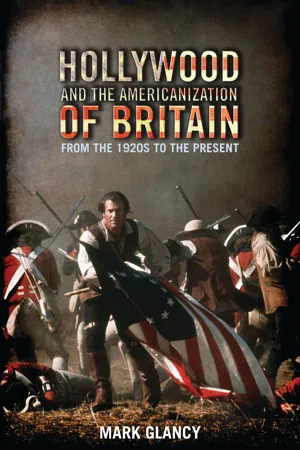
For 100 years, Hollywood has provided both the majority and the most popular of films shown on British screens. For many Britons, Hollywood films are not foreign films. Whether seen in the cinema, on television or the internet, they are regarded as normal screen fare and a part of everyday life. Hollywood and the Americanization of Britain is the first book to take a wide ranging view of this phenomenon, exploring the tastes and preferences of British audiences from the silent era to the present. Mark Glancy investigates the British reception of Hollywood films, ranging from The Public Enemy through film history to The Patriot and Grease. Drawing on rich original sources, his carefully researched and lively book explores Hollywood's capacity to appeal to British audiences, as well as its ability to alienate, enrage and amuse them.
Information
Notes
Introduction
1. See, for example, Genevieve Abravanel, Americanizing Britain: The Rise of Modernism in the Age of the Entertainment Empire (Oxford: Oxford University, 2012); Margaret Dickinson and Sarah Street, Cinema and State: The Film Industry and the British Government (London: British Film Institute, 1985); Ian Jarvie, Hollywood’s Overseas Campaign: The North Atlantic Movie Trade, 1920–50 (Cambridge: Cambridge University Press, 1992); Tom Ryall, Britain and the American Cinema (London: Sage, 2001); Paul Swann, The Hollywood Feature Film in Postwar Britain (London: Croom Helm, 1987); John Trumpbour, Selling Hollywood to the World: US and European Struggles for Mastery of the Global Film Industry (Cambridge: Cambridge University Press, 2002); and Duncan Webster, Looka Yonder: The Imaginary America of Populist Culture (London: Routledge, 1988).
2. Sean Perkins relates that in 1946, the peak year of cinema-going in Britain, 1.6 billion cinema tickets were sold, which represents an average of 36 tickets per person in that year. In 2010, feature films were watched on 4.6 billion occasions, which represents an average of 81 films watched per person in that year. The comparison should be regarded as a rough one, though, especially as cinema-goers often saw more than one feature film in a single visit to the cinema in the 1940s. See Sean Perkins, ‘Film in the UK, 2001–10: A Statistical Overview’, Journal of British Cinema and Television 9/3 (2012), pp. 310–12.
3. Geoffrey Nowell-Smith, ‘But Do We Need It?’, in Martyn Auty and Nick Roddick (eds), British Cinema Now (London: British Film Institute, 1985), pp. 151–52.
4. Ryan Gilbey (ed.), The Ultimate Film: The UK’s 100 Most Popular Films (London: British Film Institute, 2005).
5. See especially Melvyn Stokes and Richard Maltby (eds), Hollywood Abroad: Audiences and Cultural Exchange (London: British Film Institute, 2004); and Sarah Street, Transatlantic Crossings: British Feature Films in the USA (London: Continuum, 2002).
6. Andrew Higson, ‘The Concept of National Cinema’, Screen 30/4 (1989), p. 37.
7. Victoria de Grazia, ‘Mass Culture and Sovereignty: The American Challenge to European Cinemas, 1920–60’, Journal of Modern History 61/1 (1989), p. 53.
8. For a wider examination of ideas of national decline, and one that traces the concept back to the nineteenth century, see the essay entitled ‘Statecraft: The Haunting Fear of National Decline’, in David Cannadine, In Churchill’s Shadow: Confronting the Past in Modern Britain (London: Allen Lane, 2002), pp. 26–44.
9. Helen Taylor, Scarlett’s Women: Gone with the Wind and its Female Fans (London: Virago, 1987); and Jackie Stacey, Star Gazing: Hollywood Cinema an Female Spectatorship (London: Routledge, 1994).
10. Annette Kuhn, An Everyday Magic: Cinema and Cultural Memory (London: I.B.Tauris, 2002).
11. Another book that might be considered here is Thomas Austin’s Hollywood, Hype and Audiences: Selling and Watching Popular Films in the 1990s (Manchester: Manchester University Press, 2002). Like Taylor and Stacey, Austin also used questionnaires to seek British audience responses to popular Hollywood films, albeit of a much more recent vintage. But while Austin’s research highlights important aspects of reception study (notably the impact of marketing and publicity on audience responses), he is largely unconcerned by the transnational dimensions of his study.
12. Janet Staiger, Interpreting Films: Studies in Historical Reception of American Cinema (Princeton, NJ: Princeton University Press, 1992).
13. This argument is made most forcefully in Janet Staiger, ‘“The Handmaiden of Villainy”: Methods and Problems in Studying the Historical Reception of a Film’, Wide Angle 8/1 (1986), p. 21. It is also made, with less specific reference to audience research, in Staiger’s Interpreting Films, pp. 79–80.
14. See, for example, Richard Weight, Patriots: National Identity in Britain, 1940–2000 (London: Macmillan, 2002), p. 88.
15. Staiger: Interpreting Films, p. 93; and Barbara Klinger, ‘Film History Terminable and Interminable: Recovering the Past in Reception Studies’, Screen 38/2 (1997), pp. 107–28.
16. Klinger: ‘Film History Terminable and Interminable’, p. 111.
17. Richard Maltby, ‘Introduction: The Americanisation of the World’, in Melvyn Stokes and Richard Maltby (eds), Hollywood Abroad: Audiences and Cultural Exchange (London: British Film Institute, 1994), pp. 2–3.
18. Michael Hammond, The Big Show: British Cinema Culture in the Great War, 1914–1918 (Exeter: Exeter University Press, 2006), p. 4.
19. Harper’s studies concern the Regent Cinema, Portsmouth, in the 1930s and 1940s; see ‘A Lower Middle-Class Taste Community in the 1930s: Admissions Figures at the Regent Cinema, Portsmouth, UK’, Historical Journal of Film, Radio and Television 24/4 (2004), pp. 565–87; and ‘Fragmentation and Crisis: 1940s Admissions Figures at the Regent Cinema, Portsmouth, UK’, Historical Journal of Film, Radio and Television 26/3 (2006), pp. 361–94. Poole’s study concerns the Majestic Cinema, Macclesfield; see Julian Poole, ‘British Cinema Attendance in Wartime: Audience Preference at the Majestic, Macclesfield, 1939–1946’, Historical Journal of Film, Radio...
Table of contents
- Cover
- Title Page
- Copyright Page
- Dedication
- Table of Contents
- List of Illustrations
- Acknowledgements
- General Editor’s Introduction
- Introduction
- One ‘Temporary American Citizens’: Audiences and Americanization
- Two ‘For the Purpose of Pleasing Women’: British Fan Culture and Rudolph Valentino
- Three ‘Two Countries Divided by a Common Language’: The Arrival of the Talkies
- Four ‘Nothing Ever Happens in England’: Keeping the Gangsters at Bay
- Five ‘The Minx’s Progress’: Gone with the Wind as Britain’s Favourite War Film
- Six ‘The American Film Par Excellence’: Domesticating the Western
- Seven ‘The Sixth Form Was Never Like This’: Grease (1978) and the American 1950s
- Eight ‘The Wrong Side of the Special Relationship’: The Patriot (2000) and the War of Independence in Films
- Notes
- Select Bibliography
Trusted by 375,005 students
Access to over 1.5 million titles for a fair monthly price.
Study more efficiently using our study tools.
Frequently asked questions
Yes, you can cancel anytime from the Subscription tab in your account settings on the Perlego website. Your subscription will stay active until the end of your current billing period. Learn how to cancel your subscription
No, books cannot be downloaded as external files, such as PDFs, for use outside of Perlego. However, you can download books within the Perlego app for offline reading on mobile or tablet. Learn how to download books offline
Perlego offers two plans: Essential and Complete
- Essential is ideal for learners and professionals who enjoy exploring a wide range of subjects. Access the Essential Library with 800,000+ trusted titles and best-sellers across business, personal growth, and the humanities. Includes unlimited reading time and Standard Read Aloud voice.
- Complete: Perfect for advanced learners and researchers needing full, unrestricted access. Unlock 1.5M+ books across hundreds of subjects, including academic and specialized titles. The Complete Plan also includes advanced features like Premium Read Aloud and Research Assistant.
We are an online textbook subscription service, where you can get access to an entire online library for less than the price of a single book per month. With over 1.5 million books across 990+ topics, we’ve got you covered! Learn about our mission
Look out for the read-aloud symbol on your next book to see if you can listen to it. The read-aloud tool reads text aloud for you, highlighting the text as it is being read. You can pause it, speed it up and slow it down. Learn more about Read Aloud
Yes! You can use the Perlego app on both iOS and Android devices to read anytime, anywhere — even offline. Perfect for commutes or when you’re on the go.
Please note we cannot support devices running on iOS 13 and Android 7 or earlier. Learn more about using the app
Please note we cannot support devices running on iOS 13 and Android 7 or earlier. Learn more about using the app
Yes, you can access Hollywood and the Americanization of Britain by Mark Glancy in PDF and/or ePUB format, as well as other popular books in Media & Performing Arts & Film & Video. We have over 1.5 million books available in our catalogue for you to explore.