- 352 pages
- English
- ePUB (mobile friendly)
- Available on iOS & Android
eBook - ePub
About this book
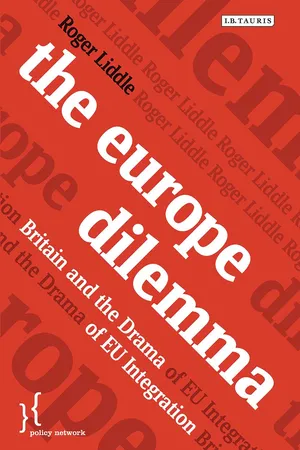
What is Britain's future in Europe? This book revisits an old argument but for dramatically new times. The old argument is about Britain's 'semi-detachedness' from Europe and whether that posture could ever change. The new times are the crisis in the Eurozone and its wider impact on the European Union's future. While logic may point to deeper integration, the politics associated with the EU's problems make this a significant and possibly insurmountable challenge. Where should Britain stand? What future should Britain want for the EU? And how important is continued membership of the EU for Britain's future? This book offers new answers to these questions from the perspective of an author who has combined experience both at the heart of the British Government, as Tony Blair's European adviser and with years of understanding Europe from the inside - working at a senior level in the European Commission. This book will be essential reading for anyone interested in the future of British and European politics.
Information
Chapter 1
The Conservative Legacy
The European legacy that Blair inherited in 1997 was essentially a Conservative story in two distinct halves, with Labour’s Harold Wilson occupying the stage at times decisively, at other moments mercurially. The first half of the Conservative story is the one-time party of Empire somehow by the 1960s turning itself into the party of Europe. Then, this remarkable achievement is gradually cast aside and the story becomes one of steady drift towards Euroscepticism with consequences that are apparent to this day.
The Conservative Turn to Europe
Harold Macmillan deserves the accolade of a prime minister who ‘made the weather’. To put membership of the European Community on the agenda of British politics was a major change of direction and part of a wider reassessment of Britain’s role in the world following the 1956 Suez debacle. Amazingly for a protégé of Churchill, he accepted the imperative of rapid withdrawal from Empire.1 He ended conscription and gave impetus to a process of bringing Britain’s defence commitments in line with constrained resources. He was the first prime minister to recognise and grapple with Britain’s decline. The motivations for his turn to Europe were a mixture of high strategy and low politics, with both economic and foreign policy justifications playing a part.
At the level of electoral politics, Macmillan sensed an opportunity to enhance the credentials of the Conservatives as a party of the future: the party best equipped to modernise Britain and meet the growing aspirations of a newly enfranchised consumer society, as opposed to a Labour party stuck in its old world of class politics, trade union power and the culture of the ‘cloth cap’. Macmillan famously boasted that Britons had ‘never had it so good’. Privately, however, he came to recognise a less optimistic truth. The West German ‘economic miracle’ was by then well underway. The economic balance of power in Europe was shifting rapidly, rather as the rise of China has altered the global balance of economic power in the last 15 years. Britain was rapidly being overtaken by Germany – not only in terms of growth and relative gross domestic product (GDP), but in terms of competitiveness and quality. Britain was rapidly losing ground in world export markets. As Geoffrey Owen has argued, the protectionism of imperial preference facilitated a strong export revival after 1945, but damaged Britain in the longer term by focusing our exports on slowly growing markets.2 In the 1930s, public policy had actively encouraged cartels and monopolies, in part to protect key sections of Conservative core support in the depression, who might have been attracted by fascism: for example, retail price maintenance protected small shopkeepers (like Margaret Thatcher’s father in Grantham). But these lingering monopolies and restrictive practices needed to be exposed to tougher competition if British productivity was to rise. The best route was thought to be through participation in the Common Market’s rapid growth and the ‘cold shower’ of competition it would bring.
Failing to Secure Free Trade
Politics, however, made it difficult for the government to acknowledge publicly the realities of Britain’s reduced economic position. Macmillan’s first preference was to find a technical solution to Britain’s trade problem that would not open up a seismic political debate. Hence Britain’s 1957 proposal for a European free-trade area aimed at securing unimpeded access for our exports to the Common Market, while avoiding the imposition of the Six’s common external tariff on Britain’s Commonwealth imports. At the same time, a free-trade area would weaken the importance of the integrated political structures that the Six had agreed in the Treaty of Rome.3 This position had some potential for support in Germany. Chancellor Adenauer’s heir apparent, Ludwig Erhard, the author of the West German Wirtschaftwunder, feared that too close an embrace of the French might result in protectionist policies threatening his ordo-liberal economic achievement.4 Yet Britain’s diplomatic potential to build a credible free-trade alliance had been greatly weakened by its stand-offish attitude to the Messina talks. For Adenauer, the Treaty of Rome was the top political priority, believing as he did that European integration was the only way that Germany could regain international legitimacy and its own sense of nationhood after World War II. He was in no mood to abandon it.
The failure of Macmillan’s ‘free-trade area’ initiative is now largely forgotten. Yet there is also a crucial lasting lesson that Macmillan was forced to learn, but today’s Eurosceptics forget. When Eurosceptics argue that when Britain joined the Common Market we ‘simply joined a free-trade area’, they do not know their history. A European free-trade area ‘without Brussels strings’ proved impossible to negotiate when European integration was in its infancy. For the UK, creating the European Free Trade Association (EFTA) Seven to rival the Common Market Six proved a poor and inadequate substitute, both in terms of its market size and political clout. The episode has contemporary echoes. Macmillan was trying to get most of the economic benefits of being an ‘in’ and avoid the political risks of the ‘ins’ caucusing in ways damaging to UK interests, while preserving British sovereignty as an ‘out’: a classic example of Britain wanting to participate in the benefits of European integration, but in a highly conditional way that our prospective partners found unacceptable. When the proposal for a wider European free-trade area foundered, the big political choice on Community membership could not be circumvented. But the realities of brute power were hard for ‘Great Britain’ to acknowledge and therefore the public arguments were fudged.
The Strategic Case for Europe
Macmillan also recognised the strategic significance of the Schuman Declaration and the Treaty of Rome. In part there was idealism in his support for a united Europe that would end the risk of mass slaughter in which so many of his compatriots and friends had died. It was tinged, however, with steely cynicism and ‘realpolitik’. He feared the emergence of a united Europe across the Channel from which Britain would find itself excluded. A united Europe without Britain would, he reckoned, eventually be dominated by Germany. As he once minuted the Treasury’s permanent secretary, ‘it is really giving them on a plate what we fought in two world wars to prevent’.5 Also, a united Europe without Britain would diminish the UK in the eyes of Washington. Here crude politics mixed with Macmillan’s traditionalist view of Britain’s global role. Conservative electoral strategy required Britain visibly to maintain its ‘seat at the top table’ in world affairs. Just as Churchill in the first half of the 1950s had sustained the image that he could deal with Eisenhower and Stalin in a British-led initiative to end the Cold War, so Macmillan relished international summitry with Khrushchev and Eisenhower, and as the statesman father figure to the young Jack Kennedy. The claim that under Macmillan the Conservatives could be trusted with foreign policy6 and Britain would maintain its seat at the top table featured strongly in their 1959 election victory.7 The flaunting of the closeness of Britain’s relationship with the USA was Macmillan’s means of assuaging a national pride wounded by the decline of Empire: on it rested his famous boast that Britain could be the ‘Athens’ to the new ‘Rome’.8 Macmillan also depended on the Americans to supply the Polaris nuclear missiles to deliver Britain’s independent nuclear deterrent and sustain this continued badge of great power status. The turn to Europe enabled Macmillan to rebuild the strained ‘special relationship’ with America and at the same time hand him some electoral trump cards. His policy was a curious mixture of idealism, statesmanship and genuine belief in a European vocation for Britain, on the one hand, laced with crude cynicism, loathing of the Germans, great power illusion and electoral showmanship, on the other.
Overcoming the ‘Dunkirk Myth’
To achieve his goals, Macmillan and the succeeding generation had to overcome, or rather circumvent, the ‘Dunkirk myth’. The most enduring hold of this myth was of British exceptionalism – how ‘standing alone’ became Britain’s ‘finest hour’, bolstering a legacy of pride in Britain’s independent role in the world which outlived reality and fed a deep suspicion of Europe and its entire works.9 Ironically, pre-war this same basic mindset had led to appeasement and the shameful resonance of Chamberlain’s words at the time of Munich about an abandoned Czechoslovakia as a ‘far away country of which we know little’. Post-war, of course, no one seriously argued that Europe could be ignored. The Soviet tanks were too close and threatening. Nevertheless, the Continent remained largely a world of alien ‘otherness’ with lingering hatred of the Germans and deep suspicion of the French. For these reasons, the domestic politics of European Union (EU) membership had the potential to be extremely destabilising within the Conservative party. Here was the traditional party of Empire proposing to join an entity that would impose tariffs on the vital exports of white Commonwealth countries on the other side of the world, whose soldiers had fought to defend the home country on battlefields as far flung as Gallipoli, Burma, North Africa and the Western Front. Here was a European Community committed to a common agricultural policy (CAP) that at this time alarmed British farmers so much that ‘Rab’ Butler warned Macmillan it was ‘dynamite for and to the County constituencies’.10 Here was a system of agricultural protection that could deny working-class families access to cheap New Zealand lamb and butter that had become staples of the household diet.
Macmillan’s inner resolve was firm and clear: he wanted to join the Common Market and sidelined the sceptics in his cabinet, cleverly ensuring that all the key players in the ministerial negotiations were firm supporters of British entry. Yet he publicly positioned his historic change of policy as a tentative application – ‘talks about talks’ – an exploration of whether joining the Community could be in the UK’s interests. By positioning Britain’s application as conditional, he ran the risk that the more the government stressed the importance of the ‘terms of entry’, the greater the possibility that others would suggest that the price might be too high, or that they could in future negotiate a better deal:11 the Labour opposition was duly to oblige. A more successful negotiating strategy might have been to accept as the starting point the Treaty of Rome in full, but argue that various derogations and transitional arrangements were necessary to meet the essential interests of the UK and Commonwealth. De Gaulle’s veto of the British application in January 1963 would then have been more difficult. Also, the priority Macmillan gave to the USA backfired in Europe, or at least with the only person who really mattered: the Nassau agreement to supply Britain with US Polaris missiles may have pushed de Gaulle over the brink to exercise his veto on the grounds that the British could never be trusted to be genuine Europeans.
The obvious contrast is with the post-war international settlement of the 1940s. The Labour government did not announce that it was only prepared to sign up for the International Monetary Fund (IMF) or North Atlantic Treaty Organization (NATO) as long ‘as the terms were right’– despite the fact that both international engagements were major limitations on British sovereignty by comparison with the pre-1939 world. Rather, the government was unequivocal that these were the right choices for Britain and that the obligations that went with them had to be accepted without qualification. Opposition in Parliament was simply faced down. If, in the European case, the issue had been presented as a clear, straight choice, the immediate politics might have been more difficult, but a definitive resolution obtained a lot earlier.
Macmillan’s tactics set five major parameters that were to weaken Britain’s ‘national strategy’ for Europe over the next half-century. First, the commitment to Europe has always been pitched as a conditional one. In 1961, the Conservatives set three conditions for entry; Labour expanded the list to five. Harold Wilson rejected the terms Edward Heath had negotiated in 1971, but then ‘renegotiated’ them in 1975. This same tentative approach was applied to virtually every further move in European integration: the ‘Madrid conditions’ for joining the exchange rate mechanism (ERM); Labour’s ‘five tests’ for membership of the single currency. If the government itself was not 100 per cent convinced, why should the British public ever be?
Second, the focus on the ‘terms’ turned the question of membership into a largely economic calculus. This was convenient for governments in diverting attention away from awkward debates about the political nature of the Community and its implications for national sovereignty. But it also accentuated a divergence of views with our partners about the main purpose of the Community. In the 1980s, for example, most of our partners believed the single market was about the ‘construction of Europe’, not just a conscious policy of liberalisation. Similarly, the single currency was mainly seen on the continent as a political, not primarily an economic, project. Our partners regard the British habit of looking at Europe mainly on the basis of an economic calculus as very strange.
Third, the US relationship was publicly given pride of place. Macmillan’s emphasis on the transatlantic ‘bridge’ – joining Europe as a means to remain relevant to the Americans – was broadly adhered to by successive governments.12 This priority for Britain’s global role made our partners feel that Britain was by definition semi-detached. Britain’s commitment was always conditional on whether it was seen to help achieve, and not contradict, our wider global interests. This was a quite different attitude of mind to our partners.
The project of European integration succeeded, not primarily because of an ideological or idealistic commitment to a federalist vision of a United States of Europe: in some senses, quite the opposite was true. The original Common Market Six judged that moves toward European unity were the only means by which their sense of sovereignty and nationhood13 could be restored after World War II. The carefully limited, but nonetheless hugely significant, supranationalism of the original Monnet/Schuman Declaration for the Coal and Steel Community was accepted as being essential to the national interests of the six signatories. Restoration of industrial growth on the Continent required that the post-war suppression of German industrial power should be relaxed. Sovereignty pooling constituted a guarantee that never again would the coal and steel industries become destructive engines of war production. It was the sine qua non of European economic recovery. Post-war British governments never thought in this way about Europe.
Fourth, Britain has had to pay a continuing price for its late arrival. De Gaulle’s veto kept Britain out of the European Economic Community (EEC) effectively for its first crucial decade and a half. As a result we had no say in shaping the CAP, resulting in negative associations with higher food prices that persist to this day, especially among working-class women. It also led to the original unfairness in the British contribution to the EU budget, not out of Continental conspiracy, but simply as a consequence of the fact that our agricultural sector was then a lot smaller than that of all our partners, yet agriculture spending consumed the bulk of the original EU budget. That in turn provided the political backcloth for the virulent ‘I want my money back’ wars fought by Margaret Thatcher in the early 1980s.
Fifth, the long delay in Britain joining led to a decade and a half of adversarial domestic debate that has never really gone away. It was in the nature of our ‘winner takes all’ politics that the issue became highly contested. The 1975 referendum ‘yes’ was historic in guaranteeing Britain’s place in Europe (for 40 years at any rate), but it was a grudging place and it did not end the argument. The British European debate never broke out of the argument ‘for’ or ‘against’ membership. In that sense the referendum did not settle the European question. The ‘antis’ felt they had been cheated: as time went on, they convinced themselves that if only the British people had been told the ‘truth’, the result would have been different. This has hampered intelligent debate about what kind of Europe Britain wants and diverted attention from the real choices facing the country.
Edward Heath ultimately succeeded in achieving Macmillan’s historic goal of EU membership, but the legacy of that struggle in its qualified and conditional commitment to European integration, and its reluctance to embrace its real political significance, has left a mark that has cramped Britain’s European policy ever since.14
Thatcher and the Creation of a New European Myth
The past three decades have seen a gradual fracturing of the Conservative internal coalition between consensus-driven moderates; free-market and ‘big business’ liberals; and British nationalists. Committed Conservative pro-Europeanism has been destroyed in the process. A Thatcherite myth gained an ideological hegemony over the party: the myth of ‘offshore Britain’. This involved rejection of Continental social market capitalism in the frame...
Table of contents
- Title Page
- Copyright Page
- Contents
- Biography
- A Drama in Three Acts
- The Prelude
- Act One: Missed Opportunity
- Chapter 1 The Conservative Legacy
- Chapter 2 Europe and the Failure of Labour Revisionism
- Chapter 3 Labour’s Turn to Europe
- Act Two: Blair’s Failure
- Chapter 4 In Power without a Policy
- Chapter 5 Policy-Making at the Red Lion
- Chapter 6 (Half) Making the Case
- Chapter 7 Reforming the Club Rules
- Chapter 8 Reforming Member State Economies
- Chapter 9 Drafting, Ditching and (90 per cent) Reviving Europe’s Constitution
- Chapter 10 Blocked on the Euro
- Chapter 11 A Glass Half Empty
- Act Three: Cameron’s Gamble
- Chapter 12 The Unexpected Return of Europe to British Politics
- Chapter 13 Renegotiation and Referendum
- Chapter 14 A Progressive Alternative
- Conclusion
- Appendix A Timeline of UK–European Relations
- Notes
- Bibliography
Trusted by 375,005 students
Access to over 1.5 million titles for a fair monthly price.
Study more efficiently using our study tools.
Frequently asked questions
Yes, you can cancel anytime from the Subscription tab in your account settings on the Perlego website. Your subscription will stay active until the end of your current billing period. Learn how to cancel your subscription
No, books cannot be downloaded as external files, such as PDFs, for use outside of Perlego. However, you can download books within the Perlego app for offline reading on mobile or tablet. Learn how to download books offline
Perlego offers two plans: Essential and Complete
- Essential is ideal for learners and professionals who enjoy exploring a wide range of subjects. Access the Essential Library with 800,000+ trusted titles and best-sellers across business, personal growth, and the humanities. Includes unlimited reading time and Standard Read Aloud voice.
- Complete: Perfect for advanced learners and researchers needing full, unrestricted access. Unlock 1.5M+ books across hundreds of subjects, including academic and specialized titles. The Complete Plan also includes advanced features like Premium Read Aloud and Research Assistant.
We are an online textbook subscription service, where you can get access to an entire online library for less than the price of a single book per month. With over 1.5 million books across 990+ topics, we’ve got you covered! Learn about our mission
Look out for the read-aloud symbol on your next book to see if you can listen to it. The read-aloud tool reads text aloud for you, highlighting the text as it is being read. You can pause it, speed it up and slow it down. Learn more about Read Aloud
Yes! You can use the Perlego app on both iOS and Android devices to read anytime, anywhere — even offline. Perfect for commutes or when you’re on the go.
Please note we cannot support devices running on iOS 13 and Android 7 or earlier. Learn more about using the app
Please note we cannot support devices running on iOS 13 and Android 7 or earlier. Learn more about using the app
Yes, you can access The Europe Dilemma by Roger Liddle in PDF and/or ePUB format, as well as other popular books in Politics & International Relations & European Politics. We have over 1.5 million books available in our catalogue for you to explore.