- 352 pages
- English
- ePUB (mobile friendly)
- Available on iOS & Android
eBook - ePub
About this book
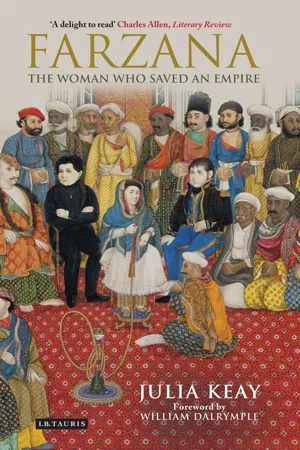
Amongst the riches of nineteenth century India, as the British fought their way across Mughal territory, an orphaned streetgirl ends up at court with the ear of the Emperor. That girl was Farzana, and she would become a courtesan, a leader of armies, a treasured defender of the last Mughal emperor and the head of one of the most legendary courts in history. In this beautifully written book, the author's last, Julia Keay weaves a story which spans the Indian continent and the end of a golden era in Indian history, the story of a nobody who became a teenage seductress and died one of the richest and most prominent women of her age. Farzana rode into battle atop a stallion, though only 4 1/2 feet tall, and led an army which defended a sickly Mughal Empire. She dabbled in witchcraft while gaining favour with the Pope, and died a favourite of the British Raj. Farzana is an evocative and moving depiction of one of the most remarkable, and least-known, historical lives of the nineteenth century.
Trusted by 375,005 students
Access to over 1.5 million titles for a fair monthly price.
Study more efficiently using our study tools.
Information
PART ONE
MARRIED TO THE REGIMENT
1750–1778
1750–1778

1
WHERE PASSIONS RAGE
Though infamous in her prime and celebrated in her declining years, Farzana’s childhood went unnoticed and has taxed her biographers sorely ever since. By common consent she was born into such impoverished obscurity that no one had reason to record the circumstances, least of all herself. Rather, she drew a veil of silence over anything to do with her origins. It was only in the last years of her life, when recent memories grew dim and the long-distant past drifted back into a hazy focus, that her grip on this veil of secrecy slackened and a few tantalizing details began to slip out.
Through the winter of 1835 she had taken to her bed in one of the upstairs rooms of the Sardhana Palace. Her adopted son David attended her, and her loyal munshi, or secretary, Lallah Gokul Chand, squatted on the floor by her side. Swathed in shawls of the finest pashmina, propped on cushions of silk and brocade, the frail old lady mumbled unnecessary orders for the management of her estates, muttered the ‘Hail Mary’, fretted about members of her household, drifted between sleep and daydreams, and just occasionally reminisced. Disjointedly and sometimes incoherently, snippets from her childhood tumbled forth. Both son and scribe took note. The latter then worked some of his notes into a flowery Persian panegyric.
Lallah Gokul Chand’s illustrated verse narrative Zeb-un-Tavarikh, or ‘The Ornament of History’ (a play on Zeb-un-Nissa, another of Farzana’s titles and meaning something like ‘Ornament of Women’) is the earliest attempt at a ‘biography’ of Farzana. First composed in 1822 but later revised and then reissued in 1850 after both subject and author had died, it contains a lot more ornament than history and touches only lightly on her early years. But from its pages, from the adopted son David’s endearingly naïve diaries, and from rumour, legend, the mining of memoirs and archives and not a little fanciful reconstruction, some consensus about Farzana’s origins has been reached.
Her given name, if she had one, is unknown. As was usual with female Muslim infants, her parents would simply have called her by a stock term of endearment. To all others she would have been the more formal ‘daughter of Latafat [or Lutf] Khan’; for according to unsourced research conducted by Cecil Burns,1 sometime dean of the Bombay College of Architecture, that was indeed her father’s name. Dean Burns says nothing of Latafat Khan’s occupation or circumstances but asserts that he had left his ‘native deserts of Arabia’ and settled in the town of Kutana, about 30 miles west of Sardhana, in the early years of the eighteenth century. As was customary, Latafat Khan had several concubines or wives (in those days there was little distinction). By the first of these he had a son, and by the second – a Kashmiri dancing girl called Zeldah – he had a daughter. This was Farzana.
Though Burns chose to keep his sources to himself, it seems unlikely that he invented all this. The dearth of circumstantial detail is even more convincing than the few facts. Possibly he was drawing on some oral tradition, possibly on some no longer extant memoir. And there was more. Again, according to Burns’s anonymous source, Latafat Khan died in 1756 when Farzana was about six years old (making her year of birth 1749–50 rather than the 1745–46 implied by her epitaph). ‘The scanty property he [Latafat Khan] left behind him was at once appropriated by the son of his senior wife, [and] the superfluous junior wife with her offspring [was] promptly turned adrift.’2 In reality the now ‘superfluous’ Zeldah, knowing no alternative, turned to her roots. She had originally been discovered by Latafat Khan in a kotha, a salon or brothel, in Delhi’s Chauri Bazaar, and it was to there that she now returned with her disinherited daughter in tow. It must have been about ten years since she had last seen the city.
More properly, the great walled city into which mother and daughter straggled was that called Shahjahanabad. One of at least seven cities to have occupied the sprawling site of modern-day Delhi, Shahjahanabad is now known as ‘Old Delhi’ to distinguish it from the ‘New Delhi’ laid out by the British. It had been built during the years 1639 to 1648 by the Mughal emperor Shah Jahan to supersede Agra as his imperial capital. A planned city, unparalleled for magnificence in its late seventeenth-century heyday, its 8 miles of crenellated wall embraced elegant streets and wide carriageways, tree-lined maidans and shaded waterways. There were grand mosques and inconspicuous temples, vast bazaars and gardens. The palatial residences of the imperial staff and nobility sat in walled compounds, gated and guarded by club-wielding sentries in long-tailed turbans and matching liveries, while the many-balconied mansions known as havelis housed the merchants whose entrepreneurial skills had turned the city into the greatest trading centre in Asia. Between and behind the main thoroughfares, and spilling beyond the great walls, acres of one- and two-storey housing, mostly of mud and wattle construction, lined a maze of tight alleyways and was home to the teeming population of half a million.
Only in the north-east quadrant of the walled city was this pattern of magnificence interspersed with squalor broken. Here, detached and slightly elevated above the worlds of labour and commerce, Shah Jahan had built his two pieces de resistance. The Jami Masjid, the largest mosque in India, enclosed a prayer ground of 100 metres square and could accommodate 5,000 prostrating worshippers. Lofty minarets of red sandstone, striated with white marble to accentuate their 40-metre height, flanked its great white onion domes and commanded the entire city – quite literally so when, five times a day, the call to prayer went forth from their topmost pavilions.
To the west and south this muezzin’s call travelled along the rooftops lining Chauri Bazaar, in whose maze of side streets Latafat Khan had first lit upon his Zeldah. But east and north, across a part of the city later cleared by the British, the muezzin’s call met the high curtain walls of Shah Jahan’s other great creation, the Lal Qila or Red Fort. ‘Red’ by virtue of its salmon sandstone construction and so handsomely provided with bastions, buttresses and towering gateways as to be virtually impregnable, the fort was a city within the city. It had its own market, mosque, barracks, gardens and stables and, backing onto its eastern wall where the bed of the Jumna river provided a natural glacis as well as a sunken arena for elephant fights, it shielded the concourse of exquisitely fretted white marble pavilions studded with precious stones that constituted the Imperial Palace.
Sadly though, history had already taken its toll of the city. By the time Farzana and her mother reached Delhi/Shahjahanabad in the late 1750s, a century of imperial neglect followed by half a century of strife had left their mark. Ever since the death in 1707 of Aurangzeb, the last of the six ‘Great Mughal’ emperors, it had suffered repeatedly at the hands of invaders – Afghan, Persian, Maratha – all intent on commandeering whichever of Aurangzeb’s ineffectual successors was currently on the throne and taking possession of his coveted capital. The walls still stood and the great studded gates were still closed at night, but the fabric of the city within had been devastated.
Yet worse now followed. Within months of Zeldah and Farzana’s arrival, Delhi suffered its most destructive invasion of all. For in 1761 the Afghan warlord Ahmed Shah Abdali followed up his crushing defeat of the emperor’s Maratha guardians at the battle of Panipat by falling upon the city. It was Abdali’s fourth visitation and this time he was in no mood to negotiate a ransom. In a fit of rage he authorized his troops to reward themselves by sacking and ransacking whatever took their fancy. ‘They stole and plundered, and obscenely enriched themselves,’ wrote the chronicler Mir Taqi Mir. ‘They laid hands upon women. In every lane there was a reign of terror, and every marketplace was a field of combat … The poor were drained bloodless, while tyrants wallowed in their blood.’3
How can I describe the desolation of Delhi [wrote another contemporary observer, Mirza Muhammad Rafi Sauda]? There was not a house in the city from where the jackals’ cries could not be heard…. The lovely buildings and…gardens…lay in ruins. In the villages surrounding Delhi, young women were no longer seen drawing water from the wells. They were full of corpses.4
Battered and looted, its monuments crumbling, its houses, mosques and palaces in varying stages of dilapidation, its water supply suspect, its streets littered with the detritus of war and its population traumatized, the city was scarcely a safe haven for a penniless refugee and her slip of a daughter. ‘In the then anarchic and degraded state of Indian society,’ reflects Cecil Burns, ‘the needy widow and her orphaned child must have been esteemed of less value than the dogs which picked up a living in the Delhi streets.’ Burns paints a painful picture of the forsaken pair struggling to survive amidst ‘the corrupt and lawless population’. As their condition worsened the desperate Zeldah had little choice but to realize her only asset. She must sell the young Farzana into a form of slavery.
For Muslim girls the short years immediately prior to puberty were the most emancipated of their lives. As yet free of the restrictions of ‘chador aur char darri’, ‘the veil and the four walls [of domestic confinement]’, they could seek out society of their own age and roam the city unnoticed. They made friends, ran errands, turned the streets into a playground and learnt fast. But whatever dusty delights a ransacked city might afford, for Farzana they soon faded. Zeldah’s needs were pressing. At the time – as still in parts of the world – a girl child was deemed dispensable. More than that, the not-too-dusky daughter of a destitute parent was a sought-after commodity.
To Colonel Louis Laurent de Fèderbe, otherwise the Comte de Modave and a crucial witness to the turbulent times in which Farzana lived, the only thing more shocking than the lack of discipline in India’s native armies was the discovery that India’s cities harboured a thriving trade in child-virgins. Compounding the crime, the vendor was not infrequently the child’s own mother. ‘Mothers do deals in the virginity of their daughters, sometimes three or four years before they reach puberty. When the time comes they deliver them to fulfil the terms of the deal and leave them to their fate.’
Used, abused and finally discarded, the girls might then be picked up for a few rupees by a broker who would either sell them on or hire them out by the month. ‘In Delhi and several other cities there are shops or depots where the sad victims of this detestable commerce are kept,’ writes Modave. Most of the girls were billed as Kashmiris or Punjabis, both of whom were favoured for their fair complexions; ‘and you can choose the one that you want to buy as you would choose a horse.’5
Of those trafficked children not claimed by an individual buyer like a horse, most would be consigned to a life of more organized prostitution. This might not be as dire as it sounds. The fairer of form and more obliging of disposition might even be rewarded with some training in the art of nautch. That the little Farzana was already turning heads can be implied from her induction into this marginally more select profession. For minus Zeldah, who here fades back into obscurity and never again features in her story, and minus her virginity as a result of ‘this detestable commerce’, the first thing that is known for certain about Farzana is that at the age of fourteen she was performing as a nautch girl in the same ‘district of lust and debauchery’ from which her mother had once been plucked by Latafat Khan.
Here, surmises John Lall, a distinguished Indian Civil Service officer and would-be-racy raconteur, ‘Farzana grew into a young beauty, with flashing eyes, a pearly complexion and lively wit. She became one of the most sought-after girls of the kotha in Chauri Bazaar, the street of pleasure in the shadow of the Jami Masjid.’6 No doubt her physical charms more than lived up to this wishful billing, but it was through the nautch that she exerted her new-found appeal and it was thanks to the nautch that she acquired her first taste of status and influence.

Common to several Indian languages and derived from the Sanskrit, nautch means simply ‘dance’; and just as a twenty-first-century ‘dancer’ can be anything from a prima ballerina to a lap dancer, so an eighteenth-century Indian ‘nautch girl’ could be anything from a virtuoso artiste to a clumsy coquette. Yet at every level nautch girls were more than just dancers. Those at the top of their profession excelled, like the Japanese geisha, in such accomplishments as would appeal to the social and intellectual interests of a wealthy patron as well as those that would gratify his physical tastes. Although the daughters of noble families did not become nautch girls, there was no stigma attached to girls whose talents or looks lent themselves to the profession. As devadasis, literally ‘slaves of gods’, some were actually attached to Hindu temples and their services advertised in the sensuously explicit statuary on the temples’ walls. Though officially performing for the resident deity, they too were expected to reserve a mascaraed twinkle for any male worshipper likely to reward their favours with a donation to the temple’s Brahmin priesthood.
Europeans, and especially European missionaries, were horrified. But all these girls were accepted members of society. Their training from early childhood as performers and companions was acknowledged as an education of sorts and was often envied by their closely purdah-ed sisters. Many learnt to read and write and to memorize and recite verses suitable to their profession. Some cultivated a singing voice while others became adept at strumming an instrument. Privy to all manner of gossip and intelligence, they might become fluent in more than one language, skilled in the arts of flattery and physical relaxation, and generally capable of elevating the business of love-making into an ethereal experience. What man would not admire such a delectable array of charms? Even the Christian missionaries were reported to have grudgingly ‘regarded nautch girls as the only intelligent and cultivated class of Indian women, although they did not approve of their public performances’.7 Nor, presumably, of their private ones.
Success for a nautch girl at this level might come in the shape of an invitation to join the private troupe of a nawab or rajah and thereafter live in his palace, entertain his guests and, for the lucky few, win a permanent place in his harem. At the other end of the scale, by practising a few enticing moves and donning their most seductive apparel, common prostitutes might also call themselves nautch girls; and if their skills were less apparent than those of their more sophisticated sisters, their ambition was the same – to attract patrons who would pay for their company.
Most of the kothas in Chauri Bazaar were straightforward brothels. Girls, often barely into their teens, touted for business from balconies overlooking the narrow noisy streets, their diaphanous clothes and painted faces illuminated by strategically sited oil lamps. More stylish establishments with pretensions to refinement offered music and floor shows. Presided over by professional madames who were more often than not former nautch girls themselves and who combined the roles of instructor, protector and cashier, these classier kothas acted as agents for troupes of dancers who, as well as performing on the premises, might be hired out to enliven private parties elsewhere in the city.
To visiting Europeans – merchants, fortune hunters, East India Company officials, and military men – the nautch was irresistible. In 1780 Captain Innes Munro of the 71st Highlanders attended one such private performance at the home of a fellow officer in Lucknow:
[The dancers] accompany the music with amorous songs and a palpitation or heaving of the bosom calculated to excite in the spectators corresponding desires. In this they are generally very successful, continuing their lascivious gestures till by the force of imagination and the heat of exercise they become almost frantic with ecstasy and sink down in the most inviting attitudes, motionless with fatigue. The conclusion of the scene it is unnecessary to describe. Where the passions rage in their utmost violence, such opportunities for indulgence are not to be lost.8
‘Opportunities for indulgence’ constituted the standard finale, with the host inviting his guests to choose their partners for the night from among the dancers. And it was the same in Chauri Bazaar. There patrons, Indian or European, who could not afford to hire a troupe or had no friends with whom to share the cost, were welcome to attend the public performances in the kotha and then avail themselves of whatever sexual companionship they were prepared to pay for.
At the time few Europeans had any understanding of the role of either dance or sex in Indian tradition. Where they cam...
Table of contents
- Cover
- About the Author
- Title Page
- Copyright
- Contents
- Foreword
- Prologue
- Part One: Married to the Regiment 1750–1778
- Part Two: Daughter of the Emperor 1778–1788
- Part Three: The Only Lady at the Table 1788–1836
- Epilogue
- Afterword
- Notes
- Select Bibliography
Frequently asked questions
Yes, you can cancel anytime from the Subscription tab in your account settings on the Perlego website. Your subscription will stay active until the end of your current billing period. Learn how to cancel your subscription
No, books cannot be downloaded as external files, such as PDFs, for use outside of Perlego. However, you can download books within the Perlego app for offline reading on mobile or tablet. Learn how to download books offline
Perlego offers two plans: Essential and Complete
- Essential is ideal for learners and professionals who enjoy exploring a wide range of subjects. Access the Essential Library with 800,000+ trusted titles and best-sellers across business, personal growth, and the humanities. Includes unlimited reading time and Standard Read Aloud voice.
- Complete: Perfect for advanced learners and researchers needing full, unrestricted access. Unlock 1.5M+ books across hundreds of subjects, including academic and specialized titles. The Complete Plan also includes advanced features like Premium Read Aloud and Research Assistant.
We are an online textbook subscription service, where you can get access to an entire online library for less than the price of a single book per month. With over 1.5 million books across 990+ topics, we’ve got you covered! Learn about our mission
Look out for the read-aloud symbol on your next book to see if you can listen to it. The read-aloud tool reads text aloud for you, highlighting the text as it is being read. You can pause it, speed it up and slow it down. Learn more about Read Aloud
Yes! You can use the Perlego app on both iOS and Android devices to read anytime, anywhere — even offline. Perfect for commutes or when you’re on the go.
Please note we cannot support devices running on iOS 13 and Android 7 or earlier. Learn more about using the app
Please note we cannot support devices running on iOS 13 and Android 7 or earlier. Learn more about using the app
Yes, you can access Farzana by Julia Keay in PDF and/or ePUB format, as well as other popular books in History & Historical Biographies. We have over 1.5 million books available in our catalogue for you to explore.