- 320 pages
- English
- ePUB (mobile friendly)
- Available on iOS & Android
eBook - ePub
About this book
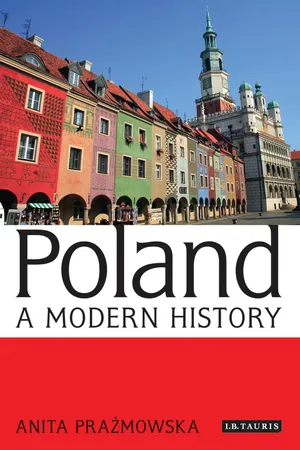
Polish independence following the end of World War I marked a new era for a nation which had endured centuries of foreign partition. But the spirit of Polish nationalism - forged during this long period of external domination - has been frequently at odds with the modernising drives of democracy and communism. How can the ideals of nationalism survive in a modern nation-state? Anita Prazmowska traces this conflict from the emergence of an independent Poland in 1918; through World War II, communism and the democratic victories of Solidarity; to the present day, when Polish membership of the EU is changing perceptions both within Poland and in the wider world.
Information
1 Poland on the Eve of the First World War
At the end of the nineteenth century and the beginning of the twentieth century, nationalism as a political ideology came to play an increasingly important role in Europe. In the Polish case, the growth of Polish nationalism was not constrained by the boundaries of the three partitioning empires. Poles who had been incorporated into the Russian Empire, believed themselves to be a spiritual and cultural community with Poles in the Austrian and German Empires. More importantly, Polish leaders did not feel they were merely addressing the Polish question with reference to specific problems faced by Poles in one of the three empires. They felt they were addressing the Polish question in its entirety, even though they lived in areas ruled by governments of differing political character. Nevertheless, while it is possible to see how the Polish-inhabited regions developed distinct characteristics, a sense of national unity persisted and increased over time.
Polish political thinkers faced two dilemmas. The first was the dilemma of how Poland was to regain independence. At the same time, closely linked to that debate, was the question of the form in which Poland was to be restored. These two issues led to the question of modernisation. The Poles’ efforts to modernise the Commonwealth had failed. Henceforth, all political, social and economic decisions would be made by the three partition powers. While implementing their own modernisation programmes, they aimed at integrating the Polish areas into their own territories and separating them from other Polish lands. Thus the process of economic and political modernisation took place and was paralleled by the attempt to destroy the Polish nation. This led to profound dilemmas within the Polish communities. They came to view state activities with distrust, even if they were economically beneficial to the Poles. Critically, it led to the emergence of the perception that the nationalist question was more important than progress towards modernisation.1
The Dismemberment of the Polish–Lithuanian Kingdom during the Second and Third Partitions

If economic and social developments are considered in separation from cultural self-expression, the picture was complex at the beginning of the twentieth century. Like other East and Southeast European areas, Polish-inhabited regions continued to be generally economically underdeveloped, with a heavy dependence on agriculture. In most cases, agriculture was desperately backward and villages were overpopulated. The most obvious way out was through emigration, mainly to North America, where the Polish communities formed a sizeable diaspora. At the beginning of the twentieth century, the USA restricted the number of immigrants from backward parts of Eastern Europe. This and the growing birth rate increased pressure in the countryside. At the end of the nineteenth century, village life was still dominated by the landowners, who controlled the local economy. In most cases the economic power of the landlords was mirrored by them retaining political control over the villages. When universal franchise was introduced, the landlord had means of ensuring that the peasants would cast their votes as instructed. This was the case in the Austrian and German areas. But the situation was far from uniform or static. An eminent historian has pointed out that at that time Poland was not an ‘economic reality’.2 At the turn of the century, discrepancies between the backward, neglected countryside, and areas affected by industrialisation, became more pronounced. The process of industrialisation was always patchy and coexisted side by side with the traditional village community economy. At the same time, extensive state involvement encouraged and facilitated industrial development. Therefore primitive manufacturing methods continued while modern, up to date, usually foreign-owned industrial plants were introduced into the region. Industrialisation and the development of extensive railway systems had a big impact on Polish areas. In addition, the trade policies of the partitioning powers were of critical importance in determining the speed and pattern of development. The Russian and German Empires formed extensive markets protected by tariff barriers. Polish areas benefited from being part of those closed economic regions.
In Pomerania and the Poznań regions, which were under Prussian control, agriculture was more advanced than in the Russian or Austrian Empires. In Berlin there was a natural desire to support this region for its high-quality agricultural production, which economically complemented the industrially advanced areas of Germany. Labour mobility was made possible by the development of a railway system and peasants were able to move from the agricultural Poznań region and seek employment in Germany or Silesia. Chancellor Otto von Bismarck formulated policies in relation to Polish inhabitied areas. In doing this, he followed his predecessors who had aimed at integrating the Polish areas into the Reich. In the first place, he sought to destroy the Polish gentry and the Catholic Church – both of which he saw as carriers of dangerous liberal ideas.3 The first move was to destroy the Catholic Church’s control over education. Thus the process of Germanisation had two purposes.4 In this policy of denationalisation and integration of the Polish community into the Reich, Bismarck sought to reduce the amount of land held by the Poles. This was done through the state which acted as an agent in the process of buying land from Polish landowners and encouraging German colonisation.5 The result was conflict with the Polish community which only marginally reduced the amount of land held by the Poles. An unexpected result was the development of Polish peasant cooperatives, self-help associations and local banks. Polish peasants had the incentive and means of fighting back, as their property rights were protected by the well-functioning German legal system to which they had recourse. At the same time, they were encouraged to improve production and to modernise. Savings and credit companies and agricultural circles were the by-product of the Poles’ attempts to counter German policies.6 In Polish parts of Prussia, agriculture became advanced and productive, with villages becoming prosperous and economically stable. At the same time, Poles in the German Empire were well educated and easily assimilated into industry as a skilled workforce.
In Silesia, textile and coal mining formed the basis of the industrial takeoff. At the end of the nineteenth century, coal mining and steel production came to dominate Upper Silesia, which became one of the most industrially advanced regions in Europe. In Silesia, colonisation and industrialisation led to changes in the population structure. The Polish presence was visible in agricultural areas and in the Katowice coal-mining region. Most industrial production was financed by either German or foreign capital. Most managerial and skilled posts were held by Germans, which from the outset caused ethnic tensions.7
The situation in the Polish areas which had been incorporated into the Austrian Empire was very different. In 1868, Polish Galicia was granted autonomy. Although an assembly was constituted to administer the region, it was not until 1865 that the Austrians allowed the Poles to assume full responsibility for local issues. After years of neglect, Agendor Goɫuchowski, the imperial governor, implemented policies aimed at, in the first place reforming the educational system and improving the infrastructure. At the turn of the century, the provision of elementary education was considerably better than in areas under Russian control. However shortage of funds and conflicts among Polish conservatives, who dominated the Galician Sejm and administration, meant that the region continued to be backward. The issue of education had exercised the minds of the conservative landowners. They were unhappy at the prospect of the peasants having access to education, which would provide them with knowledge beyond the basic literacy levels. Conflicts between the landowners and the peasants continued into the twentieth century. At the same time, the economic situation was difficult. Agriculture suffered from years of neglect. In villages, poverty was endemic, as was illiteracy. In some areas industry made its mark, but in most cases the local population benefited little from new economic activities in the region.8 Oil exploration, dominated by foreign capital, was a good example of the way industrial activities bypassed the region. In Austrian Polish areas, small-scale and light industries usually meant food processing. Sugar beet production constituted some agricultural progress. As a direct result, sugar refining developed in the Ukrainian regions.
Even on the eve of the outbreak of the First World War, politics in the Galician Sejm were dominated by particular groups. These groups firmly believed that the Poles had a lot to benefit from loyally supporting the empire. The main issue of debate was whether to seek a larger degree of autonomy within the Austrian Empire, or full independence. By then, they were united in supporting educational reforms. Most of the politicians came from landed backgrounds. They therefore did not feel comfortable supporting industrial developments. They also distrusted those calling for investment as this would encourage the transformation of the local economy.9
In Austrian Poland, the ethnic composition of the community was very diverse. This was particularly the case in Eastern Galicia, where the Ukrainian population increasingly resented the Poles’ domination of local political life and the economy. In addition, 11.5 per cent of the inhabitants of the regions were Jewish. Some members of the Jewish communities were unconstrained by discriminatory laws. These members tended to be fully active in all areas of the economic life of Polish Austria. This varied from small-scale retail activities, to banking and industrial entrepreneurship. Before the outbreak of the First World War, up to 75 per cent of local trade was in Jewish hands. The Jewish community, outside the cultural centre of Kraków, remained unassimilated.10
Within areas under Russian control the economic situation was entirely different. The abolishment of serfdom in 1864 reduced the economic and political role of the landed gentry but stimulated the growth of village communities. In Congress Poland, the process of transforming village life was delayed in comparison with other parts of Europe, in particular Western Europe. Economic development was nevertheless of great interest to successive Tsarist governments. The first stages of economic modernisation occurred during the first thirty years of the nineteenth century while serfdom was still in place. In the Polish areas, manufacture and trade were advanced in relation to the Russian areas. Customs barriers between Congress Poland and the Russian Empire had been abolished in 1856. This meant that the Polish areas were then able to take full advantage of the vast markets offered by the empire. This led to the emergence of several important industrial zones in Congress Poland, notably the Dąbrowa Basin, the town and district of Ɫódź and, finally, the towns of Biaɫystok and Warsaw. The industrial revolution in the Polish areas was made possible by the opening up of the Russian markets to goods produced in Congress Poland. Congress Poland was protected by the establishment of tariffs between the Russian Empire and the neighbouring states. The Polish regions benefited economically from the economic changes taking place in the empire. Nevertheless, Russian policy had always ensured that the emergence of an industrial and middle class did not pose a challenge to the autocratic Tsarist system. Thus, in addition to maintaining a strong control over economic activities, the Tsarist administration encouraged foreign investment. That way, although Congress Poland was the centre of industrial production and sent over 70 per cent of its goods to the Russian Empire, the Poles did not reap the full financial benefits of trade between the Congress areas and the Russian Empire. Politically, the system remained impervious to change until 1905. Following defeat at Japan’s hands and strikes and riots, which rocked the foundations of the regime, Tsar Nicholas II relented and agreed to political reforms.11
The Jewish community in Congress Poland was swelled by an influx of Jews from the empire. This was due to the policy of confining Jews to the Western European parts of Russia, the so-called Pale of Settlement. The Jewish population made up 14 per cent of those living in Congress Poland. In some cases, particularly in the eastern districts, over 50 per cent of the population of a given town was Jewish. The issue of assimilation was extensively debated by Jews and non-Jews alike. Jewish life in the Russian Empire was constrained by laws which applied only to that community. Despite this, Jews played an important role not merely in the economic life of the small towns, but also in trade with the Russian regions.
In spite of the different pace and character of economic changes affecting Polish territories, there were similarities. The rapid and extensive development of railway networks had a dramatic impact on all communities. In all three cases, the partitioning powers had an interest in financing and supporting the process. Military considerations still played an important role in their plans. Nevertheless, it was only natural that trade, movement of goods and migration of workers to places of employment was rapidly accelerated. As the three empires financed the expansion of the railway system, they hoped to integrate the Polish areas into the empires. At the time of the outbreak of the First World War, railway lines connected Polish regions with Vienna, Berlin and St. Petersburg, though few cut across the frontiers of the three empires. The Russian railway gauge was different from that used by the Austrians and Germans, making it impossible to run trains directly and without interruption from the East to the West. This situation created problems once an independent Polish state emerged after the First World War. Due to this, Polish economists had to grapple with the fact that Poland did not have a railway system which would serve Poland and its capital. Before the war it was easier for Poles to travel from Warsaw to Odessa than to Berlin.12
At the end of the nineteenth century and the beginning of the twentieth, the nature of the political debates had gone beyond the debate of the role of the nobility and ways of combating village backwardness. Industrialisation and the emergence of new social groups connected with industry, created new political dilemmas. Industrialisation had led to greater disparities in wealth. The political demands of those involved in manufacture and industry were increasingly different from those of the gentry and peasants. Conflicts between the workers and the industrialists led to new forms of political activism, to debates and with that to the formation of different priorities. Polish community leaders and intellectuals were only too well aware of the way industrialisation destroyed traditional societies and led to exploitation of workers and their families. In the Polish case, political debates could not address the workers’ question without, at the same time, referring to the fact that there was no Polish state. Thus, the two emerging political trends – the nationalist and the socialist – were initially linked and had in effect the same roots. In each of the partition areas, the political debate and the nature of political organisations, which emerged at the end of the nineteenth century, continued to be defined by the character of the regime. In the German and Austrian cases, trade unions and political parties were accepted as legal organisations. The introduction of manhood suffrage meant that most working men had an awareness of how the liberal democratic system worked and how it could be used to their advantage. In the Russian Empire, all forms of dissent were illegal, and there was no right of free association. Only in 1906 did the Tsar allow for the formation of an elected assembly and accepted that political organisations could be formed. These factors determined the character of political movements and had an impact on the programme they put forward.
From the outset, political thinkers and Polish nationalists realised that to be successful they had to appeal to Poles living in all three partition areas. At the end of the nineteenth century, political organisations and parties emerged. These became the accepted way to pursue political objectives either within the parliamentary system or in conspiracy. They not merely sought to build links between the three, but they also claimed to represent the aspirations of all Polish communities. Links within the Polish territories were consolidated by the fact that activists frequently had to move from one partition area to another in order to evade arrest. This particularly affected politically active Poles in Congress Poland, who moved to Kraków, from where they were able to maintain contact with conspirators in the Russian Empire. Polish language publications were, likewise, disseminated from the Austrian areas where they could be published legally. They were then conveyed to regions under Russian control, where censorship was very restrictive.
The Polish communities in exile were a factor in the building of links between activists and organisations. They frequently experienced economic hardship and were often the object of surveillance by the local police forces in various West European capitals where they had sought sanctuary. In spite of this, these men and women continued campaigning for the restoration of a free Poland. By necessity they associated with political exiles from other regimes. This frequently led to a very vibrant exchange of ideas. Thus, exile Poles were exposed to the most up to date political ideas and discussions. From these, they derived intellectual stimulation to address Poland’s problems. When looked at from that background of discussions of political ideas, Poland’s problems were no longer so unique. Nevertheless, relations between exile political leaders and those in the Polish territories were never easy. In principle, they shared the same objectives, namely the restoration of an independent Poland. To that aim they supported each other and facilitated the dissemination of new ideas and publications. But in reality, relations between the exile communities and Poles were uneven. Some exiles tended to dwell on the past, rehearsing past failures and, on the basis of a limited understanding of what was happening in Polish areas, hoped to spark off another great national insurrection. Socialist, and even anarchist ideologies, advocated a revolutionary transformation of the political life of Europe. Some tried to apply these ideas to the still industrially backward Polish territories. In Polish territories, social inequalities and the political and economic consequences of industrialisation tended to increasingly dominate the debate on the restoration of Poland.
A number of organisations emerged in exile and in the Polish territories during the second half of the nineteenth century. The national democratic movement emerged from the coming together of these organisations. What these organisations had in common was the rejection of the positivist acceptance of the foreign tutelage and their desire to involve all people in the fight for independence. In Warsaw, a weekly publication Gɫos (The Voice), the first copy of which was published in 1886, led the debate on the subject of an independent Polish state. Its readership was confined to intellectuals and students. They came to disagree with what they thought was a preoccupation with economic advancement at the expense of the national agenda. Jan Ludwik Popɫawski established the weekly with Józef Potocki. He drew a link between the rural community and the survival of Polish natio...
Table of contents
- Cover
- Title page
- Copyright
- Contents
- Abbreviations
- Preface
- Introduction
- 1. Poland on the Eve of the First World War
- 2. The First World War and the Emergence of Independent Poland
- 3. Independent Poland in Interwar Europe
- 4. The Outbreak and the Course of the Second World War
- 5. Post-war Poland, 1945–70
- 6. From Gierek to Solidarity
- 7. Post-communist Poland
- Conclusion
- Notes
- Bibliography
Trusted by 375,005 students
Access to over 1.5 million titles for a fair monthly price.
Study more efficiently using our study tools.
Frequently asked questions
Yes, you can cancel anytime from the Subscription tab in your account settings on the Perlego website. Your subscription will stay active until the end of your current billing period. Learn how to cancel your subscription
No, books cannot be downloaded as external files, such as PDFs, for use outside of Perlego. However, you can download books within the Perlego app for offline reading on mobile or tablet. Learn how to download books offline
Perlego offers two plans: Essential and Complete
- Essential is ideal for learners and professionals who enjoy exploring a wide range of subjects. Access the Essential Library with 800,000+ trusted titles and best-sellers across business, personal growth, and the humanities. Includes unlimited reading time and Standard Read Aloud voice.
- Complete: Perfect for advanced learners and researchers needing full, unrestricted access. Unlock 1.5M+ books across hundreds of subjects, including academic and specialized titles. The Complete Plan also includes advanced features like Premium Read Aloud and Research Assistant.
We are an online textbook subscription service, where you can get access to an entire online library for less than the price of a single book per month. With over 1.5 million books across 990+ topics, we’ve got you covered! Learn about our mission
Look out for the read-aloud symbol on your next book to see if you can listen to it. The read-aloud tool reads text aloud for you, highlighting the text as it is being read. You can pause it, speed it up and slow it down. Learn more about Read Aloud
Yes! You can use the Perlego app on both iOS and Android devices to read anytime, anywhere — even offline. Perfect for commutes or when you’re on the go.
Please note we cannot support devices running on iOS 13 and Android 7 or earlier. Learn more about using the app
Please note we cannot support devices running on iOS 13 and Android 7 or earlier. Learn more about using the app
Yes, you can access Poland by Anita Prazmowska in PDF and/or ePUB format, as well as other popular books in History & European History. We have over 1.5 million books available in our catalogue for you to explore.