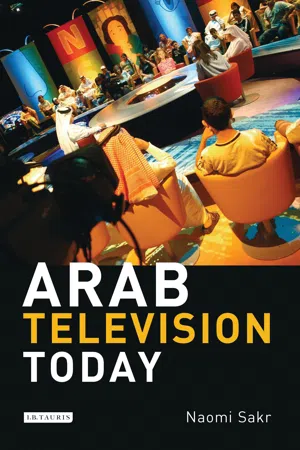
There is a great deal at stake for everyone in the future of Arab television. Political and social upheavals in this central but unsettled region are increasingly played out on television screens and in the tussles over programming that take place behind them. Al-Jazeera is of course only one player among a still-growing throng of satellite channels, which now include private terrestrial stations in some Arab states. It is an industry urgently needing to be made sense of; this book does exactly this in a very readable and authoritative way, through exploring and explaining the evolving structures and content choices in both entertainment and news of contemporary Arab television. It shows how owners, investors, journalists, presenters, production companies, advertisers, regulators and media freedom advocates influence each other in a geolinguistic marketplace that encompasses the Arab region itself and communities abroad.
Probing internal and external interventions in the Arab television landscape, the book offers a timely and compelling sequel to Naomi Sakr's "Satellite Realms: Transnational Television, Globalization and the Middle East", which won the Middle Eastern Studies Book Prize in 2003.
- 272 pages
- English
- ePUB (mobile friendly)
- Available on iOS & Android
eBook - ePub
Arab Television Today
About this book
Information
1
Publicity Machine or Complex Industry?
For a phenomenon characterized by ever increasing diversity and contradictions, the epithet ‘Arab television’ may imply an undue sense of coherence. It is a favourite refrain of many commentators that the number of Arab television channels now runs into hundreds. It only runs into hundreds for television viewers with satellite access, but today in many parts of the Arab region such access is the norm. In countries like Algeria, Lebanon and Saudi Arabia, 90 per cent or more of television households are able to receive satellite channels. The same applies to more than half of television households in Syria and Jordan, and in Morocco and Egypt the level of penetration is approaching half.1 That is to say: at any given moment, a member of those households can zap through dozens of channels showing a seemingly endless array of drama, music, feature films, game shows, talk shows, documentaries, cartoons, sports, religious guidance, all types of news and all manner of current affairs. To someone watching so many varieties of ‘Arab television’ it may seem reductive to apply this single heading to a landscape crowded with national and pan-Arab players, involved in public and private companies, producing and transmitting information and entertainment. Too often, casual comment on the state of ‘Arab television’ is prone to sweeping generalizations driven by value judgements about taste and decency, relevance or political bias. This book, far from underestimating the range of content now on offer or the strong reactions it provokes, starts from a recognition that this range has major significance in terms of representation and social interaction in a group of countries where multiple injustices and grievances, felt deeply over generations, have given rise to intractable current-day policy dilemmas. As part of acknowledging this complexity, the book seeks to draw out strands of development in Arab terrestrial and satellite broadcasting that can be examined on the basis of evidence, to see what they reveal about struggles for control.
With that aim, it is plausible to take a broad view of Arab television as an interconnected set of cultural industries, where production and exchange takes place across a market circumscribed not by tariffs or jurisdiction but by language. To take such an approach is to lay open the possibility that development of more complex and differentiated social and economic relations in the industry might entail shifts in power over public communication and cultural expression. Raymond Williams has charted the ‘long period of overlap between patronal and market social relations’ in cultural production in parts of Europe, noting that there is ‘great practical complexity in the various stages of transition between these essentially alternative relationships’ and that modern forms of patronage are ‘common in advanced capitalist societies’.2 There is some agreement among Arab analysts that the arrival of satellite channels did not in itself rupture the relations of patronage that had previously dominated the region’s television output. A changing system of ownership, in which some owners were nominally private, did not immediately hand market power to consumers or to cultural producers and other professionals. It has been said of the so-called ‘new’ Arab media in recent years that they are ‘still effectively dealing with one consumer’, namely the head of state,3 and that they are ‘appendages of the ruling political and economic order in the Arab world, not challenges to it’.4 There is a view that the satellite stations ‘are detached from any broader history’, having been created as an ‘instant weapon’ at the time of the 1991 Gulf War without any accompanying legislation to oversee their independence.5 These observations are in line with the finding that governments in the region still had the upper hand in the evolution of Arab satellite television a decade after it took off.6 But the story continues. A further phase of expansion, which started in 2000–01 and gathered momentum in 2004, raised questions as to whether new paymasters or intermediaries were emerging, whose dealings would introduce new forms of patronage or stimulate market relations on a scale sufficient to erode the ruler-dependent patronage of the status quo.
Such questions can be addressed in various ways. One is to consider whether any new institutions and interest groups, which may have formed in parallel with television ownership diversification, served to reinforce a process of de-linking or differentiation between the television industry and the state.7 To uncover such a process requires scrutiny on several levels. Studies have shown that the challenge of promoting media content that is independent of governments, political forces and business is not best served by drawing simplistic distinctions between market and state.8 The meaning of the state’s role in television ownership and regulation differs between situations where electorates can change governments at regular intervals and those where they cannot. Yet a tendency towards ownership concentration in all television markets means that even systems of democratic accountability do not always succeed in protecting the broadcast media against de-differentiation or refeudalization, in the form of encroaching domination and incorporation by a single force. The strength of safeguards may depend on political visions of the audiovisual market, as demonstrated by contrasting British and French routes to marketization during the 1980s–90s.9 It may, as demonstrated by Silvio Berlusconi’s dual roles as Italian prime minister and television magnate, be put to the test by personal ambition.10 For Arab television, the subject of enquiry at this point is not whether the grip of powerful political or economic forces is tightening, but the reverse. It is tempting, for example, to regard the rise of new kinds of broadcaster, new satellite platforms, licensing commissions, independent production houses, professional alliances, audience research agencies, advertisers’ trade associations, training bodies, media watch groups, and organizations advocating media freedom as evidence of formal and informal institutions putting down separate roots and establishing autonomous platforms for articulating shared or conflicting interests. Where such interests impinge on ownership patterns or controls on content, interesting possibilities would seem to exist for developments in the television industry to contribute to a process of differentiation between media and ruling elites.
Later chapters of this book explore big changes and small adjustments taking place in various parts of the television industry. Chapter 2 tracks the new paymasters who have benefited from a changing licensing regime and considers whether a more liberal approach to licences has been matched by a relaxation of censorship. Chapter 3 highlights divergent trends in television journalism and evaluates the support mechanisms available to journalists facing unfamiliar types of pressure. Chapter 4 probes the stimuli that have propelled women to prominent positions on screen and assesses how far the medium of television has lent itself to constructive public discussion of gender equality. Chapter 5 compares advantages and disadvantages of developments in entertainment programming in terms of the medium-term outlook for indigenous production, and Chapter 6 does likewise for other programme categories, especially news, sport and various genres of television talk. Issues of sustainability, thrown up by these chapters, are carried over into Chapter 7, where leading television companies’ strategies on expansion, branding, revenue diversification and location are discussed. Chapter 7’s conclusion pulls together strands from preceding chapters to answer the question posed in this introduction, as to whether the growing complexity of institutions and interest groups who play a part in Arab television has opened the way to increasing independence from forces that were traditionally dominant. Before proceeding to these elements of the investigation, the next step in this introductory chapter is to analyse the nature of the industry’s recent expansion. It is proposed to look first at the proliferation of channels and then at the potential for devolution of power in terms of the players and resources involved.
Changes in the landscape, 2000–06
From a distance, it might seem reasonable to categorize new entrants to the Arab television landscape according to three pre-defined contrasting approaches to the business of broadcasting. In a dual-product model, in which advertising revenue finances content, television owners supply programmes to viewers as a means of supplying viewers to advertisers, in the sense that audiences form a potential market for items to be advertised in programme breaks.11 Advertisers’ interests can then influence programme development and scheduling on the basis of demographic calculations about viewers’ ages, purchasing power and daily leisure time, with programmes responding to some themes of public interest but not others.12 In television globally, there are two obvious alternatives to this model. On the one hand, based on a distinction in status between consumer and citizen, is the possibility of addressing television audiences not as a market but as a public with an exhaustive range of information needs.13 On the other is the distinction between satisfying market demand and satisfying demand for favourable publicity on the part of prominent political figures. As the broadcast equivalent of vanity publishing, loss-making television that caters neither to citizen nor to consumer but to the perceived self-interest of those with deep enough pockets is primarily concerned with organizing information so as to suppress or disseminate particular messages.
Arab television channels launched during the first phase of expansion in the 1990s seemed to fit at least the first and third of these categories in some respects. Lebanon’s privately owned LBC is often cited in comparisons of leading channels as the most market-oriented and intent on making profit. Sebouh Alavanthian, its head of programming, implied strong conformity to the dual-product model at a conference in 2002. Describing LBC’s expansion into satellite transmission as a leap into the unknown, Alavanthian stressed the need to know ‘viewers’ expectations’, to receive ‘daily feedback’, and to establish a ‘direct, clear, daily rating system’.14 The Middle East Broadcasting Centre (MBC), on the other hand, followed the favourable publicity model closely enough for some observers to joke that its initials stood for ‘My Broadcasting Company’.15 ‘My’ in this case referred to Saudi Arabia’s late King Fahd, who is believed to have helped his brother-in-law launch MBC in a private capacity to further the political aims of certain members of the kingdom’s ruling elite.16
At the same time, however, other channels displayed the potential for overlap between the three models. It was clear, for example, from the high price of its subscriptions and from statements in its promotional literature that the Saudi-owned pay-TV network Orbit aimed, from its launch in 1994, to meet the needs of what its management saw as a niche market of affluent professionals. Samir Abdulhadi, the network’s chief executive, confirmed in 2002 that this was still the case, when he described Orbit as a ‘commercial business and not a public service enterprise’.17 Yet Orbit was the first to experiment, in 1994–96, with Arabic-language news programming commissioned from a public-service source, the British Broadcasting Corporation (BBC). Al-Jazeera was created in 1996 with a mission to become self-financing within five years, through advertising sales based on expectations of healthy viewing figures. When its failure on this count exposed the politicized nature of advertising sales in Arab television, Qatar’s ruler, Sheikh Hamad bin Khalifa Al Thani, continued to finance it anyway, portraying this decision as a public service consistent with Qatar’s project of turning itself into a parliamentary democracy.18 Al-Jazeera’s managing director at the time acknowledged that ‘Al-Jazeera brings the government non-financial benefits’.19 But these benefits appeared compatible with a model of state-funded broadcasting that Qatari officials regularly likened to the BBC.
Meanwhile, early expansion into satellite broadcasting by the Egyptian Radio and Television Union (ERTU) lacked the attributes of being either a commercial enterprise or a public service, creating a situation at odds with its public funding. With its cumulative deficit of £E4 billion ($690 million) in 2004, increasing at a rate of £E800 million ($138 million) per year20 despite preferential access to advertising revenue, the ERTU was slow to seek financial recovery by enhancing its appeal or usefulness to viewers. Hassan Hamed, who was later to become the organization’s chief executive, said as head of the ERTU’s Nile News: ‘Ours is still official news. We have to weigh things very carefully.’ 21 The practice of weighing things very carefully appeared to explain subsequent delays and omissions in ERTU channels’ coverage of local events that might reflect negatively on the Egyptian government. An ERTU official rationalized the use of public funds to pay for pro-government publicity when she told two Egyptian reporters, ‘TV is state-owned and thus represents the views and policies of the government.’ 22
The proliferation of television stations that took place from 2000 onwards brought with it a further blurring of missions along with more intricate permutations of patronal and market relationships underlying sources of finance. In part, the expansion and diversification was facilitated by Egyptian state investment in Nilesat, the company created to give Egypt its own platform for transmission as an alternative to the pan-Arab but Saudi-dominated Arabsat fleet. Nilesat, presented from the outset as a public–private partnership that would more than cover its costs, had a commercial incentive to lease its satellite transponder slots to the largest possible number of newcomers to regional broadcasting. For small broadcasters, this option was attractive not only for its low cost but also because shared space on a transponder reduced the likelihood of a single operator’s uplinks being cut for censorship reasons, because of potential harm to other leaseholders on the same transponder. Nilesat accounts showed a sharp rise in revenue during the first four years after Nilesat 101 was launched in 1998. With the addition of Nilesat 102 in August 2000, the two satellites’ total capacity was nearly 230 digital channels. The change in Egyptian broadcasting regulations announced in January 2000 thus provided a timely government boost to Nilesat’s business. It allowed private broadcasters, both Egyptian and foreign, to operate exclusively by satellite from a designated free zone next to Media Production City and the Nilesat earth station.
Among the Egyptian-owned channels created to take advantage of this opening, Dream TV and Al-Mehwar illustrated how crossover between commercialism and elements of public service is apt to occur in an environment marked by tight government controls and a general absence of state provision for pluralist public-service content. Whereas Al-Mehwar presented itself as the ‘voice of civil society’, Dream was quintessentially a ‘business project’ – a vehicle for advertising goods produced by the business empire of Ahmad Bahgat. Nevertheless, both found themselves juggling between government-imposed constraints on their output and the imperatives of corporate survival in ways that produced examples of market-led programming on Al-Mehwar and public-service-style talk shows on Dream 2. While Dream’s widely watched Al-Aasher Masa’an (10pm) questioned public figures about current Egyptian affairs on viewers’ behalf, Al-Mehwar sought to boost ratings in Ramadan 2006 through a series on sexual health and personal relationships called Kalam Kabeer (Serious Talk). Both played safe in the 2005 presidential election, allocating 69 per cent and 41 per cent of election coverage respectively to the incumbent, Hosni Mubarak, who was one of ten candidates.23
Various forms of overlap between diverse broadcasting objectives can be found across the spectrum of Arab television start-ups, in line with the mix of stimuli and operating conditions from place to place. Later chapters consider these in more detail, showing how changing regulations in several countries opened the way to newcomers and how the established players behind companies like MBC, Al-Jazeera, Dubai TV and Rotana expanded their operations into groups of channels covering a range of programming types. In a region where religious guidance is highly prized, it was not incongruous for religious channels, from Al-Majd to Al-Resalah, to frame their efforts in business terms, not as spreading a message but as meeting a market need. Nor was it unusual for business or real-estate channels to tai...
Table of contents
- Cover
- About the Author
- Title Page
- Copyright
- Contents
- Acknowledgements
- Note on Sources, Citations and Transliteration
- 1. Publicity Machine or Complex Industry?
- 2. Law and Policy on Ownership and Content
- 3. Conflicting Influences on Arab TV Journalism
- 4. Women in the Public Eye: ‘Advancement’ via TV?
- 5. Facing up to Reality: Entertainment Programming Rationales
- 6. Calculations Behind News, Sport and Talk TV
- 7. Business Strategies of Leading TV Firms
- Notes
- Bibliography
Trusted by 375,005 students
Access to over 1.5 million titles for a fair monthly price.
Study more efficiently using our study tools.
Frequently asked questions
Yes, you can cancel anytime from the Subscription tab in your account settings on the Perlego website. Your subscription will stay active until the end of your current billing period. Learn how to cancel your subscription
No, books cannot be downloaded as external files, such as PDFs, for use outside of Perlego. However, you can download books within the Perlego app for offline reading on mobile or tablet. Learn how to download books offline
Perlego offers two plans: Essential and Complete
- Essential is ideal for learners and professionals who enjoy exploring a wide range of subjects. Access the Essential Library with 800,000+ trusted titles and best-sellers across business, personal growth, and the humanities. Includes unlimited reading time and Standard Read Aloud voice.
- Complete: Perfect for advanced learners and researchers needing full, unrestricted access. Unlock 1.5M+ books across hundreds of subjects, including academic and specialized titles. The Complete Plan also includes advanced features like Premium Read Aloud and Research Assistant.
We are an online textbook subscription service, where you can get access to an entire online library for less than the price of a single book per month. With over 1.5 million books across 990+ topics, we’ve got you covered! Learn about our mission
Look out for the read-aloud symbol on your next book to see if you can listen to it. The read-aloud tool reads text aloud for you, highlighting the text as it is being read. You can pause it, speed it up and slow it down. Learn more about Read Aloud
Yes! You can use the Perlego app on both iOS and Android devices to read anytime, anywhere — even offline. Perfect for commutes or when you’re on the go.
Please note we cannot support devices running on iOS 13 and Android 7 or earlier. Learn more about using the app
Please note we cannot support devices running on iOS 13 and Android 7 or earlier. Learn more about using the app
Yes, you can access Arab Television Today by Naomi Sakr in PDF and/or ePUB format, as well as other popular books in Sciences sociales & Étude des média. We have over 1.5 million books available in our catalogue for you to explore.