eBook - ePub
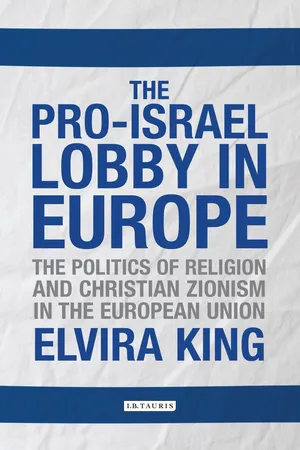
The Pro-Israel Lobby in Europe
The Politics of Religion and Christian Zionism in the European Union
- 264 pages
- English
- ePUB (mobile friendly)
- Available on iOS & Android
eBook - ePub
The Pro-Israel Lobby in Europe
The Politics of Religion and Christian Zionism in the European Union
About this book
The activities of pro-Israel pressure groups and lobbyists in the US are well-known. But the pro-Israel lobby in Europe is less prominent in both academic and media accounts. In a unique account, Elvira King identifies the pro-Israeli groups which attempt to influence policy-makers and implementers in the EU, specifically examining Christian Zionist groups. Through a detailed study of the European Coalition for Israel (ECI), the only Christian Zionist lobby in Brussels, Elvira King analyses whether and how a religious group can (and can fail to) influence decision-makers in the EU. By exploring the context of European relations with Israel as well as the mechanisms through which pressure groups are able to influence EU-wide policies, King offers an analysis which demonstrates how the EU can be a site where religion and politics meet, rather than just being a secular institution. It therefore contains vital primary research for both those interested in the pro-Israel lobby as well as those examining the role of religion in politics more generally.
Information
CHAPTER 1
EUROPE’S VALUES AND RELIGION
So far the EU’s evolution towards a supranational construct, which brought functional changes in social, economic and political institutions, could be described as a relative success (Bohmelt, 2012; Cross, 2012). However, it is the question about the new European identity and consequently the EU legitimacy that is more frequently raised. Within this normative context scholars have only recently engaged with the dimension that religion plays in contemporary European identity and its role in European politics. While the EU normative values provide the Europeans with an attractive political identity, nevertheless, the multifaceted religious trends (such as the rise of new religious movements (NRMs), revival of old religious identities, and formation of religious lobby groups) that are flourishing in twenty-first-century Europe illustrate the reality that Europe is not as secular as political and academic establishments would like to believe. This causes a dilemma, if not a problem, for the EU in light of the fact that the union’s nature as a single market could mean that the EU does not have adequate instruments to deal with issues pertaining to religion.
This chapter therefore discusses the nature and importance of the relationship between the EU and religion, not least because the EU’s evolving character gradually included social and ethical issues. The ratification of the Lisbon Treaty in 2009 was a milestone that brought substantial institutional changes to the EU, but it also afforded a legal status for religious communities/organisations through Article 17 of the treaty. The inclusion of Article 17 demonstrated that a resurgent religion has itself reached a milestone in its progressive quest for political influence in the EU, but the article also further encouraged proliferation of religious lobby groups. This is evidenced by research conducted so far that religious lobby groups are firmly established in Brussels, with clear agendas, good resources and sufficient insider knowledge that makes them as effective in their lobby strategy as any other well-organised non-religious interest group (Silvestri, 2010 and 2007; Massignon, 2010; Pastorelli, 2009; Steven, 2009; Houston, 2009; Parker, 2007).
Article 17, however, was preceded by other factors that caused the establishment of these groups. Firstly, they emerged as a natural outcome of a development that includes Islamic inroads into European societies and renewed interest in Christian heritage, as well as an exponential rise in the new spirituality of neo-Paganism and NRMs. Secondly, the institutional changes with the Single European Act (SEA) in 1985 created a conducive environment for the formation of lobby groups that went beyond business interest representation. What initially started as harmonisation of business interests across Europe for the purpose of creating the Single European Market (SEM), further evolved into an extension of QMV and establishment of the three pillars in the Treaty of European Union in Maastricht 1992. Two major developments in particular conditioned the proliferation of the non-governmental political participation – the inclusion of the principle of subsidiarity in the European Communities pillar, and, crucially, the emergence of the EP with a significantly enhanced role in the decision-making process.
The enhanced decision-making role of the EP is meant to demonstrate that the federalist agenda need not impede the reduction of the institutional democratic deficit, as the EU is firmly committed to uphold its own values and principles. Accordingly, this chapter reviews the EU’s normative values, why they are associated with a post-Westphalian paradigm, and why the inherent contradictions within the EU normative power discourse and the EU’s policies draw both criticism and defence from the academic community. Related to this debate is the EU’s foreign policy since, if the rise of Christian Zionism in Brussels is to be understood correctly, it must be viewed within the wider context of both resurgent religion in European societies and the EU’s foreign policy. The chapter discusses the complex institutional segmentation of the EU and specifically how it generates the structural incoherence in the Common Foreign and Security Policy (CFSP), which, as demonstrated in Chapter 2, undermines the impact that the EU seeks to accomplish in the Middle East, specifically in its relations with Israel through the instrument of European Neighbourhood Policy (ENP).
Having discussed in the initial two sections the CFSP and the EU’s normative values respectively the chapter proceeds to the third section that is focused on the (lack of) new European identity. Given that the soft power concept and the EU’s rejection of militarism runs parallel to a large measure to the rejection of the American hard power model and its unilateralism, this section of the chapter refers to utilisation of anti-American sentiments as a part of the current search for, and the construction of, Europe’s cosmopolitan identity. This is important to emphasise since Christian Zionists who lobby in member states, and particularly those in Brussels, are at times keen to distance themselves from the US-style Christian Zionist lobbying that is widely described as confrontational and unsophisticated.
Further on the chapter addresses the issue of religion in Europe with sections 5 and 6 elaborating Christian and Muslim roles respectively in a multi-religious Europe. While some academic voices are sceptical about the current status of European Christianity (Caldwell, 2010: 142–71), and others are bemoaning its decline in contemporary scholarship (Henry and Agee, 2003), the prevailing academic consensus nevertheless holds to a pragmatic view that the inherent values of justice and peace in Christian religion can be utilised within a secular normative framework, with the role of the Vatican in the integration process as a supreme example. Islam’s role in a contemporary Europe, a very important subject for Christian Zionists, also polarises the academic community that argues whether Islam is going to be Europeanised, or whether Europe will be Islamised (Meijer and Bakker, 2012; Hunter, 2002; Ye’or, 2011; Kilpatrick, 2000). Both sections highlight the tension in a secular Europe that has to accommodate the competing demands of two religions – both with inherent expansionist impulses at their core – but have to co-exist in a multi-faith community of European believers.
Demands for a political space that is projected from different religious persuasions are demonstrated most clearly in the formation of numerous religious lobby groups that operate in national settings, but with an increasing significance in Brussels also. This is explained in the last section of the chapter, which does not deal with the ECI and its Christian Zionist political agenda, but demonstrates that there was an identified gap in the scholarship on religion in the EU, and that a number of scholars have addressed it by looking into the religious mobilisation in Brussels. It also demonstrates that the rise of lobbying among the religious communities, and competition for access to supranational institutions of agenda setting and decision making, reflects a growing recognition of the EU’s political leverage.
The EU’s foreign policy and institutional challenges
The complexities of the EU’s institutional functioning, particularly in the area of foreign policy, often presents a puzzle for both the politically astute, for whom the comprehension of international order is largely derived from the Westphalian paradigm, and for the uninformed, for whom the creation of new decision-making offices further confuses their attempt to understand the concept of supranationality of the new Europe (Underhill, 2010). Even though the 2009 Lisbon Treaty established the European Presidency, which is largely expected to represent a united European voice, a rotating six-months Presidency remains intact. The interesting, and somewhat surprising, choice of Catherine Ashton and Herman Van Rompuy for the appointments to the foreign policy chief’s office and Presidency respectively reflects the fact that the EU prefers not to rely on personal charisma and wide publicity of political candidates (indeed Ashton was favoured over Tony Blair). Furthermore, these appointments reflect how heads of the member states (France and Germany in particular) still decide who represents Europe collectively. Toby Vogel explains that both were individuals who in fact worked efficiently behind the scenes for pro-EU agendas, and how Brussels is through their election ‘signalling its will to create a strong and efficient institutionalisation framework of both Presidency and High Commissioner offices’ (2009). Sceptics, however, claim that the reason behind appointments of unknown politicians with very little international clout is a clear signal that member states are not ready to sign over that part of national sovereignty to an institution in Brussels (Charter, 2010). In particular it is the economic crisis that ensued since the Lisbon Treaty that added a considerable degree of distrust towards the EU among the euro-sceptics.
To understand these challenges, it is pertinent at this point to outline the functioning of the EU institutions in foreign policy, namely the Council of Ministers, the European Commission and the EP. Although the 1993 Treaty of Maastricht was a progression from the European Community into the European Union – an agreement that furthered European political unity by establishing three pillars – it was an arrangement, however, that contained a degree of fluidity and, as such, was subject to periodic revision. For this reason the Commission, in itself an autonomous institution since its inception in 1951, used ways and means by which it could solidify its authority in given areas, as well as try to extend its authority in areas out of its scope. The Commission, in terms of decision making in the context of international agreements, has powers to negotiate with third countries and international organisations. These negotiations have to be, of course, conducted according to the Council’s approval, with the exception of humanitarian aid, where the Commission has full authority. It is in the area of foreign policy (political and military agreements) where the Commission has been largely powerless, although it has exercised a fair amount of leverage through the Neighbourhood policy. Arguably, its level of influence has increased with the ratification of the Lisbon Treaty. While the Council of Europe remains in control of European foreign policies, it is widely anticipated that the High Representative for Foreign Affairs and Security Policy, an institution that was created by the fusion of the High Representative office with the office of the Vice President of the Commission, will in reality limit the powers of the Council and enhance those of the Commission. In this way, it is expected that the treaty will overcome ‘some of the debilitating divisions between the two institutions that have hampered the EU’s foreign policy in the past years’ (Vogel, 2009).
It is also significant that the Lisbon Treaty increased the powers of the EP, such as the requirement that the Council consults the EP before voting on the Commission’s legislation proposal. In its early days the EP was an institution regarded as ineffectual and irrelevant, but its leverage increased in the 1970s when it was granted power over the annual budgetary decision making (Hix et al., 2003a). Largely ignored by member states, the affairs of the EP did, however, manage to create a stir during the European parliamentary elections in 2009. The level of participation across the EU stood at 43 per cent, which was widely publicised as a result of the overall victory of the political right from across Europe, and particularly due to the fact that the extreme right gained a number of seats. Although the EP’s powers remain limited when compared to the Council and the High Representative office, the EP is, nevertheless, more than a marginal player in the functioning of the EU (Diedrichs, 2007), which is substantiated by the considerable increase in the number of interest groups in the last two decades (Greenwood, 2010; Kohler-Koch, 1997).
The establishment of the CFSP with the Maastricht Treaty in 1992 arguably added to the existing complexities of the EU governance. The criticism about the limitations of the institutional capacity of the CFSP does not only refer to the complex nature of national and supranational cross-institutional functioning, but also to the area that remains exclusively in the decision-making domain of the Council of the EU, where the repeated question concerns ‘how far individual governments try to impose their national preferences during the presidency or whether the experience pushes them towards identifying with collective EU interest’ (H. Wallace, 2005: 60). Although national officials are meant to co-ordinate national positions and use ministerial meetings to set unified agendas in the Political and Security Committee, the discrepancies of national objectives remain. Until the Lisbon Treaty was ratified, common strategies needed a unanimous voice in the Council, and joint actions and positions were decided by the QMV. Even though the latest changes now allow for the QMV in the Council on proposals from the High Representative, as well as joint proposals from the High Representative and the Commission, it still remains to be seen whether these latest arrangements will streamline the EU foreign policy to a substantial degree.
Apart from the structural incoherence of the CFSP, it is also its institutional commitment to the EU’s normative values and principles that defines its role globally, most significantly in the Middle East (Smith, 2008). For historical reasons the EU is keen to avoid a ‘hard power’ foreign policy model that is defined by a militaristic approach and determined traditional American role in the region (Mackenstein and Marsh, 2005). It is precisely the opposite ‘soft power’ approach which, as some EU enthusiasts would like to believe, is going to not only solve the problems in the Middle East, but even define the global politics of the twenty-first century (Leonard, 2005). This defining initially took place in the context of the comprehensive Euro-Mediterranean Partnership (EMP) that was launched with the Barcelona Process in 1995, which aimed at close economic, political and cultural cooperation in the Euro-Mediterranean region, and currently involves the EU and Algeria, Albania, Egypt, Israel, Jordan, Lebanon, Mauritania, Morocco, Occupied Palestinian Territory and Syria, as well as Libya, with its observer status (EuroMed, Partnership). These threefold aspects of proposed cooperation are embedded in legally binding bilateral relationships through association agreements designed to foster greater political and economic reforms, but they also aim to promote multilateral relationships through joint conferences and programmes. For instance, the MEDA programme, the most important economic instrument that emerged from the EMP, invested 90 per cent of its resources in individual countries of the Middle East, but it also included the Palestinian Authority (PA). In the period of 1995–2006 the combined financial aid from the EMP through MEDA I and MEDA II funds and the European Investment Bank to the PA reached 15.2 billion euros, and under the new European Neighbourhood and Partnership Instrument (ENPI) the allocated budget to the PA for the period of 2007–13 stands at 12 billion euros (Huber, 2008: 53).
Given that the EMP is part of an overall EU effort to formulate its own foreign policy, the evolution of the CFSP can arguably be perceived as a process that is gradually establishing Europe’s state-like credentials in global affairs. Logically then, the close proximity of the Mediterranean region, as well as its deep impact on Europe’s political and economic interests, is a factor that explains the EU’s ongoing interest in influencing political outcomes in the Middle East. Although the initial (and existing) structural incoherence of the CFSP prevented the EU from conducting a consistent foreign policy, the ongoing institutional changes are arguably creating a closer political interdependence that is conducive to the making of a single EU foreign policy. Although both sceptics and supporters of a politically more integrated Europe will arrive at different conclusions about the Lisbon Treaty, few would disagree that this particular institutional milestone is an attempt on the part of the EU to assert its credibility in global decision making.
The academic consensus holds that the EU’s ongoing regional engagement in the Middle East is clearly not superficial, based on recognition that Europe has deep historic, political, economic and cultural ties with the region. When disagreements and criticism do however arise (and these span from across the spectrum of contemporary political culture and academia), they are almost always centred on the EU’s (lack of) political success in the region, and the reasons behind it, of which the most important relates to the fact that the CFSP is still developing (Bicchi and Gillespie, 2011; Holden, 2009). Given the historical, cultural and political differences among the European countries and divergent attitudes and relationships that member states have with countries in the Middle East, which are largely, though not exclusively, a result of past colonialism (Behr, 2008), the continuing intergovernmental institutional functioning of the CFSP and the attempts to streamline the EU’s foreign policy are, from the viewpoint of Europhiles, admirable, and, according to Eurosceptics, unrealistic (Underhill, 2010). Such multifaceted ties between the two regions ensure therefore that the differences of opinion are not merely based on the structural analysis of the EU’s (incoherent) foreign policy, but they also encompass the debate about the external projection of the EU’s values and principles.
EU’s normative values
Numerous theories have been developed over decades that sought to explain the complex and unique structural evolution and identity construction of the European Union. The EU’s modest beginning in the form of the European Coal and Steel Community (ECSC) in 1951 and its development into a supranational global power at the beginning of the twenty-first century has challenged not only the traditional Westphalian notion of state sovereignty, but also the concept of power itself. The effectiveness of soft power, initially conceptualised by Joseph Nye (2007 and 2004), is a premise that underlines the EU’s current quest for global influence (Nye, 2004a). As a framework and narrative, which is meant to underpin the CFSP, it was established by a number of scholars of the European Union, whose conceptualisation of the EU’s unique ability to expand steadily in geographic, economic and political terms is based on rejection of the traditional understanding of power defined by military prowess.
John McCormick explains that ‘Europe is a superpower, not one that threatens and coerces, but one that offers a new set of interpretations and possibilities to a world that has too long been dragged along behind the increasingly bankrupt philosophy of hard power and militarism’ (2007: 174). Similarly Mark Leonard reflects on the EU’s lack of statehood and argues that the EU’s functioning as a network (2005: 28) guarantees that its success does not depend on hard power, but on the fact that member states bind themselves to the law of the Community and turn ‘mutual interference and surveillance into the basis of their security’ (2005: 41). Europe’s role in the emerging new world order, argues Leonard, will occur as a result of the superiority and spread of the EU’s soft power: ‘As this process continues, we will see the emergence of a “New European Century”. Not because Europe will run the world as an empire, but because the European way of doing things will have become the world’s’ (2005: 143).
The notion of a global spillover of the ‘European way of doing things’ is conceptualised as the Normative Power EU that derives most prolifically from the work of Ian Manners, and is currently a dominant discourse within the EU studies, which generates a lively debate. While Nye envisions soft power as an empirical concept, which should be used in foreign policy for the pursuit of national interests (2007), Manners argues that the normative power of the EU is not self-serving, but is a ‘theoretical concept requiring an understanding of the social diffusion and normative practices’ (2007: 179) that stems from a larger context of multilateralism and adherence to international treaties (2007: 181–2). ‘The concept of normative power’, explains Manners, ‘is an attempt to refocus analysis away from the empirical emphasis on the EU institutions and policies, and towards including cognitive processes, with both substantive and symbolic components’ (2002: 239).
Such discourse inevitably singles out traditional understanding of the international system as the most significant aspect of this cognitive process. It focuses on the distinction between a certain set of ethics (i.e. Wesphalian conventions) and power to change what is normal, or perceived to be normal, in world politics. The unique quality of the EU as different from all other ‘pre-existing political forms’ is precisely the factor that pre-disposes the EU to act in a certain normative way (Manners, 2002: 242). For that reason, Manners maintains, even the creation of the European Security and Defence Policy (ESDP) in June 1999, caused no contradictions to Europe’s normative claims. Indeed, as long as militarisation of Europe serves the purpose of diffusing Europe’s substantive normative principles, then ‘normative and military power are not necessarily incompatible’ (Diez and Manners, 2007: 187).
The creation of the ESDP is precisely what gave an impetus to concerns about, and critical appraisal of, the EU’s normative power status. Although the widespread consensus among scholars holds that the EU should exercise its soft power through its normative values in both external relations and internal policy making, a relatively small number of scholars persist in theorising the EU from the realist perspectives by singling out militarising of the EU through the institutionalisation of the common defence policy. Alexander Siedschlag (2006) uses a security paradigm of neo-realism and maintains that the ESDP, as an embedded system that is subject to the effects of the world system and balance of power, should be analysed through methodological collectivism (2006: 1–2). Within the Waltzian concept of security maximisation, of which conflict prevention and post-conflict reconstruction are essential components of European security, Siedschlag incorporates Gilpin’s flexibility in agency, i.e. pooling European resources in the defence sector authorised by the European Council, as well as Grieco’s ‘voice opportunity’ proposition (2006: 3–4). Siedschlag insists that multilateralism of the ESDP is effectively explained by the neo-realist theory, as long as it is flexible and corresponding to changing national interest. Similarly, Tomas Weiss argues that ‘effective multilateralism’, which was formulated within the framework of the UN Charter, is unworkable because
[the] European Union cannot prostitut...
Table of contents
- Front Cover
- Title
- Copyright
- Contents
- List of Abbreviations
- Introduction Religion and Lobbying in the European Union
- 1. Europe’s Values and Religion
- 2. EU–Israel Relations in Context
- 3. The ECI Structure
- 4. The ECI Values
- 5. The ECI Strategy
- Conclusion
- Notes
- Bibliography
- Back Cover
Trusted by 375,005 students
Access to over 1.5 million titles for a fair monthly price.
Study more efficiently using our study tools.
Frequently asked questions
Yes, you can cancel anytime from the Subscription tab in your account settings on the Perlego website. Your subscription will stay active until the end of your current billing period. Learn how to cancel your subscription
No, books cannot be downloaded as external files, such as PDFs, for use outside of Perlego. However, you can download books within the Perlego app for offline reading on mobile or tablet. Learn how to download books offline
Perlego offers two plans: Essential and Complete
- Essential is ideal for learners and professionals who enjoy exploring a wide range of subjects. Access the Essential Library with 800,000+ trusted titles and best-sellers across business, personal growth, and the humanities. Includes unlimited reading time and Standard Read Aloud voice.
- Complete: Perfect for advanced learners and researchers needing full, unrestricted access. Unlock 1.5M+ books across hundreds of subjects, including academic and specialized titles. The Complete Plan also includes advanced features like Premium Read Aloud and Research Assistant.
We are an online textbook subscription service, where you can get access to an entire online library for less than the price of a single book per month. With over 1.5 million books across 990+ topics, we’ve got you covered! Learn about our mission
Look out for the read-aloud symbol on your next book to see if you can listen to it. The read-aloud tool reads text aloud for you, highlighting the text as it is being read. You can pause it, speed it up and slow it down. Learn more about Read Aloud
Yes! You can use the Perlego app on both iOS and Android devices to read anytime, anywhere — even offline. Perfect for commutes or when you’re on the go.
Please note we cannot support devices running on iOS 13 and Android 7 or earlier. Learn more about using the app
Please note we cannot support devices running on iOS 13 and Android 7 or earlier. Learn more about using the app
Yes, you can access The Pro-Israel Lobby in Europe by Elvira King in PDF and/or ePUB format, as well as other popular books in Social Sciences & Christian Church. We have over 1.5 million books available in our catalogue for you to explore.