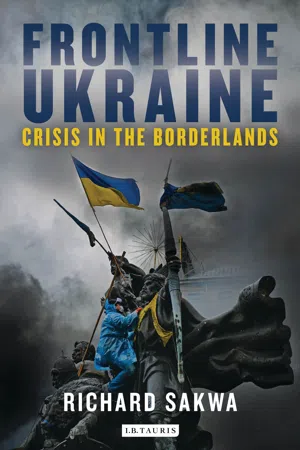
- 320 pages
- English
- ePUB (mobile friendly)
- Available on iOS & Android
eBook - ePub
About this book
The unfolding crisis in Ukraine has brought the world to the brink of a new Cold War. As Russia and Ukraine tussle for Crimea and the eastern regions, relations between Putin and the West have reached an all-time low. How did we get here? Richard Sakwa here unpicks the context of conflicted Ukrainian identity and of Russo-Ukrainian relations and traces the path to the recent disturbances through the events which have forced Ukraine, a country internally divided between East and West, to choose between closer union with Europe or its historic ties with Russia. In providing the first full account of the ongoing crisis, Sakwa analyses the origins and significance of the Euromaidan Protests, examines the controversial Russian military intervention and annexation of Crimea, reveals the extent of the catastrophe of the MH17 disaster and looks at possible ways forward following the October 2014 parliamentary elections. In doing so, he explains the origins, developments and global significance of the internal and external battle for Ukraine. With all eyes focused on the region, Sakwa unravels the myths and misunderstandings of the situation, providing an essential and highly readable account of the struggle for Europe's contested borderlands.
Information
RICHARD SAKWA is Professor of Russian and European Politics at the University of Kent, an associate fellow of the Russia and Eurasia programme at Chatham House, and a fellow of the Academy of Social Sciences. His main research interests are Russian domestic and international politics, European international relations and comparative democratisation. Recent books include The Crisis of Russian Democracy: The Dual State, Factionalism and the Medvedev Succession (2011), Putin and the Oligarch: The Khodorkovsky–Yukos Affair (I.B.Tauris, 2014) and Putin Redux: Power and Contradiction in Contemporary Russia (2014).
‘Cool, balanced and well sourced… Sakwa gives the best analysis yet in book form’
Jonathan Steele, Guardian
‘fascinating… an intelligent, well-researched and thoughtful attempt to explain the major crisis of our time. Anybody, whatever he or she might think of the issue, would benefit from reading it.’
Peter Hitchens, Mail on Sunday
‘Frontline Ukraine is a formidably powerful, well-argued and thoroughly sourced attempt to correct world opinion on the Ukrainian conflict. Even those who cannot accept Professor Sakwa’s underlying case – that the Ukrainian disaster has been brought about more by Western post-Cold War triumphalism than by President Putin’s supposed “imperialism” – will find invaluable data and perceptions in this brilliant and hard-hitting book.’
Neal Ascherson
‘The great merit of Richard Sakwa’s book is its willingness to challenge the prevailing wisdoms about the Ukraine crisis and to explain how its origins lie in the West’s failure to create an equitable political and security order in Europe after the collapse of communism. It is essential reading to understand the causes and complexities of the Ukraine crisis.’
Angus Roxburgh
author of The Strongman: Vladimir Putin and the Struggle for Russia (I.B.Tauris, 2012)
author of The Strongman: Vladimir Putin and the Struggle for Russia (I.B.Tauris, 2012)
‘In these fraught times, informed analysis of the causes and context of the crisis is invaluable… Sakwa’s account is a powerful critique of Western policy towards Ukraine and Russia.’
John Barber, Times Higher Education

Paperback edition published in 2016 by
I.B.Tauris & Co. Ltd
London · New York
www.ibtauris.com
I.B.Tauris & Co. Ltd
London · New York
www.ibtauris.com
Hardback edition first published in 2015 by
I.B.Tauris & Co. Ltd
I.B.Tauris & Co. Ltd
Copyright © 2015, 2016 Richard Sakwa
The right of Richard Sakwa to be identified as the author of this work has been asserted by the author in accordance with the Copyright, Designs and Patents Act 1988.
All rights reserved. Except for brief quotations in a review, this book, or any part thereof, may not be reproduced, stored in or introduced into a retrieval system, or transmitted, in any form or by any means, electronic, mechanical, photocopying, recording or otherwise, without the prior written permission of the publisher.
References to websites were correct at the time of writing.
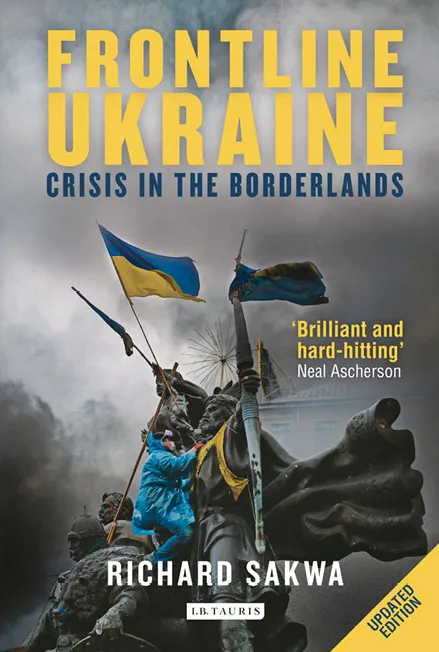
Cover image: Anti-government protesters in Independence Square, Kiev, February 20, 2014 (Photo by Jeff J Mitchell/Getty Images).
ISBN: 978 1 78453 527 8
eISBN: 978 0 85773 804 2
ePDF: 978 0 85772 437 3
eISBN: 978 0 85773 804 2
ePDF: 978 0 85772 437 3
A full CIP record for this book is available from the British Library
A full CIP record is available from the Library of Congress
A full CIP record is available from the Library of Congress
Library of Congress Catalog Card Number: available
Text design, typesetting and eBook by Tetragon, London
Contents
- Note on Transliteration and Translation
- Preface
- Maps
- 1. Countdown to Confrontation
- 2. Two Europes
- 3. Ukraine Contested
- 4. The February Revolution
- 5. The Crimean Gambit
- 6. When History Comes Calling
- 7. The Novorossiya Rebellion
- 8. Worlds in Collision
- 9. Frontline Politics
- 10. The Future of Ukraine
- Afterword: The Challenge of Transformation
- List of Abbreviations
- Notes
- Select Bibliography
Note on Transliteration
and Translation
The transliteration system employed in this book is a modified version of British Standard, and is used in all cases except those where convention decrees otherwise. Thus the Cyrillic letter ‘ю’ becomes ‘yu’, ‘я’ becomes ‘ya’, and at the beginning of names ‘е’ becomes ‘ye’ (i.e. Yevgeny rather than Evgeny). For the sake of reader-friendliness the ‘—ий’ or ‘—ый’ at the end of words is rendered simply as ‘—y’ (i.e. Dmitry rather than Dmitrii); similarly, in forenames ‘кs’ has been rendered ‘x’ (i.e. Alexei rather than Aleksei). Diacritics representing the Russian and Ukrainian hard and soft signs have been omitted in proper nouns. Note also that the Ukrainian ‘g’ (‘г’) is pronounced as an ‘h’; thus Lugansk is pronounced as Luhansk, and Tyagnybok is spoken as Tyahnybok.
In general, for ease of reading, proper names have been anglicised and the conventional forms applied: thus Oleksandr is mostly given as Alexander, Serhiy as Sergei and Andriy as Andrei, unless the context is clearly Ukrainian. In addition, Kyiv will be rendered Kiev, and other place names will conform to the majority language spoken in the region: thus we will have Lviv, the only one of Ukraine’s ten largest cities with a Ukrainian-speaking majority; but Dnepropetrovsk, Kharkov and Odessa, where Russian is the majority language. No political or cultural preference is thereby implied.
Transliteration in bibliographical references will largely follow the more precise Library of Congress system (albeit with ‘ya’ for ‘я’ and ‘yu’ for ‘ю’), and so the reader may at times notice variations between the spelling in the text and that found in the references.
All translations, unless otherwise indicated, are by the author.
Preface
In 2014, history returned to Europe with a vengeance. The crisis over Ukraine brought back not only the spectre but the reality of war, on the one hundredth anniversary of a conflict that had been spoken of as the war to end all war. The great powers lined up, amid a barrage of propaganda and informational warfare, while many of the smaller powers made their contribution to the festival of irresponsibility. This was also the seventy-fifth anniversary of the beginning of World War II, which wreaked so much harm on Central and Eastern Europe. The fall of the Berlin Wall 25 years earlier and the subsequent end of the Cold War had been attended by expectations of a ‘Europe whole and free’. These hopes were crushed in 2014, and Europe is now set for a new era of division and confrontation. The Ukrainian crisis was the immediate cause, but this only reflected deeper contradictions in the pattern of post-Communist development since 1989. In other words, the European and Ukrainian crises came together to devastating effect.
The ‘Ukrainian crisis’ refers to profound tensions in the Ukrainian nation and state-building processes since Ukraine achieved independence in late 1991, which now threaten the unity of the state itself. These are no longer described in classical ideological terms, but, in the Roman manner, through the use of colours. The Orange tendency thinks in terms of a Ukraine that can finally fulfil its destiny as a nation state, officially monolingual, culturally autonomous from other Slavic nations and aligned with ‘Europe’ and the Atlantic security community. I describe this as a type of ‘monism’, because of its emphasis on the singularity of the Ukrainian experience. By contrast, Blue has come to symbolise a rather more plural understanding of the challenges facing Ukraine, recognising that the country’s various regions have different historical and cultural experiences, and that the modern Ukrainian state needs to acknowledge this diversity in a more capacious constitutional settlement. For the Blues, Ukraine is more of a ‘state nation’, an assemblage of different traditions, but above all one where Russian is recognised as a second state language and economic, social and even security links with Russia are maintained. Of course, the Blue I am talking about is an abstraction, not the blue of Viktor Yanukovych’s Party of Regions. The Blues, no less than the Orangists, have been committed to the idea of a free and united Ukraine, but favour a more comprehensive vision of what it means to be Ukrainian. We also have to include the Gold tendency, the powerful oligarchs who have dominated Ukraine since the 1990s, accompanied by widespread corruption and the decay of public institutions. Since independence, there has been no visionary leader to meld these colours to forge a Ukrainian version of the rainbow nation.
The ‘Ukraine crisis’ refers to the way that internal tensions have become internationalised to provoke the worst crisis in Europe since the end of the Cold War. Some have even compared i...
Table of contents
- Cover
- Praise for Frontline Ukraine
- Title
- Contents
- Note on Transliteration and Translation
- Preface
- Maps
- 1. Countdown to Confrontation
- 2. Two Europes
- 3. Ukraine Contested
- 4. The February Revolution
- 5. The Crimean Gambit
- 6. When History Comes Calling
- 7. The Novorossiya Rebellion
- 8. Worlds in Collision
- 9. Frontline Politics
- 10. The Future of Ukraine
- Afterword: The Challenge of Transformation
- List of Abbreviations
- Notes
- Select Bibliography
- eCopyright
Trusted by 375,005 students
Access to over 1.5 million titles for a fair monthly price.
Study more efficiently using our study tools.
Frequently asked questions
Yes, you can cancel anytime from the Subscription tab in your account settings on the Perlego website. Your subscription will stay active until the end of your current billing period. Learn how to cancel your subscription
No, books cannot be downloaded as external files, such as PDFs, for use outside of Perlego. However, you can download books within the Perlego app for offline reading on mobile or tablet. Learn how to download books offline
Perlego offers two plans: Essential and Complete
- Essential is ideal for learners and professionals who enjoy exploring a wide range of subjects. Access the Essential Library with 800,000+ trusted titles and best-sellers across business, personal growth, and the humanities. Includes unlimited reading time and Standard Read Aloud voice.
- Complete: Perfect for advanced learners and researchers needing full, unrestricted access. Unlock 1.5M+ books across hundreds of subjects, including academic and specialized titles. The Complete Plan also includes advanced features like Premium Read Aloud and Research Assistant.
We are an online textbook subscription service, where you can get access to an entire online library for less than the price of a single book per month. With over 1.5 million books across 990+ topics, we’ve got you covered! Learn about our mission
Look out for the read-aloud symbol on your next book to see if you can listen to it. The read-aloud tool reads text aloud for you, highlighting the text as it is being read. You can pause it, speed it up and slow it down. Learn more about Read Aloud
Yes! You can use the Perlego app on both iOS and Android devices to read anytime, anywhere — even offline. Perfect for commutes or when you’re on the go.
Please note we cannot support devices running on iOS 13 and Android 7 or earlier. Learn more about using the app
Please note we cannot support devices running on iOS 13 and Android 7 or earlier. Learn more about using the app
Yes, you can access Frontline Ukraine by Richard Sakwa in PDF and/or ePUB format, as well as other popular books in History & Russian History. We have over 1.5 million books available in our catalogue for you to explore.