- 272 pages
- English
- ePUB (mobile friendly)
- Available on iOS & Android
eBook - ePub
About this book
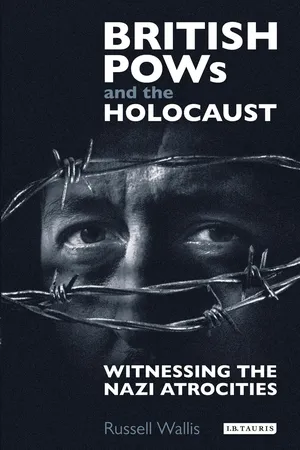
In the network of Nazi camps across wartime Europe, prisoner of war institutions were often located next to the slave camps for Jews and Slavs; so that British PoWs across occupied Europe, over 200,000 men, were witnesses to the holocaust. The majority of those incarcerated were aware of the camps, but their testimony has never been fully published. Here, using eye-witness accounts held by the Imperial War Museum, Russell Wallis rewrites the history of British prisoners and the Holocaust during the Second World War. He uncovers the histories of men such as Cyril Rofe, an Anglo-Jewish PoW who escaped from a work camp in Upper Silesia and fled eastwards towards the Russian lines, recounting his shattering experiences of the so-called 'bloodlands' of eastern Poland. Wallis also shows how and why the knowledge of those in the armed forces was never fully publicised, and how some PoW accounts were later exaggerated or fictionalised. British PoWs and the Holocaust will be an essential new oral history of the holocaust and an extraordinary insight into what was known and when about the greatest crime of the 20th century.
Information
CHAPTER 1
BRITISH POWS: WHAT THEY SAW AND UNDERSTOOD
For British soldiers captured in the early part of the war and transported eastwards, the first atrocities they heard about were those committed against Poles. They were the first widespread atrocities committed in World War II and were carried out using troops who were imbued with anti-Polish prejudice, all done according to a preconceived plan. Before the German invasion of Poland, the respective hierarchies of the Security Services and the Wehrmacht reached an agreement. Following victory ‘some thirty thousand people would be arrested, based on lists of names … compiled in advance.’ Members of ‘the aristocracy, Catholic clergy, and Jews’ were to be liquidated because they were deemed ‘hostile to Germany and the Reich in enemy territory behind the front lines.’1 In addition to the officially sanctioned murder of Polish intelligentsia came a ferocious assault against ordinary civilians, especially those deemed to be obstructive to German aims.2 In scenes that were strikingly reminiscent of atrocities committed by German forces in Belgium during World War I, this new generation of invaders exacted widespread violent revenge, based on the smallest of pretexts.3 Old-style German militaristic methods of waging war conveniently dovetailed with new ideas forged in the Nazi imagination.4 It became a racial war of annihilation. As Richard Evans writes, ‘almost everything that was to happen in the invasion of the Soviet Union from June 1941 onwards was already happening on a small scale in the invasion of Poland nearly two years before.’5
Some Germans, however, had doubts. Wholesale massacre prompted Lieutenant Colonel Helmuth Stieff, head of Group 3 in the Operations Department of the General Staff, to write to his wife stating that he was ‘ashamed to be German’. He continued:
The wildest imaginings of propagandists who make up atrocity stories are tame compared to the crimes that an organized gang of murderers, robbers, and looters is really committing here, supposedly with the tacit consent of the highest levels.6
Yet isolated members of the German senior staff were not the only ones who were alarmed by the atrocities. In 1940 D. C. Mason, a Royal Engineer, was captured near Poperinghe, Belgium. Within a short time he was transferred to Lamsdorf. He wrote of the relaxed atmosphere around the camp before the end of 1940, how ‘it was possible to stroll around the Stalag’, visiting friends or comrades with a degree of freedom that would have astonished those who arrived later in the war. However, Mason was able to pinpoint the moment when this pre-atrocity complacency was shattered. ‘Something happened’, he wrote, something ‘very sinister, and surely horrendous.’ It made him ‘aware that a barbaric atrocity had been perpetrated by the German invaders of Poland’.
Roaming around the camp, he noticed a group of prisoners gathered by the main entrance gate. Two German soldiers had brought a Polish youth into custody, and while one of the guards reported to the camp office the POWs pressed the young man for news. Mason continued:
It transpired that the lad had lived with his parents and a sister on their farm in Poland, where they had been happy and contented, and had worked very hard at their occupation and source of livelihood. Then following the invasion of their homeland by the Germans, a detachment of SS troops had arrived at their farm. They were absolutely brutal and sadistic. They dragged the youth's parents out of the farmhouse, and wilfully shot them both. Not content with these vile murders, they next grabbed his sister and dragged her screaming outside the farm. There they tore her clothes off, stripping her naked. They then tied the distressed girl to a tree, and the SS troops then repeatedly raped her. Finally after satisfying their lust one of the SS thrust a bayonet into the girl's womb, and then slit her stomach open. The Polish youth had been forced to watch this appalling atrocity.7
Mason had no doubts that the young Pole was telling the truth and seemed even to identify with the ideals of family, hard work and living off the land. These elements combined to create a context that emphasised the shattering events that followed in the youth's story. The survivor was merely a ‘lad’, whose innocence and family had been torn away. Although Mason's description of the rape and murder of the youth's sister could be described as gratuitous, it also showed that he fully comprehended the awfulness of the violence. Certainly the account seems to have burned itself onto Mason's memory. Although the SS allegedly carried out this atrocity, incidents such as these occurred on a daily basis through the winter of 1939–40, committed by a mixture of regular German troops, ethnic German militias, SS Einsatzgruppen and Order Police.8 But it was not just the awfulness of the crimes that stayed with Mason. The powerlessness of the POWs to intervene or to even call for justice also seems to have had a profound effect. As Mason wrote:
All our chaps were absolutely stunned at the news, but felt helpless. There was of course nothing that we could do to help the youth. The despair in his eyes and his pleas for help, as the guard dragged him off to the Stalag cell-block remain with me to this day.
Mason and his fellow internees were not the only ones to have heard about German brutality towards Poles. V. West had been captured on 22 June 1941 and arrived at Lamsdorf in late November via Salonika and then Stalag IVB Mühlberg, near Dresden. West developed friendships among the Palestinian contingent in the camp. He talked with one in particular, Moische Feinelbaum, a tall, young civil engineer ‘who was a mine of information on the Nazi brutality in Poland.’ Through him, West and his fellow POWs picked up information about who was being targeted. They heard how ‘intellectuals and the officer class’ were singled out, along with ‘educated Poles of any culture’. From what West gathered, the Nazis had particular hatred ‘for Poles claiming to be Volksdeutsch’.9 As well as hearing about German savagery on the vibrant camp grapevine, West also witnessed it for himself. The barbaric treatment of Russian POWs made a particular impression and contributed to his general understanding that German forces were committing widespread atrocities.
Like Mason, West's testimony was written after the event as an unpublished memoir, therefore, elements could have been subsequently added. However, unlike a minority of POWs who gained significant publicity, neither portrayed themselves heroically. In fact, West was even happy to name his source. That the information came from a Palestinian Jew makes sense because some of those captured were recent émigrés from Europe who were multi-lingual and able to understand news transmitted in Polish, German or Yiddish. Although Mason's testimony is strong on specific details that are indicative of eyewitness testimony, West's is notable less for detail than for the level of strategic knowledge. It seems that British POWs captured early on in the war understood German troops were carrying out something systematic: a wide-ranging policy with defined objectives, involving the murder of Poles on a large-scale, particularly the Polish intelligentsia, in an effort to ‘decapitate’ Polish society.10 However, as German forces consolidated their position in Poland, the focus of their collective rage shifted. Instead of Poles, Polish Jews were increasingly subject to harsh treatment and measures that were designed to isolate them from the rest of the population.11
For German service personnel and citizens in occupied territories, Jews, Evans states, ‘scarcely qualified as human beings at all’.12 This is partly because in the eyes of the invaders, Polish Jews were very different to most of those living in Germany itself. Whereas in Germany, most Jews had been conscious members of a westernised community, in Poland, Jews constituted ‘a distinctive national minority’ which amounted to over three million souls, ‘the largest proportion of Jews living in any European state.’13 The majority of Polish Jewish men dressed differently to Christian Poles, wearing beards and sidelocks in accordance with Judaistic tradition. Most worked as small-scale traders, shopkeepers and artisans and were very poor. According to Evans, ‘to the incoming Germans these were “Eastern Jews”, a wholly alien and despised minority regarded by most of them as non-European, to be treated with even greater contempt and mistrust than the Jews of Germany itself.’14 When German authorities took steps towards separating Polish Jews, who, in the racial hierarchy were deemed lower than ethnic Poles, from the rest of the population, the presence of British POWs helped puncture the dark shroud of secrecy insisted upon by Nazi leaders.
After capture in May 1940, D. Swift of the Royal Sussex Regiment was transferred to a town he knew as ‘Shubin’, located ‘at the bottom of the Polish Corridor’. He was probably referring to the Polish town of Szubin (Schubin in German), a few miles north east of Poznań. In early 1941, Swift was transferred to Stalag XXIB in Poznań itself. Here he encountered local Jews whose lives had been catastrophically transformed by the arrival of the Germans. Thousands of books from the Jewish library had been confiscated, Jewish schools closed and Jewish shops taken over. Those who were not deported to the General Government, a vast racial dumping ground to the east set up by German authorities, were forced into over 20 ‘camps’ in the Poznań area. At this stage of the war, Jews were just as likely to be forced into particular buildings as ‘camps’ in order to separate them from the rest of the population; in effect this process constituted an early form of ghettoisation.15 From 29 November 1939 Jews were made to wear the yellow Star of David and became forced labourers on ‘public works, construction, gardening and transport projects’ throughout Poznań.16 British POWs stationed in Szubin and thereafter in Poznań, were able to witness the steady deterioration in conditions endured by Jews in the area. When he first arrived in 1940, Swift noted that ‘Jews still had a little freedom but had to live in a ghetto and wear a large yellow Star of David sewn on their jackets and do menial jobs.’ Along with his comrades, Swift was presently moved south by cattle truck to Poznań and ‘Fort Rauch’. Not far away from their new accommodation was ‘another fort filled with Jewish women.’ He noted that ‘all their hair had been shaved off and they went out daily with guards, doing labouring jobs like cleaning and shifting piles of old bricks etc.’ Next, Swift reported that ‘things were getting terrible for the Jews’ as they were given ‘hard labour jobs with little to eat, drink or wear’.17
Even at this early stage of the war POWs worked side-by-side with Jewish labourers. Swift noted that the ‘German “steigers” or civilian bosses on construction sites had the power to hit and kill Jewish workers with a pick axe handle, or anything; telling the other Jews to tip their loads of soil over the body to cover it up.’ For Swift it was plain that the ‘bosses and SS guards had the power of life and death over the Jews.’ POWs were sometimes even able to see inside Jewish labour camps. Swift reported that a working party of POWs passed one of these camps in the area and saw SS guards letting their ‘dogs chase and savage the Jews around the compound, while German boys twirled the feet of hanging Jews’. He was also able to gain some understanding of the ideology that drove this maniacal behaviour. Swift observed that SS guards ‘did not want to soil their hands on unclean Jews’ therefore they ‘always put their gloves on before bashing hell out of a Jew.’ POWs did not necessarily have to be out and about to see what was going on. On one occasion, two Jewish women ‘came by our camp crying bitterly followed by a guard’ and the POWs ‘could only conclude that they were going somewhere they wouldn't be coming back from’. Such an assumption could only be made because they had already seen for themselves the new brutalised reality for Poznań Jews. Swift even noted the ‘posters were put up in the streets of Poznan, giving the death lists of those who had been executed.’ For Swift it seems that these things were part of a new norm. He mused that:
To see a column of Jewish forced labour workers shamble by was like looking at a set of sub humans. They walked unsteadily, weakly, their backs bent as they hobbled along, their faces showing the hopelessness of their situation.18
From what they saw and heard, Swift and his fellow POWs understood that, for the occupiers, Jewish lives were cheap. They were both moved by Jewish suffering and frustrated by their own impotence. As Swift stated, ‘our hearts went out to them, but we could do nothing.’19 This sense of powerlessness permeates POW accounts of interactions with persecuted Jews. This is partly because the vast majority of Britons spent their war, not on the run, but firmly incarcerated with little or no hope of escape. S. V. Mackenzie confirms this, adding, ‘only a minority of prisoners of war were ever keen to jeopardize their own lives or the precariously stable lifestyle of their fellows by making or supporting escape attempts.’20
It is then a common misconception that most British POWs were constantly attempting to escape or thinking about how they could do it. This particular invention probably had its origins in the account of one particularly ingenious bid, a three-man tunnel dug under a vaulting horse at Stalag Luft III, Sagan (now Żagań in western Poland). The Wooden Horse, published in 1949, became an immediate bestseller and shortly after was made into an equally successful film.21 Its success somehow gave impetus to the myth that by attempting to escape POWs provided a perpetual diversion to German authorities and therefore had a ‘good’ war, even behind the barbed wire. Such notions were continually reinforced for later generations because of seemingly interminable repeats of the 1963 film The Great Escape. The reality was different; only a minority ever escaped and then, normally, only for a while. Those that made this courageous or reckless decision spent time travelling around occupied Poland and had access to places and information normally denied to the average prisoner. Because these individuals were relatively few and far between, on re-arrest they became objects of interest for camp populations starved of news. One such individual was Richard Pape.
The Polish town of Częstochowa was 60 miles north of Auschwitz. It was here that one escaped British POW was able to piece together evidence about the particular plight of Jews in the town. Pape was shot down and captured in 1941 when returning from a bomber raid over Berlin. Briefly incarcerated in Lamsdorf before volunteering for a work party based at one of the Upper Silesian mines, he escaped with the help of a Polish POW in early 1943. They found their way to Częstochowa, latterly made famous by Art Speigelman's Maus, and made contact with the Polish underground.22
Częstochowa was situated in a district that was made up of ‘predominantly Polish and Jewish populations.’23 A massacre of Poles and Jews had already taken place on 3 September 1939 when the Wehrmacht entered the town, after which, Częstochowa Jewry, renowned for its business, cultural and social activities, was steadily denuded of its position and possessions. Physical and psychological persecution characterised the period of occupation.24 A Jewish ghetto was established on 9 April 1941, ‘the largest in the Radom district containing ...
Table of contents
- Front Cover
- Title Page
- Copyright
- Contents
- Acknowledgements
- Introduction
- 1. British POWs: What They Saw and Understood
- 2. British POWs and Jewish POWs: A Common Experience?
- 3. Jewish POWs and Jewish Inmates
- 4. The Reaction of British POWs to the Outworking of Nazi Anti-Jewish Policies
- 5. Comparisons
- 6. The Limits of POW Testimony
- Coda
- Notes
- Bibliography
- Back Cover
Trusted by 375,005 students
Access to over 1.5 million titles for a fair monthly price.
Study more efficiently using our study tools.
Frequently asked questions
Yes, you can cancel anytime from the Subscription tab in your account settings on the Perlego website. Your subscription will stay active until the end of your current billing period. Learn how to cancel your subscription
No, books cannot be downloaded as external files, such as PDFs, for use outside of Perlego. However, you can download books within the Perlego app for offline reading on mobile or tablet. Learn how to download books offline
Perlego offers two plans: Essential and Complete
- Essential is ideal for learners and professionals who enjoy exploring a wide range of subjects. Access the Essential Library with 800,000+ trusted titles and best-sellers across business, personal growth, and the humanities. Includes unlimited reading time and Standard Read Aloud voice.
- Complete: Perfect for advanced learners and researchers needing full, unrestricted access. Unlock 1.5M+ books across hundreds of subjects, including academic and specialized titles. The Complete Plan also includes advanced features like Premium Read Aloud and Research Assistant.
We are an online textbook subscription service, where you can get access to an entire online library for less than the price of a single book per month. With over 1.5 million books across 990+ topics, we’ve got you covered! Learn about our mission
Look out for the read-aloud symbol on your next book to see if you can listen to it. The read-aloud tool reads text aloud for you, highlighting the text as it is being read. You can pause it, speed it up and slow it down. Learn more about Read Aloud
Yes! You can use the Perlego app on both iOS and Android devices to read anytime, anywhere — even offline. Perfect for commutes or when you’re on the go.
Please note we cannot support devices running on iOS 13 and Android 7 or earlier. Learn more about using the app
Please note we cannot support devices running on iOS 13 and Android 7 or earlier. Learn more about using the app
Yes, you can access British PoWs and the Holocaust by Russell Wallis in PDF and/or ePUB format, as well as other popular books in Historia & Historia del Holocausto. We have over 1.5 million books available in our catalogue for you to explore.