eBook - ePub
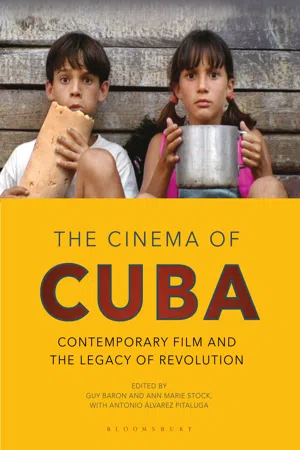
The Cinema of Cuba
Contemporary Film and the Legacy of Revolution
- 336 pages
- English
- ePUB (mobile friendly)
- Available on iOS & Android
eBook - ePub
The Cinema of Cuba
Contemporary Film and the Legacy of Revolution
About this book
Contemporary Cuba is opening up to the rest of the world. Its colonial past and the Communist revolution have left a lasting imprint on society, yet there is a tangible sense of rapid change which is reflected in the island's national cinema. New screen technologies and digital distribution media have supported the efficacy and global reach of Cuban filmmakers whose work, somewhat in lieu of adequate distribution and traditional screening facilities in Cuba itself, is often disseminated via 'flash' (USB memory sticks).Channelling an energetic DIY attitude through grassroots movements and ad-hoc resourcefulness, the new filmmakers of Cuba have inspired the editors of this book to embrace their contagious enthusiasm through essays on authentic Cuban cinema. Whilst the book provides a comprehensive overview of the history behind current practices, it also moves beyond this to examine key case studies as well as 'snapshots' of individuals working within the industry today. Chapters celebrate the shared creativity as well as diversity of Cuban cinema, including both productions of the Cuban Film Institute's (ICAIC) as well as those from the industry margins. The films discussed demonstrate a driving cinematic force through social criticism, the emphasis of debate and historical change through film, reassessments of gender relations, the use of new technologies and much more.
Information
Part One
Pan / Context / Nation
Introduction to Part One
History of Cuban Cinema: A Pending Task for the Social Sciences in the Twenty-First Century
ANTONIO ÁLVAREZ PITALUGA
Translated by Guy Baron
There have been some notable failings from within Cuba in writing the history of contemporary Cuban cinema. The first of these is the lack of social science research and the second is how few academic historians on the island work closely on the subject of cinema.1 This of course does not diminish in any way the various approaches to the historical development of film made by other specialists; on the contrary, thanks to them we have a well-researched written memory of Cuban cinema. However, social scientists and academic historians on the island have not been particularly interested in cinema as an object of study. I am one of those historians who has, up until recently, neglected cinema as a research topic and so I take this as a personal responsibility. There are several reasons for this lack of attention on Cuba’s film history:
•The traditional concern of the social sciences with other aspects of society and national history such as the demographic, the political or the economic.
•The traditional way that Cuban Social Sciences has treated art and literature as mere complements to their investigations and not as a means in and of themselves to understand history.
•The priorities set by Cuban historians during the second half of the twentieth century, and their lack of desire to chronicle the revolutionary period sufficiently.
•The dominant role that the nineteenth century has held as a historical period for the study of the formation of Cuban nationality and the nation, largely due to the three Wars of Independence (1868–78, 1879–80 and 1895–98) which for decades have been the focus for historians; in fact, seventy to eighty per cent of all history books published on the island deal with the nineteenth century.
•At the same time, Cuban historians have maintained the idea that they need to chronologically distance themselves from their subjects by a minimum of thirty to forty years before they can interpret and write about historical issues concerning the content and evolution of art.
•Finally, to understand art and literature not simply as events, but also as part of a complex and critical sociocultural process was, for decades, not the privilege of many historians, as most were persuaded by a culture of positivist thought from the beginning of the twentieth century.
From 1990 this particular approach to art and literature among historians began to change. It was at this time that Cuban society took a new direction due to the end of European socialism and the arrival of the disastrous economic crisis known as the ‘Special Period’. To paraphrase the Cuban historian Juan Pérez de la Riva, 1990 symbolically marked the end of ‘Cuba A’ and the beginning of ‘Cuba B’. At that point social history and cultural studies began to emerge among the new generation of students of Cuban history. Critical Marxism and studies of Antonio Gramsci, along with studies from theoretical schools such as Frankfurt and Birmingham became more understood on the island. From the traditionally used theoretical and methodological instruments, some historians began to implement approaches from cultural studies to allow them to observe and understand cinema as a powerfully informative and interpretive instrument of the country’s recent history.
The limited production of Cuban Revolution historical studies coming out of the island itself left open a field of social interpretation that has been covered to some extent by national film production and in novels. In fact, from the beginning of the decade, Cuban cinema deepened its anthropological vision of reality to the point of being a great visual anthropological museum of Cuba. It is no secret that for a social, historical and anthropological perspective of contemporary Cuban society one should go to the movies and read the Cuban novels of the past six decades, as Cuban social sciences have not been able to match this close examination of the social.
More recently, Cuban historians and social scientists have used the contemporary production of film as a starting point and focus several of their investigations on the necessity of placing film and its social analysis firmly within the mechanics of power relations that articulate hegemony in the modern state. After all, film is both a technological and ideological product of modernity.
Imbued with this necessary, new perspective, in 2011–13 a group of Cuban history scholars, along with another group of British and US academics, developed a joint research project on Cuban cinema post-1990.
The project was perhaps the first time such a large group of Cuban historians analysed such a variety of social issues in today’s Cuba through an examination of Cuban audiovisual production. One of the attractions of these texts is that they examine, from a distinctive historical viewpoint, some of the various problems in Cuban society as presented through its cinema. Thus, issues such as the general evolution of Cuban cinema in relation to cultural policies and different historical periods of the country; the presence of burning issues such as racial identity and racism; visual anthropology and the treatment of rural communities; and the reflection of national historical themes are dealt with in the first section of this book.
The first chapter, ‘Brief Notes on a History of Cuban Cinema (1959–2015)’ is not a catalogue of film production, nor is it an encyclopaedic text. Its objectives are to historically locate the various stages of film production in Cuba and to identify and characterise prominent social and historical themes reflected in major feature films produced by the Cuban Film Institute (ICAIC) from its inception up until 2015. In addition, it valorises the relationship between different social topics and historical junctures of the cultural policy of the state. Thus, it seeks to place the role of Cuban cinema within the structures of the cultural hegemony of the revolutionary system. Finally, using an historical perspective, the article proposes a characterisation of the work undertaken by younger filmmakers in recent years. This opening text, therefore, presents the reader with a guide to precede the various other aspects of Cuban cinema discussed throughout the book.
Chapter 2 by British academic Guy Baron draws on a number of films from the early part of the new millennium to illustrate how, at the turn of the century, Cuban cinema represented the continuous struggles of ordinary Cubans to survive. The films focused on are all produced after the supposed ‘Special Period’ has come to an end and yet the levels of dysfunction, discontent and isolation presented are as great as at any time in Cuban film history. In films such as Lista de espera (Waiting List), Miradas (Glances), Miel para Ochún (Honey for Ochún), Suite Habana (Havana Suite), Entre ciclones (Between Cyclones), Perfecto amor equivocado (Perfect Mistaken Love), Barrio Cuba (Cuba Neighbourhood), Doble juego (Double Play) and Viva Cuba (Long Live Cuba), the panorama of Cuban cinema becomes ever more critical and Baron proposes that, during this period, Cuban cinema becomes increasingly inward looking in a process of self-examination, in a fraught and anxious way. A number of these films expose dysfunctionality in families, relationships and society in general and, by voicing and envisioning such a strong critique of a malfunctioning society, these films question the very idea of Cuban revolutionary national identity.
Cuba is a country without the regional, geographic and cultural diversity of other Latin American and European countries. From one end of the island to the other, we speak the same language. Generally we eat the same type of food and we dress the same without differences across traditions. Music features heavily as part of our national culture. Our material culture is practically a singular one. Essentially, the transculturation of Spanish and African cultures is what defines the visible unity of Cuban culture without denying other contributions and external components. However, there do exist distinct physical and cultural spaces on the island that illustrate the different ways of life for diverse communities, both urban and rural, which are reservoirs of a common Cuban culture. In Chapter 3, ‘Community Film and Audiovisual Production’, the Cuban anthropologist and ethnologist Jesús Guanche presents an interesting study that analyses the approaches that cinema has taken to illustrate these diverse communities across the island. The article takes an anthropological look at how film has dealt with these communities, paying particular attention to rural areas. The lives of these people and their relationship with nature is seen as an intellectual concern that has produced about 500 documentaries in the country. Guanche takes a detailed look at the audiovisual production company Televisión Serrana based in the Sierra Maestra mountains and discusses how, through a generous network of connections with national and international institutions, this audiovisual community has gained considerable space in the cinema of the Revolution.
Chapter 4, ‘Cinema, Race and Revolution: Dialogue and Disagreements of a Cuban Trilogy’, by Cuban scholar Alejandro L. Fernández Calderón reflects on how racism and racial identity in Cuba have been depicted in its revolutionary cinema. He presents the notion of two competing realities: the conflicts of racism and racial identity, and the different mutations that both have experienced in Cuban society from 1959 to the present. According to Calderón, revolutionary cinema has illustrated Cuban racial complexity through visions of social and moral dilemmas, strategies that at one time disappeared but later re-emerged in the 1990s with so-called ‘negrometrajes’ (fiction films with racial themes starring mostly black actors). Finally, via analyses of several films, the author explains that racism is still a pending issue in Cuban society, even when at various times in the history of the Revolution, it has been claimed that the issue has been overcome. For Calderón, cinema has been an important cultural tool that has continued to debate one of the most sensitive issues in Cuban revolutionary society.
This section deals with some thoughts from a group of historians and anthropologists. To think of cinematography from the point of view of historical science is something relatively new in Cuba. To place film within the complex dynamics of an atypical Cuban reality is the focus of this part of the book. Despite not having vast financial resources, contemporary Cuban national cinema has for years been a visual and ideological reference point for the whole of Latin America and still today it is recognised as a major cultural project in the region, providing a beautiful painted window of images and sounds that gets close to reflecting one of the most unique societies in the world.
Note
1.There have been a number of excellent studies on Cuban cinema written from outside the island, such as Michael Chanan’s Cuban Cinema, Ann Marie Stock’s On Location in Cuba (recently translated into Spanish as Rodar en Cuba), Guy Baron’s Gender and Cuban Cinema and Enrique García’s Cuban Cinema After the Cold War.
1
Brief Notes on a History of Cuban Cinema (1959–2015)
ANTONIO ÁLVAREZ PITALUGA
Translated by Guy Baron
It is very difficult to study a revolution from a single concept or theoretical definition. The intellectual confluence of a variety of theoretical assumptions is the key to understanding the totality of any revolutionary process; its social complexity demands this approach. Sometimes not even living within a revolution guarantees an understanding of it. The binomial cycle of reason-irrationality becomes a constant within its quotidian and epic discourse. Some people assume that a revolution is a point of arrival, when political power is seized and control of past institutions is achieved. However, a real revolution is something quite different.
The point of arrival is only a starting point, a new beginning after the seizure of power that turns into a permanent social transformation to articulate a new logic of reality. A revolution is an important cultural event during its time. It is a process of the cultural subversion of all representations of reality and of the powers that both the state and common subjects construct and reproduce in order to create a new system of social relations in which national culture, the essential pillar of cultural hegemony, is re-cast and re-claimed.
When the Cuban Revolution triumphed in 1959 what came before it was regarded as the basis for change. The depth of this historical turn meant the end of the old state and emergence of the new. The projected path was possible because the Revolution acted immediately on the most important element for every citizen, their subjectivity; more important than their origin or social status. It was necessary to deeply subvert many of the attitudes of the Cuban people in order to dismantle the system of values that had previously dominated. The victorious sectors projected the process as an ideological crusade for the purposes of ‘mental decolonisation’, within which cinema played an essential role. It was to contribute to the creation of a counter hegemony from an audiovisual perspective in order to transform a world bound by centuries of colonisation.
That is why just eighty days after 1 Janua...
Table of contents
- Cover
- Author Bio
- Series Information
- Endorsement
- Title Page
- Copyright Page
- Contents
- List of Illustrations
- Contributors
- Acknowledgements
- Part One Pan / Context / Nation
- Part Two Zoom / Text / Auteur
- Part Three Reverse Shot / Individual / Testimony
- Bibliography
Trusted by 375,005 students
Access to over 1.5 million titles for a fair monthly price.
Study more efficiently using our study tools.
Frequently asked questions
Yes, you can cancel anytime from the Subscription tab in your account settings on the Perlego website. Your subscription will stay active until the end of your current billing period. Learn how to cancel your subscription
No, books cannot be downloaded as external files, such as PDFs, for use outside of Perlego. However, you can download books within the Perlego app for offline reading on mobile or tablet. Learn how to download books offline
Perlego offers two plans: Essential and Complete
- Essential is ideal for learners and professionals who enjoy exploring a wide range of subjects. Access the Essential Library with 800,000+ trusted titles and best-sellers across business, personal growth, and the humanities. Includes unlimited reading time and Standard Read Aloud voice.
- Complete: Perfect for advanced learners and researchers needing full, unrestricted access. Unlock 1.5M+ books across hundreds of subjects, including academic and specialized titles. The Complete Plan also includes advanced features like Premium Read Aloud and Research Assistant.
We are an online textbook subscription service, where you can get access to an entire online library for less than the price of a single book per month. With over 1.5 million books across 990+ topics, we’ve got you covered! Learn about our mission
Look out for the read-aloud symbol on your next book to see if you can listen to it. The read-aloud tool reads text aloud for you, highlighting the text as it is being read. You can pause it, speed it up and slow it down. Learn more about Read Aloud
Yes! You can use the Perlego app on both iOS and Android devices to read anytime, anywhere — even offline. Perfect for commutes or when you’re on the go.
Please note we cannot support devices running on iOS 13 and Android 7 or earlier. Learn more about using the app
Please note we cannot support devices running on iOS 13 and Android 7 or earlier. Learn more about using the app
Yes, you can access The Cinema of Cuba by Ann Marie Stock, Guy Baron, Antonio Álvarez Pitaluga, Ann Marie Stock,Guy Baron,Antonio Álvarez Pitaluga in PDF and/or ePUB format, as well as other popular books in Media & Performing Arts & Film History & Criticism. We have over 1.5 million books available in our catalogue for you to explore.