- 272 pages
- English
- ePUB (mobile friendly)
- Available on iOS & Android
eBook - ePub
About this book
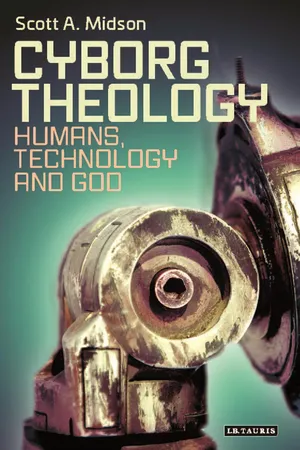
In particular, Donna Haraway argued in her famous 1991 'Cyborg Manifesto' that people, since they are so often now detached and separated from nature, have themselves evolved into cyborgs. This striking idea has had considerable influence within critical theory, cultural studies and even science fiction (where it has surfaced, for example, in the Terminator films and in the Borg of the Star Trek franchise). But it is a notion that has had much less currency in theology. In his innovative new book, Scott Midson boldly argues that the deeper nuances of Haraway's and the cyborg idea can similarly rejuvenate theology, mythology and anthropology. Challenging the damaging anthropocentrism directed towards nature and the non-human in our society, the author reveals - through an imaginative reading of the myth of Eden - how it is now possible for humanity to be at one with the natural world even as it vigorously pursues novel, 'post-human', technologies.
Information
Part I
CHAPTER 1
Imago Dei: Anthropogeny & Theological Anthropology
WHAT DOES IT MEAN TO BE ‘HUMAN’?
If you were asked to describe or explain humans, what words would you use? Would you emphasise human uniqueness over other animals, appealing to traits such as language, bipedalism, the ability to develop more abstract things like culture and religiosity or spirituality? Or would you draw attention to human craftsmanship and tool use that enables construction of the world? Or would you suggest instead that humans cannot be separated or abstracted from their surroundings in terms of the networks in which we find them? Are any of these a truly satisfactory answer to the question ‘what are humans’?
Although a difficult question, the issue of what it is – or perhaps isn't – to be human, particularly in a world rife with technological developments that are advancing at an exponential rate (or at least if technologist Ray Kurzweil's predictions are correct), is central to this investigation. The cyborg, as already suggested, represents a profound way in which our understandings and assumptions about what it is to be human are challenged. Indeed, for Donna Haraway, ‘cyborg anthropology attempts to refigure provocatively the border relations among specific humans, other organisms, and machines’.1 In order to more fully appreciate the critical work that is being undertaken via the cyborg here, it is necessary to explore how the human is constructed and conceived, particularly in terms of the ‘border relations’ where the cyborg critique is most acute. In other words, the question that is raised sharply by Haraway's cyborg figure is one of how we regard the human, and especially how we discern it against the nonhuman. There is a strong sense that what we recognise as ‘human’ is ascertained by identifying what is not human, in a dialectic process that makes conclusions by means of thesis and antithesis. For example, one might posit that humans are distinct from animals: we have the ability to use abstract thought; animals (to our knowledge) do not; abstract thought is thus a marker of human difference and humanness. Or, in a more technological context, we might look to the differences between humans and robots: humans have emotions and complex feelings; robots (to our knowledge) do not; emotions thereby help us to understand what it is to be human in a world shared with increasing numbers of robots.
What is interesting to note in each of these cases is that we are able to dialectically arrive at some understanding or sense of what it is to be human only insofar as we actively seek to identify the nonhuman, the counterpoint to constructions of the human, in the first place. Put differently, we seek to produce a difference, and as such we bring assumptions to our explorations of non/humanness. To sketch out another brief technological example of this, consider the term ‘artificial intelligence’. Embedded in this label are certain underlying attitudes: there is, on the one hand, the foregrounding of intelligence as the defining feature of these beings. This may, in a weak sense, be used to discriminate against other forms of life, or more likely, other technologies that are non-intelligent. Yet, on the other hand and in a stronger sense, ‘artificial’ more readily lends itself to the contrast between the non-artificial, or natural. From the term ‘artificial intelligence’ alone, then, there is suggestion of an assumed difference: we want to recognise this form of intelligence in some way as different, and the idea of artificiality provides a way of securing and qualifying that difference. An important way that Haraway theorises and uses cyborgs is to challenge such boundaries and markers, or presumptions, of difference.
Why are boundaries and differences so important to the human and to our understandings of what it is to be human? This is a broad question that encompasses a great deal of religious and philosophical reflection since the earliest evidenced parts of human history. To attempt to fully resolve it here, or indeed anywhere, would be a futile and dangerously misleading endeavour. It would be dangerous because of what such a definitive understanding of humanness would suggest: to presume to have resolved the complex matter of humanness would be to totalise one assumption or set of assumptions, whereas human nature is not something static or immutable. And yet, this is what we have tended to do with our striving to locate and buttress notions of human difference against animals, technologies, even nature.
Theology and the understandings of the human that it presents, in a sub-discipline referred to as theological anthropology, are here important. This may seem like a striking statement, given that much scholarly attention – particularly in the social sciences – has been given to the argument that society has become increasingly secular. Secularisation presents a complex debate, however,2 and in spite of discernible trends that might suggest a waning influence of religion in certain spheres of society, it is a key contention of this book that the cultural and even tacit influence of religious and theological motifs has far from faded. Although the present western context is often characterised as ‘secular’, then, given the parallels between Edenic narratives and general attitudes to humans and the world, I argue that theological resonances are ongoing. This should come as no particular surprise, given that, as explained in the Introduction, we live in a context shaped by (as well as continuing to shape) (hi)stories. Of these, theology is a significant mythological narrative.
The Judeo-Christian tradition depicts humans as having been created in the image of God (imago dei) (Genesis 1:27). Because of this, the first chapters of Genesis that document God's creation of the world are an oft-cited set of passages in theological reflection. What is specifically relevant for the discussion of the boundaries of the human raised so far in this chapter is that it is only humans that are (explicitly) presented as having been made according to God's image, and so this may provide a theological incentive to identifying a sense of human difference from, for example, animals.3 Furthermore, in Genesis 1:26, the matter of ‘dominion’ is raised as connected somehow to the notion of imago dei, which has led to understandings of humans as not only different from animals, but moreover as above them in a hierarchical sense. This has led to scholars such as Lynn White to regard Christianity, due to its undergirding Genesis-based anthropology, as being ‘the most anthropocentric religion the world has seen.’4 Animals are in a sense ordered-to the human who is ranked somehow above them, and so the ramifications of this structure have been negatively regarded by a number of critics, including Haraway, who voices her concerns and her search for an alternative perspective through her cyborg figure.
According to sociologist Steve Fuller, and concordant with the points made above, we have a ‘lingering sense of theologically-based ontological privilege’.5 In declaring this, Fuller connects theological understandings of the human to our present general attitudes that manifest in political, ecological, and social acts. Thus, in everything that we do – from genetic modification of crops to destruction of ecosystems, from investing in fossil fuels to pursuing or protesting fracking, from seeking to augment ourselves with prosthetic appendages to patenting new hybrid animals – we enact a certain interpretation of what it is to be human. This is theological, or at least by virtue of (hi)stories is theologically informed, whether or not we directly believe we were made in God's image. That there are numerous critics of this humanocentrism, particularly prompted by pressing contemporary concerns such as climate change, means that we must address the roots and dynamics of these trends. For many, these trends can be referred to as ‘humanism’, which, like the cyborg, has branched off into many forms and variations. Overall, though, humanism places humans as central and declares a marked commitment to the welfare of that figure, often at the detriment of other species and beings.
For John Gray, the link between theology and humanism is blatant: ‘humanism is a secular religion thrown together from the decaying scraps of Christian myth’.6 Humanism, for Gray and others, cannot be understood without its Christian heritage,7 and so it may usefully be labelled ‘post-Christian’, where the term ‘Christian’ remains in order to demonstrate that it still is significant. Attentiveness to the resonances of this theological tradition challenges the notion it is ‘decaying’ but invites us to question our relationship to it. Within a post-Christian framework, the uniqueness of the human (against the generalised ‘nonhuman’) is regarded by Gray (among others)8 as ‘Christianity's cardinal error.’9 It is so considered because of the embeddedness of this uniqueness in our general attitudes. Gray takes this substantive human core as a root of humanism, because humanism outworks a human identity that is predicated on difference and the ability to discern the non/human.10
The cyborg, though, as Haraway articulates it, makes a significant rupture with this particular Christian legacy that deals in substantive notions of humans, nature and technology: ‘Haraway is looking for a figure of humanity outside the narratives of humanism. Cyborg myth is a narrative of permanent possibility, of accommodation of the nonhuman in the fabric of the social.’11 Where Haraway declares that she rejects the notion that we are human,12 she is using this as shorthand for rejecting the embedded legacy of humanism that our understandings of the human are so caught up with.
Developing this notion, Rosi Braidotti writes, ‘the human of humanism […] spells out a systematised standard of recognisability – of Sameness – by which all others can be assessed, regulated and allotted to a designated social location. The human is a normative convention’.13 The cyborg, on the other hand, de-centres the human, who can no longer be regarded as ‘human’ in the humanist sense against its background cast of nonhuman objects that now share in the limelight rather than being relegated to the periphery. What is to be emphasised, though, in this dramaturgical analogy is that it is chiefly the stage dynamics that have changed: ‘we’ still act, but we are not enacting the humanist drama by ourselves any longer. The cyborg narratives that Haraway articulates give due emphasis to the diffusion of roles and performances across networks of actors, who are no longer humanocentric or humanist.
A theological engagement with the cyborg and its alternative narratives is not only possible, but important and fruitful. In order to challenge problematic notions of the human, as Haraway does with her cyborg figure, it is not enough simply to identify and point blame in one direction, namely towards theological traditions. What is instead needed is a way to reflect on the problematic legacies of certain attitudes in their complexity and manifestation in different spheres, rather than tracing them back to a singular origin: the irony of Haraway's rejection of myths of origin while tracing problems back to a point of origin should here not be lost. In my alternative proposal, theology is to be recognised as part of a problematic legacy insofar as its dominant anthropological perspective has lent itself well to humanocentric notions of human dominance, but it is also part of the way that we must rethink our understandings. As such, I echo Sigurd Bergmann's calls for a ‘theology that both examines and overcomes the ecological crisis’.14 The position sought is one that is deeply introspective and (self-)critical, but that is also able to recognise the connectivity of ideas and identities in a way that foregrounds relationality. How this connects to theological anthropology is the focus of the rest of this chapter.
THEOLOGICAL MODELS OF THE HUMAN
Christian theology features a number of images of the human. These range from being workers to being neighbourly, and from being fighters to being loving. Arguably, though, all of these labels can be related to the notion of imago dei, which encapsulates the idea that humans were made in the ‘image of God’, and so in some way they bear a resemblance or ‘likeness’ to their Creator. For some commentators, this means that God and humans are closely linked: humans, who have dominion, are in a sense God's representatives on earth. For others, we should be cautious about overemphasising similarities between humans and God because this may challenge the sovereignty of God that humans are to be distinguished from. Concomitantly, we might seek to use imago dei to affirm a difference between humans and animals, as previously discussed, but there are likewise concerns that this might overlook similarities and commonalities such as that humans and animals alike are created by God, and so share in a sense of ‘creatureliness’. Rather than resolve these discussions here, they are highlighted as a means of framing the discussions surrounding imago dei as a cornerstone of theological anthropology that will be explored throughout this book. From these initial observations and analyses, imago dei seems to be about understanding various boundaries that surround the human, including being aware of the tensions between similarities and differences, particularly those pertaining to the one whose image we are made according to, namely God.
What is striking about the significance of imago dei for Christian theological anthropology, though, is that the concept itself features little in Scripture, and particularly not beyond the first chapters of Genesis. Asides from the plainly stated notion, then, that ‘God created mankind in his own image, in the image of God he created them; male and female he created them’ (Gen. 1:27) we know little of human nature through references to our origins. In more technical terms, it is difficult to establish a clear sense of anthropology through anthropogeny. And yet, regardless of this, imago dei remains an influential theological concept expressing what it means to be (created as) human.
Approaches to theological anthropology that give priority to anthropogeny, or creation, such as those focused on imago dei, can be characterised as producing what Marc Cortez labels a ‘prototypical’ vision of humanity.15 If this view is taken as a model for understanding humans, then the structure according to which God creates and populates the world is rendered significant. Emphasis is here given to how it is uniquely humans who are seen as made according to, or bearing, God's image. The notion of imago dei thus lends itself well to supporting claims of human uniqueness, which combines a sense of difference and hierarchy in relation to the nonhuman as briefly referred to earlier in this chapter. Humans are linked to God in a vague way as a significant part of understanding what it is that makes us different from animals and other nonhumans that do not seem to share in imago dei.
These are not the only narratives that might reveal something about human nature in Christian theology, however. As well as prototypical visions associated with original anthropogeny as part of the wider cosmogeny where God creates the world, there are also episodes of rebirth and renewal of human nature. Cortez alludes to these by noting a second set of ‘eschatological’ visions of humanity. These look more towards a goal that is future-oriented, and suggest a sense of humanness as something to be fulfilled rather than something innate. For example, there are narratives associated with the Fall, whic...
Table of contents
- Front Cover
- Title Page
- Copyright
- Dedication
- Contents
- List of Figures
- Acknowledgements
- Introduction
- PART I
- PART II
- PART III
- Conclusion
- Notes
- Bibliography
- Back Cover
Trusted by 375,005 students
Access to over 1.5 million titles for a fair monthly price.
Study more efficiently using our study tools.
Frequently asked questions
Yes, you can cancel anytime from the Subscription tab in your account settings on the Perlego website. Your subscription will stay active until the end of your current billing period. Learn how to cancel your subscription
No, books cannot be downloaded as external files, such as PDFs, for use outside of Perlego. However, you can download books within the Perlego app for offline reading on mobile or tablet. Learn how to download books offline
Perlego offers two plans: Essential and Complete
- Essential is ideal for learners and professionals who enjoy exploring a wide range of subjects. Access the Essential Library with 800,000+ trusted titles and best-sellers across business, personal growth, and the humanities. Includes unlimited reading time and Standard Read Aloud voice.
- Complete: Perfect for advanced learners and researchers needing full, unrestricted access. Unlock 1.5M+ books across hundreds of subjects, including academic and specialized titles. The Complete Plan also includes advanced features like Premium Read Aloud and Research Assistant.
We are an online textbook subscription service, where you can get access to an entire online library for less than the price of a single book per month. With over 1.5 million books across 990+ topics, we’ve got you covered! Learn about our mission
Look out for the read-aloud symbol on your next book to see if you can listen to it. The read-aloud tool reads text aloud for you, highlighting the text as it is being read. You can pause it, speed it up and slow it down. Learn more about Read Aloud
Yes! You can use the Perlego app on both iOS and Android devices to read anytime, anywhere — even offline. Perfect for commutes or when you’re on the go.
Please note we cannot support devices running on iOS 13 and Android 7 or earlier. Learn more about using the app
Please note we cannot support devices running on iOS 13 and Android 7 or earlier. Learn more about using the app
Yes, you can access Cyborg Theology by Scott A. Midson in PDF and/or ePUB format, as well as other popular books in Theology & Religion & Religion. We have over 1.5 million books available in our catalogue for you to explore.