Researchers have shed light on the literary production of the Ismailis since the early 1930s. The cataloguing of these work has been carried out by Ivanow, Fyzee, Goriawala, Poonawala, Gacek, Cortese and de Bloise. Many works attributable to Ismaili scholars, however, are still unavailable either because they remain hidden in private collections or because they have not survived.
Ismaili law, in particular, is still a largely unexplored field of study. Al-Qadi Abu Hanifa al-Nu'man is generally considered the founder and greatest exponent of Ismaili jurisprudence, Many of his works have been lost, and information on some others is scattered; yet other works remain in manuscript form, and only a few have been published.
The present book is a critical edition and translation of al-Nu'man's Minhaj al-fara'id, based on its three known copies. It deals with the law of inheritance, one of the most complex in Islamic law.
In comparing the Minhaj with two published works (the Da'a'im al-Islam and Kitab al-iqtisar) as well as a manuscript (Mukhtasar al-athar) of al-Nu'man, a significant doctrinal evolution clearly emerges, reflecting his early Maliki training and then his work under four Fatimid imams. Ismaili law is also compared with the doctrines of the Imami school as well as the legal system of the four Sunni schools.
This book thus allows us to determine the time of the composition of the Minhaj al-fara id, the development and the originality of Ismaili jurisprudence, and its relation to other schools of law.
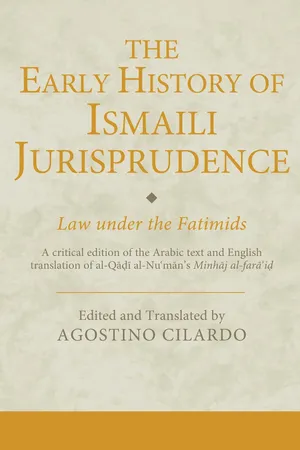
- 208 pages
- English
- ePUB (mobile friendly)
- Available on iOS & Android
eBook - ePub
About this book
Information
Chapter 1
The life and works of al-Qāḍī Abū Ḥanīfa al-Nuʿmān
I. The Fatimids and al-Qāḍī Abū Ḥanīfa al-Nuʿmān
The history of the Fatimid dynasty (297‒567/909‒1171) and the life and work of the Ismaili author and jurist al-Qāḍī al-Nuʿmān (d. 363/974) during this period are popular fields of research for both Western and Muslim scholars of Islamic studies.1 The recurring allegations, products of a Sunni polemic, that Ismailism is similar to the religion of the Majūs and that the Ismailis tried to put an end to the domination of Arabs and Islam, while themselves seeking to dominate the Majūs, are obviously false.2 De Sacy3 believes that until Abū ʿAbd Allāh al-Shīʿī (d. 298/911),4 the Ismailis were nothing more than an ordinary sect of the Shiʿis. This opinion is shared by Ivanow5 who maintains that ‘Ismailism was in its plain religious system closely connected with moderate, or Twelvers’, Shiism’,6 even if he rightly observes that ‘the elements of Shiism probably did not go further than the importance attached to the theocratic principle and a strong sympathy with the house of the Prophet’.7
Five stages in the evolution of Ismailism can be distinguished,8 but it was during the second stage, which coincided with the Fatimid era,9 that both the Ismaili movement and Ismaili literature attained maturity. It is through the efforts of al-Qāḍī al-Nu‘mān during this period in elaborating the Ismaili juristic system that he may be rightly considered the Fatimid jurist above all others and perhaps led Poonawala to observe that ‘Ismaʿili law began with Nuʿmān and ended with him’.10
Al-Nuʿmān11 entered the service of the first Fatimid Imam-Caliph al-Mahdī (r. 297–322/909–934) while he was still a very young man. But it was during the reign of the fourth Fatimid Imam-Caliph al-Muʿizz (r. 341‒365/953‒975) that he composed the main legal works of the Ismaili school.12 These appear to be the product of an unusual method: al-Nuʿmān wrote nothing without first consulting the imams, and as such, his main work, the Daʿāʾim al-Islām, is considered the result of cooperation between him and al-Muʿizz. This circumstance gave it great authority since ‘the Imam was both the secular ruler and the real pontiff in one person’.13 In any case, it is to be underlined that al-Nuʿmān’s major merit was the construction of a juridical and legal system not just for Ismaili adherents but for the use of the Fatimid state.
The new system of law was only gradually brought into practice. Based on information furnished by al-Kindī,14 we know that Jawhar, the conqueror of Fusṭāṭ, left the Mālikī Abū Ṭāhir, there as qāḍī with instructions to decide cases according to the tenets of the madhhab of the ahl al-bayt in the particular fields of succession, repudiation and the new moon (hilāl), although he allowed the Sunnis to follow their school regarding the law of inheritance. To a case regarding fasting, however, both Sunni and Ismaili rules were applied.15 We also know that al-Muʿizz recommended that Abū Ṭāhir consult al-Nuʿmān on the major questions regarding the administration of justice and on controversial juridical points.16 Because the major goal of al-Muʿizz was to ensure the enforcement of Ismaili rules, particularly regarding the law of inheritance, when Abū Ṭāhir died, al-Muʿizz did not appoint Abū Ṭāhir’s son as qāḍī, but al-Nuʿmān’s son, ʿAlī b. al-Nuʿmān.17 Al-Maqrīzī (d. 845/1442) clearly shows that a long time passed before there was wide knowledge of the new system: ‘“Fatimide law, according to the Shīʿite doctrine, was first taught at the Azhar in Ṣafar 365 (975), when ʿAlī Ibn al-Nuʿmān, the cadi, sat in the Cairo mosque known as the Azhar and dictated a compendium of law composed by his father for the Shīʿites”. This work was called the Kitāb al-iqtiṣār’.18 What we can assume is that a distinct Ismaili law did not exist before the establishment of the Fatimid dynasty.19 The early Ismailis followed the law of the land wherever they settled.20
II. Does Ismaili fiqh lack originality?
In the last century, several eminent scholars shed light upon the history and the law of the Ismailis. In particular, they discovered and presented the works of the Ismaili school, which for the most part had been kept hidden by the Ismailis themselves. It is noteworthy, however, that sometimes the distinctive features of Ismaili law escape other Muslim as well as Western writers, so much so that one sees few differences between Imāmī and Ismaili law, and Sunni and Ismaili law in the literature.
Thus, Ivanow21 considers the main Ismaili treatise, the Daʿāʾim al-Islām, a work which
really very closely resembles an Ithnaʿ-asharī treatise of its kind, the only substantial difference at first sight being in the opening book, on walâyat instead of the usual kitâb at-tawḥîd. This kitâb al-walâyat is a really good summary of what most probably were the basic ideas of the religion under the early Fatimids.
Ivanow22 adds:
It is possible therefore to state positively that the ‘practical theology’ of the Fatimids, except in certain aspects of the doctrine of Imamat, differed very little from the early Ithnaʿ-asharī school as it is summed up in al-Kāfī and other early works. It was perfectly faithful to the latter doctrine in spirit, and even in letter, if we disregard minute differences here and there, similar to those found in the case of the four orthodox Sunnite madhhabs, etc. The best proof of this similarity is the fact that the basic work of this doctrine, Qāḍī Nuʿmān’s Daʿāʾimu’l-Islām, is to this day claimed by the Ithna-ʿashari experts as a work belonging to their school.
According to Gottheil, ‘the differences between Sunnite and Shīʿite actual practice seems to have been small – to us they appear infinitesimal’.23 The geographer al-Maqdisī relates only three classes of Fatimid ‘peculiarities’, all of them regarding prayer.24 Another reference, describing Fatimid practices, shows that ‘in many fundamental principles of faith (uṣūl) they agree with the Muʿtazilites’.25 Other scholars note a few further differences between Ismaili and Imāmī law, such as the prohibition of temporary marriage (mutʿa), the annulment of a will (waṣiyya) in favour of an heir by quota without the consent of the remaining heirs, and other minor differences in ritual.26
However, in the particular field of inheritance law, it did not escape Fyzee’s27 notice that there were marked differences between Ḥanafī and Shiʿi law: ‘In the law of inheritance, the divergence between the Ḥanafī law and its Ithnā ʿAsharī counterpart is so extreme and so remarkable that it seems strange that no one except Tyabji should have dealt with the question.’ In a later work, ‘The Fatimid Law of Inheritance’, Fyzee gives a very brief summary of the Book of Inheritance of the Daʿāʾim. Fyzee’s summary concerns only a few aspects of the Ismaili inheritance system. It does not purport to be complete. Moreover, there is no comparison between the Ismaili school and any other law school. Lastly, Fyzee is not interested in the question of the formation and the originality of this Ismaili system. However, it seems that sometimes there are errors in his presentation:
(i) Father, mother, brother. Fyzee gives the following solution for their share of the inheritance accordingly: one-sixth to the father, one-sixth to the mother, two-thirds to the brothers. According to him, ‘this happens only if there are more brothers than one; if there is only one brother, the distribution is: father 1/3, mother 1/3, brother 1/3’ (p. 64). But later on, in a contradictory way, he states that ‘full, consanguine and uterine brothers and sisters28 are entirely excluded by the father, mother, son, and daughter. They inherit only in the absence of parents and children’ (p. 65). However, according to all the law schools, the first solution given by Fyzee is absolutely wrong because the father always bars brothers and sisters of every kind (p. 64). Conversely, later on (p. 65), he correctly relates the Imāmī and Ismaili doctrine as clearly pointed out in the Daʿāʾim. As a matter of fact, on this issue, the doctrine explicated in the Daʿāʾim is very clear. It states that brothers cause the partial exclusion of the mother, thus her share of the inheritance is reduced from one-third to one-sixth, although they themselves do not receive the difference, which is allotted to the father.29 It further specifies that only two full or consanguine brothers, or the one full and the other consanguine brothers, or four full or consanguine sisters, or a brother and two sisters,30 cause the mother’s inheritance to be reduced fro...
Table of contents
- Cover
- Title page
- Copyright
- Table of Contents
- Acknowledgements
- Introduction
- 1. The life and works of al-Qāḍī Abū Ḥanīfa al-Nuʿmān
- 2. Differences among al-Nuʿmān’s five Ismaili works, and a comparison of their doctrines with Imāmī and Sunni doctrines on inheritance
- Conclusion
- Note on the edition
- Translation of the Minhāj al-farāʾiḍ
- Bibliography
- Arabic Text
Trusted by 375,005 students
Access to over 1.5 million titles for a fair monthly price.
Study more efficiently using our study tools.
Frequently asked questions
Yes, you can cancel anytime from the Subscription tab in your account settings on the Perlego website. Your subscription will stay active until the end of your current billing period. Learn how to cancel your subscription
No, books cannot be downloaded as external files, such as PDFs, for use outside of Perlego. However, you can download books within the Perlego app for offline reading on mobile or tablet. Learn how to download books offline
Perlego offers two plans: Essential and Complete
- Essential is ideal for learners and professionals who enjoy exploring a wide range of subjects. Access the Essential Library with 800,000+ trusted titles and best-sellers across business, personal growth, and the humanities. Includes unlimited reading time and Standard Read Aloud voice.
- Complete: Perfect for advanced learners and researchers needing full, unrestricted access. Unlock 1.5M+ books across hundreds of subjects, including academic and specialized titles. The Complete Plan also includes advanced features like Premium Read Aloud and Research Assistant.
We are an online textbook subscription service, where you can get access to an entire online library for less than the price of a single book per month. With over 1.5 million books across 990+ topics, we’ve got you covered! Learn about our mission
Look out for the read-aloud symbol on your next book to see if you can listen to it. The read-aloud tool reads text aloud for you, highlighting the text as it is being read. You can pause it, speed it up and slow it down. Learn more about Read Aloud
Yes! You can use the Perlego app on both iOS and Android devices to read anytime, anywhere — even offline. Perfect for commutes or when you’re on the go.
Please note we cannot support devices running on iOS 13 and Android 7 or earlier. Learn more about using the app
Please note we cannot support devices running on iOS 13 and Android 7 or earlier. Learn more about using the app
Yes, you can access The Early History of Ismaili Jurisprudence by Agostino Cilardo in PDF and/or ePUB format, as well as other popular books in Law & Jurisprudence. We have over 1.5 million books available in our catalogue for you to explore.