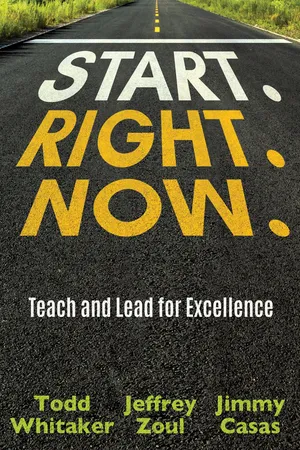
In their work leading up to Start. Right. Now. Todd Whitaker, Jeff Zoul, and Jimmy Casas studied educators from across the nation and discovered four key behaviors of excellence: Excellent leaders and teachers Know the Way, Show the Way, Go the Way, and Grow Each Day. If you are ready to take the first step toward excellence, this motivating book will put you on the right path.
eBook - ePub
Start. Right. Now.
Teaching and Leading for Excellence
- English
- ePUB (mobile friendly)
- Available on iOS & Android
eBook - ePub
Start. Right. Now.
Teaching and Leading for Excellence
About this book
Information
Topic
PedagogíaSubtopic
Liderazgo en educación1:
Teaching Is Leading;
Leading Is Teaching
Effective leaders are, first and foremost, good teachers. We are in the education business.
— John Wooden

Great leaders, as Coach Wooden noted, are indeed great teachers. Conversely, great teachers are also great leaders. In fact, let’s look at the quote again, transposing the words, “leaders” and “teachers”: Effective teachers are, first and foremost, good leaders. Our very best leaders know that they must teach those they lead, and our very best teachers realize they are leaders and behave accordingly.
We have visited thousands of schools around the world during the past several decades, and wherever we go, we notice this reality playing out before our eyes. We observe great teachers exhibiting amazing leadership skills, not only in their classrooms, but also throughout their schools, districts, communities, and beyond. We also observe educators in “official” leadership roles, such as principals and superintendents, taking an active role in teaching those with whom they serve. They simultaneously teach specific content and skills and lead by example as they seek to continually grow and improve themselves, their colleagues, and their organizations.
We are avid collectors of quotes about leaders and leadership, and teachers and teaching. In perusing our favorite quotes about leaders and leadership, we realized an interesting phenomenon: In virtually every instance, if we replace the word “leader” with “teacher,” or “leadership” with “teaching,” the quotation loses nothing in translation. In fact, the meaning remains just as strong. In addition to the Wooden quote, we’ve listed a few more examples below to make this case. These quotations make a point about great leaders and great leadership, and each applies equally well to great teachers and great teaching. Try replacing the words “leader” or “leadership” with “teacher” or “teaching” in each:
“As a leader [teacher], your principal job is to create an operating environment where others can do great things.”
— Richard Teerlink
“No person can be a great leader [teacher] unless he takes genuine joy in the successes of those under him.”
— W. A. Nance
“A good leader [teacher] inspires others with confidence in him; a great leader [teacher] inspires them with confidence in themselves.”
— Unknown
“Leadership [Teaching] is practiced not so much in words as in attitude and in actions.”
— Harold S. Geneen
“Leadership [Teaching] and learning are indispensable to each other.”
— John F. Kennedy
These quotations — along with many others we have collected — validate our belief that much of what makes a great leader is also what makes a great teacher, and vice versa. We have come to believe that these two terms have much more in common than some might think and, in fact, are interchangeable in our very best classrooms and schools. Specifically, we have noticed that in the very best schools we have visited, the lines between “teacher” and “leader” tend to blur, with classroom teachers taking on active leadership roles and building principals devoting time to directly teaching students and staff. We began to wonder exactly what behaviors these excellent teachers and excellent leaders both exhibited in their daily lives as educators. What was it that made them stand out as truly exceptional? Our discoveries, based on our many years of observing such educators, are the focus of this book.
From Beliefs to Behaviors
In nearly all the schools in which we have worked, the vast majority of educators share many similar beliefs, at least in a big-picture sense. Visit any school around the world, and presumably all educators working there would tell you that they believe all kids can learn, that we should try to foster lifelong learning within our students, and that we should engage our kids in the 4 C’s of twenty-first-century learning: Communication, Collaboration, Creativity, and Critical Thinking. We have also noticed, however, that merely professing to believe in these things is not enough. Truly exceptional teachers and leaders move beyond beliefs, exhibiting specific, observable, and intentional behaviors that turn these beliefs into reality. Although amazing educators share many similar beliefs, they also have strong, differing beliefs about education and their roles in our noble profession and are often quite vocal about sharing them. Regardless of whether their beliefs mirror those of their colleagues, the educators we consider to be excellent are quick to align their beliefs with their actions.
On the other hand, each of us has worked with educators who, when asked, would say they share the exact same beliefs as those expressed by their truly exceptional colleagues, yet exhibit behaviors that simply do not align with these beliefs. They “believe” all kids can learn, but they begin the school year assuming a certain percentage of students will fail their course. They “believe” in collaborative school cultures, but issue top-down mandates. They “believe” in student-centered classrooms, but spend a majority of class time lecturing and assigning worksheets. Or they “believe” that principals should be highly visible, yet find they are too busy to get in classrooms themselves each day. A key difference between our mediocre teachers and leaders and our truly exceptional ones is the fact that truly exceptional teachers and leaders walk the talk, exhibiting behaviors that are consistent with their beliefs.
When interviewing teaching or principal candidates, we sometimes ask, “Do you consider yourself more a ‘doer’ or a ‘dreamer?’” Often the answers are revealing, but, truthfully, we hope to find the perfect blend of these two apparent extremes within the professional makeup of those with whom we serve. Truly excellent teachers and school administrators realize the need for both “dreaming” and “doing.” They consider their beliefs their “dreams,” and their behaviors are what they will “do” to make these dreams come true.
Values in Action? Mission Accomplished!
Virtually every school we visit has a mission statement. However, only a small minority of these schools have actually managed to make the mission statement the driving force of the decisions made and the actions taken by staff members. In most schools, the statement is merely a nice collection of words on a wall that has no impact whatsoever on student or staff performance, outcomes, or satisfaction. The variable is not the mission statement itself (since almost all schools have one), but the actions and decisions that team members make because of the mission statement.
We believe in the power of mission statements that are created with intention and communicated and acted upon regularly. Despite the hit-or-miss nature of mission statement efficacy that we have observed at schools around the world, we remain advocates for investing in this process as a starting point for excellence. Simon Sinek, author of Start with Why, makes a compelling case for the importance of starting any worthy venture by asking, “Why?” We view the school or district mission statement as the ultimate answer to that organization’s “Why?” Moreover, we suspect that many outstanding teachers and administrators also start by examining why they do what they do, going so far as to adopt a personal mission statement by which they live on a daily basis. Some may actually have written out those statements. Others may not have a mission statement actually written out and posted anywhere in their classroom or office, but we suspect that if one were to observe them in action over a period of time, it would not take long before we could discern their “mission” by the behaviors they consistently exhibit.
The organizational mission statement should succinctly answer the questions, “Why do we (as a classroom, school, or district) exist? What is our core purpose for being?” Our purpose in this book is not to answer these questions; instead, we simply wish to suggest that examining our true purpose — as individual educators and as teams of educators working together — is a worthwhile and often revealing activity.
Ask: Why do we (as a classroom, school, or district) exist?
Even with a compelling mission statement in place — one that is known by all members of the organization, communicated regularly among many in the organization, and used frequently as a driving force for decision making — having an overarching description of why we exist is still not as important as the consistent behaviors each team member exhibits as they go about their jobs. Successful school leaders know this, and so, shortly after agreeing to adopt a mission statement, they also identify the values by which the members of their organization will operate to ensure that the school stays mission-focused. We equate values with behaviors, or commonly held commitments that team members make regarding non-negotiable actions to which they will adhere over time.
For example, we often see school mission statements promoting the belief that “all kids can learn.” Sounds noble, but again, what actions will educators within such schools take when some students do not learn, at least not in the way we assumed they would, or within the allotted time for which we have planned? Commonly held values — created collaboratively and agreed to collectively — can help to answer such questions. By themselves, such value statements documented in words are no more effectual than meaningless mission statements. However, when these values statements are backed up with specific actions or behaviors that team members live out and hold each other accountable for, amazing things can happen. Values in action result in missions accomplished!
The 4 Core Behaviors of Excellence
The importance of commonly held core values, which play out as actions taken on a daily basis to ensure that the mission is accomplished, cannot be overstated. In addition, we have observed that in high-performing schools staffed by high-performing teachers and leaders and filled with energized, engaged, and connected students, there is also a shared vision of excellence. Teachers are not there merely to deliver lessons, principals do not exist simply to react to situations that arise, and students are not passive receivers of instruction. Instead, each member of these educational communities actively pursues their own learning and leadership opportunities. In such schools, standards of excellence are clearly in place for students and staff. These expectations for excellence are carefully established at the outset. They are reiterated not only every school year, but also each day, to consistently remind everyone in the school what the work is, why it matters, and how to go about accomplishing it. There are likely hundreds, if not thousands, of specific daily actions taking place in such schools that work together to make these high-performing schools stand out from others. Those activities can be classified into four overarching areas, three of which are often attributed to leadership guru John Maxwell, who defines a leader as one who, “knows the way, goes the way, and shows the way.” To this definition (which we apply to teachers as well as administrators), we would add the critical component of intentional, personal, daily growth: A leader is one who knows the way, shows the way, goes the way, and grows each day. We will expand on these four elements of excellence in the subsequent chapters of this book. For now, here is a brief summary of the four core behaviors that distinguish the very best from all the rest.
To start, great teachers and great leaders know the way. Whether they are teaching a lesson on astronomy, working with colleagues on a new intervention strategy, developing a social/emotional learning curriculum, or helping a student shoot a basketball, these educators know their stuff. Not every leader or teacher knows the most about every aspect of their job, but when they are leading others — whether students or staff — they take the time to make sure they have learned as much as possible prior to enlisting others to follow their lead.
A leader is one who knows the way, shows the way, goes the way, and grows each day.
Great teachers and leaders also show the way. One of the best pieces of advice about writing fiction that we have heard is the adage that the writer must “show” rather than “tell” what is happening. We recall a talk given by Robert Newton Peck, author of many young adult novels, including A Day No Pigs Would Die, driving this point home to a group of student authors by imploring, “Don’t just say the fat lady screamed; bring her on and let her scream!” Great teachers and leaders know the importance of showing, rather than merely telling. They may start by explaining how something is done or why an action needs to be taken, but they move beyond mere telling to showing how it can or will be done and painting the picture of precisely why the work needs doing.
In addition to knowing the way and showing the way, great teachers and leaders go the way. They teach and lead by modeling, living out what they expect others to do by doing it themselves. When teachers model lifelong learning for their students by connecting with educators around the world to find new resources, enroll in a graduate program for an advanced degree, or research new ways to teach a math concept, they go the way that they also want their students to go. When administrators make positive calls home to parents or write positive notes to staff members for a job well done, they, too, are going the way they want others to go.
Finally, great teachers and leaders grow each day. They not only grow themselves, but also grow those around them. They are professionals who are always striving to get better, never allowing the fact that they are good at what they do to get in the way of wanting to be great at what they do. They carve out time in each busy day to learn something new, practice a skill they already have, or find a way to help someone else reach a goal. They not only “believe” in a growth mindset, but exhibit such a mindset by actively seeking out and...
Table of contents
- 1: Teaching Is Leading; Leading Is Teaching
- 2: Know the Way
- 3: Show the Way
- 4: Go the Way
- 5: Grow Each Day
- 6: Behaviors to Beliefs and Back Again
- References
- More from Dave Burgess Consulting, Inc
- About the Authors
Trusted by 375,005 students
Access to over 1.5 million titles for a fair monthly price.
Study more efficiently using our study tools.
Frequently asked questions
Yes, you can cancel anytime from the Subscription tab in your account settings on the Perlego website. Your subscription will stay active until the end of your current billing period. Learn how to cancel your subscription
No, books cannot be downloaded as external files, such as PDFs, for use outside of Perlego. However, you can download books within the Perlego app for offline reading on mobile or tablet. Learn how to download books offline
Perlego offers two plans: Essential and Complete
- Essential is ideal for learners and professionals who enjoy exploring a wide range of subjects. Access the Essential Library with 800,000+ trusted titles and best-sellers across business, personal growth, and the humanities. Includes unlimited reading time and Standard Read Aloud voice.
- Complete: Perfect for advanced learners and researchers needing full, unrestricted access. Unlock 1.5M+ books across hundreds of subjects, including academic and specialized titles. The Complete Plan also includes advanced features like Premium Read Aloud and Research Assistant.
We are an online textbook subscription service, where you can get access to an entire online library for less than the price of a single book per month. With over 1.5 million books across 990+ topics, we’ve got you covered! Learn about our mission
Look out for the read-aloud symbol on your next book to see if you can listen to it. The read-aloud tool reads text aloud for you, highlighting the text as it is being read. You can pause it, speed it up and slow it down. Learn more about Read Aloud
Yes! You can use the Perlego app on both iOS and Android devices to read anytime, anywhere — even offline. Perfect for commutes or when you’re on the go.
Please note we cannot support devices running on iOS 13 and Android 7 or earlier. Learn more about using the app
Please note we cannot support devices running on iOS 13 and Android 7 or earlier. Learn more about using the app
Yes, you can access Start. Right. Now. by Dr. Todd Whitaker, Jeffrey Zoul and Jimmy Casas in PDF and/or ePUB format, as well as other popular books in Pedagogía & Liderazgo en educación. We have over 1.5 million books available in our catalogue for you to explore.