May Seaton Dix, Associate Editor
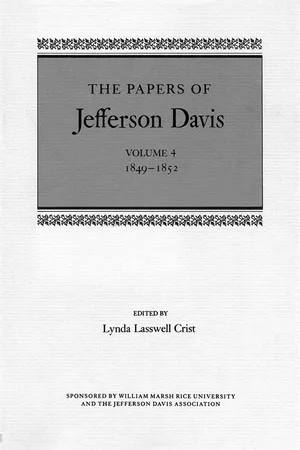
Richard E. Beringer, Visiting CoeditorIn Volume 4 of The Papers of Jefferson Davis, which covers the years 1849 to 1852, Davis had clearly chosen politics ar his life's work. He relished in his role as Mississippi's senior senator and willingly assumed the responsibility of being a national spokesman for the South. This period also saw a number of events in Davis' personal life, notably the birth of his first child and the beginning of a long estrangement from his brother Joseph.In January, 1849, Davis signed the Southern Address, although he occasionally disagreed with the extreme positions of its author, John C. Calhoun. Outside the Senate, Davis supported the objectives of the Nashville Convention and, later, the idea of a southern congress. During the crisis of 1850 Davis spoke often on such key issues as the regulation of slavery in the territories, the extension of the Missouri Compromise line, the admission of California, the Texas-New Mexico boundary, the continuation of the slave trade in the District of Columbia, and the Fugitive Slave Act. In 1851 he proposed purchasing camels for military transportation and urged that a Pacific railroad route be considered in the definition of the Mexican boundary.As a loyal Democrat, Davis had supported Lewis Cass in 1848, but he was a conspicuous personal favorite of Zachary Taylor, the new Whig president and his former father-in-law. In 1850 Taylor reportedly intervened to prevent a duel between Illinois representative William H. Bissell and Davis, who was incensed by Bissell's remarks about the Mississippi regiment at Buena Vista. Soon after joining the Taylor family at the president's deathbed in July, 1850, Davis defended Taylor's Mexican War performance in well-publicized Senate speech. Between sessions in 1849 Davis canvassed Mississippi, addressing gatherings throughout the state in favor of congressional candidates. He warned of northern aggressions, yet urged the exhaustion of all means of peaceful resistance before secession be considered. When he returned home after the arduous 1850 session, he defended his course, denying charges that he was a disunionist.In February, 1850, Davis had been reelected to the Senate for a full six-year term, but in September, 1851, he resigned to accept the Sate Rights nomination for governor in opposition to Union nominee Henry Foote. Although illness precluded much active campaigning in the few weeks before the election, Davis substantially reduced the Union lead and lost by a narrow margin. A private citizen for the first time since 1845, Davis continued his involvement in politics. Despite nagging personal problems and ill health, he promoted Democratic unity and took to the stump for Franklin Pierce in 1852.
- 472 pages
- English
- ePUB (mobile friendly)
- Available on iOS & Android
eBook - ePub
About this book
Trusted by 375,005 students
Access to over 1.5 million titles for a fair monthly price.
Study more efficiently using our study tools.
Information
Subtopic
American Civil War HistoryIndex
HistoryINDEX
Abbreviations edn and dm refer to editorial note and descriptive note, respectively.
Aberdeen: Davis speaks at (1849), 26n, 47edn, (1851), 329, 390-91, 395
letter from citizens, 328
Abert, Charles: Davis endorses, 329
Abert, John J., 316
Abolitionism: res. of, 6-7, 37-38, on, 71
Davis on, 19, 26-27, 34-38, 72-73, 135, 199-201, 221, 263-65, 268, 279-80, 330, 373
and extension of slavery, 28-29
and Supreme Court, 29
in West Indies, 33, 45n
British influence, 33, 35-36, 143, 201
political power, 34-35, 48, 200
pubs. in South, 36, 48
divisions, 37
and mails, 50n
D. Webster on, 83n
and fugitive slaves, 196-200
Adams, Daniel W., 136n
Adams, Stephen (sketch, 2:298): elected to Senate, 237n
mentioned, 326
Adams County Democratic Association: invites Davis to speak, 399
Adams-Onfs Treaty, 64
Alabama, University of: Davis invited to speak, 397
Alden, Bradford R. (sketch, 132): protests Davis’ remarks, 130-31
Alden, Edward, 382
Alexander, Blanche Matheny (grandniece-in-law): genealogy, 409
Alexander, Hugh D. (grandnephew): genealogy, 409
Alexander, Isaac S. (grandnephew): genealogy, 409
Alexander, Jane Stamps (niece) (sketch, 1:460): genealogy, 409
Alexander, John R. (grandnephew): genealogy, 409
Alexander, Joseph D. (grandnephew): genealogy, 409
Alexander, Lucinda D. See Anderson, Lucinda Alexander
Alexander, Richard (grandnephew) : genealogy, 409
Alexander, William S. (grand-nephew): genealogy, 409
Alexander, William W. (nephew-inlaw): genealogy, 409
mentioned, 183n
Allen, Henry W.: Davis recom., 360
Allen, John L. (sketch, 2:387): Davis inquires re appt., 332
Allen, William (sketch, 1:457), 46n
Allison letter, 51n
American Academy of Arts and Sciences, 4
American and Foreign Anti-Slavery Society: Davis quotes reports, 29, 34-36
founding, 46n
American Anti-Slavery Society: Davis on, 19, 27
dissenters, 46n
mentioned, 21n
American Colonization Society, 126n, 127n, 202, 216n, 366, 393
American Ephemeris and Nautical Almanac, 5n
American Philosophical Society, 4
American Revolution, 208, 211, 282, 284
Ames, Charles B., 249n
Anderson, Anna White (grandniece): genealogy, 412, 439
Anderson, Ellen Davis (niece) (sketch, 1:282): genealogy, 415
mentioned, 119, 123, 183n
Anderson, Fulton (sketch, 136), 136
Anderson, Jane (grandniece): genealogy, 415
Anderson, Lucinda Alexander (grandniece): genealogy, 409
Anderson, Robert (sketch, 1:252): relationship with Davis, 57-58
letter to, 57-58
letter from, 378
Anderson, Robert D. (grandnephew): genealogy, 415
Anderson, Robert P. (sketch, 230): letter to, 394
mentioned, 230
Anderson, Thomas H. (grandnephewin-law): genealogy, 412
Anderson, Thomas S. (nephew-inlaw): genealogy, 415
Anderson, William (grandnephew-inlaw): genealogy, 409
Andrews, Timothy P. (sketch, 1:441), 340
Annals of Congress: Davis sends to nephew, 182
Davis receives, 332
mentioned, 162n
Anti-mason movement, 32
Apache, 149, 168
Archer, Richard T.: letters from, 314, 371
Arkansas, 311, 319, 353, 384
Armistead, Walter K., 364
Army: bills for mil. asylum, 58, 330-31, 378, for cav. rgts., 130n, 355, for bounty land, 311, 313, 363, for surgeons and chaplains, 313, 400, for dependents, 318, for increase in engrs., 337, 350, on enlistments, 337-38, on sutlers, 339, for increased pay in Pacific, 348, on paymasters’ clerks’ pay, 351
on frontier defense, 129n, 358, 377, 384, and supplies, 379
approps. for, 132n, 311, 324, 347, 371-72, 387
mil. road, 165-67
camel experiment, 168-70, 380-81
pensions, 309, 312, 367-68, 378
Mex. War vols., 309, and substitutes, 311
compensation of officers, 311, 312, 318, 324, 349, 377, 380, 384, 387
lost property, 311, 358, 365
and reenlistment, 322
merit certificates, 322
early discharge, 324
employment of clerks, 340-41
chaplains, 343
joint line and staff appts., 365, 382
additional grades of officers, 372
punishment regulations, 375-76
promotion policies, 384, 387. See also Adjutant General’s Office; Artillery; Cavalry; Commissary Department; Engineers, Corps of; Medical Departmer.t; Ordnance Department; Paymaster’s Department; Quartermaster’s Department; Topographical Engineers
Articles of Confederation, 31, 283-84
Artillery, 316, 347, 365
Ashbridge, J. H. & Co. (ident., 240), 237, 239
Asquith, William E., 334
Atchison, David R. (sketch, 125): on Calif., 124
and Sioux lands, 156edn
letter with, 312
Athens, Miss.: Davis speaks at, 231-32
letter to citizens, 392
Atherton, Charles G. (sketch, 17): Davis on speech, 14
res., 20, 38-39, 263-64
mentioned, 46n
Atkins, Rowena H. See Farish, Rowena Atkins
Atkinson, Thomas P. (sketch, 274), 267-68
Atwater, Olive S. See Farish, Olive
Atwater Augusta land office, 332, 340, 381
Auter Katherine. See Davis, Katherine Auter
Auxiliary Southern Rights Association: invites Davis to speak, 393
Bache, Alexander D. (sketch, 290): Davis praises, 279, 321
letters to, 325-26, 349-50, 372-73, 386, 417
Bache, Eliza Patterson, 359
Bache, George M., 359
Bache, Richard D. (sketch, 2:536), 344
Badger, George E., 96, 160, 214n
Bagby, Arthur P. (sketch, 3:301), 45n
Bailey, James, 334
Baird, Clarrissa I. See Davis, Clarrissa
Baird Baker, Edward D. (sketch, 9), 9
Baldwin, Henry (sketch, 215), 195
Baldwin, Roger T., 361
Balfour, Lewis G. (grandnephew-inlaw): genealogy, 406
Balfour, Lucy Smith (grandniece): genealogy, 406
Ballard, Rice C. (sketch, 13), 14n
Baltimore: Davis passes through, xxxv
Baltimore Patriot, 122
Baltimore Sun: on Davis-Bissell dispute, 86n
criticizes Davis, 122n
Banks, George G. (sketch, 178): Davis recom., 177
Ban(n)ister, Charlotte (ident., 240), 238
Ban(n)ister, Thomas (ident., 240)
Barksdale, Ethelbert (sketch, 224): on 1851 gub. election, 234n
letters from, 222-23, 234-36
mentioned, 252
Barksdale, William (sketch, 2: 116): letter to, 138-45
Barksdale & Jones: letters to, 241-49, 396-97
letter from, 250-51
Barnard, John G., 312
Barnes, H. W., 323
Barnwell, Robert W. (sketch, 125): on Calif., 124
letter from, 227-28
Barry, William T. S. (sketch, 253), 252, 298n
Barstow, George (gran...
Table of contents
- Cover
- Title Page
- Copyright Page
- Introduction: by Richard E. Beringer
- Acknowledgments
- Editorial Staff
- Board of Directors
- Editorial Method
- Symbols and Abbreviations
- Repository Symbols
- Contents
- Illustrations
- Chronology 1849-1852
- The Papers of Jefferson Davis: Volume 4 1849-1852
- Appendix I Calendar 1849-1852
- Appendix II: Davis Family Genealogy Prepared with the assistance of Ernesto Caldeira
- Appendix III Addenda, 1846
- Sources
- Index
Frequently asked questions
Yes, you can cancel anytime from the Subscription tab in your account settings on the Perlego website. Your subscription will stay active until the end of your current billing period. Learn how to cancel your subscription
No, books cannot be downloaded as external files, such as PDFs, for use outside of Perlego. However, you can download books within the Perlego app for offline reading on mobile or tablet. Learn how to download books offline
Perlego offers two plans: Essential and Complete
- Essential is ideal for learners and professionals who enjoy exploring a wide range of subjects. Access the Essential Library with 800,000+ trusted titles and best-sellers across business, personal growth, and the humanities. Includes unlimited reading time and Standard Read Aloud voice.
- Complete: Perfect for advanced learners and researchers needing full, unrestricted access. Unlock 1.5M+ books across hundreds of subjects, including academic and specialized titles. The Complete Plan also includes advanced features like Premium Read Aloud and Research Assistant.
We are an online textbook subscription service, where you can get access to an entire online library for less than the price of a single book per month. With over 1.5 million books across 990+ topics, we’ve got you covered! Learn about our mission
Look out for the read-aloud symbol on your next book to see if you can listen to it. The read-aloud tool reads text aloud for you, highlighting the text as it is being read. You can pause it, speed it up and slow it down. Learn more about Read Aloud
Yes! You can use the Perlego app on both iOS and Android devices to read anytime, anywhere — even offline. Perfect for commutes or when you’re on the go.
Please note we cannot support devices running on iOS 13 and Android 7 or earlier. Learn more about using the app
Please note we cannot support devices running on iOS 13 and Android 7 or earlier. Learn more about using the app
Yes, you can access The Papers of Jefferson Davis by Jefferson Davis in PDF and/or ePUB format, as well as other popular books in History & American Civil War History. We have over 1.5 million books available in our catalogue for you to explore.