Reveals the systematic marginalization of women within pop culture fan communities
When Ghostbusters returned to the screen in 2016, some male fans of the original film boycotted the all-female adaptation of the cult classic, turning to Twitter to express their disapproval and making it clear that they considered the film's "real" fans to be white, straight men. While extreme, these responses are far from unusual, with similar uproars around the female protagonists of the new Star Wars films to full-fledged geek culture wars and harassment campaigns, as exemplified by the #GamerGate controversy that began in 2014.
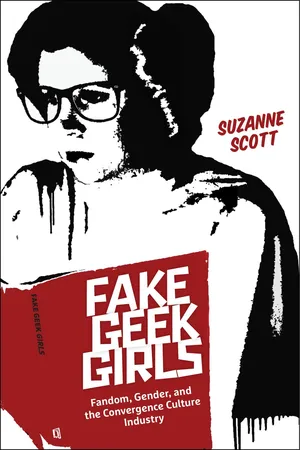
Over the past decade, fan and geek culture has moved from the margins to the mainstream as fans have become tastemakers and promotional partners, with fan art transformed into official merchandise and fan fiction launching new franchises. But this shift has left some people behind. Suzanne Scott points to the ways in which the "men's rights" movement and antifeminist pushback against "social justice warriors" connect to new mainstream fandom, where female casting in geek-nostalgia reboots is vilified and historically feminized forms of fan engagement—like cosplay and fan fiction—are treated as less worthy than male-dominant expressions of fandom like collection, possession, and cataloguing. While this gender bias harkens back to the origins of fandom itself, Fake Geek Girls contends that the current view of women in fandom as either inauthentic masqueraders or unwelcome interlopers has been tacitly endorsed by Hollywood franchises and the viewer demographics they selectively champion. It offers a view into the inner workings of how digital fan culture converges with old media and its biases in new and novel ways.
- 304 pages
- English
- ePUB (mobile friendly)
- Available on iOS & Android
eBook - ePub
About this book
Information
1
A Fangirl’s Place Is in the Resistance
Feminism and Fan Studies
On January 21, 2017, an estimated four million people took to the streets to participate in the Women’s March on Washington and in various sister marches across the United States and around the globe. Responding to both the divisive election of Donald Trump as the forty-fifth president of the United States and the growing political and cultural influence of the alt-right, the Women’s March featured an array of protest signs that wielded pop-culture iconography to offer political commentary. Like many fans still mourning the untimely death of actress Carrie Fisher, I composed a protest sign rooted in both my own identity as a lifelong Star Wars fan and the tradition of transformative criticism within female fan communities. Invoking Fisher’s most iconic role, Princess Leia, and bearing the slogan “A Woman’s Place Is in the Resistance,” the poster appropriated the nostalgically sexist refrain that is routinely used to silence any woman who dares express an opinion on the Internet: “A woman’s place is in the kitchen.” A pink-tinged version of this Princess Leia poster created by graphic designer Hayley Gilmore was widely disseminated on social media and displayed at the Women’s March alongside handmade iterations like my own, with the “Resistance” symbiotically referencing Star Wars’ fictional Rebel Alliance and calls to “Resist” Trump’s political agenda and rising antifeminist sentiment.
Commenting in Wired on Hayley’s design and the ubiquity of Leia protest posters at the Women’s March, Angela Watercutter made a point of acknowledging both Fisher’s and the character’s feminist legacy, citing the place of prominence of female protagonists in the most recent entries of the Star Wars film franchise as clear marks of progress.1 Missing from this celebratory narrative was any mention of fan backlash to the Star Wars franchise’s evolving (if still not sufficiently multifaceted) commitment to representational diversity, ranging from outcry that “having two Star Wars movies in a row with female protagonists is taking things too far, and is a clear sign of political correctness taking over Hollywood”2 to a fan edit of Star Wars: Episode VIII—The Last Jedi (2017) labeled “The Chauvinist Cut” that attempted to excise female characters from the film. Nor does this narrative of progress account for the thinly veiled sexism in some critical responses to these female protagonists. For example, Todd McCarthy complained in his review for the Hollywood Reporter that Rogue One: A Star Wars Story (2016) lacked “a strong and vigorous male lead (such as Han Solo or John Boyega’s Finn in ‘The Force Awakens’),”3 erasing the significance and centrality of the franchise’s first female protagonist, Rey, to The Force Awakens’ artistic and commercial success. Thus, just as fandom is often characterized by the interplay between fascination and frustration with media objects, Leia protest posters at the Women’s March were polysemic: they expressed solidarity with a female-led resistance movement and mourned the passing of a popular feminist icon, but they also bore the marks of fannish frustration with both a media object and surrounding (fan) culture that has historically privileged and empowered white men at all levels of its production, textuality, and consumption.
I preface this chapter’s exploration of the evolving place of feminism within fan studies with an anecdote of how a fictional feminist icon was mobilized as an expression of real-world feminist anxiety and resistance for a number of reasons. The first is to emphasize that fandom and feminist politics have long been intertwined, with the “resistance” of female fans often placed at the center of scholarly accounts of what makes fandom a distinct mode of media consumption. The brief list of broader fannish, critical, and industrial biases obscured in this narrative of the Princess Leia poster’s place of prominence at the Women’s March brings us to another key point: namely, that any discussion of the feminist capacity of fan culture or scholarship requires that we grapple with industrial efforts to contain and circumvent female fan engagement. To do this, we must recognize that the same transformative and critical qualities that make female fan communities distinctive for researchers also render them disruptive and undesirable for media producers. A related third point is that it is the feminist dimensions of fan culture (however problematically assumed or inferred) that have frequently rendered female fans en masse as “threatening” to the status quo, and have provoked fanboys’ desire to police the boundaries of “authentic” fan identity along gender lines. Finally, just as many cultural critics justly accused the Women’s March of being an exclusionary exercise in white feminism (performatively obfuscating the fact that a majority of white women voted for Donald Trump), it is essential that we cast a similar critical eye on the intersectional failings of feminist work within fan studies. I take up this issue in more detail in the book’s conclusion, but it bears stating clearly at the outset that any call to tactically reinvest in fan studies’ feminist roots requires that we confront the field’s propensity to focus on white, straight, Western female fans.
This chapter unpacks the long, and occasionally fraught, relationship between feminism and fan studies, and contemplates why gender remains the primary axis of fan identity engaged by scholars. Fan studies has experienced rapid growth and diversification over the past decade alongside fan culture, and has similarly confronted anxieties around how this perceived “mainstreaming” would impact the discipline’s original emphases on pleasure and power. “Mainstreaming” has long been a dirty word within subcultural communities, evoking crass commercialization of grassroots community practices and a loss of authenticity, all of which are encapsulated in the ultimate critique of “selling out.” To sell out is to become popular, and to have that success provoke resentment within the subcultural communities that used to be able to claim ownership over a cultural object. Mainstreaming is also importantly marked by diversification, and it is in this tension that we can begin to interrogate the interrelated, yet ultimately divergent, anxieties around the mainstreaming of fan culture and fan studies.
Below, I will briefly survey fan studies’ feminist roots, before moving on to two of the field’s structuring dichotomies: the framing of fans’ relationship to media industries, producers, and texts through the incorporation/resistance paradigm, and the delineation between “affirmational” and “transformative” modes of fan engagement. These oft-deployed theoretical binaries, while not sufficiently flexible, remain significant in large part because they allow us to interrogate the centrality of gendered fan cultures and industrial power to the field. Next, I will consider how the specter of a postfeminist fan studies haunts debates over the scope of “fan” identities and the future of the field. To conclude, I will address a common critique of first wave fan studies, described as the “Fandom Is Beautiful” phase, in order to call for a renewed investment of the feminist valences of the field in this cultural moment of growing antifeminist sentiment and escalating performances of toxic masculinity within fan culture.
Shipping Feminism and Fan Studies
Media fan studies emerged in the late 1980s and early 1990s and was informed by multiple strains of media studies, including television studies, subculture studies, feminist media studies, and queer theory. Focused predominantly on female fans and the texts produced and circulated within the communities they formed, fan studies immediately differentiated itself from the male-dominated studies of music subcultures that had emerged out of the Birmingham School in the 1970s, and prior cultural studies work focused on class and race. By homing in on female media fans and their negotiated reading practices, first wave fan scholars built on existing ethnographic work focused on derided “feminine” genres such as romance and soap opera.4 Contemporaneous work by queer theorists like Alexander Doty also foundationally shaped early fan studies’ theorizations of the textual production and consumption of slash fanfiction, fanart, and fanvids by predominantly straight female fans. The place of prominence of slash (a term that encompasses an array of homoerotic reception and production practices exploring the emotional and physical relationships between characters of the same sex that are canonically platonic) within fan culture offers compelling evidence of Doty’s claim that “basically heterocentrist texts can contain queer elements, and basically heterosexual, straight-identifying people can experience queer moments.”5 Though work on this topic within fan studies has evolved to engage queer audiences more explicitly, early work on slash tended to characterize its creators and consumers as mainly “heterosexual, cisgender, white, middle class American Women,” an assumption that “led to skewed conclusions about fan motivations for participating in certain types of transformative fanworks,”6 and perhaps unintentionally had a chilling effect on more robust considerations of intersectional fan identities.
From the field’s inception, though, fannish pleasures and feminist politics were conceptually intertwined. Constance Penley was one of the earliest fan scholars to suggest that, even though many female fans might not openly embrace the label of “feminist,” their reading and writing practices offered “an indirect (and sometimes not so indirect) commentary on issues usually seen as feminist, such as women’s lack of social and economic equality, their having to manage a double-duty work and domestic life, and their being held to much greater standards of physical beauty than men.”7 Penley speculated that female fans’ reticence to “speak from a feminist position,” despite their declarations of left-leaning politics, might be due in part to much of second wave feminism’s “moralistically anti-pornography” stance8 and the centrality of erotica to female fan culture. Class was also positioned as a factor, with feminist identities being aligned with middle-class professional status, which many of Penley’s interview subjects did not identify with.9 Penley makes it clear that female fans’ “affiliation is to fandom,” rather than feminist politics, but her emphasis on the “feminist sentiments”10 voiced by fans and undergirding fans’ transformative textual production helped shape the field’s frequent equation of “fandom” and “feminism.”
In reality, much like Penley’s interview subjects, scholarly work describing fandom as a politically charged, progressive, and female-driven space has its own tendency to avoid the dreaded “F-word,” and rarely situates fans within the feminist movement’s various waves, factions, or discontents. There are, of course, notable exceptions, such as Louisa Stein’s 2015 book Millennial Fandom, which makes an explicit connection between “third wave” (circa 2000 onwards) fan studies “locating fandom within the fabric of the everyday” and third wave feminism’s “unsettling of divides between the personal and the political.”11 Even when one accounts for multiple feminisms, it is impossible to paint fan culture as a universally “feminist” space, but it is precisely this politicized conception of the “fan” that initially made fan culture an appealing topic of study. What makes Penley’s early work especially significant is that it explicitly locates fan culture and fan studies within feminist media studies, while acknowledging that fans themselves might not embrace that label or consciously embody its politics. Applying Michel de Certeau’s notion of “Brownian movements,” or tactical interventions of the powerless into various systems of power,12 Penley chose to view this tension between “the feminist concerns of the fans and their unwillingness to be seen as feminists” as an opportunity to move beyond conceptions of “authentic” feminist thought,13 and to interrogate trends within feminist media studies, as well as feminist research ethics.14
Other influential fan studies essays from the 1980s were essential to centering themes of gendered pleasure and power within the field, linking female fan culture with a rejection of patriarchal and binaristic conceptions of gender that are damaging to men and women alike. Joanna Russ’s “Pornography by Women for Women, with Love” and Patricia Frazer Lamb and Diane L. Veith’s “Romantic Myth, Transcendence, and Star Trek Zines,” for instance, both established concepts that continue to resonate within contemporary fan studies: fan texts being conceptualized as a “labor of love,”15 presumption of a female writership and readership for fanfiction,16 discussions of how thinly drawn female television characters lead to the “coding” of male characters as “female” in slash stories,17 and so on. Importantly, both of these essays frame slash fanfiction as reflecting the “desire for true equality with men and reciprocity in their intimate relationships,”18 affording “a situation in which questions about who is the man and who is the woman, who’s active and who’s passive, even who’s who, cannot even be asked.”19 The communal cultural production of female fans was thus theorized as an inherently feminist “project of working against the patriarchal grain and imagining a utopian, truly equal world.”20
The year 1992 presented a watershed moment for the nascent field, marked by the publication of Camille Bacon-Smith’s Enterprising Women: Television Fandom and the Creation of Popular Myth, Henry Jenkins’s Textual Poachers: Television Fans and Participatory Culture, and Lisa A. Lewis’s edited collection, The Adoring Audience: Fan Culture and Popular Media. Lewis’s anthology devoted an entire section to essays exploring the intersection of “Fandom and Gender,” and female fan communities and practices dominated both Jenkins’s and Bacon-Smith’s conception of fan culture as a distinct (and distinctly gendered) mode of media consumption. Bacon-Smith grappled most actively with sexism within science fiction fan culture, citing the 1960s as the period in which women became visible within science fiction fan communities. Bacon-Smith was mindful to interrogate claims from male interview subjects and prior academic work suggesting that “before Star Trek, the only w...
Table of contents
- Cover
- Half Title
- Series Page
- Title Page
- Copyright
- Dedication
- Contents
- Introduction: Make Fandom Great Again
- 1. A Fangirl’s Place Is in the Resistance: Feminism and Fan Studies
- 2. “Get a life, will you people?!”: The Revenge of the Fanboy
- 3. Interrogating the Fake Geek Girl: The Spreadable Misogyny of Contemporary Fan Culture
- 4. Terms and Conditions: Co-Opting Fan Labor and Containing Fan Criticism
- 5. One Fanboy to Rule Them All: Fanboy Auteurs, Fantrepreneurs, and the Politics of Professionalization
- 6. From Poaching to Pinning: Fashioning Postfeminist Geek Girl(y) Culture
- Conclusion: Fan Studies’ OTP: Fandom and Intersectional Feminism
- Acknowledgments
- Notes
- Index
- About the Author
Trusted by 375,005 students
Access to over 1.5 million titles for a fair monthly price.
Study more efficiently using our study tools.
Frequently asked questions
Yes, you can cancel anytime from the Subscription tab in your account settings on the Perlego website. Your subscription will stay active until the end of your current billing period. Learn how to cancel your subscription
No, books cannot be downloaded as external files, such as PDFs, for use outside of Perlego. However, you can download books within the Perlego app for offline reading on mobile or tablet. Learn how to download books offline
We are an online textbook subscription service, where you can get access to an entire online library for less than the price of a single book per month. With over 1.5 million books across 990+ topics, we’ve got you covered! Learn about our mission
Look out for the read-aloud symbol on your next book to see if you can listen to it. The read-aloud tool reads text aloud for you, highlighting the text as it is being read. You can pause it, speed it up and slow it down. Learn more about Read Aloud
Yes! You can use the Perlego app on both iOS and Android devices to read anytime, anywhere — even offline. Perfect for commutes or when you’re on the go.
Please note we cannot support devices running on iOS 13 and Android 7 or earlier. Learn more about using the app
Please note we cannot support devices running on iOS 13 and Android 7 or earlier. Learn more about using the app
Yes, you can access Fake Geek Girls by Suzanne Scott in PDF and/or ePUB format, as well as other popular books in Social Sciences & Gender Studies. We have over 1.5 million books available in our catalogue for you to explore.