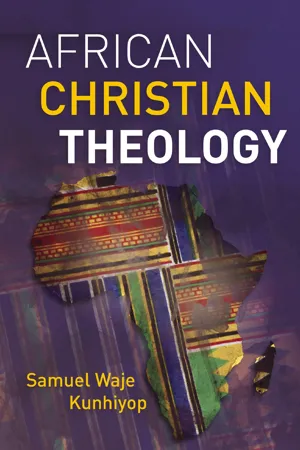
Christian theology evolves out of questions that are asked in a particular situation about how the Bible speaks to that situation. This book, African Christian Theology, is written to address questions that arise from the African context. It is intended to help students and others discover how theology affects our minds, our hearts, and our lives. As such, it speaks not only to Africans but to all who seek to understand and live out their faith in their own societies. Samuel Kunyihop understands both biblical theology and the African worldview and throws light on areas where they overlap, where they diverge, and why this matters. He explores traditional African understandings of God and how he reveals himself, the African understanding of sin and way the Bible sees sin, and how the work of Christ can be understood in African terms. The treatment of Christian living focuses on matters that are relevant to Christians in Africa and elsewhere, dealing with topics such as blessings and curses and the role of the church as a Christian community. The book concludes with a discussion of biblical thinking on death and the afterlife in which it also addresses the role traditionally ascribed to African ancestors.
- 272 pages
- English
- ePUB (mobile friendly)
- Available on iOS & Android
eBook - ePub
African Christian Theology
About this book
Trusted by 375,005 students
Access to over 1.5 million titles for a fair monthly price.
Study more efficiently using our study tools.
Information
Topic
Theology & ReligionSubtopic
Biblical Studies 1
THEOLOGY
What Is Theology?
The root meaning of theology is the study of God. The word was originally used by ancient Greek poets to refer to myths about pagan gods, but in the second century AD Clement of Alexandria used it when speaking of the true knowledge of God. In the fifth century, Augustine of Hippo in North Africa used the term to refer to the study of temporal rather than eternal matters. He did not see these as separate but as complementary. Both were meant to serve wisdom, the acquisition of which was the ultimate goal of all philosophy.
It was only in the twelfth century that theology gained a more technical meaning. Peter Abelard, a medieval French philosopher, taught that theology was sacred learning as a whole, as distinguished from secular disciplines such as the sciences. Theology deals with how we understand God and his revelation to his creation. While it is concerned with matters of faith and with eternal happiness as our ultimate goal, it is also a “self-conscious scholarly enterprise of understanding”.1
Over the centuries, Christians have tended to emphasize either the scholarly or the spiritual side of theology. In the main, universities have taken the academic route while seminaries have been more concerned with the spiritual side, focusing on faith, prayer, virtue and passion for God. Average Christians have tended to shy away from the scholarly side, regarding it academic and therefore non-spiritual. There have been misrepresentations, mistrust, suspicion and even name-calling on both sides of the divide.
The true meaning of theology, however, lies somewhere between the two extremes. It is an intellectual and spiritual search for answers to questions about divine revelation and the human condition. It studies both God’s revelation of himself and our own condition as beings composed of a body, mind and spirit. Then it seeks to apply the truths that emerge to men and women today. Theology is useless if it confines itself merely to ideas. It has to be vitally concerned with everyday life and the issues that affect God’s creatures. Indeed, it is as much interested in real life as it is interested in correct belief, for doctrine and practice are intimately related.
Philosophy and Theology
Philosophy and theology have always been cousins. Traditions in philosophy have shaped and challenged Christian doctrine and ethics as the theologians of each era have examined the faith in light of contemporary thought. This is not a new phenomenon. Early Christian theology was influenced by the thinking of Plato and Aristotle; eighteenth- and nineteenth-century theologians had to wrestle with the challenges posed by the Enlightenment and philosophers like Immanuel Kant. Today, we have to respond to the serious questions posed by postmodernism.
Some people become very nervous when they are told that philosophy plays a significant role in the development of a meaningful and relevant theology. This is because they define philosophy as human wisdom in opposition to the word of God. Others dismiss philosophy as merely human – and often useless – speculation. While it is true that philosophy has sometimes been used to discredit the word of God, the fact that something is used wrongly does not mean that it is inherently wrong. For example, the devil quoted Scripture to tempt Jesus (Matt 4:1–11), but this does not mean that we cannot quote or use Scripture ourselves. Moreover, even critical philosophy has been used by God to open our eyes to some of our own blind spots. It has sometimes led to the dismantling of some harmful beliefs and practices in the church that contradict the Christian faith. For example, philosophical enquiry into the rules of logic and evidence has helped Christians to identify the falsehood and lies that underlie many stories and confessions that are used to promote the belief and practice of witchcraft.
The root meaning of the word philosophy is the love of wisdom. The recognition that both philosophy and theology are committed to a rigorous intellectual search for wisdom and truth is the basis for a working relationship between them. Philosophy pursues truth by seeking to clarify concepts and issues. It is concerned with “critical reflection on justification and evidence. Philosophy evaluates arguments and assesses presuppositions and truth claims”.2
We should not see reason as automatically opposed to faith. The ability to reason is one of the characteristics of God, and we can reason because God created us in his image (Gen 1:26).3 We are rational beings, just as God is rational. God himself invites us to use our reasoning ability: “ ‘Come now, let us reason together’, says the Lord” (Isa 1:18, NIV ’84). Reason, illuminated by the Holy Spirit, enables us to understand God’s truth in the Holy Scriptures. What God opposes is self-sufficient, unaided-by-the-Spirit reason, as used by secular philosophers.
Here is a list of some areas in which theology benefits from its interaction with philosophy:
• Logic: Philosophers study logic in order to be able to distinguish between good and bad arguments. Logic helps us avoid fuzzy thinking when we recognize that “what is historically untrue or logically contradictory can neither possess religious value nor make theological sense. Error is error and nonsense is nonsense in every realm of thought.”4 Over the centuries, philosophy has helped to purge theology of inconsistencies and make it more coherent.
• Hermeneutics: What we know is influenced by how we interpret things, and hermeneutics is the philosophical study of the nature of interpretation. As theologians, we have to interpret God’s revelation of himself in Scripture and also in nature, which is the revelation he has made available to all created beings. The fact that we are fallen and need God’s grace to rightly understand the things of God does not excuse us from using our minds to study them and clarify our ideas about God and the things of God.
• Apologetics: Philosophy can help us provide a reasoned defence of the Christian faith to the unbelieving world. People who might not be willing to listen to direct biblical preaching might respond to the gospel when confronted with philosophical reasoning that is in agreement with the Bible.
• Systematic theology: Theologians use tools and terms provided by philosophy when seeking to clearly explain how different parts of the teaching in the Bible fit together. For example, the word “Trinity” is not found anywhere in the Bible. But theologians use it as a quick way of expressing the concept that God is one yet three. This concept arose because inductive study of the whole Bible led theologians to conclude that God exists as the Father, the Son and the Holy Spirit. They then made a deduction that these are not three gods, but one God in three persons. In the same way, an inductive study of the Bible leads to the conclusion that Christ exhibited both human and divine qualities. Philosophy has helped theologians wrestle with the problem of how the omnipotent (all-powerful), omniscient (all-knowing) and unchanging God can be united to human nature, which is finite, mortal and not all-knowing. Our answers to this question are not complete, but they are better than they would be if we had not been able to use the tools of philosophy (like induction and deduction) to shape our teaching on this issue.
• Philosophical theology: Christian thinkers have to wrestle with issues that the Bible does not address directly. For example, the Bible assumes that God exists; philosophy looks for proofs of his existence. It also has to wrestle with the relationship between the sovereignty of God and human freedom, and with the problems posed by pain and suffering in this world. It can also be used to help African Christians ask meaningful questions about the nature and activities of the spirit world as it interacts with our world.
Ethics and Theology
The relationship between ethics and theology is similar to the relationship between dance and music. As a Hausa proverb states idan ganga ya canja, rawa zai canja [If the beating of the drum changes, the dance will change]. In the same way, any change in our theology affects our world views, beliefs and values, and thus our ethics. Christian ethics and morality are the end result of theology. That is why we cannot say that the theoretical issues of theology are only important for scholars, teachers, students or professors in the classroom. Theology affects the way we behave in real-life situations.
God demands that his people should be holy as he is holy. Theology, as the study of God and his revelation, helps us to interpret what this means so that we can live holy lives in this world. This too underscores the close relationship between theology and ethics; one cannot study one without addressing the other. As Ray Sherman Anderson states, “It is the right hearing of the Word and the obedient response to the claim on one’s personal and social life this Lord brings that constitute the basis for a theological ethics.”5 Karl Barth puts it this way: “Ethics as a theological discipline is the auxiliary science in which an answer is sought in the Word of God to the question of the goodness of human conduct. As a special elucidation of the doctrine of sanctification it is reflection on how far the Word of God proclaimed and accepted in Christian preaching effects a definite claiming of man.”6
Thus Christian theology is critical for ethics. Our behaviour must be consistent with our theological position.
Church History and Theology
God’s work in redemption did not cease with his revelation in Scripture and the incarnation of his Son, Jesus Christ. God has been at work through the Holy Spirit throughout history to preserve his creation, to save humankind and to build his church. He has promised that he will be with his people till th...
Table of contents
- Cover Page
- Title Page
- Copyright Page
- Ebook Instructions
- Contents
- Foreword
- Acknowledgements
- Introduction
- 1. Theology
- 2. Revelation
- 3. God and Spirits
- 4. Creation and the Fall
- 5. Christ and Salvation
- 6. The Holy Spirit and Salvation
- 7. Salvation and the Christian Life
- 8. The Community of God
- 9. Beliefs and Practices In the Community of God
- 10. Death, Judgement and Eternity
- Appendix: General Theologies
Frequently asked questions
Yes, you can cancel anytime from the Subscription tab in your account settings on the Perlego website. Your subscription will stay active until the end of your current billing period. Learn how to cancel your subscription
No, books cannot be downloaded as external files, such as PDFs, for use outside of Perlego. However, you can download books within the Perlego app for offline reading on mobile or tablet. Learn how to download books offline
Perlego offers two plans: Essential and Complete
- Essential is ideal for learners and professionals who enjoy exploring a wide range of subjects. Access the Essential Library with 800,000+ trusted titles and best-sellers across business, personal growth, and the humanities. Includes unlimited reading time and Standard Read Aloud voice.
- Complete: Perfect for advanced learners and researchers needing full, unrestricted access. Unlock 1.5M+ books across hundreds of subjects, including academic and specialized titles. The Complete Plan also includes advanced features like Premium Read Aloud and Research Assistant.
We are an online textbook subscription service, where you can get access to an entire online library for less than the price of a single book per month. With over 1.5 million books across 990+ topics, we’ve got you covered! Learn about our mission
Look out for the read-aloud symbol on your next book to see if you can listen to it. The read-aloud tool reads text aloud for you, highlighting the text as it is being read. You can pause it, speed it up and slow it down. Learn more about Read Aloud
Yes! You can use the Perlego app on both iOS and Android devices to read anytime, anywhere — even offline. Perfect for commutes or when you’re on the go.
Please note we cannot support devices running on iOS 13 and Android 7 or earlier. Learn more about using the app
Please note we cannot support devices running on iOS 13 and Android 7 or earlier. Learn more about using the app
Yes, you can access African Christian Theology by Samuel Waje Kunhiyop in PDF and/or ePUB format, as well as other popular books in Theology & Religion & Biblical Studies. We have over 1.5 million books available in our catalogue for you to explore.