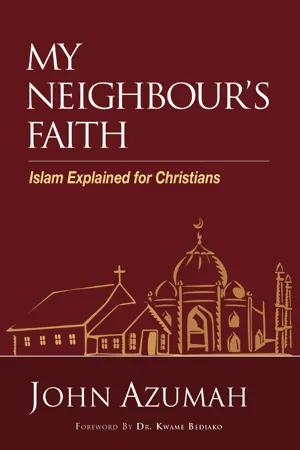
Nowhere else in the world have both Islam and Christianity been more instrumental in shaping the history of a people and their way of life than in Africa. African Muslims and Christians have a lot in common, including kinship ties, shared languages and citizenship. Yet, despite the centuries of deep historical links and harmonious existence between the two religions, new challenges threaten this harmony. Conflicts involving Christians and Muslims in places like Sudan, Nigeria and Ivory Coast are common. These conflicts are fueled primarily by ignorance, stereotyping and prejudice, which in turn breed fear, suspicion and even hatred, in some cases leading to violence. My Neighbour's Faith sheds light on the beliefs and teaching of Islam by addressing matters of contemporary importance to Christians and the wider non-Muslim audience. It presents the human face of Islam--the face of a close relative, a neighbour, a teacher and even a head of state--in a balanced and critical way that gives a credible view of Islam.
- 176 pages
- English
- ePUB (mobile friendly)
- Available on iOS & Android
eBook - ePub
About this book
Information
Topic
Theology & ReligionSubtopic
Biblical Studies
1
Introduction
Africa has an interreligious and interfaith environment that is unique in many ways. We have multifaith families, clans, ethnic groups and nations. At each of these levels, African Muslims and Christians have a lot of things that bind them together, including kinship ties, shared languages and citizenship. If I may use my own case as an example, I come from a family where believers in Traditional African Religion, Muslims and Christians live and share basically everything. My Muslim uncle made significant contributions towards my theological training and about 95 per cent of the family members who attended my ordination service were Muslim. Similarly, when there is anything involving a family member, all members of the family, irrespective of their religious affiliation, are called upon to contribute.
At the national level, Ghana has a Catholic president, and a Muslim vice-president who were sworn into office by a lay Methodist chief justice. Similar examples of pluralist realities are fairly common across sub-Saharan Africa.
The other side of the coin is that most of the inhuman acts perpetrated by human beings have, directly or indirectly, something to do with religion. As one theologian writing on religion and violence observes:
Many of the violent conflicts in the world today involve religious animosities. Indeed, the history of the encounters among the world’s religions is filled with distrust and hatred, violence and vengeance. The deepest tragedy of the history of religions is that the very movements that should bring human beings closer to each other and to their ultimate source and goal have time and time again become forces of division. In one conflict after another around the world, religious convictions and interpretations of revelation have been used and abused as justifications for violence.1
Again speaking from my own context, in 1995 Ghana had her fair share of interreligious confrontations, mainly between Christians and Muslims in Takoradi, Kumasi and Tamale. The conflicts involving Christians and Muslims in places like Sudan, Nigeria and Ivory Coast are well known. These conflicts have their roots in the collective historical experience of Africans as well as in present socio-political and religious challenges. Some would argue, however, that ignorance accounts for much of the fear, suspicion and hatred that lead to violence and open conflicts between people of different religions. On both the Christian and Muslim sides in Africa, there is a lot of ignorance, prejudice and stereotyping. How do we maintain peace between the Christian and Muslim communities?
In the words of Mother Theresa, ‘peace is not something you wish for, it’s something you make, something you do, something you are, something you give away.’ Also talking about religion and peace, the prominent Swiss theologian Hans Küng made the following solemn observation:
No world peace without peace among religions; no peace among religions without dialogue between the religions; and no dialogue between the religions without accurate knowledge of one another.2
There is therefore an urgent need for accurate knowledge of the teaching and beliefs of religions other than our own. The British Prime Minister Tony Blair is right when he says, ‘Knowledge dispels fear. Knowledge clears away misunderstanding. Knowledge strengthens trust.’3
Over the last half century, there have been many discussions and activities aimed at promoting better understanding between people of different religious traditions and civilisations. One of the positive results of these endeavours is the proliferation of study centres and literature in the West aimed at presenting Islam in a more sympathetic and positive light.
This is a welcome departure from the medieval demonisation of Islam and nineteenth-century Western polemics against it. In the wake of 11 September 2001, the need to carry on with this task has become even more urgent. Many Western journalists, politicians, clergy and academics have taken up this task and are genuinely trying to help redress the situation. This is certainly a valid and welcome undertaking in our increasingly pluralistic and interdependent world.
The problem, however, is that the drive to address past misconceptions has brought about another unhealthy tendency, referred to by Bernard Lewis as ‘voluntary censorship’.4 Western scholars in particular, have tended to take a very critical and sometimes hostile view of the Christian tradition and heritage. However, they do not apply the same critical approach when dealing with Islamic teaching and history. As a direct result, mainline post-colonial Western discourse on Islam has, in the view of many, moved from extreme Islamophobia (the fear and demonisation of Islam) to what some have termed Islamophilia (the love and romanticisation of Islam).
Another reason for self-censorship is identified by Thomas L. Friedman in his response to the protests and sporadic violence that flared up across the Muslim world in response to Pope Benedict XVI’s critical comments about Islam in September 2006:
The pope was actually treating Islam with dignity. He was treating the faith and its community as adults who could be challenged and engaged. That is a sign of respect. What is insulting is the politically correct, kid-gloves views of how to deal with Muslims that is taking root in the West today. It goes like this:‘Hushhh! Don’t say anything about Islam! Don’t you understand? If you say anything critical or questioning about Muslims, they’ll burn down your house. Hushhh! Just let them be. Don’t rile them. They are not capable of a civil, rational dialogue about problems in their faith community.’Now that is insulting. It’s an attitude full of contempt and self-censorship, but that is the attitude of Western elites today, and it’s helping to foster the slow-motion clash of civilizations that Sam Huntington predicted. Because Western masses don’t buy it. They see violence exploding from Muslim communities and they find it frightening, and they don’t think their leaders are talking honestly about it. So many now just want to build a wall against Islam.5
In the wake of the 11 September 2001 terrorist attack on America, interest in Islam amongst Christians across the world has been on the increase. We read about and see Muslims blowing themselves and others up in the name of their religion, while at the same time we hear Muslim leaders and Western experts proclaiming that Islam is a religion of peace. One theological student in India once said to me, ‘Sir, I am confused! We hear Islam is a religion of peace, but we also read about and see Muslims praying with AK-47 rifles and teenage girls shot dead or disfigured for not wearing a veil!’ He is not alone in his confusion. Thomas Friedman, who has lived in the Muslim world, enjoyed the friendship of many Muslims and seen the compassionate side of Islam, writes:
On the first day of Ramadan last year a Sunni Muslim suicide bomber blew up a Shiite mosque in Hilla, Iraq, in the middle of a memorial service, killing 25 worshippers. This year on the first day of Ramadan, a Sunni suicide bomber in Baghdad killed 35 people who were lining up in a Shiite neighbourhood to buy fuel. The same day, the severed heads of nine murdered Iraqi police officers and soldiers were found north of Baghdad. I don’t get it. How can Muslims blow up other Muslims on their most holy day of the year – in mosques! – and there is barely a peep of protest in the Muslim world, let alone a million Muslim march? Yet Danish cartoons or a papal speech lead to violent protests.6
Of course there are problems within all faith communities. But that is not the point. The point is that believers should be prepared to confront and deal with issues honestly in a mature and level-headed manner.
To add to the confusion, Islam itself is far from being a monolithic entity. There are Muslims who assert and genuinely believe that Islam is a religion of peace, while there are others whose discourse and activities proclaim the opposite. Both claim that their version of Islam is the ‘true’ Islam. It has to be said that what does or does not constitute true Islam is a legitimate internal Muslim discussion that Christians can only join as detached commentators. In my view, Christians should concern themselves with matters in Islam that directly relate to them. In other words, Islam has a lot to say to and about Christians and Christianity in its scripture, traditions and theology, and Christians need to know these things. As one leading Muslim scholar put it:
Islam’s attitude to Christianity is as old as Islam itself, since Islam partly took shape by adopting certain important ideas from Judaism and Christianity and criticizing others. Indeed, Islam’s self-definition is partly the result of its attitude to these two and their communities.7
In other words, right from the beginning, Islam has always defined itself in contradistinction to the other religions, especially Judaism and Christianity.
What I shall attempt to do in this book is to throw some light on the beliefs and teaching of Islam for Christians. In doing this, I shall touch on some matters that I consider of contemporary importance to Christians and the wider non-Muslim audience. I shall draw heavily from mainline Muslim sources and shall strive to avoid the two extremes of demonising and romanticising Islam. I shall always endeavour to keep the human face of Islam in mind. In Africa, as already noted, Islam is not an impersonal system of beliefs or the religion of immigrant communities. Rather, Islam has a human face: the face of a close relative, a neighbour, a teacher and even a head of state.
At the same time I have my academic integrity to protect. Hence, I will try to present the facts, including the hard facts, in the conviction that good relations can only be built on accurate and critical knowledge of self and one another. In addition I believe it is vital to provide Christian theological students with credible and balanced information in order to prevent them from being misinformed by other unhelpful material on the market or simply wall themselves off.
Notes
1
Leo D. Lefebure, Revelations, the Religions, and Violence (New York: Orbis Books, 2000): 7–8.
2
H. Küng, ‘Christianity and world religions: Dialogue with Islam’, in L. Swidler (ed.), Toward a Universal Theology of Religion (Maryknoll NY: Orbis Books, 1987): 194.
3
The text of Blair’s speech to Christian and Muslim academics is included in Michael Ipgrave (ed.), The Road Ahead: A Christian–Muslim Dialogue (London: Church House Publishing, 2002): xiv.
4
B. Lewis, Islam and the West (New York: Oxford University Press, 1993): 130.
5
Thomas L. Friedman, ‘Islam and the Pope’, in International Herald Tribune, September 30–October 1, 2006: 7.
6
Ibid.
7
Fazlur Rahman, Major Themes of the Qur’ān (Minneapolis: Bibliotheca Islamica, 1980): 162.
2
The Challenges Posed by Islam
To appreciate why it is important for Christians to study Islam, we need to know some of the key challenges Islam poses to Christian thought and theology in Africa. In this chapter, I will highlight some of these challenges.1
Existential Challeng...
Table of contents
- Cover Page
- Title Page
- Copyright Page
- Dedication
- Contents
- Foreword
- Acknowledgements
- 1. Introduction
- 2. The Challenges Posed By Islam
- 3. Islam: Its Context, Prophet and Early History
- 4. Mainstream Muslim Beliefs and Practices
- 5. Scripture (Qur’ān) and Tradition (Hadith)
- 6. Main Divisions and Movements Within Islam
- 7. Islamic Law (Shari’ah)
- 8. Islamic Teaching On Women
- 9. Islamic Teaching On People of Other Faiths
- 10. Jesus In Islam
- 11. A Christian Response to Islam
- 12. Key Theological and Missiological Questions
- Appendix: Key Qur’ānic Passages, Organised Thematically
- Further Reading
Trusted by 375,005 students
Access to over 1.5 million titles for a fair monthly price.
Study more efficiently using our study tools.
Frequently asked questions
Yes, you can cancel anytime from the Subscription tab in your account settings on the Perlego website. Your subscription will stay active until the end of your current billing period. Learn how to cancel your subscription
No, books cannot be downloaded as external files, such as PDFs, for use outside of Perlego. However, you can download books within the Perlego app for offline reading on mobile or tablet. Learn how to download books offline
Perlego offers two plans: Essential and Complete
- Essential is ideal for learners and professionals who enjoy exploring a wide range of subjects. Access the Essential Library with 800,000+ trusted titles and best-sellers across business, personal growth, and the humanities. Includes unlimited reading time and Standard Read Aloud voice.
- Complete: Perfect for advanced learners and researchers needing full, unrestricted access. Unlock 1.5M+ books across hundreds of subjects, including academic and specialized titles. The Complete Plan also includes advanced features like Premium Read Aloud and Research Assistant.
We are an online textbook subscription service, where you can get access to an entire online library for less than the price of a single book per month. With over 1.5 million books across 990+ topics, we’ve got you covered! Learn about our mission
Look out for the read-aloud symbol on your next book to see if you can listen to it. The read-aloud tool reads text aloud for you, highlighting the text as it is being read. You can pause it, speed it up and slow it down. Learn more about Read Aloud
Yes! You can use the Perlego app on both iOS and Android devices to read anytime, anywhere — even offline. Perfect for commutes or when you’re on the go.
Please note we cannot support devices running on iOS 13 and Android 7 or earlier. Learn more about using the app
Please note we cannot support devices running on iOS 13 and Android 7 or earlier. Learn more about using the app
Yes, you can access My Neighbour's Faith by John Azumah in PDF and/or ePUB format, as well as other popular books in Theology & Religion & Biblical Studies. We have over 1.5 million books available in our catalogue for you to explore.