Why did Jesus die? And how does his death change us and our world? These questions stand at the center of our faith. But that doesn’t mean they are simple or straightforward.
Michele Hershberger helps us peer deeply into the meaning of the cross by sifting through Scripture and the life of Christ. Learn about theological concepts like sin, salvation, and atonement. Find out how Christians across the centuries have thought about Jesus’ death. Discover how Jesus’ life, crucifixion, and resurrection change everything.
The Jesus Way series delves into big questions about God’s work in the world. These concise, practical books are deeply rooted in Anabaptist theology. Crafted by a diverse community of internationally renowned scholars, pastors, and practitioners, The Jesus Way series helps readers deepen their faith in Christ and enliven their witness.
Books in series:
What Is the Bible and How Do We Understand It? Dennis R. Edwards [Fall 2019]
Why Did Jesus Die and What Difference Does It Make? Michele Hershberger [Fall 2019]
Why Do We Suffer and Where Is God When We Do? Valerie G. Rempel [Spring 2020]
What Is the Trinity and Why Does It Matter? Steve Dancause [Spring 2020]
Who Are Our Enemies and How Do We Love Them? Hyung Jin Kim Sun [Summer 2020]
What Is God’s Mission in the World and How Do We Join It? Juan F. Martínez [Summer 2020]
What Is the Church and Why Does It Exist? David Fitch [Fall 2020]
What Does Justice Look Like and Why Does God Care about It? Judith and Colin McCartney [Fall 2020]
What Is God’s Kingdom and What Does Citizenship Look Like? César García [Spring 2021]
Who Was Jesus and What Does It Mean to Follow Him? Nancy Elizabeth Bedford [Spring 2021]
- 120 pages
- English
- ePUB (mobile friendly)
- Available on iOS & Android
eBook - ePub
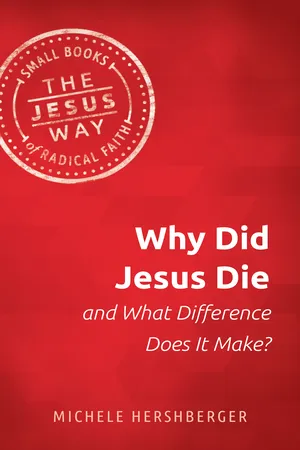
Why Did Jesus Die and What Difference Does it Make?
About this book
Information
Topic
Theology & ReligionSubtopic
Christian Theology1
How Does Jesus Save Us—and from What?
Once there were two families who lived with alcoholism. In both families, one member got drunk every Friday night, came home, and verbally abused and sometimes beat the other members of his or her family. Both were terrible situations of fear and bondage.
The first family reacted to the person who was alcoholic in this way: every Saturday morning, after the drunken brawl and the abuse, they forgave her. They loved her, and they listened to her pleas for forgiveness and accepted them. But the next Friday night, she would go out and get drunk again. When she was put in jail, the family would pay the bond. The pattern stayed the same, week after week after week.
The second family also loved their family member who was alcoholic. And they also forgave him. But one Saturday morning, they decided to open the way for him to get sober. They offered to get him into a treatment center, where he could get help. He got sober; he found healing. Before he was addicted and in bondage to this habit, and now he was free. He didn’t drink anymore. He was not only forgiven; he was set free.
The first family offered forgiveness. The second family offered forgiveness and healing. We could say that the second family gave their loved one a fuller salvation than the first family.
What do these stories have to do with atonement? Like the second family, Jesus longs to provide real deliverance from whatever holds us in bondage. Atonement is our word for the how of that deliverance: how Jesus both saves us and heals us.
How can we again become “at one” with God? Why did Jesus have to die, and how does this death save us? How is the death of Jesus different from the death of another noble person, like Martin Luther King Jr.?
Although it’s more complicated than the stories of the loved ones with alcoholism would suggest, the atonement means that Jesus came not only to forgive us or pay the bond to get us out of jail; he also made a way for us to “get sober” from our addictions, our ways of harming ourselves and others, our sins. As we will see, this atonement comes to us not only by his death. Jesus also saves us by his birth, life, teachings, and resurrection. In that way, it’s better to define atonement not just as what happened on the cross but, more broadly, as the work of Christ.
WHY IS ATONEMENT NECESSARY?
What makes atonement necessary? The Bible gives us a one-word answer: sin. Yet we shouldn’t be fooled into thinking that this one word—sin—is a simple, one-dimensional concept. It isn’t. The Bible uses many words that hover around the general theme of sin. Adding to that complexity is the fact that different cultures understand the concept of sin with different shades of meaning; we need to honor this reality. Yet we can also get a foundational grounding in what sin means by looking at four stories in Genesis.
Genesis 3–11 offers us four narratives that show the danger of sin. The stories of Adam and Eve, Cain and Abel, the flood, and the Tower of Babel show us how sin breaks four major relationships in our lives. Take the Adam and Eve narrative. They disobey God by eating the forbidden fruit. This breaks their relationship with God. Adam and Eve blame each other, thus illustrating how sin breaks our relationship with other people. In their lostness, they realize they’re naked. This symbolizes shame, or a broken relationship we experience in our inner self when we sin. Finally, the ground is cursed, and childbearing becomes unbearable. Sin also destroys our relationship with the physical world.
God, of course, responds. Adam and Eve are sent out of the garden. And while this feels like a terrible judgment, it’s also grace. God doesn’t want them to eat fruit from the second tree, the tree of eternal life, because this would then leave them in a sinful state forever. It’s a paradox: God, in mercy, gives them judgment. It’s also important to note that God doesn’t withdraw from them. After Adam and Eve sin, Yahweh walks in the garden, calling out, “Where are you?” (Genesis 3:9). God is right there, up close and personal with sinful humanity. This is important to remember when we encounter views of atonement that emphasize a God who withdraws, or a God who is not able to handle our sin, or a God who does not want to be close to us.
In the other three stories from Genesis—Cain and Abel, the flood, and the Tower of Babel—the same four relationships are broken through sin: with God, with others, with self, and with the natural world. If sin is the problem, then salvation is the solution. Atonement is the how of salvation. If sin breaks these four relationships, then salvation, however we might understand it, needs to heal these same four relationships. And Jesus is all about healing.
JESUS HEALS BROKEN RELATIONSHIPS
Jesus cares deeply about our broken relationship with God. The cross brings this healing, and the rest of the book will center on what that means. Yet Jesus also healed this relationship before his death. He forgave people’s sins before he ever died on the cross (Mark 2:1-12). Without eliminating the connection between forgiveness and the cross, we must admit that it was possible for Jesus—and God—to forgive sins without this “payment.” The four Gospels are filled with stories of Jesus working to heal our brokenness with God. In the story of the prodigal son, Jesus shows us who God is by describing a forgiving father who bends over backward to welcome home a wayward child. John 3:16 says that it was for love that God sent Jesus into the world.
Jesus also healed the broken relationships that people experience with each other. His birth to poor peasants, instead of to a priestly family, showed God’s heart for the poor. Jesus taught us to love our enemies, and he did so himself. First-century Jews had to realign their belief that sick people were terrible sinners, because Jesus healed those unclean people. Jesus forgave the soldiers who crucified him, for they did not know what they were doing (Luke 23:34).
Jesus knew the pain of inner shame—of separation from the self—and worked to heal it. While many of his healings were private, and while he sometimes asked those he healed not to tell anyone, Jesus went public with the healing when that healing couldn’t be visibly ratified. He knew that diseased persons suffered not only from physical disease but also from being social outcasts. He wanted to heal that broken relationship too (see Luke 8:40-56).
Finally, Jesus cared about the physical world. He didn’t just forgive sins, important as that is; he didn’t just teach in such a way that the law was fulfilled (Matthew 5:17). He cared about physical needs. He fed thousands of people. He healed people who were blind and those who were paralyzed. And he challenged unjust realities like the temple system, which made people so poor that they couldn’t care for themselves or their families. He condemned the religious leaders for adding to the burden of the poor. He even overcame creation’s worst enemy—death. God resurrected Jesus, bringing his dead body back to life. In this mighty event, God gave a hearty yes to the goodness of the physical world.
These four broken relationships continue to be healed by the Holy Spirit, who moves among us. The Spirit comforts us, challenges us, convicts us of sin, and guides us in our discipleship.
THE RESULTS OF SIN
Ask most Christians to define sin, and they’ll talk about disobeying God or neglecting to do what God has called us to do. But ask people about the results of sin, and you get different answers. Many emphasize how sin damages our relationship with God. Only a few give attention to how sin hurts the relationships we have with others, the physical world, and our own selves. But sin works like a wrecking ball against those relationships too.
If we view the results of sin too narrowly, then we view atonement too narrowly, and we limp through life. Our sins may be forgiven, but our lives are not fully restored. This is not to say that our relationship with God isn’t important; it is paramount. But God longs for us to have full salvation—full “at-one-ment.” If our view of the atonement doesn’t include a way for all these relationships to be healed, then we have a weak salvation. If our view of the atonement gets our sins forgiven but leaves us stuck in brokenness, unable to love our enemies or even love ourselves, then our salvation is incomplete. It leaves us captive to our addictions, in much the same way that the person with alcoholism in the first family was forgiven but still stuck. Jesus wants to heal not only our relationship with God but the other broken relationships too. Yes, Jesus brought salvation through his death, but also through his life, teaching, miracles, and resurrection, and through the gift of the Holy Spirit.
Why is a fuller definition of sin important? It’s not only in the first four “fall stories” of Genesis that we see the wrecking-ball effect of sin; it’s everywhere in the Bible. People hurt each other—think Jacob and Esau. People stumble with the weight of their guilt—think David after his affair with Bathsheba. And sin hurts God’s beautiful creation—we see that “the whole creation has been groaning” (Romans 8:22) and that people with diseased bodies are pleading with Jesus for healing.
Our view of atonement must take into account all of Jesus’ life. This truth remains a paradox. For while it’s true that Jesus was saving people before he died on the cross, it’s also true that the death of Jesus is key to our becoming one with God.
HOW WE SEE JESUS AND WHY IT MATTERS
Our view of atonement influences how we see Jesus and what it means to follow him. If we have a narrow view, then we believe that Jesus came to die for only one reason—to pay for our sins, in whatever way we interpret that metaphor. But it’s equally true to say that Jesus was killed. When we say it that way, everything changes. Yes, Jesus died on the cross for our sins. And yes, he was executed by agents of the state.
We could say that Jesus died for spiritual reasons and was killed for historical ones. The truth of the first statement doesn’t contradict the truth of the second. The Romans sought to get rid of Jesus because he was a threat. He was collecting a following, and they had seen other messiahs do the same thing, with violent uprisings as a result. They didn’t want that kind of trouble. When Jesus rode into the city on a donkey, his people hailed him as a king, and that didn’t sit well with authorities either. As Messiah, Jesus saw his purpose as setting people free (Luke 4:16-19); he had to challenge oppression and injustice. And those in power hate to be challenged. If Jesus was going to speak out for justice and commit to being nonviolent all the way to the cross, it’s easy to see why he got killed.
But it wasn’t just the Romans who wanted Jesus dead. The Jewish religious leaders likewise were threatened. Jesus healed on the Sabbath, clearly against their understanding of Mosaic Law. He challenged their theological claims, and the common people loved him for it. He called the Pharisees a “brood of vipers” (Matthew 12:34), and that wasn’t exactly complimentary either. The religious leaders hated him so much that they gave up their most cherished belief—that Yahweh was the only King—to ensure that Pilate would go through with the crucifixion. They said, “We have no king but the emperor” (John 19:15). They had no warm feelings toward Caesar, but they were willing to call him king if it meant getting rid of Jesus.
Jesus died for our sins. Jesus was killed for being a threat to oppressive systems. We can believe both to be true. In fact, without this balance, we don’t fully understand atonement. If Jesus only died for our sins, then his death on the cross carries only one meaning for us—that through the cross we get saved. This is a wonderful and important part of why he died, but it’s crucial to see that Jesus was also killed because he challenged unjust structures and systems. At the same time, if Jesus only died because he was a threat to the state, he is just one more in a long line of courageous people who stood up to oppression and, by so doing, got themselves killed. We need to be saved from both personal sin and unjust systems, not just from one or the other.
TAKE UP YOUR CROSS
Jesus told his disciples—and us—that all who want to follow him must “deny themselves and take up their cross daily and follow me” (Luke 9:23). He said these words before he hung on a cross himself. So the cross must symbolize something in addition to the way he paid for our sins. Why? Because if you and I are called to carry our crosses, it must be for a purpose other than dying for the sins of others. We aren’t Jesus.
To carry our cross is to be ready to suffer for following Jesus. “For those who want to save their life will lose it, and those who lose their life for my sake will save it,” Jesus said. “What does it profit them if they gain the whole world, but lose or forfeit themselves?” (Luke 9:24-25). Like Jesus, we are called to nonviolently challenge the evil structures of our world and to remain nonviolent in the face of death. If we do both things—challenge evil and refuse to defend ourselves—it’s clear we’ll suffer. And this daring discipleship gives us “the whole world.”
Somehow, in the mystery of Jesus, when we lose ourselves for the sake of the kingdom, we gain. We save our lives when we lose them. There is danger in emphasizing discipleship t...
Table of contents
- Front Cover
- Half Title Page
- Title Page
- Copyright Page
- Contents
- Introduction to The Jesus Way Series from Herald Press
- Introduction
- 1 How Does Jesus Save Us—and from What?
- 2 What Does Jesus Say about Atonement?
- 3 What Does Paul Say about Atonement?
- 4 What Does the Church Say about Atonement?
- 5 How Does Atonement Transform Us?
- Glossary
- Discussion and Reflection Questions
- Shared Convictions
- Notes
- The Author
Trusted by 375,005 students
Access to over 1.5 million titles for a fair monthly price.
Study more efficiently using our study tools.
Frequently asked questions
Yes, you can cancel anytime from the Subscription tab in your account settings on the Perlego website. Your subscription will stay active until the end of your current billing period. Learn how to cancel your subscription
No, books cannot be downloaded as external files, such as PDFs, for use outside of Perlego. However, you can download books within the Perlego app for offline reading on mobile or tablet. Learn how to download books offline
Perlego offers two plans: Essential and Complete
- Essential is ideal for learners and professionals who enjoy exploring a wide range of subjects. Access the Essential Library with 800,000+ trusted titles and best-sellers across business, personal growth, and the humanities. Includes unlimited reading time and Standard Read Aloud voice.
- Complete: Perfect for advanced learners and researchers needing full, unrestricted access. Unlock 1.5M+ books across hundreds of subjects, including academic and specialized titles. The Complete Plan also includes advanced features like Premium Read Aloud and Research Assistant.
We are an online textbook subscription service, where you can get access to an entire online library for less than the price of a single book per month. With over 1.5 million books across 990+ topics, we’ve got you covered! Learn about our mission
Look out for the read-aloud symbol on your next book to see if you can listen to it. The read-aloud tool reads text aloud for you, highlighting the text as it is being read. You can pause it, speed it up and slow it down. Learn more about Read Aloud
Yes! You can use the Perlego app on both iOS and Android devices to read anytime, anywhere — even offline. Perfect for commutes or when you’re on the go.
Please note we cannot support devices running on iOS 13 and Android 7 or earlier. Learn more about using the app
Please note we cannot support devices running on iOS 13 and Android 7 or earlier. Learn more about using the app
Yes, you can access Why Did Jesus Die and What Difference Does it Make? by Michele Hershberger in PDF and/or ePUB format, as well as other popular books in Theology & Religion & Christian Theology. We have over 1.5 million books available in our catalogue for you to explore.