Wharton, Hemingway, and the Advent of Modernism is the first book to examine the connections linking two major American writers of the twentieth century, Edith Wharton and Ernest Hemingway. In twelve critical essays, accompanied by a foreword from Wharton scholar Laura Rattray and a critical introduction by volume editor Lisa Tyler, contributors reveal the writers' overlapping contexts, interests, and aesthetic techniques.
Thematic sections highlight modernist trends found in each author's works. To begin, Peter Hays and Ellen Andrews Knodt argue for reading Wharton as a modernist writer, noting how her works feature characteristics that critics customarily credit to a younger generation of writers, including Hemingway. Since Wharton and Hemingway each volunteered for humanitarian medical service in World War I, then drew upon their experiences in subsequent literary works, Jennifer Haytock and Milena Radeva-Costello analyze their powerful perspectives on the cataclysmic conflict traditionally viewed as marking the advent of modernism in literature. In turn, Cecilia Macheski and Sirpa Salenius consider the authors' passionate representations of Italy, informed by personal sojourns there, in which they observed its beautiful landscapes and culture, its liberating contrast with the United States, and its period of fascist politics. Linda Wagner-Martin, Lisa Tyler, and Anna Green focus on the complicated gender politics embedded in the works of Wharton and Hemingway, as evidenced in their ideas about female agency, sexual liberation, architecture, and modes of transportation. In the collection's final section, Dustin Faulstick, Caroline Chamberlin Hellman, and Parley Ann Boswell address suggestive intertextualities between the two authors with respect to the biblical book of Ecclesiastes, their serialized publications in Scribner's Magazine, and their affinities with the literary and cinematic tradition of noir.
Together, the essays in this engaging collection prove that comparative studies of Wharton and Hemingway open new avenues for understanding the pivotal aesthetic and cultural movements central to the development of American literary modernism.
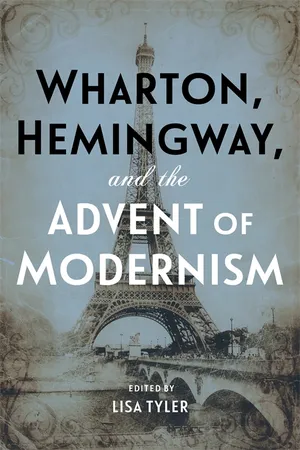
- 264 pages
- English
- ePUB (mobile friendly)
- Available on iOS & Android
eBook - ePub
Wharton, Hemingway, and the Advent of Modernism
About this book
Information
Topic
LetteraturaSubtopic
Critica letteraria modernaV
INTERTEXTUALITIES
INTERTEXTUALITIES
Wharton, Hemingway, Ecclesiastes, and the Modernist Impulse
DUSTIN FAULSTICK
When Edith Wharton’s adviser at Scribner’s, William Crary Brownell, tried to include an epigraph from Ecclesiastes at the beginning of Wharton’s 1905 novel The House of Mirth, the author responded by “drawing an inexorable blue line through the text” (Letters 94). Her fear, as she indicates in her letter to Brownell, was that she “might surely be suspected of plagiarizing from Mrs. Margaret Sangster’s beautiful volume, ‘Five Days with God’” (94), a pious text devoted to religious duty. “Seriously,” she explained of her title borrowed from the biblical Ecclesiastes, “I think the title explains itself amply as the tale progresses” (94). Ernest Hemingway does include an epigraph from Ecclesiastes to accompany his Ecclesiastes-titled 1926 novel The Sun Also Rises, but few readers of this Lost Generation novel full of drinking, sexuality, and bullfighting would accuse the young Hemingway of plagiarizing a pious religious text. A casual reader might consider any biblical reference as an indication of moralizing, but for readers familiar with Ecclesiastes, the book is less likely to convey this association. In fact, the interpretation history of Ecclesiastes includes endorsements from such notable skeptics as Voltaire, Volney, and Arthur Schopenhauer. John Franklin Genung, in his 1904 commentary on Ecclesiastes, claims, “One never hears of the skeptics rejecting this book. It seems rather to warm and nourish them” (Words of Koheleth 3). Likewise, Samuel Cox’s 1903 commentary acknowledges, “From Schopenhauer downward, this Book is constantly cited by them as if it confirmed the conclusion for which they contend, [Agnes] Taubert even going so far as to find ‘a catechism of pessimism’ in it” (4–5).1
Beyond being the beloved scripture of the skeptics, Ecclesiastes enjoyed widespread popularity in the early twentieth century. Cox sees the book as primary among Christian readers as well: “few books were, or are, more popular than the book Ecclesiastes. [. . .] Brief as the Book is, I am disposed to think it is better known among us than any other of the Old Testament Books except Genesis, the Psalter, and the prophecies of Isaiah” (289). Genung sees the views of its main author—the Preacher, or Qoheleth2—as “eminently timely” (Words of Koheleth 159), and, in 1906, William Forbush calls Ecclesiastes “the most modern book in the Bible” (3). In his 1919 commentary A Gentle Cynic, Morris Jastrow identifies the book’s twofold appeal for early twentieth-century readers: “The book is not only intensely human, it is also remarkably modern in its spirit” (8).
Ecclesiastes’ modernity rests largely on its compatibility with contemporary science and philosophy. Darwin, Freud, and Nietzsche had recently established a climate at odds with much of the Bible, but markedly consistent with Ecclesiastes. Although most of the Bible claims a superior role for humans, Qoheleth agrees with Darwin and Freud that humans “themselves are beasts” (3:18). And while Ecclesiastes doesn’t share Nietzsche’s proclamation of the death of God, it is largely compatible with that proclamation because it focuses less on God’s imminence than does much of the Bible and concludes that life is foundationally meaningless. From the book’s second verse—“vanity of vanities; all is vanity” (1:2)—Qoheleth rejects inherent meaning. “Vanity” or the Hebrew hebel appears thirty-seven times in the book, and, in addition to the King James Version’s translation of hebel as “vanity,” it also gives the sense of emptiness, uselessness, worthlessness, “ephemerality,” “meaninglessness,” and “absurdity”; most literally, in Hebrew hebel means “vapor or breath” (W. Brown 21–22). The phrase “vanity of vanities, all is vanity,” is repeated, before a short epilogue, as Qoheleth’s final observation in verse 12:8. By framing his narrative with vanity, Qoheleth acknowledges that all of his claims stem from and exist in a world of hebel, or meaninglessness.
Furthermore, by challenging the conventional Old Testament deed-consequence wisdom formula, Ecclesiastes privileges real-life experiences over abstract theological dogma. The book of Proverbs, for example, promises God’s reward for good actions and punishment for bad ones. Ecclesiastes, however, recognizes that life doesn’t work so predictably: sometimes “there [are] just men, unto whom it happeneth according to the work of the wicked; [and] there [are] wicked men, to whom it happeneth according to the work of the righteous” (8:14). Freely challenging the infallibility of traditional wisdom, Qoheleth concludes that the only thing we can know for certain about God is that God encourages people to eat, drink, and work well in a loving community: “Go thy way, eat thy bread with joy, and drink thy wine with a merry heart; for God now accepteth thy works. [. . .] Live joyfully with the wife whom thou lovest all the days of the life of thy vanity” (9:7, 9). Although many Christian readers move away from this conclusion, almost all recognize the general outline of Ecclesiastes as expressed in Alan McNeile’s 1904 commentary: “Since the work of the Deity is inscrutable from beginning to end, and no one has any idea of what the future contains, or whether after this life there is any future for man at all, [. . . t]he only course open to him is to make the most of the present” (20). Featuring even this well-known carpe-diem phrasing, Paul Haupt, in 1894, states simply, “The chief maxim of Ecclesiastes is: There is nothing better than to eat and drink and be merry” (245; Haupt’s emphasis).
If Wharton hoped to avoid a pious allusion in her novel’s title, she chose wisely. And yet, as Hemingway would later do in The Sun Also Rises, she chose to title The House of Mirth after Ecclesiastes, which—despite its secular characteristics—is still a canonized biblical book. Both Wharton and Hemingway were fascinated by religion, but wanted a more demanding, complex, and realistic experience than the religion offered to them in childhood. Wharton biographer Hermione Lee shows that Wharton adopted a position of “skeptical agnosticism” but not one of atheism (62), and Larry Grimes charts what he calls “Hemingway’s peculiar religious odyssey. He does not turn to atheism when Protestantism fails him, [but instead] converts to Catholicism and continues to attend mass and say prayers until his death” (3). Wharton, too, developed an interest away from her inherited Protestantism and toward Catholicism. Lee reveals, “Many of Wharton’s friends supposed that she might be thinking of converting” (714). Although Wharton doesn’t convert and Hemingway’s multiple divorces complicate his Catholicism, both authors’ lifelong religious journeys meaningfully influenced their literary imaginations. Carol Singley claims readers “can no more separate [Wharton’s] religious and philosophical perspectives from her fiction than one can divorce T. S. Eliot’s Christianity from his poetry” (xi). Similarly, Grimes sees Hemingway’s own seeking after religion reflected in several of his protagonists, and H. R. Stoneback insists that Hemingway’s Catholicism “is everywhere in his work, which is fundamentally religious and profoundly Catholic from the earliest good work to the last” (122).
Wharton’s and Hemingway’s interest in Ecclesiastes and in Catholicism seems to have stemmed from a similar impulse, one especially relevant in light of Catholic Modernism. Before defining a literary or an aesthetic movement, modernism in the twentieth century referred to a liberal movement within the Catholic Church. Though they disliked the label—in part because modernism was condemned in 1907...
Table of contents
- COVER
- TITLE PAGE
- COPYRIGHT PAGE
- CONTENTS
- FOREWORD
- ACKNOWLEDGMENTS
- INTRODUCTION
- I. WHARTON, HEMINGWAY, AND THE MODERNIST CANON
- II. THE GREAT WAR
- III. GEOGRAPHIES
- IV. GENDER AND MODERNITY
- V. INTERTEXTUALITIES
- CONTRIBUTORS
- INDEX
Trusted by 375,005 students
Access to over 1.5 million titles for a fair monthly price.
Study more efficiently using our study tools.
Frequently asked questions
Yes, you can cancel anytime from the Subscription tab in your account settings on the Perlego website. Your subscription will stay active until the end of your current billing period. Learn how to cancel your subscription
No, books cannot be downloaded as external files, such as PDFs, for use outside of Perlego. However, you can download books within the Perlego app for offline reading on mobile or tablet. Learn how to download books offline
Perlego offers two plans: Essential and Complete
- Essential is ideal for learners and professionals who enjoy exploring a wide range of subjects. Access the Essential Library with 800,000+ trusted titles and best-sellers across business, personal growth, and the humanities. Includes unlimited reading time and Standard Read Aloud voice.
- Complete: Perfect for advanced learners and researchers needing full, unrestricted access. Unlock 1.5M+ books across hundreds of subjects, including academic and specialized titles. The Complete Plan also includes advanced features like Premium Read Aloud and Research Assistant.
We are an online textbook subscription service, where you can get access to an entire online library for less than the price of a single book per month. With over 1.5 million books across 990+ topics, we’ve got you covered! Learn about our mission
Look out for the read-aloud symbol on your next book to see if you can listen to it. The read-aloud tool reads text aloud for you, highlighting the text as it is being read. You can pause it, speed it up and slow it down. Learn more about Read Aloud
Yes! You can use the Perlego app on both iOS and Android devices to read anytime, anywhere — even offline. Perfect for commutes or when you’re on the go.
Please note we cannot support devices running on iOS 13 and Android 7 or earlier. Learn more about using the app
Please note we cannot support devices running on iOS 13 and Android 7 or earlier. Learn more about using the app
Yes, you can access Wharton, Hemingway, and the Advent of Modernism by Lisa Tyler in PDF and/or ePUB format, as well as other popular books in Letteratura & Critica letteraria moderna. We have over 1.5 million books available in our catalogue for you to explore.