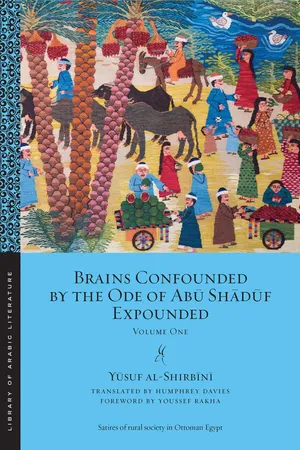
Witty, bawdy, and vicious, Y?suf al-Shirb?n?'s Brains Confounded pits the "coarse" rural masses against the "refined" urban population. In Volume One, al-Shirb?n? describes the three rural "types"—peasant cultivator, village man-of-religion, and rural dervish—offering anecdotes testifying to the ignorance, dirtiness, and criminality of each. In Volume Two, he presents a hilarious parody of the verse-and-commentary genre so beloved by scholars of his day, with a 47-line poem supposedly written by a peasant named Ab? Sh?d?f, who charts the rise and fall of his fortunes. Wielding the scholarly tools of elite literature, al-Shirb?n? responds to the poem with derision and ridicule, dotting his satire with digressions into love, food, and flatulence.
Volume Two of Brains Confounded is followed by Risible Rhymes, a concise text that includes a comic disquisition on "rural" verse, mocking the pretensions of uneducated poets from Egypt's countryside. Risible Rhymes also examines various kinds of puzzle poems, which were another popular genre of the day, and presents a debate between scholars over a line of verse by the fourth/tenth-century poet al-Mutanabb?. Together, Brains Confounded and Risible Rhymes offer intriguing insight into the intellectual concerns of Ottoman Egypt, showcasing the intense preoccupation with wordplay, grammar, and stylistics and shedding light on the literature of the era.
An English-only edition.
eBook - ePub
Brains Confounded by the Ode of Abū Shādūf Expounded
Volume One
- 320 pages
- English
- ePUB (mobile friendly)
- Available on iOS & Android
eBook - ePub
About this book
Trusted by 375,005 students
Access to over 1.5 million titles for a fair monthly price.
Study more efficiently using our study tools.
Information
BRAINS CONFOUNDED
BY THE ODE OF ABŪ SHĀDŪF
EXPOUNDED
BY THE ODE OF ABŪ SHĀDŪF
EXPOUNDED
Part One
IN THE NAME OF GOD THE MERCIFUL, THE COMPASSIONATE TO WHOM WE TURN FOR HELP
0.1
Praise be to God,1 Who has honored Man with the gift of speech and singled him out for bounty and blessings of every kind, Who has equipped him to grasp the verities of knowledge and persuasive argument, Who has crowned his brow with dignity, prowess, and virtuosity, Who has made his constitutions diverse and tempers disparate as long as time shall last, and Who has distinguished the man of sound taste with refinement of person and sweetness of tongue while bestowing on his opposites—the likes of the common people of the countryside, the base loafers by the walls—wickedness of disposition and coarseness of nature! And blessings and peace upon our Lord Muḥammad, sent forth from the noblest stock of the Arabs of ʿAdnān, endowed with pithiness in speech and brilliance in exposition, and upon his kin and Companions, whom God made adept at gathering wisdom’s pearls2—for ever and ever, in every age and time!

THE AUTHOR DESCRIBES THE ODE OF ABŪ SHĀDŪF
1.1
To proceed. The humble slave of the Almighty, Yūsuf ibn Muḥammad ibn ʿAbd al-Jawād ibn Khiḍr al-Shirbīnī, may God be his support and have mercy on his ancestors, declares: among the rural verse to come my way—verse characterized by a coarseness of expression that cannot be gainsaid, with lines set out like blocks of mud for making walls—and which has become the subject of comment in certain salons, was the “Ode of Abū Shādūf,” a thing redolent of sheep’s droppings or shoveled mud. And what an ode I found it to be—as though made out of iron or by stacking the thick ends of palm fronds!3 Then one whom I cannot disobey and with whose commands I have no choice but to comply4 besought me to stick on it a commentary, like butterfly feathers, or clouds of dust and whirlwinds of manure, that would unravel its tepid turns of phrase, make plain its uncommendable motifs, and strip the mask from the face of its tongue-in-cheek dialectalisms and lame paradigms, its banal motifs and battered constructions, its silly senses and tendentious terms; to round it out with strange tales and amazing nonsensical discussions; and to embellish it with an explanation of the linguistic peculiarities of the countryside, which are on a par, without a doubt, with the farting of ants, of their poetry, ladled out from the ocean of chaos, and of the etymologies of some of the words resembling old clouts in shape and form that occur therein, as well as of the misadventures that befell certain among them, by chance, in al-Qāhirah, Miṣr, and the port of Bulaq;5 to include an account of their ignorant dervishes, whose learning is to knowledge as gruel is to porridge, of their uncouth village pastors, and of the condition of both the riffraff among them and the elite; to mention their women when slapping and tickling and at their sport in bed, which resembles the gamboling of apes or the jabbering of Indians; and to make available the eddying dust devils of the original text, which, should you taste it, Dear Listener, would put you in mind of urine, and whose ripe lexical fruits, should you pluck them, Dear Reader, would make you think of ghoul droppings, while the contemplation of its verses would remind you of clods of mud stacked in courses and the scrutiny of its slovenly language would convince you you were chewing on horse dung; and that I include within it some comic quips and moronic maxims, by way of something obscene and lewd, and frivolous and rude, so that knowledge of my commentary on the ode be guaranteed from Dimyāṭ to the Ṣaʿīd. And indeed, I pray that not one clime, nay, nor any of the countries of mankind, be without it, since rare is he who, having once heard this ode, can put the droning of its worthless phrases from his mind, or, having once read it, is not taken with an urge to vomit, for when it passes by the ear, it does so like wind, and, should the body reject it, that’s only to be expected. As the poet of chaste speech has said, in these verses gleaned from The Glowing Pearls:6
Grant but that utterance7 is sound,
And sound meaning, O you of eloquence undimmed,
And you will grant that what I write are words
That charm the ear, and also wind.
And, as the proverb has it, “Said one, ‘There’s a fish farts fire in the seas.’ ‘The water,’ said others, ‘would put it out!’ ‘It’s all talk,’ returned the first, ‘Take it or leave it as you please!’”
1.2
Likewise, there being no harm in depicting this commentary in verses fragrant as maidens’ pee, I declare it to be:
A book full of the art of naught, a book full of the feathers of butterflies!
A book with pages, ink, and words—some true, some lies!
Within, my friend, are examples foul-tasting of every topos,
And phrases like piss that glisten with eye pus.
Within it are debates8 infantile
Draped over it all like a mantle,
While the verses it contains are like bricks in their stacking,
And there are learned discussions free for the taking.
Gaze on it well and peruse it truly
And very soon you’ll find your stomach’s unruly!
All of this has been done to match the phrasing of the ode itself and to unravel its meanings that resemble the butt ends of palm branches, for the commentator from the author’s text should never depart, according to the custom of those, be they experts or dabblers, who practice this art.
1.3
And what a commentary it has turned out to be! Set it on the highest mountain, and the mountain would tumble! Engrave it on the Pillar of the Columns,9 and the Pillar would crumble! Were a rock but to touch it, the latter would shatter, and were it thrown in the ocean, it would churn in commotion! Meet it is to be inscribed in donkey foals’ piss on the walls of a church, and to be written out in the urine of brides, outhouse walls to besmirch; yet more that it be thrown on top of a midden, being so despicable that it should on the walls where the loafers sit be written, for it is a commentary in coarseness without peer, on the characteristics of the people of the countryside brought to bear, and in boorishness without rival, being devoted to describing the ignoble.
1.4
Now, you must know that every commentary should have a title that’s right and a name that’s apposite. This, then, I have entitled Brains Confounded by the Ode of Abū Shādūf Expounded, calling on a talent that’s turned and a wit that’s spurned for help with words I’ve dredged up that are brainchildren of mine, and with setting them down, line after empty, vaunting line, hoping they will take their place in the ocean of nonsensicality and farcicality, and of license and buffoonery, with just a touch of Ibn Sūdūn-ery; for the listener will often take pleasure in laughter and license and show no interest in eloquence and excellence, because, in these times, it’s for distractions that the soul yearns, and for whatever may sweep aside its worries and concerns. I have composed a verse to this effect that says:
To my mind, licentiousness is rest—
It dispels one’s worries when depressed.
In this age of ours, none survive but those possessed of a measure of profligacy and buffoonery, and frivolity and effrontery, which is why the poet says:
Dead of hunger is he who lived by eloquence,
While Fortune smiles on pimps and clowns.
He who cannot pen a line is blessed with a living fine, while the master of wit sees of victuals not a whit, leading the poet to say:
Billy goats get given their livelihood with ease
While that of the eloquent is refused;
If my eloquence be the cause of my privation,
Let me with the billy goats be confused!
And the leading man of letters al-Būṣīrī, may the Almighty have mercy on his soul, said in a mawāliyā:
The man of great taste stands puzzled and at a loss,
While the billy goat advances and puts on airs.
Lord, let me be a billy goat, son of a dumb billy goat,
If you intend no relief for my cares!
And Ibn al-Rāwandī, God excuse his sins, said:
Allocator of our Daily Bread, how Fate has straitened me!
If You are not to blame, pray tell me, who might be?
You give silver in bushels brimming10 to the Jews
When I don’t have enough to even buy shoes.
You gave me wisdom, but not lucre.
Tell me, without the one, what use is the other?
1.5
It follows that one should stay in tune with one’s days, humor the age by acting in keeping with its ways, be on guard against whatever assaults Fate may bring, and “dance for the ape when he is king.” One should get along with people as best he may, perform any role he may be asked to play, implicate himself in men’s excesses, and number himself among them in their successes. As a poet has said:
Humor them in their homes,
Greet them courteously while their guest.
Make friends with some
That those may help you against the rest.
And in a Tradition it says, “I have been commanded to deal circumspectly with others.”
1.6
Th...
Table of contents
- Cover
- Letter from the General Editor
- About this Paperback
- Title Page
- Copyright
- Dedication
- Contents
- Foreword
- Introduction
- Note on the Text
- Notes to the Introduction
- Brains Confounded by the Ode of Abū Shādūf Expounded, Part One
- The Author Describes the Ode of Abū Shādūf
- The Author Embarks on a Description of the Common Country Folk
- An Account of Their Escapades
- An Account of Their Pastors and of the Compounded Ignorance, Imbecility, and Injuries to Religion and the Like of Which They Are Guilty
- An Account of Their Poets and of Their Idiocies and Inanities
- It Now Behooves Us to Offer a Small Selection of the Verse of Those Who Lay Claim to the Status of Poets but Are in Practice Poltroons, and Who Make Up Rhymes but Are Really Looney Tunes
- An Account of Their Ignorant Dervishes and of Their Ignorant and Misguided Practices
- Urjūzah Summarizing Part One
- Notes
- Index
- About the NYU Abu Dhabi Institute
- About the Translator
- Titles Published by the Library of Arabic Literature
Frequently asked questions
Yes, you can cancel anytime from the Subscription tab in your account settings on the Perlego website. Your subscription will stay active until the end of your current billing period. Learn how to cancel your subscription
No, books cannot be downloaded as external files, such as PDFs, for use outside of Perlego. However, you can download books within the Perlego app for offline reading on mobile or tablet. Learn how to download books offline
Perlego offers two plans: Essential and Complete
- Essential is ideal for learners and professionals who enjoy exploring a wide range of subjects. Access the Essential Library with 800,000+ trusted titles and best-sellers across business, personal growth, and the humanities. Includes unlimited reading time and Standard Read Aloud voice.
- Complete: Perfect for advanced learners and researchers needing full, unrestricted access. Unlock 1.5M+ books across hundreds of subjects, including academic and specialized titles. The Complete Plan also includes advanced features like Premium Read Aloud and Research Assistant.
We are an online textbook subscription service, where you can get access to an entire online library for less than the price of a single book per month. With over 1.5 million books across 990+ topics, we’ve got you covered! Learn about our mission
Look out for the read-aloud symbol on your next book to see if you can listen to it. The read-aloud tool reads text aloud for you, highlighting the text as it is being read. You can pause it, speed it up and slow it down. Learn more about Read Aloud
Yes! You can use the Perlego app on both iOS and Android devices to read anytime, anywhere — even offline. Perfect for commutes or when you’re on the go.
Please note we cannot support devices running on iOS 13 and Android 7 or earlier. Learn more about using the app
Please note we cannot support devices running on iOS 13 and Android 7 or earlier. Learn more about using the app
Yes, you can access Brains Confounded by the Ode of Abū Shādūf Expounded by Yūsuf al-Shirbīnī, Humphrey Davies in PDF and/or ePUB format, as well as other popular books in Literature & Middle Eastern Literary Collections. We have over 1.5 million books available in our catalogue for you to explore.