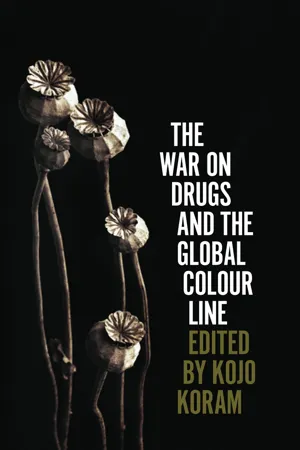
The War on Drugs has led to millions of people dead, displaced and incarcerated. Disproportionately enforced on oppressed races, international drug prohibition has reinforced the colour line across the globe. While laws prohibiting the production, sale and use of particular drugs are presented as politically neutral and objective, this collection reveals the racist impact of the War on Drugs across multiple continents and in numerous situations. From racialised drugs policing at festivals in the UK to the necropolitical wars in Juarez, Mexico and from the exchange of drug policing programs between the United States and Israel to the management of black bodies in Brazil, this collection proves that the regulation of drugs and race is an international, and intentional, disaster. Pushing forward the debate and activism led by groups such as Black Lives Matter and calling for radical changes in drug policy legislation and prison reform, both nationally and internationally, this collection cuts deep and rings true for all people fighting racism today.
- 240 pages
- English
- ePUB (mobile friendly)
- Available on iOS & Android
eBook - ePub
The War on Drugs and the Global Colour Line
About this book
Information
1
Benevolent whiteness in Canadian drug regulation
Elise Wohlbold and Dawn Moore
Xenophobia and racism are inscribed in the origins of laws interdicting certain (racialized) substances.1 Canada is in no way an outlier in using criminal law to target and control certain populations. Contra its popular self-image as a tolerant and open society, Canada is one of the most carceral nations in the world and Canadian prisons are fuelled by a mass over-incarceration of Indigenous peoples and a considerable overuse of criminal justice for other racialized groups. Typically, race is targeted as the ‘problem’ here, an argument with contestable terms. We begin with the premise that ‘race’ is deployed as a stand-in for non-White. Whiteness by default is unmarked, natural – invisible to many – and without race.2 Whiteness, as David Roediger points out, does not need to declare its own name; it is defined by what it is not.3 As a result, in this chapter we present the possibility that whiteness – as the negation of the notion of ‘race’ – itself is the problem of the War on Drugs (WOD) in Canada. By naming whiteness, we aim to reveal its invisible yet central position around drug regulation in Canada.4 This argument is likely more intuitive than innovative, but it does offer an alternate correction to the prevailing narrative of drug control in Canada as well as the important perspective of a nation built largely on a benevolent whiteness – the focus of our interrogation.
We offer here a survey of the historical relationships between people, intoxicating substances (IS) and law in Canada. We argue that the problems drug laws have sought to address are routinely underpinned by the desire to shape whiteness in particular ways by regulating threats to the imagined and ongoing colonial project. DiAngelo describes whiteness as ‘a constellation of processes and practices rather than as a discrete entity’.5 Thus, whiteness must continuously be defined, reproduced and protected; it is in constant operation, it is fragile.6 Yet, as DiAngelo points out, ‘white fragility is not weakness per se. In fact, it is a powerful means of white racial control and the protection of white advantage.’7 For example, criminal justice systems continue to perpetuate settler violence over Indigenous and colonized, racialized bodies with drug laws as the primary technology.8 In an evolving state-sponsored colonial system, preserving and protecting the fragility of whiteness serves as a justification for colonial violence.9 As a result, we shift the focus of drug prohibition in Canada to whiteness, a claim heretofore not concisely made, claiming that the WOD is a response to particular and repeated crises of whiteness – benevolent whiteness – thus re-reading the extant histories as narratives of perilous, ongoing colonial projects.
The problem of benevolent whiteness
I see these souls undressed and from the back and side. I see the working of their entrails. I know their thoughts and they know that I know. This knowledge makes them now embarrassed, now furious! They deny my right to live and be and call me misbirth! My word is to them mere bitterness and my soul, pessimism. And yet as they preach and strut and shout and threaten, crouching as they clutch at rags of facts and fancies to hide their nakedness, they go twisting, flying by my tired eyes and I see them ever stripped-ugly, human.10
The undressed souls of the White oppressors reveal for Du Bois a vulnerable truth about the White folk he so subversively makes subject to his own gaze. White folk must maintain a careful veneer to marshal their claims to racial superiority. This observation gives Du Bois cause for question: ‘But what on earth is whiteness that one should so desire it? Then always, somehow, some way, silently but clearly, I am given to understand that whiteness is the ownership of the earth forever and ever, Amen!’11
Whiteness is a problem of capitalism and domination, and its maintenance is vital to the protection of capital colonial control of land and people. Whiteness, as Ahmed reminds us, ‘could be described as an ongoing and unfinished history, which orientates bodies in specific directions, affecting how they “take up” space’.12
So too is the WOD an ongoing and unfinished history tied in perpetuity to unfolding histories of whiteness. And though we see a generalizable global theory of colonial whiteness, no colony’s story is exactly like another’s. Observationally (not comparatively), we offer an understanding of Canada’s nationalistic whiteness, a whiteness easily and routinely erased because it is seen as impossibly better than the empire of White supremacy to which it is always compared: the United States. After all, Canada – unlike the US melting pot – is a cultural mosaic where cultural and racial differences are thought to be celebrated.13
To describe benevolent whiteness: the term ‘benevolent’ here is descriptive, not value laden. Our thesis is simple: Canada continues to look pretty good from a global perspective. Canada looks good by appearing to do good. Doing good is a smart trope of nationalism because to do good is to intervene and interventions cue scripts and those scripts are scripts of whiteness and they are scripts of colonialism, patriarchy and control. We argue that Canada’s ‘good guy’ reputation is best described as a benevolent whiteness, by which we mean a whiteness that appears progressive and ‘post-racial’ even as it re-inscribes racialized, gendered and sexualized bodies with the same tropes of domination and supremacy.
We are not the first to arrive at this conceptualization. Eva Mackey writes about Canada’s nationalistic self-image of benevolence in the context of governing Indigenous peoples.14 The convenient national forgetting of obvious acts of racism and xenophobia on the part of the state is well documented by Lozanski, who makes the explicit link between this national need to forget the aspects of the past that offer a counter-narrative to this benevolent statehood by recognizing the threats remembering poses to bourgeois liberalism.15
‘I anticipate nothing more intimate than history’, writes Dionne Brand in Poem 1 of Thirsty.16 Benevolent whiteness is a whiteness of intimacy; it is a whiteness defined by its ability to gently penetrate and manipulate bodies as a screen for smashing others, often in seemingly non-violent ways. Thus, as we describe the Canadian legal dance around drug regulation as one between three partners: the drugs/users, public health and criminalization. This is not to suggest that public health and criminalization are necessarily different and certainly carry comparable capacity to do violence. On the contrary, maintaining this false binary between health and criminality is the most telling feature of benevolent whiteness in the Canadian WOD.
Taking a cue from Bruno Latour’s actor-network theory, substances themselves are also subject to tropes of whiteness.17 Crises as each substance is added to criminal legislation and again as substances, later, experience movement through the different degrees of schedule, are recognized as transporting embedded meanings of colonialism through both their pharmacodynamics as well as their cultural meaning. Substances are signifiers and their cultural personas (drugalities) dictate their relative level of danger based not on pharmacological knowledge but rather on the populations with whom they are affiliated, as well as the manner in which they are ingested. Smoking, for example, with the exception of tobacco (despite its explicit roots in colonialism), is a distinctly non-White form of consumption, especially when compared with, for example, the hypodermic syringe or the elixir, both consumption formats with the medicalized stamp of White acceptability.
Regulating drugs in Canada
The Constitution of Canada makes the regulation of drugs complicated. After Confederation (1867), legislative responsibilities were divided between the provinces and the federal government. Criminal law falls under federal jurisdiction, while health is a provincial matter. In practice, this means that there is a clear, albeit false, cleavage in Canadian responses to drug use, resulting in diverse use of law. Chiefly this constitutional division sets the terms of drug debate in Canada as a battle over provincial autonomy manifested through arguments of whether IS and their use are matters of health or criminality.
In practice, this divide creates faulty poles between responding to drug use as a health or criminal problem. Typically, discourses of health, rooted in the British model of harm reduction, are seen as necessarily more progressive and benevolent than criminal responses. We want to disrupt this dichotomy by showing that the health/criminal divide is false, making the point clear that health interventions regarding drug use are often tightly bound to criminal justice responses.
Unlike other jurisdictions in which the theme of heavy-handed criminalization remains a constant and ever-amplifying thread, since the enactment of the federal Opiate Act in 1908, Canada oscillates between these false binaries of health and crime, selectively and strategically deploying narratives best suited to the targeted population. The first country in the West to introduce anti-drug legislation, Canada’s foray into criminalizing substance use was clearly linked to colonialist-fuelled racial tensions and provided a handy remedy to the surplus of Chinese labourers imported to build the nation’s railroad.18 Since then, Canada has twinned hyper-criminalized responses to drug use heavily inspired by (if not directly resulting in pressure from) the United States with more medicalized responses inspired by early biopolitical movements in the United Kingdom. The result is a contradictory array of responses to drug use and the drug trade, that weave narratives of drug use and users through clinical/penal mentalities.
Early drug legislation and the formation of benevolent whiteness
Canada’s first legislated prohibition arrives in the 1886 Indian Act. Here, Indigenous peoples were banned from buying and selling alcohol. Though, as with most colonial initiatives, the first alcohol prohibition was presented as a benevolent way to save the ‘Indians’ from them...
Table of contents
- Cover
- Title
- Copyright
- Contents
- Acknowledgements
- Introduction
- 1 Benevolent whiteness in Canadian drug regulation
- 2 Policing the ‘Black party’: racialized drugs policing at festivals in the UK
- 3 Racism and drug policy: criminal control and the management of Black bodies by the Brazilian state
- 4 Necropolitical wars
- 5 The apotheosis of war in Colombia
- 6 A people’s history of police exchanges: settler colonialism, capitalism and the intersectionality of struggles
- 7 Perpetuating apartheid: South African drug policy
- 8 Racism and social injustice in War on Drugs narratives in Indonesia
- 9 Colonial roots of the global pandemic of untreated pain
- Notes on contributors
- Index
Trusted by 375,005 students
Access to over 1.5 million titles for a fair monthly price.
Study more efficiently using our study tools.
Frequently asked questions
Yes, you can cancel anytime from the Subscription tab in your account settings on the Perlego website. Your subscription will stay active until the end of your current billing period. Learn how to cancel your subscription
No, books cannot be downloaded as external files, such as PDFs, for use outside of Perlego. However, you can download books within the Perlego app for offline reading on mobile or tablet. Learn how to download books offline
Perlego offers two plans: Essential and Complete
- Essential is ideal for learners and professionals who enjoy exploring a wide range of subjects. Access the Essential Library with 800,000+ trusted titles and best-sellers across business, personal growth, and the humanities. Includes unlimited reading time and Standard Read Aloud voice.
- Complete: Perfect for advanced learners and researchers needing full, unrestricted access. Unlock 1.5M+ books across hundreds of subjects, including academic and specialized titles. The Complete Plan also includes advanced features like Premium Read Aloud and Research Assistant.
We are an online textbook subscription service, where you can get access to an entire online library for less than the price of a single book per month. With over 1.5 million books across 990+ topics, we’ve got you covered! Learn about our mission
Look out for the read-aloud symbol on your next book to see if you can listen to it. The read-aloud tool reads text aloud for you, highlighting the text as it is being read. You can pause it, speed it up and slow it down. Learn more about Read Aloud
Yes! You can use the Perlego app on both iOS and Android devices to read anytime, anywhere — even offline. Perfect for commutes or when you’re on the go.
Please note we cannot support devices running on iOS 13 and Android 7 or earlier. Learn more about using the app
Please note we cannot support devices running on iOS 13 and Android 7 or earlier. Learn more about using the app
Yes, you can access The War on Drugs and the Global Colour Line by Kojo Koram in PDF and/or ePUB format, as well as other popular books in Sozialwissenschaften & Strafrecht. We have over 1.5 million books available in our catalogue for you to explore.