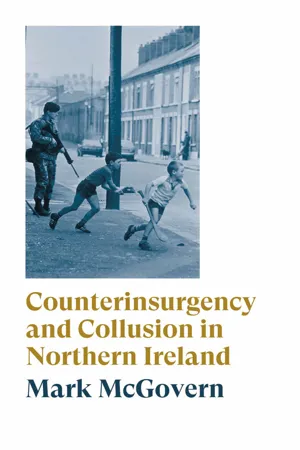
Collusion by British state forces in killings perpetrated by loyalist paramilitaries was a dubious hallmark of the 'dirty war' in the north of Ireland. Now, more than twenty years since the Good Friday Agreement, the story of collusion remains one of the most enduring and contentious legacies of the conflict, a shadow that trails British counterinsurgency to this day. Here Mark McGovern turns back the clock to the late 1980s and early '90s - the 'endgame' of the Troubles, and a period defined by a rash of state-sanctioned paramilitary killings. Drawing on previously unpublished evidence, and original testimony from victims' families and eyewitnesses, he examines several dozen killings of republicans that took place in the Mid-Ulster area, and the impact on their families and communities. Placing these accounts within a wider critical analysis of the nature of British counterinsurgency and the state use of agents and informers, McGovern paints a damning picture of covert, deniable and unlawful violence.
- 256 pages
- English
- ePUB (mobile friendly)
- Available on iOS & Android
eBook - ePub
Counterinsurgency and Collusion in Northern Ireland
About this book
Information
1
British Counterinsurgency and the Roots of Collusion
Collusion and British Counterinsurgency
Despite considerable failings, a 2012 report by Sir Desmond de Silva into the loyalist killing of human rights lawyer Pat Finucane in 1989 confirmed collusion between British military intelligence and RUC Special Branch with loyalist paramilitaries during the conflict in Northern Ireland was widespread, institutionalised and strategic in nature. Long suspected, the true scale still came as a shock – not least that 85 per cent of all intelligence held by loyalists in the late 1980s, which was used to plan their escalating campaign, originated from state intelligence sources.1 At the centre of these activities, pivotal in disseminating this tsunami of state-sourced information, was Brian Nelson. At that time Nelson was the chief intelligence officer of the Ulster Defence Association (UDA). He was also a British Army agent working for the key British Army intelligence unit operating in the North, the Force Research Unit (FRU). Nelson, said de Silva, passed on intelligence to better target ‘republican personalities’ at the instigation and behest of his FRU handlers.2 The FRU, MI5 and Nelson were also intimately involved in the importation of a large cache of weapons into Northern Ireland in late 1987 that greatly facilitated the upsurge in loyalist killing and assassination that was to follow. So much so that by 1993 (for the first time in decades), loyalists were responsible for more killings in the North than anyone else, including the IRA. Discussions within the highest government, military, police and intelligence circles over the rules governing the handling of agents and informers changed nothing until the conflict was over. Such things will be examined more later. Suffice to say at this point a picture emerges of loyalist paramilitary groups, under the guidance of state agencies such as the FRU, and via the work of agents like Nelson, becoming a more deadly, sometimes more targeted force. In large part, this was the result of what has been termed a growing British state ‘interest in the increased military professionalisation’ of loyalists.3
There was not, of course, a single cause of such institutional collusion. Rather it was the outcome of a confluence of forces. Much focus falls on the divided nature of Northern Irish society and the links between sectarian social relations, power structures and state institutions. The long-term sectarianised character of state and society in Northern Ireland undoubtedly played an important role. So also an intelligence-led attritional strategy that generated a grey zone of official deniability around the criminal actions of state agents and informers designed to defeat an intractable, armed enemy.4 Crucial too, however, was a longer-term history of British state counterinsurgency thought and practice, driven less by a doctrine of ‘minimum force’ than of ‘necessity’.5 It is that context – of British thinking and conduct of ‘small wars’, of counterinsurgency campaigns rooted in colonial and imperial rule – with which the story of collusion might therefore begin.
At the core of our concerns lie two questions: what was the extent, form and rationale of collusion, and what made collusion as a form of state practice possible? There are no simple answers, but the practice and thought that form the tradition of British Counterinsurgency (COIN) are a necessary if insufficient condition. A critical analysis of the roots of collusion in British COIN challenges two of its longstanding myths. First, that it is characterised by a commitment to a minimum force doctrine combined with a non-coercive ‘hearts and minds’ approach. Second, that it has been invariably constrained by adherence to the rule of law. Rather, it will be argued, the realities of the British COIN tradition form a critical backdrop to the ways of thinking and acting evidenced in the collusive practices of state actors in Northern Ireland. Illuminating key dimensions of British counterinsurgency therefore casts a light on how collusion, as an example of covert, coercive state violence, could come to be.
This is not to suggest that there is a direct or simple cause-andeffect relationship between this body of counterinsurgency theory and collusion – or that other factors, which need to be explored, are not important too. Rather, the threads identified within this lineage of British COIN illustrate a series of linkages, paradigms of theory and practice, that weave the fabric of a longer-term cultural and institutional context within which collusion becomes possible. This is analogous, in many ways, to the corporate memory and institutional culture that facilitated the use of torture by ‘cruel Britannia’.6 In this perspective, collusion can be understood as an expedient coercive state practice, premised on a ‘doctrine of necessity’, designed to remove ‘enemies’ and induce fear in a target population via a strategy of proxy assassination in which the appearance of adherence to the rule of law is a political end shaping the specific forms of state violence involved. Far from being an aberration in the tradition of British counterinsurgency violence, collusion emerges instead as exemplary.
What is Counterinsurgency?
What then is counterinsurgency? The current British Army field manual on counterinsurgency defines it as ‘those military, law enforcement, political, economic, psychological and civic actions taken to defeat an insurgency, while addressing the root causes’.7 Published in the wake of the chaos and destruction wreaked in Kandahar and Basra, it stresses that while this includes ‘low-intensity operations’ such as those ‘on the streets of Northern Ireland ... counterinsurgency is warfare’. Force and other means are therefore integrated and interwoven into a coherent strategy designed to overcome insurgency, understood as any ‘organised, violent subversion used to effect or prevent political control, as a challenge to established authority’. As the US Army’s counterinsurgency manual argues, separating the insurgent from the population therefore emerges as the key means of defeating opposition.8 Counterinsurgency is a ‘population-centric’ subset of warfare, a ‘military activity centred on civilians’ in which people’s attitudes, actions, outlook, expectations and (by no means least) fears become the primary contested ground.9
According to General David Petraeus, who co-authored the manual, ‘the biggest of the big ideas’ underpinning the US ‘surge’ strategy he led in Iraq in 2007 was the ‘recognition that the decisive terrain (in a counterinsurgency campaign) is the human terrain’.10 Local ‘cultures’, understood as ‘protocols for system behaviour’ are scrutinised to predict and impact upon the actions and perceptions of those identified as part of an ‘insurgent eco-system’.11 The aim is to effect ‘behavioural change’ through, for example, ‘psychological operations’ as a planned means ‘to convey selected information and indicators’ to an audience in order to ‘influence their emotions, motives [and] objective reasoning’.12 The ‘principal defining characteristic’ of counterinsurgency is its core concern with ‘moulding the population’s perceptions’.13 The management of the subject people is therefore directed towards the counterinsurgent imposing or ‘maximising his own interests’.14 Success is defined by winning a ‘competition to mobilize’ support not only within the local population but at ‘home, internationally and among allied and neutral countries’. Victory may be less concerned with the total military defeat of insurgents than with their long-term neutralisation through ‘stability operations’ and the creation of ‘popular support for permanent, institutionalized anti-terrorist measures’.
Of course this does not mean that force and ‘hard power’ do not continue to have a central role – far from it. The ‘wider political purpose’ of counterinsurgency always lies at its core, writes Brigadier Gavin Bulloch, author of the British counterinsurgency manual, who himself served in the North. It is the ‘political potential’ rather than ‘military power’ of insurgents that represents ‘the true nature of the threat’.15 Finding means to undermine the support base for insurgent groups is therefore the ‘strategic centre of gravity’, with the end being to ‘shatter the enemy’s moral and physical cohesion rather than seek his wholesale destruction’. In that process, however, the ‘physical destruction of the enemy still has an important part to play’. Military involvement in ‘deep operations’ may also be through ‘covert and clandestine action by special units’.16 While formal adherence to the rule of law is advocated, physical destruction is also calculated on the ‘degree of attrition necessary’. The normative culture of legal compliance and military professionalism co-exist with ‘necessity’ in the calibration of the extent and nature of state force and killing required to reshape the political terrain in a way conducive to the ends and interests of the state. The aim of counterinsurgency is also then to employ state violence and other means to define the balance of post-conflict political forces. Thus if post-conflict ‘reconciliation’ is a ‘two-way process’ it is one ‘best undertaken from a position of strength’.17
‘The British Army’, one former solider has argued, ‘is a counterinsurgency army’.18 Historically its principal mission has been to ‘acquire police imperial possessions’ ensuring no one has ‘amassed as much experience in counterinsurgency as Great Britain’. No one, it is claimed, does it ‘better than the British’.19 Likewise General Sir Mike Jackson, once head of the British Army and commander of British forces during the occupation of Iraq, extolled the virtues of this ‘peculiarly British way’ of going about ‘military business’ whose origins go back into Britain’s imperial past ‘at least a couple of centuries to Ireland, to India a century and a half ago, to Africa about the same time and, indeed, to Iraq almost a century ago’.20 The campaign in Northern Ireland is for Jackson an exemplar of British counterinsurgency, characterising the army’s role as to ‘prevent the unlawful use of violence’ while creating the conditions for a political resolution to the problem of having ‘two peoples on one piece of territory’.21 As he sees it, the ‘trick’ in counterinsurgency is ‘applying force that has profound political connotations’, balancing a concern not to be seen as either ‘too harsh’ or ‘too faint-hearted’ in a battle for ‘hearts and minds’.22
There is considerable debate about whether this much-vaunted, British approach to counterinsurgency has been as distinct as often argued.23 Some have seen it as a tradition largely invented following the invasion of Iraq as an essentially spurious means to contrast British strategy with that of their supposedly more gung-ho and violent American counterparts. This possibility is ironic given that US commentators were often pivotal in valorising a mythic British prowess for counterinsurgency in the first place. As the appalling, costly failures in Iraq and Afghanistan became all too apparent, the Ministry of Defence also sought to formally celebrate a distinct British approach to counterinsurgency, not least by citing the example of Northern Ireland, despite it actually being ‘a bruising encounter characterized by a vicious undercover intelligence war’.24 So the British military and state has increasingly come to see itself as ‘peculiarly’ well versed in the conduct of counterinsurgency campaigns, a conceit that continues into the present despite the fact that recent years have seen a revisionist assault on the idea that British counterinsurgency was more benign in pract...
Table of contents
- Cover
- Title
- Copyright
- Contents
- Acknowledgements
- List of Abbreviations
- Introduction: What is Collusion?
- 1. British Counterinsurgency and the Roots of Collusion
- 2. Northern Ireland and the Roots of Collusion
- 3. An Intelligence War
- 4. Arming Loyalism
- 5. Shooting to Kill: Targeting Republican Combatants
- 6. Stopping Sinn Fein: Collusion as Political Force
- 7. Instilling Fear: Targeting Republican Families and Communities
- Conclusion: Collusion, Truth and Justice
- Notes
- Further Reading
- Index
Trusted by 375,005 students
Access to over 1.5 million titles for a fair monthly price.
Study more efficiently using our study tools.
Frequently asked questions
Yes, you can cancel anytime from the Subscription tab in your account settings on the Perlego website. Your subscription will stay active until the end of your current billing period. Learn how to cancel your subscription
No, books cannot be downloaded as external files, such as PDFs, for use outside of Perlego. However, you can download books within the Perlego app for offline reading on mobile or tablet. Learn how to download books offline
Perlego offers two plans: Essential and Complete
- Essential is ideal for learners and professionals who enjoy exploring a wide range of subjects. Access the Essential Library with 800,000+ trusted titles and best-sellers across business, personal growth, and the humanities. Includes unlimited reading time and Standard Read Aloud voice.
- Complete: Perfect for advanced learners and researchers needing full, unrestricted access. Unlock 1.5M+ books across hundreds of subjects, including academic and specialized titles. The Complete Plan also includes advanced features like Premium Read Aloud and Research Assistant.
We are an online textbook subscription service, where you can get access to an entire online library for less than the price of a single book per month. With over 1.5 million books across 990+ topics, we’ve got you covered! Learn about our mission
Look out for the read-aloud symbol on your next book to see if you can listen to it. The read-aloud tool reads text aloud for you, highlighting the text as it is being read. You can pause it, speed it up and slow it down. Learn more about Read Aloud
Yes! You can use the Perlego app on both iOS and Android devices to read anytime, anywhere — even offline. Perfect for commutes or when you’re on the go.
Please note we cannot support devices running on iOS 13 and Android 7 or earlier. Learn more about using the app
Please note we cannot support devices running on iOS 13 and Android 7 or earlier. Learn more about using the app
Yes, you can access Counterinsurgency and Collusion in Northern Ireland by Mark McGovern in PDF and/or ePUB format, as well as other popular books in Politics & International Relations & Terrorism. We have over 1.5 million books available in our catalogue for you to explore.