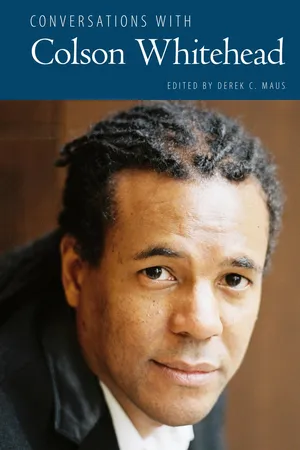
Since the publication of his first novel, The Intuitionist, in 1999, Colson Whitehead (b. 1969) has been considered an important new voice in American literature. His seven subsequent books have done little to contradict that initial assessment, especially after 2016's The Underground Railroad spent many weeks at the top of bestseller lists and won numerous major literary awards, including the Pulitzer Prize.
Ranging from 2001 to 2016, the twenty-three interviews collected in Conversations with Colson Whitehead reveal the workings of one of America's most idiosyncratic and most successful literary minds. Through these interviews, it is clear that none of this well-earned praise has gone to his head. If anything, he still seems inclined to present himself as an awkward misfit who writes about such offbeat subject matter as rival groups of elevator inspectors, the insufficiency of off-brand "flesh-colored" bandages, or a literalized alternate version of the Underground Railroad.
Whitehead speaks at length about matters related to his craft, including his varied literary and nonliterary influences, the particular methods of researching and writing that have proved valuable to telling his stories, and the ways in which he has managed the rollercoaster life of a professional writer. He also opens up about popular culture, particularly the unconventional blend of music, genre fiction, B movies, and comic books that he gleefully identifies as a passion that has persisted for him since his childhood.
- 196 pages
- English
- ePUB (mobile friendly)
- Available on iOS & Android
eBook - ePub
Conversations with Colson Whitehead
About this book
Information
Publisher
University Press of MississippiYear
2019Print ISBN
9781496821478
9781496821522
eBook ISBN
9781496821485
Topic
LittératureSubtopic
Biographies littérairesIntroduction
“No matter what you write, there’s probably someone smarter and more talented than you who has written it before. All you can hope is that you have something to bring to the table, and that you have your distinct point of view to add.”
Taking Colson Whitehead’s public utterances purely at face value, one can be left with the impression that he doesn’t believe that he leaves much of a mark on his world. The self-deprecating tone he frequently adopts in his interviews and his nonfictional writings regularly goes far beyond writerly humility in the degree to which it seems designed to paint a picture of an awkward hermit. For example, in the opening of his autobiographical New Yorker essay entitled “A Psychotronic Childhood,” he remarks, “I was a bit of a shut-in. I would prefer to have been a sickly child … [b]ut the truth is that I just didn’t like leaving the house.”1 Near the conclusion of that essay, he also directs what seem like harsh criticisms at himself in lamenting his early lack of success as a professional writer: “I’d tried to sell a novel before, one with a similarly ludicrous-sounding premise and had got dumped by my high-powered agent. Now here I was doing it again. Like an imbecile.”2 While visiting Harvard, his alma mater, in 2003, he tells a reporter from the student newspaper that he “turned his papers in late, sat in the back of his classes, and … didn’t say anything”3 during his four years in Cambridge. In a 2016 interview with Jesse McCarthy for the Harvard alumni magazine, he adds to this unprepossessing portrait of a young man as an undergraduate: “I considered myself a writer, but I didn’t actually write anything…. I wore black and smoked cigarettes, but I didn’t actually sit down and write, which apparently is part of the process of writing.” Lest one think these are merely sardonic retrospectives on the foibles of his youth and early adulthood, Whitehead also produces a book-length exemplar of it in The Noble Hustle: Poker, Beef Jerky, and Death, an account of his participation in the 2011 World Series of Poker as a putative representative of the “Republic of Anhedonia” (the name of which is emblazoned on the jacket he wears in his author’s photograph on the book’s dust cover). The book’s opening line—“I have a good poker face because I’m half dead inside”4—presages a litany of mordant comments such as “I’d long aspired to the laid-back lifestyle of exhibits at Madame Tussaud’s. There are cool perks. You don’t have to move around that much, or waste energy on fake smiles, and every now and then someone shows up to give you a good dusting.”5 Throughout the book, Whitehead walks the narrative tightrope of engaging the reader’s interest and even sympathy while providing very little evidence to suggest that his self-diagnosed affliction—“the inability to experience pleasure”—is merely a literary conceit.
Although an earnest literary critic might be inclined to see Whitehead’s self-fashioning as a schlemiel to be a kind of homage to Thomas Pynchon (whom Whitehead cites on numerous occasions as a germinal influence), I will suppress the desire to make such a claim and instead put forth the proposition that he doth protest a bit too much … albeit very much by design. To be clear, Whitehead’s idiosyncratic set of pop-cultural interests undoubtedly made it desirable for him to retreat to the sanctity of “[lying] on the living-room carpet, watching horror movies.”6 It is likewise not difficult to imagine a teenaged Whitehead resembling Benji Cooper, the protagonist of his novel Sag Harbor, in struggling to explain his musical tastes to his peers, whether translating Grandmaster Flash to his predominantly white classmates at the posh Trinity School in Manhattan or justifying his penchant for early goth music to his African American friends during their shared Long Island summers. Benji informs the reader at one point, “Let’s just put it out there: I liked the Smiths.”7 Such sheepish admissions surely discomforted both the novel’s creator and its protagonist. In his 2009 interview with Marie Mockett, Whitehead even reduces himself to an autobiographical foil for Benji, his fictional nebbish: “I had a set of disorganized life experiences and needed to discover how to shape, spindle, and mutilate them into an interesting story. Drab piece of cheap bond manipulated into gorgeous origami crane, that’s my motto.”
Whether the flesh-and-blood Colson Whitehead is actually as much of a “drab piece of cheap bond” as he makes himself out to be is a matter best attested to by his friends and family, but I believe that the public self that he propagates through his interviews, his readings, his nonfiction, and his Twitter feed—@colsonwhitehead, if you’re interested—is a meticulously curated construction that involves nearly as much forethought and clever execution as can be found in any of his novels. Far from being an accusation of insincerity or inauthenticity, this claim is intended as a fundamental premise in my attempt at unifying a written corpus that often seems designed by its inherent diversity of forms and themes to frustrate all efforts at cohesive interpretation. When asked about the variance within his work, Whitehead often repeats some version of what he tells Nikesh Shukla in a 2013 interview: “I think I just don’t want to do the same thing over and over again, so on one level each book becomes an antidote to the one [that] came before.” I believe that Whitehead consciously identifies what one might call his “peculiar ordinariness” as the source of his problems with fitting into society. He alludes to such a seemingly oxymoronic condition when he describes the traits that allow Mark Spitz, the protagonist of his novel Zone One, to survive in a world brought low by a zombie apocalypse: “If you’re smart, you kill yourself. If you’re dumb, you’re not going to make it. That leaves the rest of us.”8 He directly cites his parents’ adoption of “doomed product lines and hexed formats” such as the Betamax (instead of VHS), a TRS-80 home computer (instead of an Apple II), and Intellivision videogame system (instead of an Atari 1600) as having been “good training for a writer, for the sooner you accept the fact that you are a deluded idiot who is always out of step with reality the better off you will be.”9 He reframes his family’s ill-starred participation in technological consumerism neither as principled iconoclasm nor as abject failure, but, rather as the metaphorical lemons from which he makes his literary lemonade. Despite its ample and demonstrable brilliance, Whitehead’s writing seems less focused on celebrating exceptionality as the means for solving human problems than it is on discovering how to carve out a meaningful existence (and continue to make art) despite the daunting obstacles within individual people, social structures, literary traditions, and ultimately one’s self.
The role that race plays both in Whitehead’s self-conception and in his writing illustrates this point. Despite what some reviewers and critics have insisted, Whitehead is not a “postracial” writer. If his mocking 2009 New York Times op-ed piece entitled “The Year of Living Postracially” doesn’t convey his disdain for this concept clearly enough, he also explicitly rejects it while speaking with Shukla four years later: “I think you’re only postracial when you stop asking if you’re postracial.” Others (myself included) have attempted to apply other terms such as “post-soul” or “post-black” to Whitehead’s authorial perspective, but Donovan X. Ramsey may have most trenchantly articulated the manner in which race signifies in the bulk of Whitehead’s fiction: “Sag Harbor isn’t postracial. It might be described as metaracial because, while race does have [its] place in the novel … it doesn’t give race prominence over the everyday suckiness of being a teenager. It doesn’t cheapen the experience [of] growing up by trying to turn Benji into Bigger Thomas. The pleasure of reading a book like Sag Harbor for a black man of similar circumstance is in its treatment of the young black male condition as human above anything else and the subsequent organic social commentary that sprouts up around that precious offering.”10
What Ramsey calls Sag Harbor’s “metaracial” quality separates Whitehead from one of his earliest exemplary characters, the elevator scholar James Fulton. The manuscript of a mysterious and possibly illusory second volume of his book, Theoretical Elevators, becomes the focus of an obsessive search by nearly all characters in Whitehead’s debut novel, The Intuitionist. It purports to describe a radical new form of elevator that will bring about an almost incomprehensible change in the conception of reality, on par with Copernican heliocentrism and Einsteinian relativity. Upon learning that Fulton is a black man passing as white, the novel’s protagonist, Lila Mae Watson, makes the discovery and dissemination of his lost work her primary goal in life. As numerous critics have pointed out, she sees the “uplift” that the radically new elevator promises not simply in engineering terms but also racial ones, believing it to offer the cure to the rampant discrimination that she has faced as the only black female elevator inspector in the city. The partial discovery of the missing manuscript at the end of the novel fulfills neither of these lofty goals, thereby removing the possibility of interpreting Fulton as a messianic figure heralding a “second elevation.”11 However, it does indirectly provide Lila Mae with a new and seemingly more purposeful existence than the one offered by continuing to toil for the corrupt bureaucracy that constrains her at every turn; at the end of the novel, she devotes herself to completing Fulton’s work on the “Black Box,” a project whose ultimate feasibility remains indeterminate. The resolution of Lila Mae’s story in no way cancels out the significance—positive or negative—of her (or Fulton’s) blackness, but for the time being it becomes secondary to her elemental humanization via the act of writing.
Since his earliest interviews, Whitehead has treated his own racial identity in ways that complicate its ability to pigeonhole him. In his first published interview (unfortunately not included in this volume), Whitehead tells Laura Miller of Salon.com in 1999 that he felt himself to be part of a new generation of African American writers who were empowered to break through the limitations faced by black writers from earlier generations: “Now I think there are a lot more of us writing and a lot more different areas we’re exploring. It’s not as polemicized. I’m dealing with serious race issues, but I’m not handling them in a way that people expect.”12 In a similar vein, when Walter Mosley asks him during their 2001 interview about his reaction to being identified explicitly as a black writer, Whiteheads responds that “[i]t’s like the ‘N’ word. It depends who’s saying it. I feel like I’m trying to face black literature, I’m trying to extend the canon of black literature, and I’m a black writer doing this.” Eight years and three books further into his publishing career, Whitehead amends this statement slightly, telling Rob Spillman in 2009,
When I was starting off I was very essentialist—I’m a black writer. I was very self-conscious about what a black writer was. Like, I wasn’t going to write about a shack in the South, walking down the road with your messed-up shoes. There are certain clichés about black literature that I rebelled against … [Now] I feel like I’m just a writer trying to figure out the next book. While I did identify myself as a black writer at the beginning of my “career,” I think that was a holdover from growing up in the seventies with the nationalist idea of what my role was. I’m fine with whatever the first line of review says, i.e., “black writer,” “African American writer.”
He is not specifically addressing race when he tells Melissa Locker in a 2011 interview that “nostalgia is one of my signs of creeping zombie-ism.” However, when viewed in conjunction with his earlier comments, the distaste such a comment directs at “[b]eing stuck in particular grooves, unable to escape them” and at “[r]obotic devotion to the past” can reasonably be interpreted as a rejection of externally imposed expectations about how he should write. By 2016, Whitehead circles back explicitly to the authorial identity he adopted in his first interview, telling Boris Kachka that his comparative autonomy as a writer—and specifically as an African American writer—is a generational privilege that he welcomes: “I started writing in the ’90s, so I was free to just have an eccentric career and not conform to some idea of what a black writer has to do. I didn’t have the burden of representation. Growing up as a product of the black civil rights movement, I had a lot of different models for black weirdness, whether it’s Richard Pryor or James Baldwin or Jimmy Walker.” Again, without rendering it irrelevant or pretending it is not real, Whitehead embeds any significance attributable to his blackness within an overarching “weirdness” that frees him to write about race—and everything else—however he sees fit, a privilege that is extended automatically to writers who are not automatically identified by their race (a point he makes when he rhetorically asks Spillman, “Do people still say, ‘Philip Roth, Jewish American writer?’”). By becoming “ordinary” in regard to the ostensible significance of his race, Whitehead feels at liberty to let his freak flag fly.
A comment that Whitehead makes while speaking with Linda Selzer in 2008 shows how his definition of literary “black weirdness” is premised on the varied influences that shaped his craft as a writer: “I don’t see a distinction between the use of fantasy in, say, horror novels, and the use of fantastic elements in magical realism, the absurdity of Beckett, the surrealism of Invisible Man. The tweaked reality is a tool, and whether you use it for a ‘low culture’ purpose or a ‘high culture’ purpose is up to you.” Although his audience may project particular value judgments onto his penchant for George Romero’s zombie films or his allusions to Ellison and Pynchon, Whitehead apparently feels little obligation to alter his writing to meet such expectations. In fact, he seems inclined to frustrate (or, more accurately, to “weird”) the expectations created in his readers by their recognition of familiar elements. As he tells Robbie Baden in 2010, “I think there are clichés when talking about race, and I want to avoid them…. I just think I’m a writer, and I have my own perspective that I’m putting out there. And I don’t have to follow someone else’s idea of how you write a novel or how you approach a subject. I’m hoping that people will come to my books assuming that I am doing something different.” Such an assumption can be liberating when it works, but it can also push him to the margins when it doesn’t. In my mind, the unconscionably scant recognition that John Henry Days and Apex Hides the Hurt have received among both critical and popular audiences is due to their idiosyncrasies not being accommodated in the way that they were for The Underground Railroad.
In a 2009 interview with Jeremiah Chamberlin, Whitehead introduces a tonal dimension to the “weirdness” that appears in his work by specifying a dissonance that he admired during his formative period: “Whether it’s Beckett or Richard Pryor, artists who I liked growing up veer between the capricious horribleness of the everyday and the absurd beauty of existence. So for me the duality has always been important in terms of how I see the world, and I think that plays out in my fiction.” As he revealed to Noah Charney in a 2016 interview, this duality is the root of his darkly satirical commentary on human nature in Zone One: “I can’t say why it appeals to other people, but for me the act of transformation of a loved one, a friend or family member or neighbor … into the monster they’ve always been but kept hidden from you is very profound.” Similarly, he tells Hilary Leichter in 2016 that he strove to crea...
Table of contents
- Cover
- Title Page
- Copyright
- Contents
- Introduction
- Chronology
- Eavesdropping
- Colson Whitehead
- Writing Home
- Educating the Imagination: Colson Whitehead
- Post Office to Unveil Colson Whitehead Stamp
- New Eclecticism: An Interview with Colson Whitehead
- Marie Mockett Interviews Colson Whitehead
- Who We Are Now: A Conversation with Colson Whitehead
- Colson Whitehead Interview
- An Interview with Colson Whitehead
- An Interview with Colson Whitehead
- Colson Whitehead on His New Zombie Novel, Zone One, Destroying New York, and Apocalyptic Capitalism
- Colson Whitehead on Sandwiches, Bunker Songs, and the Zombie Apocalypse
- The Rumpus interview with Colson Whitehead
- Colson Whitehead: Each Book an Antidote
- The Confession Book: Colson Whitehead
- Colson Whitehead: Oprah, American History, and the Power of a Female Protagonist
- In Conversation with Colson Whitehead
- Colson Whitehead’s Subterranean Journey
- A Literary Chameleon
- “If You Don’t Have Hope, Then Why Go On?”: An Interview with Colson Whitehead
- #ScribdChat with Colson Whitehead
- The Carnegie Interview: Colson Whitehead
- Additional Resources
Trusted by 375,005 students
Access to over 1.5 million titles for a fair monthly price.
Study more efficiently using our study tools.
Frequently asked questions
Yes, you can cancel anytime from the Subscription tab in your account settings on the Perlego website. Your subscription will stay active until the end of your current billing period. Learn how to cancel your subscription
No, books cannot be downloaded as external files, such as PDFs, for use outside of Perlego. However, you can download books within the Perlego app for offline reading on mobile or tablet. Learn how to download books offline
Perlego offers two plans: Essential and Complete
- Essential is ideal for learners and professionals who enjoy exploring a wide range of subjects. Access the Essential Library with 800,000+ trusted titles and best-sellers across business, personal growth, and the humanities. Includes unlimited reading time and Standard Read Aloud voice.
- Complete: Perfect for advanced learners and researchers needing full, unrestricted access. Unlock 1.5M+ books across hundreds of subjects, including academic and specialized titles. The Complete Plan also includes advanced features like Premium Read Aloud and Research Assistant.
We are an online textbook subscription service, where you can get access to an entire online library for less than the price of a single book per month. With over 1.5 million books across 990+ topics, we’ve got you covered! Learn about our mission
Look out for the read-aloud symbol on your next book to see if you can listen to it. The read-aloud tool reads text aloud for you, highlighting the text as it is being read. You can pause it, speed it up and slow it down. Learn more about Read Aloud
Yes! You can use the Perlego app on both iOS and Android devices to read anytime, anywhere — even offline. Perfect for commutes or when you’re on the go.
Please note we cannot support devices running on iOS 13 and Android 7 or earlier. Learn more about using the app
Please note we cannot support devices running on iOS 13 and Android 7 or earlier. Learn more about using the app
Yes, you can access Conversations with Colson Whitehead by Derek C. Maus in PDF and/or ePUB format, as well as other popular books in Littérature & Biographies littéraires. We have over 1.5 million books available in our catalogue for you to explore.