eBook - PDF
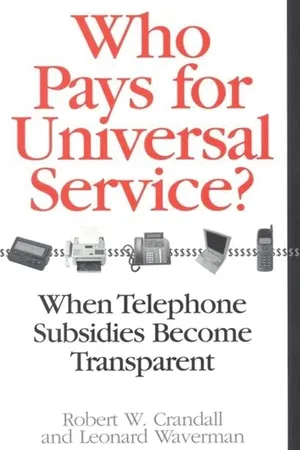
Who Pays for Universal Service?
When Telephone Subsidies Become Transparent
- 217 pages
- English
- PDF
- Available on iOS & Android
eBook - PDF
About this book
In virtually every country, the price of residential access to the telephone network is kept low and cross-subsidized by business services, long distance calling, and various other telephone services. This pricing practice is widely defended as necessary to promote ""universal service,"" but Crandall and Waverman show that it has little effect on telephone subscriptions while it has major harmful effects on the value of all telephone service. The higher prices for long distance calls reduce calling, shift the burden of paying for the network to those whose social networks are widely dispersed. Therefore, many poor and rural households--the intended beneficiaries of the pricing strategy--are forced to pay far more for telephone service than they would if prices reflected the cost of service. Despite these burdens, Congress has extended the subsidies to advanced services for schools, libraries, and rural health facilities. Crandall and Waverman show that other regulated utilities are not burdened with similarly inefficient cross-subsidy schemes, yet universality of water, natural gas, and electricity service is achieved. As local telephone service competition develops in the wake of the 1996 Telecommunications Act, the universal-service subsidy system will have to change. Subsidies will have to be paid from taxes on telecom services and paid directly to carriers or subscribers. Crandall and Waverman show that an intrastate tax designed to pay for each state's subsidized subscriptions is far less costly to the economy than an interstate tax. Robert W. Crandall is a senior fellow in Economic Studies at the Brookings Institution. Leonard Waverman is a visiting professor at the London Business School, on leave from the University of Toronto. They are coauthors of Talk Is Cheap: The Promise of Regulatory Reform in North American Telecommunications (Brookings, 1995).
Trusted by 375,005 students
Access to over 1.5 million titles for a fair monthly price.
Study more efficiently using our study tools.
Information
Table of contents
- Front Cover
- Title Page
- Copyright Information
- Foreword
- Table of Contents
- Universal Service and Telecommunications Policy
- Telephone Service versus Other Household Services
- Who Pays for Telephone Service?
- "Universal" Service in Other Regulated Sectors in the United States
- Household Demand: Monthly Rates and "Universal Service"
- Costs and Benefits of Traditional Universal Service Policies
- The 1996 U.S. Telecommunication Act and Traditional Universal Service
- The New (New) Universal Service
- The Need for a More Focused Policy
- Notes
- Index
- Back Cover
Frequently asked questions
Yes, you can cancel anytime from the Subscription tab in your account settings on the Perlego website. Your subscription will stay active until the end of your current billing period. Learn how to cancel your subscription
No, books cannot be downloaded as external files, such as PDFs, for use outside of Perlego. However, you can download books within the Perlego app for offline reading on mobile or tablet. Learn how to download books offline
Perlego offers two plans: Essential and Complete
- Essential is ideal for learners and professionals who enjoy exploring a wide range of subjects. Access the Essential Library with 800,000+ trusted titles and best-sellers across business, personal growth, and the humanities. Includes unlimited reading time and Standard Read Aloud voice.
- Complete: Perfect for advanced learners and researchers needing full, unrestricted access. Unlock 1.5M+ books across hundreds of subjects, including academic and specialized titles. The Complete Plan also includes advanced features like Premium Read Aloud and Research Assistant.
We are an online textbook subscription service, where you can get access to an entire online library for less than the price of a single book per month. With over 1.5 million books across 990+ topics, we’ve got you covered! Learn about our mission
Look out for the read-aloud symbol on your next book to see if you can listen to it. The read-aloud tool reads text aloud for you, highlighting the text as it is being read. You can pause it, speed it up and slow it down. Learn more about Read Aloud
Yes! You can use the Perlego app on both iOS and Android devices to read anytime, anywhere — even offline. Perfect for commutes or when you’re on the go.
Please note we cannot support devices running on iOS 13 and Android 7 or earlier. Learn more about using the app
Please note we cannot support devices running on iOS 13 and Android 7 or earlier. Learn more about using the app
Yes, you can access Who Pays for Universal Service? by Robert W. Crandall in PDF and/or ePUB format, as well as other popular books in Economics & Public Finance. We have over 1.5 million books available in our catalogue for you to explore.