![]()
CHAPTER 1
The Principles of Planning
Planning as Modeling
It’s worth saying right from the start that a plan is merely a model of the real world. Once you have a plan, as soon as the real world diverges from it you know something you didn’t know before. With a plan, every divergence gives you the opportunity to revise your approach, change your assumptions, and learn. Without a plan, you are a passive follower, being led by the circumstances that arise. This is why planning is so important, and why it is necessarily iterative.
So what makes a good model? Every good model is an abstraction of reality—a simplification. It must represent correctly and usefully those aspects of reality that interest you. It can, and often does, ignore less relevant bits. Good models don’t attempt to capture everything—just what’s relevant. The project manager needs simplicity: simplification without being simplistic. This leads us to the first summary point:
SP1: Plans focus on what is contextually important
In fact, it is common for models to distort reality. Take the way the world is modeled in maps. The Earth is an oblate sphere, an awkward shape to carry around. What we want is a two-dimensional model that allows us to navigate, to assess land acreage, or perhaps to establish international boundaries. The problem is that you cannot do all of these on any one map with the same degree of accuracy and confidence.
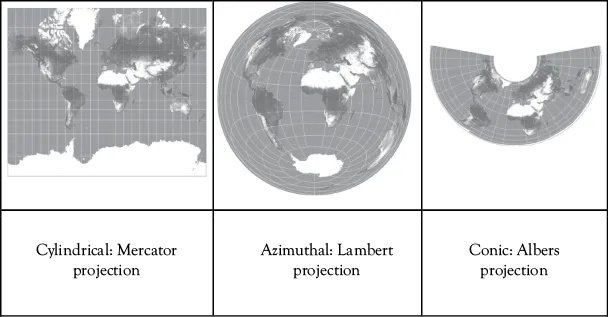
Just look at Australia or Greenland in the three maps shown in Figure 1.1. Which is the real shape? Well, none of them! The better question is: What do I want to do, and which projection makes that easiest for me?
Figure 1.1 Different projections of Earth
And so it is with models for project planning. There are different approaches that when used in the appropriate circumstances provide better insights and make the planning more directly useful. No single approach is the right approach, which leads to:
Cylindrical, conic, and azimuthal are the commonest projections used to represent the Earth on a flat sheet of paper. Each has a method for translating spatial dimensions. Each has its advantages, and each creates problems.
SP2: Different types of project initiatives require different types of plan
That portfolios, programs, and different types of projects require different types of plans is the thesis of this book. It affects every aspect, including what is planned, how it is planned, and when it is planned.
Different models examine different aspects of reality; so many different models exist. Searching for a single unifying theory linking them together may be a doomed exercise, and it is not necessary. The correct description of the project or the world is never more than a snapshot capturing the current ‘moment of truth.’ As perspectives change, and with it our understanding, what counts as truth also changes. Planning is the same. A plan is a view of a future state the project is purposed to achieve. As things change, in particular as stakeholder perceptions of what ‘good looks like’ changes, the plan must reflect this, so:
SP3: Plans evolve, reflecting the changing multiple perspectives of the stakeholders
Finally, the greater the number of analogs and the larger the number of inferences suggested by the model, the more valuable it is. This is the power of a model; it helps to uncover and discover factors that otherwise might have been overlooked as you move from the known to the less certain. A good model lets you make predictions about a future state that you would not be able to make from inspecting the current situation: precisely what a plan needs to do. It turns out that:
SP4: The process of planning is at least as important as the products of planning
Five Functions of a Project Plan
This book is not about planning; it is about planning projects. So, we had better set out what we mean by ‘projects.’ We base our definition on formulations given over the years by Turner (1999, 2003).
A project is a temporary organization set up to manage the i nherent uncertainty caused when resources are assigned to undertake a unique and transient endeavor within a set of constraints and needs to integrate the outputs created into a changed future state that delivers beneficial outcomes.
The definition is rather long, but it does capture all the essential elements.
- Projects are temporary structures, and they have to be granted authority from their parent organization to deliver specific objectives—they are goal-driven endeavors.
- Projects are unique, or at least ‘relatively unique’ (perhaps done before, but not by this team, or in this way), projects must actively manage uncertainty.
- Project success is largely determined by stakeholders believing that the project was a direct contributor to a sustained changed state that they regard as good, or at least an improvement.
- Finally, the role of constraints is highlighted in Turner’s (2003) definition. Their significance in the planning and execution of a project is the subject of much of this chapter, and the rest of the book.
Every project is a collaboration to bring about an agreed future state, and to achieve that there needs to be a plan and that plan needs to fulfill four functions. Let us look briefly at them.
Plan as a Snapshot
A plan translates today...