eBook - ePub
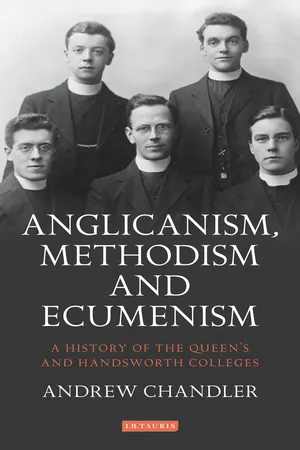
Anglicanism, Methodism and Ecumenism
A History of the Queen's and Handsworth Colleges
- 320 pages
- English
- ePUB (mobile friendly)
- Available on iOS & Android
eBook - ePub
Anglicanism, Methodism and Ecumenism
A History of the Queen's and Handsworth Colleges
About this book
For almost 200 years, the city of Birmingham has been a key location for the training of clergy. From 1828 Anglican clergy studied at the Queen's College and in 1881 the Methodist Church developed their own training facility at Handsworth College. In this book, Andrew Chandler tells the tale of these two colleges. This is a history not simply of the creation and evolution of these two religious institutions, but a study full of significance for the wider history of Christianity in British society across the nineteenth and twentieth centuries. The foundation of both colleges occurred in a confident age of civic progress and reform and their subsequent histories reveal much that was at work in the experience of the British churches at large. They were at first expressions of denominational identity and a determination to educate a class of clergy. In time they found themselves negotiating new prospects within the ecumenical currents of a later age and the deepening realities of secularization. In 1970 they united. This is a book which blends local, national and international dimensions and also shows how the two theological colleges came to embrace all kinds of intellectual, cultural, social and political history in a period of restless change.
Information
CHAPTER 1
ORIGINS: THE QUEEN'S COLLEGE, 1828—92

Figure 1 The Queen’s College as it appeared in the Illustrated London News, 12 July 1856.
The culture which created the Queen’s College in 1828 was defined by the earnestness of the nineteenth-century Church, the self-conscious evolution of the professions across national society and the prosperity of a particular city.
The growth of the town of Birmingham across two hundred years was something prodigious. In the middle of the seventeenth century it possessed only fifteen streets, by 1700 twenty-two and, by 1731, fifty.1 In this time the population had more than quadrupled, to about 23,000. By 1800 Birmingham was the fourth largest city in England. By 1831 its population rose to 170,000.2 The statistics of expansion are easily framed, but what kind of a new civilisation was this? When he had first visited the town in search of work in 1741 William Hutton was amazed by its beauty and elegance. But he also found that the people of this new metropolis ‘possessed a vivacity I had never beheld. I had been among dreamers, but now I saw men awake. Their very step along the street showed alacrity. Every man seemed to know what he was about.’3 Nine years later Hutton was back, and this time to open a book shop and bindery in Bull Street. Within a few years he had set up the city’s first circulating library, a ‘paper warehouse’ and acquired public office. Hutton was a Dissenter, and Birmingham suited Dissenters well, even after Hutton’s own commercial properties were destroyed by a vengeful crowd in 1791.4 Quite simply, Hutton thrived in a place which seemed to him devoted to the pursuits of enterprise and industry, profit and progress. In later years he would become its historian-laureate.
By the late eighteenth century Birmingham had received other visitors, not least the French tourist B. Faujas de Saint Fond, who wrote in 1784, ‘If anyone should wish to see in one comprehensive view, the most numerous and most varied industries, all combined in contributing to the arts of utility, or pleasure, and of luxury, it is hither that he must come.’5 Birmingham was now a leviathan, and it had found its prophets in the figures of Matthew Boulton, the inventor of the steam engine, James Watt, the creator of the steam pump, and William Murdock, the mining engineer. ‘I sell here, Sir, what all the world desires to have’, pronounced Boulton to James Boswell, ‘– POWER’.6 The three pioneers formed a Lunar Society with other civic luminaries like the printer, John Baskerville, the potter Josiah Wedgewood, the Unitarian minister Joseph Priestley who would become known as ‘the father of modern chemistry’, the botanist and philosopher, Erasmus Darwin and the Quaker, Samuel Galton (who manufactured firearms). Where else in the country could such an ensemble be found?7
Indeed, it was the sound of Birmingham which most of all struck its visitors. For some it was almost too much. In 1807 Robert Southey could complain, ‘I am still giddy, dizzied with the hammering of presses, the clatter of engines, and the whirling of wheels’.8 Later, in 1836, Charles Dickens would include Birmingham in the itinerary of the wandering members of the Pickwick Club and observe there:
The hum of labour resounded from every house; lights gleamed from the long casement windows in the attic stories, and the whirl of wheels and noise of machinery shook the trembling walls. The fires, whose lurid sullen light had been visible for miles, blazed fiercely up in the great works and factories of the town. The din of hammers, the rushing of steam, and the dead heavy clanking of engines, was the harsh music which arose from every quarter.9
Birmingham had become, quite simply, a colossus which was spreading from an original township of 3,000 acres and gobbling up villages and hamlets as fast as it could in all directions. The new suburb of Edgbaston, to the south, defined its progress: elegant, spaciously-conceived, affluent. By contrast the families of working men and women were being crammed into red-brick terraces everywhere about. In all of its dimensions Birmingham had come to embody the character of the industrial civilisation which Britain had made its own.
Hard-driven as its commercial interests were, religion came to flourish in Birmingham. The growth of the place also revealed a deepening of the diversity which Hutton had so enjoyed. Although the notorious riots of 1791 drove Priestley away for good, the cause of Dissent proved robust and enduring. But where, church people worried, should the denizens of this new city worship? In the centre the Church of England was most visibly represented by an overhauled medieval St Martin’s in the Bull Ring, and by Thomas Archer’s stout baroque parish church of St Philip, built in 1711. But by 1779 there was also St Paul’s nearby, then Christ Church in Colmore Row, in 1805, and Holy Trinity, Camp Hill, in 1820–22. In 1830 Birmingham lay in the archdeaconry of Coventry and in the diocese of Lichfield. Six years later – and two years before the borough was incorporated – the archdeaconry was transferred to the diocese of Worcester. Much of the old eighteenth century still lingered about it. The churches of St Philip’s and St Martin’s had absentee incumbents until 1829 and 1844 respectively. This could not last long. When, in 1846, the Evangelical John Cale Miller arrived as the new Rector of Birmingham it soon became abundantly clear that a new spirit was at work. Hitherto almost empty, St Martin’s was within weeks full to overflowing. Miller would stay for twenty years and become ‘legendary’ as an organiser, a preacher and as a formidable civic dignitary altogether.10 By 1838 a new Birmingham Church Building Society was setting to work on the construction of no fewer than ten new buildings in the rural deanery; by 1865 there would be a Birmingham Church Extension Society. This was now a city of Baptists, Congregationalists, Quakers and Unitarians too. It was Birmingham which became, in 1848, the home of the first Roman Catholic cathedral to be built in Britain since the religious revolutions of the sixteenth century. In its fashion, Birmingham had become a model of diversity in which no particular tradition could view its rivals too comfortably.
In this cluttered landscape the maturing professions soon wore a new self-consciousness as to their position in society and their responsibility to it. In this, too, the churches found their place, for at the onset of the nineteenth century the clergy of the Church of England counted themselves as a part of the recognised professions. It is not difficult to see why.11 They were useful practitioners and their work was devoted to curing souls, just as physicians healed bodies and lawyers settled disputes. As though to make this explicit, in 1824 a new company, the Clerical and Medical, offered both doctors and priests insurance. Yet if the clergy belonged to this particular tribe they did so on terms that were at least a little curious. They enjoyed a recognised, even senior, place in society. They were educated gentlemen. But in terms of money the clergy were, of course, the odd ones out. Unlike disease or litigation, the cure of souls could not be expected to generate much income on its own account. To charge for some services was castigated as simony, a lofty principle which would, if applied elsewhere, have demolished all the other professions at a stroke. A parish came with a living, and it might be large or modest. There were often tithes in the countryside and always Easter offerings. A good living might allow the paying of a curate. Some clergy lived well, sometimes at the cost of impecunious curates, and many lived badly. Advancement was important to the professions and, in this respect too, the clergy qualified as such. A priest might aspire to a canonry, a deanery, even a bishopric – and each came with a growth of income, comfort and standing. For the greatest part, however, the clergy of the Church of England presented the spectacle of genteel poverty.
Of all the various attributes which pertained to the condition of a professional existence it was in their education that the clergy were most convincing. For centuries the task of preparation for ordination in the Church of England was united with the education of the mind. This was not merely a matter of training the practitioner. It addressed a realm of intellectual life. The clergyman in his parish and at large testified to the existence of a Christian civilisation. If that theme, constructed firmly out of biblical text and language, sound doctrine and church history formed his mind he would enshrine it in the dignity of his character and the zeal of his work. Victorian Evangelicals on one side and High Churchmen on the other began to talk of the clergy with a new, heightened reverence. The Evangelical rector of Pluckley, Ashton Oxenden, would write at length of a priest as ‘a man of consecrated character’ and Charles Bridges would speak of the clergy altogether as ‘in a peculiar sense men of God’.12 If in some senses, then, the clergy bore comparison with the gentlemen of the professions, in others they were unique, for they were called by God, not man, and their office was a sacred one.
The two architects: William Sands Cox and Samuel Warneford
The growth of Birmingham was not merely a progress of finance and manufacture. It was a march towards a new civic order. What now happened there showed how a dense fabric of local alliances and civil, ecclesiastical and cultural connections might actually create a quite new institution in the very midst of the city’s tumult. For the birth of the Queen’s College was an expression of a confident entrepreneurialism. Above all, this work found its practical prophets in two men.
By 1764, the year in which the Lunar Society stirred to life, there were plans to build a new hospital in Birmingham. Within five years the General Hospital had opened its doors. This invited new innovations. Birmingham looked to London for examples and found a good many there to emulate. The capital harboured lawyers and doctors by the thousand. At this time a medical doctor won his position through apprenticeship, not registration. Some – not many – sat for university examinations at the Royal College of Surgeons in London, and others were licensed by the Society of Apothecaries or the Royal College of Physicians. This was not a genteel world at all. Students behaved badly and tutors viewed the own responsibilities lightly, if not altogether with indifference. But it was, even so, such a world which had produced William Sands Cox. Certainly he was not much taken by what he had known. Instead he envisaged a new institution, not in the capital but in Birmingham, and one governed by firm Christian principles. He looked at the still new General Hospital there and began to think that it should inspire a new medical school.
The scholar Lancelot Hogben would one day remark that Sands Cox was ‘a man of vision but of little political savoir-faire’.13 But now he clearly knew what he was about and he possessed the youth, vigour and tenacity to match. On 1 December 1825 he began to give regular medical lectures – on three days a week – at 24 Temple Row. These attracted nineteen students and soon proved sufficiently successful to bring to life, in 1828, a School of Medicine and Surgery. In the same year William IV bestowed on this fledgling institution the title of The Birmingham Royal School of Medicine and Surgery. A year later Cox bought a site at Snow Hill and began to build. 1834 found the School in Paradise Street at the heart of the swelling city, occupying an old Swedenborgian chapel and standing squarely opposite the ascending walls of the new Town Hall. An attempt was made to give the chapel a certain Grecian gloss, but evidently it failed to impress. Within only a few years it would be superseded by something more Gothic which was widely admired.
There could be no doubt that Sands Cox and his new school had by now become an established power. In 1836 the institution became the Royal School. In the same year Sands Cox was elected to the Royal Society. The new, ambitious age of Victoria beckoned and by 1839 the council of the college was looking to the creation of a second hospital in Birmingham. Sands Cox set to work again, raising money, seeking out a site for his college on the west side of the city. The enterprise went on rapidly as though nothing could stand in its way: when the builders became bankrupt Sands Cox bought the materials and paid the workmen himself. On 24 October 1841 the Royal School of Medicine and Surgery opened its doors. It received its royal charter in 1843, and with this became the Queen’s College. A second Charter, in 1847, constituted the Principal and Council ‘one body politic and corporate’. Soon the college was not merely a going concern, but a growing one. There were more buildings, and a chapel. The college took resident students. Engravings of the young institution show an elegant quad framed by a no less elegant façade. It was a very model of principled ambition, public dignity, civilization itself.
In establishing all this Sands Cox had found one crucial ally. This was the Rector of Bourton-on-the-Hill, Samuel Warneford. The scion of an ancient Wiltshire family, eminent for nothing beyond its apparent longevity, and the inheritor of a considerable fortune from his mother, Warneford had been ordained in 1790. Sensitive and dour, he simply wished to give what he possessed away in worthy enterprises, medical, educational, religious. To his mind this was a purely humanitarian and practical matter: evidently he had little interest in prestige and no taste for ostentation. Instead, he was content to regard himself as ‘a calculating miser’....
Table of contents
- Cover
- Title Page
- Dedication
- Contents
- List of Illustrations
- Acknowledgements
- Introduction
- 1. Origins: The Queen’s College, 1828–92
- 2. The Founding and Early Life of Handsworth College, 1881–1914
- 3. The Queen’s College: The Long Suspension, 1892–1923
- 4. War and Peace Come to Handsworth, 1914–31
- 5. High Tide: Handsworth in the Age of Lofthouse
- 6. High Tide: The Queen’s College and Cobham, 1923–39
- 7. Wartime, 1939–45
- 8. Cobham and the Post-War Queen’s College, 1945–53
- 9. Continuity at Queen’s: The Age of Gribble
- 10. Handsworth After Lofthouse, 1945–70
- 11. An Act of Union, 1970
- Postlude
- Appendix I The Intellectual Contribution
- Appendix II ‘Handsworth’
- Notes
- Bibliography
- Index
- Plates
- eCopyright
Trusted by 375,005 students
Access to over 1.5 million titles for a fair monthly price.
Study more efficiently using our study tools.
Frequently asked questions
Yes, you can cancel anytime from the Subscription tab in your account settings on the Perlego website. Your subscription will stay active until the end of your current billing period. Learn how to cancel your subscription
No, books cannot be downloaded as external files, such as PDFs, for use outside of Perlego. However, you can download books within the Perlego app for offline reading on mobile or tablet. Learn how to download books offline
Perlego offers two plans: Essential and Complete
- Essential is ideal for learners and professionals who enjoy exploring a wide range of subjects. Access the Essential Library with 800,000+ trusted titles and best-sellers across business, personal growth, and the humanities. Includes unlimited reading time and Standard Read Aloud voice.
- Complete: Perfect for advanced learners and researchers needing full, unrestricted access. Unlock 1.5M+ books across hundreds of subjects, including academic and specialized titles. The Complete Plan also includes advanced features like Premium Read Aloud and Research Assistant.
We are an online textbook subscription service, where you can get access to an entire online library for less than the price of a single book per month. With over 1.5 million books across 990+ topics, we’ve got you covered! Learn about our mission
Look out for the read-aloud symbol on your next book to see if you can listen to it. The read-aloud tool reads text aloud for you, highlighting the text as it is being read. You can pause it, speed it up and slow it down. Learn more about Read Aloud
Yes! You can use the Perlego app on both iOS and Android devices to read anytime, anywhere — even offline. Perfect for commutes or when you’re on the go.
Please note we cannot support devices running on iOS 13 and Android 7 or earlier. Learn more about using the app
Please note we cannot support devices running on iOS 13 and Android 7 or earlier. Learn more about using the app
Yes, you can access Anglicanism, Methodism and Ecumenism by Andrew Chandler in PDF and/or ePUB format, as well as other popular books in Theology & Religion & Biblical Studies. We have over 1.5 million books available in our catalogue for you to explore.